They called for everyone to keep to the rules until the outbreak is contained and lockdown restrictions are eased.
A couple from Auckland were arrested when they were caught in Taupō, after police said they used false documents to cross the border. A group of people from Othāhuhu were caught fishing together in Mission Bay and given infringement notices.
A teenager who married a 61-year-old father-of-two has opened up about her parents’ horrified reaction to her age-gap romance – revealing that they called the police to have her husband arrested when they first learned about her relationship.
Struggle: Despite Audrey insisting that the couple knew they were meant to be together, she admits that she initially kept the relationship secret from her parents – who are 38 and 43
Military police officer Audrey Cheyenne-Smiley Moon, 19, first met husband Kevin, 61, on dating site Badoo, on January 9, 2020 – and the pair quickly bonded, despite their 42-year age gap.
The teenager says she was first attracted to him because of his military background – noticing in his bio that he was a veteran who had worked for the military police, just like she does now.
‘I was both excited and nervous to see him,’ Audrey recalled. ‘He still talks about the day he laid his eyes on me with such passion.
‘Kevin made the first move. He took my face in his hands and we had our first kiss when we first met face to face.
‘We can both agree truly that it was love at first sight.’
Neither Audrey nor Kevin had been in a relationship with such a big age gap before but believe it doesn’t matter as they have lots in common and a deep connection.
‘Our first conversation was about the military and he asked questions about me and we became very open to each other,’ Audrey said. ‘We talked about everything together.
‘Kevin also looks very handsome to me.
‘What makes our relationship so great and perfect for us is our ever-growing love for each other.’
Before meeting Audrey, Cemex dispatcher Kevin was married for 19 years and has two children, aged 16 and 23.
His kids are supportive of the relationship and pleased to see how happy the pair are.
Because Kevin is older than both Audrey’s parents, who are 38 and 43, she initially kept their relationship a secret from her family – but made the decision to tell them in August last year.
Audrey said: ‘We were open about our relationship to our co-workers but it was a secret from my family at first.
‘I couldn’t handle the stress of keeping it a secret from my family so we agreed that he would come down to meet them.
‘My family was extremely hostile about meeting him at first because we told them about us in a bad way.
‘I texted them while I was away with him and we came back to my parent’s house to my entire family and the cops waiting outside.
‘It was scary at first but Kevin was ready to stand for what he believed in and now after getting to know him, my family has really grown to like him.
‘For three days, they yelled at him every time he came to see me and did everything they could to tell him how terrible he is for loving me.
‘He took it and since then has proven to them how much he truly and deeply loves me.
‘We haven’t heard any negative comments from strangers yet, but we have gotten looks but we normally don’t mind them. We focus on ourselves.’
On August 1, 2021, the couple eloped and got married in a small chapel in Nevada.
Now, they are planning for their future together.
Audrey said: ‘Most of the time we talk about getting our dream home, having a baby, and living our lives happily.
‘He wants to be a stay-at-home dad and watch our baby while I am at work and he can pursue his woodworking hobby.
‘He wants to cook and clean for me until I come home. Then we spend time as a family.
‘We want to travel in an RV. We want to get our favorite breed of dogs. Mine is a Staffordshire American terrier pit bull. He wants a Saint Bernard.
‘We just want to be together and never separate again. We are eager to have our baby – it is just finding the right time.
‘Our lives make it difficult for dreams like that but we know in time we will live our dream.’
Although they are now married, they are still living apart as Audrey is working abroad in the Middle East and Kevin is at home in California. They plan to move in together once Kevin retires next year.
Audrey said: ‘What makes our relationship work even thousands of miles away from each other is our constant communication.
‘We are always very affectionate towards each other and when times get hard, we try to focus on what we are fighting for. We talk about the future we can have together when our time apart is no longer.
‘I still look at him with eyes filled with pure love and joy and he looks at me the same way. Sometimes we get so happy we start to cry.
‘I love how passionate and patient he is. He is also a very giving person and very kind. He has such a pure and loving soul.
‘People my age are very inconsiderate and selfish. Kevin is the complete opposite.
‘He is very understanding and only wants to do things for me.
‘They focus on social media and gaining followers.
‘People will do anything nowadays to get a like. Me and Kevin aren’t like that. We are very kind-hearted selfless people and love to help each other and the people around us before we help ourselves.’
Audrey, who describes herself as an old soul, added: ‘I did not think I would meet the man of my dreams who is also my best friend and love of my life.
‘He is my soul mate and that is something worth fighting for. Love is endless and indescribable.
‘Kevin and I want to show the world that we aren’t the stereotypical sugar daddy or gold digger relationship.
‘We truly love each other because of who we are and what we do for each other.’
Kevin said: ‘When I first saw her profile, I thought she was a cute girl but wasn’t looking for a young girl, just a friend to talk with.
‘I was actually looking around my area and ages 30 to 50. Her profile shouldn’t have popped up. Something told me to look at it and something told me to like it, so I did.
‘I found a new best friend and fell in love with my best friend.’
A Tāmaki Makaurau businessman is gathering support for a no-vax, no-entry policy at bars, cafés and restaurants.
Sam Ansley, the owner of Shaky Isles Coffee and the bars Everybody’s and Roxy, plans to request proof of a Covid-19 vaccination card upon entry at his businesses in a month’s time.
He told RNZ he had talked the idea over with around 30 other Auckland hospitality operators, mostly from larger venues in the city, and about 75 percent were keen to do the same.
Ansley expected to lose customers when lockdown lifts, but also gain others who want to feel safer.
Sam Ansley Photo: Supplied
“Every choice someone makes has a negative or a positive consequence. And if you choose to not get vaccinated, then potentially what you’re going to do is reduce the number of options you’ve got to have a really damn good time.”
He hopes the door checks will help boost vaccination rates and reduce “incredibly damaging lockdowns”.
“We are an industry that is used to checking people at entrances. We are an industry that is able to check for IDs and we are an industry now that has to have Covid-app tracing scans at our entrances.
“We are an industry that can refuse entry to people if they are intoxicated, or if they’re underage, or not dressed in quite the right way. We are an industry that is used to having restrictions placed on people’s ability to get in.”
Ansley also hoped the government will take note.
“If we can help and get our voices heard around that government table, which I think business really struggles with at the moment, then that’s a good thing too.”
Ansley began to settle on the policy two weeks ago, when he felt the vaccination rollout was hitting “a tipping point”.
“It doesn’t benefit anti-vaxxers, and you know what? I’m kind of okay with that,” he said.
“We can ideally top the world with vaccinations, that should be our objective.”
The 40-year-old mother charged with the murder of her three daughters in Timaru on Thursday night has been remanded for a psychiatric assessment.
Lauren Dickason is accused of killing her three children, Liane, 6, Maya, 2, and Karla, 2, in Timaru. Photo/Supplied (via Stuff)
Lauren Dickason, 40, a medical practitioner appeared before Judge Dominic Dravitzki in the Timaru District Court at 10am on Saturday, Stuff reported.
“Escorted by two police officers, Dickason arrived in court dressed in a hooded sweatshirt and black trousers. Dickason looked calm and kept her arms folded close to her chest. She stared at the floor for much of her appearance”, it said.
The accused didn’t enter a plea during her appearance. She is to appear in court again on 5 October.
There was no application for bail and she faces three charges of murder. An application for name suppression was withdrawn during the hearing.
The family had recently completed MIQ after arriving from South Africa and had settled in the South Island town.
Graham Dickason, an orthopedic surgeon, found his children dead when he returned to their Queen St home.
He had recently started working for the South Canterbury District Health Board.
The woman charged with the murder of her three daughters in their Timaru home on Thursday night has appeared in court this morning.
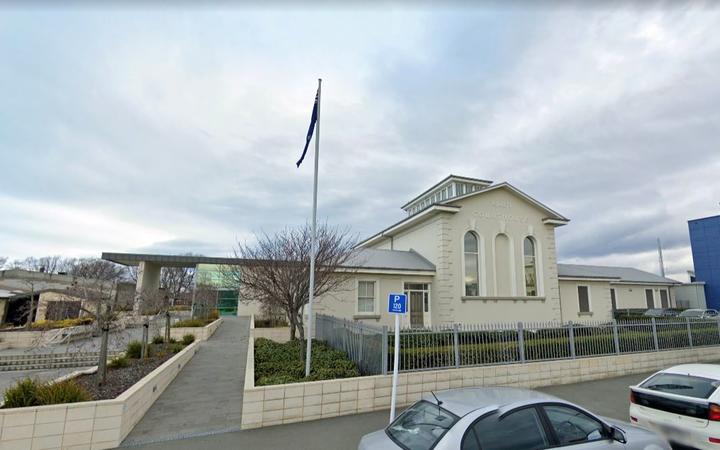
Photo: Google Maps
The three victims were 2-year-old twins Maya and Karla, and their 6-year-old sister Liane. Their bodies were found in Queen Street in Parkside just after 10pm on Thursday.
TVNZ reported that 40-year-old Lauren Anne Dickason, who is yet to register a plea, stood quietly in the dock at the Timaru District Court with her arms wrapped around herself, often looking at the floor.
No members of the public or support people were permitted in the courtroom for the brief first appearance due to Covid-19 restrictions.
Judge Dominic Dravitski remandered Dickason to Hillmorton Hospital in Christchurch for a mental health assessment under section 38 and will next appear in the High Court in Timaru on 5 October.
Six-year-old Liane with 2-year-old twins Maya and Karla. Photo: Facebook
Police earlier said the family had only left MIQ a week ago after arriving in the country from South Africa.
Members of the South African community have left flowers and a soft toy near the home, some with messages in support.
In a statement last night, police said the tragic incident was isolated and they were not seeking anyone else.
They said a scene examination would continue at the Queen Street address today.
The South Canterbury DHB said the tragedy had affected many staff and it was focusing on providing full support for them.
Dickason and her husband Graham are both doctors recently arrived from South Africa and were living in a DHB home near Timaru Hospital.
DHB chief executive Jason Power is thanking everyone who has offered support and kind messages, including colleagues from other DHBs.
The number of new community cases of Covid-19 has jumped after several days of falling numbers, with 20 new cases reported in Auckland today.
Photo: 123rf.com
There was no media conference today. In a statement, the Ministry said 19 of these are household or known contacts and only one of these remains unlinked.
“Interviews are underway with that person to determine how they are linked to the current outbreak.”
There are now seven unlinked cases from the past 14 days.
The Ministry said it was expecting some fluctuations in case numbers at this point in the outbreak.
There has now been a total of 1027 cases linked to the current outbreak, with 625 of Auckland’s 1010 cases now considered to have recovered, while all but one of Wellington’s 17 cases has now recovered.
Ten people are in hospital with the coronavirus, with three in ICU or HDU.
There were also two new confirmed cases and two historical cases in managed isolation.
The Ministry said testing at high levels in Auckland remained an essential part of the outbreak response and it was continuing to urge anyone in Auckland with cold or flu symptoms – no matter how mild – to get tested.
It said 12,427 tests were taken yesterday, including more than 7000 swabs taken in the Auckland region.
“We have also had over 1,000 saliva tests since Monday with the majority in the last 48 hours. Over 400 employers will be instigating saliva testing for almost 4500 employees across New Zealand.”
The Black Caps have abandoned their tour of Pakistan.
In Pakistan for the first time in 18 years, the New Zealand team were set to play the hosts in the first of three ODIs in Rawalpindi on Friday night.
However, following an escalation in the New Zealand Government threat levels for Pakistan, and advice from NZ Cricket security advisors on the ground, it had been decided the Black Caps would not continue with the tour.
Arrangements were being made for the team’s departure.
NZC chief executive David White said it was simply not possible to continue with the tour given the advice he was receiving.
“I understand this will be a blow for the PCB, who have been wonderful hosts, but player safety is paramount and we believe this is the only responsible option.”
New Zealand Cricket Players Association chief executive Heath Mills echoed Mr White’s sentiments.
“We’ve been across this process throughout and are fully supportive of the decision,” he said.
“The players are in good hands; they’re safe – and everyone’s acting in their best interests.”
NZC wasn’t commenting on the details of the security threat or the updated arrangements for the departing squad.
In a statement, the Pakistan Cricket Board said they had been informed by NZC earlier on Friday of the security alert.
The PCB said NZC had “unilaterally decided to postpone the series”.
“Pakistan Cricket Board and Pakistan Government made foolproof security arrangements for all visiting teams. We have assured the New Zealand Cricket of the same.
“The Pakistan Prime Minister spoke personally to the Prime Minister of New Zealand and informed her that we have one of the best intelligence systems in the world and that no security threat of any kind exists for the visiting team.
“The security officials with the New Zealand team have been satisfied with security arrangements made by the Pakistan Government throughout their stay here.
“PCB is willing to continue the scheduled matches. However, cricket lovers in Pakistan and around the world will be disappointed by this last minute withdrawal.”
Police have arrested and charged a 40-year-old woman with murder in relation to the death of three young sisters in Timaru last night.
Graham and Lauren Dickason and their three children Liane, 6, and twins Maya, and Karla, 2, moved to New Zealand from South Africa in late August. On Thursday the children were found dead at a home in Timaru. Photo/ Stuff (Supplied)
The mother is due to appear in the Timaru District Court tomorrow morning.
Police believe Lauren Dickason killed her twin daughters Maya and Karla, 2, and their older sister Liane, 6, at the property in Queen St, Parkside, on Thursday.
Reports said her husband Graham returned home on Thursday to find the bodies of his twin daughters Maya and Karla, 2, and their older sister Liane, 6.
The family had recently arrived in New Zealand and had been in Timaru for just a week after moving from South Africa and leaving managed isolation and quarantine (MIQ).
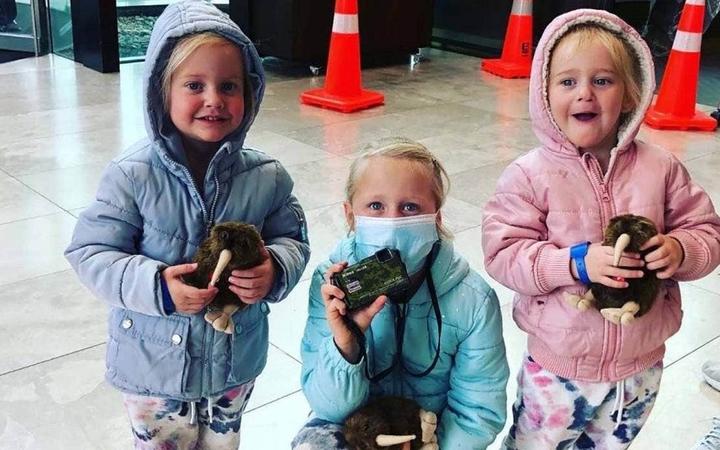
“The family – Graham, an orthopaedic surgeon, Lauren, a doctor, and their three girls – arrived in New Zealand in late August, a photograph online showing the girls happily clutching little kiwis and with beaming smiles as they embarked on their new life”, Stuff reported.
Police would like to reassure the community that this was a tragic isolated incident and we are not seeking anyone else, Detective Inspector Scott Anderson said.
An earlier release stated one child was aged seven and two were three.
This is incorrect, they were aged six and two, Anderson said.
“We apologise for this error”.
A scene examination will continue at the Queen Street address tomorrow.
As this matter is now before the courts, Police will not be making any further comment.
Australia, US and UK security pact strikes at the heart of Pacific regionalism
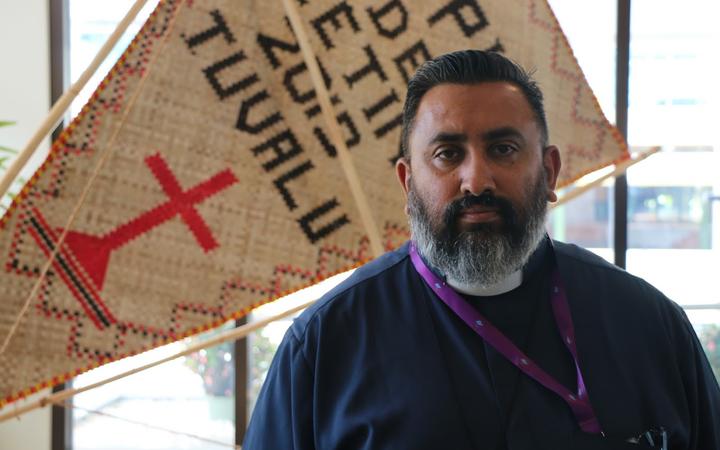
A regional church leader says Australia’s new security pact with the US and the UK strikes at the heart of Pacific regionalism.
The AUSUK alliance, announced by leaders of the three countries this week, is focused on developing nuclear-powered submarines for the Australian Navy.
The general secretary of the Pacific Council of Churches, James Bhagwan. Photo: RNZ / Jamie Tahana
The general secretary of the Pacific Conference of Churches, James Bhagwan, said the move is a serious concern for a region which lives with the legacy of nuclear testing.
“From the Sixties, from when the very first tests started in our region, this is something that government, civil society, churches have all been very adamant against, to keep our Pacific nuclear-free.
We are still dealing with the fallout from nuclear testing,” he said.
Meanwhile, New Zealand said the prohibition of nuclear powered vessels in its waters remains unchanged.
Cook Islands approves Covid-19 vaccination for adolescents
The Cook Islands government has approved Covid-19 vaccinations for 12 to 15 year olds.
In a statement the prime minister, Mark Brown, said they wanted children to be as protected against the virus as the adult population.
There is almost 100 percent vaccination coverage among adults in the Cook Islands.
Mr Brown said one of the considerations for approving youth vaccinations was the increasing evidence from around the world that young people are as likely to contract Covid-19 as any other age group.
He said the Cook Islands is taking this step now that international health agencies like Medsafe in New Zealand have detemined it is safe to vaccinate 12-15 year olds.
The government aims to start its youth vaccination roll out when more vaccine supplies arrive from New Zealand in October.
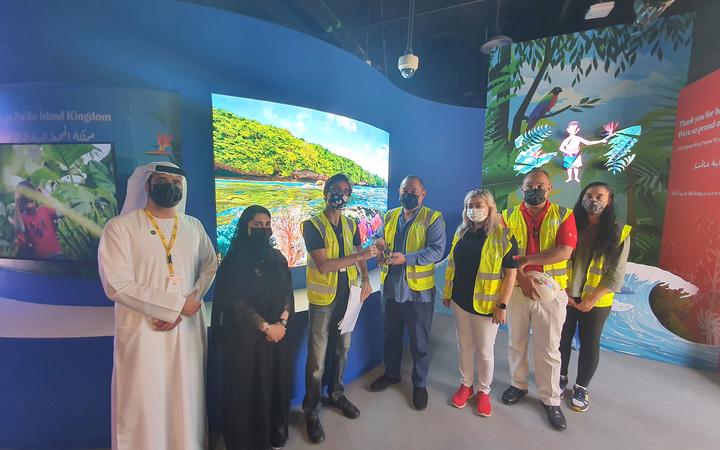
Tonga take possession of its pavilion at Expo2020Dubai.
Tonga has this week taken possession of its pavilion at Expo2020Dubai.
The commissioner general of theTonga Expo team, ‘Akau’ola, thanked the government of the United Arab Emirates for funding and construction of the building.
Tonga Pavilion at the Dubai Expo2020 in October officially handed over to Tonga. Photo: Supplied
Tonga’s participation in Expo2020Dubai, which starts next month, will be the first time it has had a stand alone pavilion at such an event.
‘Akau’ola said it is an incredible opportunity to showcase Tonga’s potential to the world.
He said he “is truly astounded at the remarkable execution of our vision to provide a modern fully interactive digital journey through our ancient Kingdom.”





 The aircraft touched down safely and no report of injuries.