Thursday, February 26, 2026
Home Blog Page 853

Pope appoints Tonga’s first Catholic cardinal

Bishop Sōane Patita Mafi of the diocese of Tonga and Niuē has been appointed a cardinal by Pope Francis.

This is the first time the title has been bestowed on a priest from the kingdom.

At 53, Bishop Mafi is the youngest of the Catholic Church’s 15 new cardinals. Among the other appointments is 95-year-old Archbishop Pimiento Rodriguez, Archbishop Emeritus of Manizales, Colombia.

The new cardinals have been chosen from 13 countries.

A Vatican statement said the Pontiff would summon a formal meeting of the College of Cardinals, known as a Consistory, on February 14, at which they would reflect on the proposals for the reform of the Roman Curia.

The Vatican statement quoted Pope Francis as saying the new Cardinals “manifest the indissoluble links between the Church of Rome and the particular Churches present in the world.”

On February 15 the newly created Cardinal Mafi will take part in a concelebrated mass presided over by the Pope.

Bishop Mafi was the third Tongan to be appointed a Catholic Bishop.

The first Tongan bishop was Pātelesio Fīnau, who served from 1972 – 1993. He was succeeded by Sōane Lilo Foliaki, who served from 1994 – 2008.

The Catholic Church was established in the kingdom in 1842.

Tribute

The news of Bishop Mafi’s elevation has been welcomed by Catholics in the kingdom who see the appointment as making Tonga’s mark in the history of the world’s largest Christian denomination.

Many Tongans have used Facebook to pay tribute to Bishop Mafi.

On the Kainga Fo’ou ‘o ‘Aotearoa forum, a page used by Tongan Catholics in Auckland, a tribute says in Tongan: “Wake up! Let’s shout for joy and be jubilant for the news. Let’s be happy all Tongan Catholic for the honour given to Bishop Soane Patita Mafi. He is cardinal of the church. He is the first Tongan to be appointed to the post.”

Bishop Mafi was born on December 19, 1961 in Nuku’alofa and was ordained as a priest in June 1991.

On October 4, 2007 he was ordained Bishop with the title of Co-adjutor (assistant) Bishop of Tonga and Niue.

On Apr, 18, 2008 he succeeded to the title of the Bishop of Tonga and Niue.

Cardinals

Cardinals hold the highest ecclesiastical positions in the Catholic Church and elect one of their number as Pope.

Known as the Princes of the Church, the Cardinals can wield immense power.

Most are in charge of a diocese or archdiocese, but they may also run departments in the Vatican administration.

In his battle to reform the church, Pope Francis has been highly critical of officials involved in the running of the Vatican, accusing them of vanity, corruption and self interest.

The main points

  • Bishop Sōane Patita Mafi of the diocese of Tonga and Niuē has been appointed a cardinal by Pope Francis.
  • This is the first time the title has been bestowed on a priest from the kingdom.
  • At 53, Bishop Mafi is the youngest of the Catholic Church’s 15 new cardinals. The new cardinals have been chosen from 13 countries.
  • On February 15 the newly created Cardinal Mafi will take part in a concelebrated mass presided over by the Pope.

For more information

http://w2.vatican.va/content/vatican/en.html

‘Pope announces names of new Cardinals’ (Official Vatican News)

Valerie Adams on Real Tonga aircraft as it slides off runway at Fua’amotu

New Zealand -Tongan world shot-put champion Valerie Adams’ decision to join a double celebration in her homeland could have ended in tragedy after the plane she was on slid off the runway at Fuaʻamotu Airport in Tongatapu during the weekend.

Adams’ flew to Tonga to take part in celebrations of the first Houma Global Community Day and the diamond jubilee of the Catholic Church, which was established in the village 75 years ago.

This was the first time the village had organised such large events, which attracted hundreds of visitors from overseas.

Adams, whose mother Lilika Ngauamo came from Houma and Haveluloto, was one of the key speakers during the events.

She also attended a reception arranged by the royal family in Nukuʻalofa.

A caption of a photo she posted read: “…the Real Tonga Airlines on their way to ‘Eua only to find out the breaks [sic] don’t work as the plane started to slide off the runway…thank goodness everyone was safe and no one got hurt.”

A commentator who followed Adams status said: “Only in Tonga can the Olympic gold medallist go home to relax and almost end up in a plane crash.”

Adams also wrote on her Instagram account and said: “Back in Tonga cause [sic] problems with brakes haha so waiting on eta for our flight zzzzz.”

Real Tonga Airline’s Director Tevita Palu told Kaniva News the aircraft involved was a Chinese-made Harbin Y12, not the notorious MA60.

Palu said the aircraft’s brakes did not operate normally during taxiing. The aircraft returned to the gate normally.

He said the flight was delayed until the defect was fixed, but it was operating normally now.

April’s accident

Last April Real Tonga’s B-65 Queenair crash landed at ‘Eua’s Kaufana Airport.

At the time, the airline said the landing gear failed to lower, causing the pilot to belly land the aircraft.

None of the seven passengers or the pilot were injured.

In 2012, the New Zealand government warned New Zealand tourists they would be flying at their own risk in Tonga because Real Tonga was using an MA60 aircraft, which did not meet New Zealand air safety standards. The MA60 has been involved in a number of incidents in different parts of the world.

New Zealand’s Foreign Affair Minister Murray McCully withheld a large grant meant to help the kingdom’s tourism industry to pressure the Tongan government into taking action over the MA60.

ICAO

In September last year Kaniva News published a confidential letter Tonga’s former Prime Minister Lord Tuʻivakanō sent to the International Civil Aviation Organisation (ICAO) on July 15, 2014 in response to two Mandatory Information Requests concerning the certification of the MA60.

In the letter the then Prime Minister promised to revise Tonga’s civil aviation rules and regulations within 60-90 days and committed the kingdom to meeting New Zealand aviation standards.

Lord Tuʻivakanō undertook to review certain areas in Tonga’s aviation system like the Air Operator Certificates, Foreign Air Operator Certificates, Maintenance Organisation Certificates, Aerodrome Operator Certificates, Airworthiness Certificates, Aircraft Certificate of Registration and Type Acceptable Certificates.

The letter was apparently written to please the ICAO after it was reported the international body was not satisfied with how the Tongan government treated its demand to review its aviation system following the arrival of the controversial aircraft in 2012.

The main points

  • World shot-put champion Valerie Adams’ decision to join a double celebration in her homeland could have ended in tragedy after the plane she was on slid off the runway at Fuaʻamotu Airport on the weekend.
  • Adams was a key speaker at the celebrations of the first Houma Global Community Day and the diamond jubilee of the Catholic Church.
  • Real Tonga Airline’s Director Tevita Palu told Kaniva News the aircraft’s brakes did not operate normally during taxiing.
  • He said the aircraft returned to the gate normally, but was delayed until the defect was fixed.

For more information

‘PM revokes Real Tonga’s airline license’

‘Tonga to Receive First China-Made Y-12 in Late-July or Early August’

Pilot crash lands plane in Tonga

ICAO

Pōhiva’s meeting with King a “great opportunity,” but HM wants political boundaries to be respected

His Majesty King Tupou VI met with Prime Minister ʻAkilisi Pōhiva in a meeting described as a “great opportunity” at the start of Mr Pōhiva’s four year premiership.

The Prime Minister said His Majesty wanted to make sure the boundaries of the executive bodies’ responsibilities were clearly defined and that they would not be overstepped.

Mr Pōhiva said the King wanted the cabinet to inform him once they came across any issues relating to His powers that might interfere with the smooth running of the new government.

Pōhiva said the king had raised the issue because when the last government was in power there were times when the Cabinet and the Privy Council overstepped each other and intruded into areas that were His Majesty’s responsibility.

He said the King did not want these problems to happen again.

In his first Cabinet meeting with his ministers on Monday, Mr Pōhiva reiterated His Majesty’s concerns and said it was important for the Cabinet to follow the guidelines regarding areas of responsibility.

Privy Council and Cabinet

Changes to the Tongan constitution made before the introduction of democracy in 2010 saw the King relinquish some of his powers, allowing the election of the 26 member Legislative Assembly.

However, His Majesty retains some of the fundamental powers laid down by the Tongan constitution such as the right to reject any laws passed by the Legislative Assembly and submitted to him for approval.

No law passed by the government is legitimate unless the king signs the legislation.

His Majesty remains Commander-in-Chief of the Tonga Defence Force and has the power to proclaim martial law over any part or over the whole of the country.

The government’s day-to-day matters are guided by an executive body controlled by the Prime Minister.

The Privy Council includes appointed law lords whose responsibility is to advise the king on certain decision making process according to his constitutional rights.

Pōhiva said an example of the problems that could occur was when His Majesty ordered the Privy Council to investigate the issuing of Tongan passports, but this was not done because of cabinet intervention.

“The Cabinet and the Privy Council were in a rift, that was how it appeared to us when it happened,” Pohiva said.

The Prime Minister said he understood that the King did not want this kind of incident to happen again.

The main points

  • His Majesty King Tupou VI wants the boundaries of responsibility between the Cabinet, Privy Council and himself to be clear under the new government.
  • The kingdom’s new Prime Minister, ‘Akilisi Pohiva, said after a meeting with His Majesty that the King did not want a repeat of certain incidents that occurred under the previous government.
  • Pohiva described the meeting at the start of his four year premiership as “a great opportunity.”
  • Pohiva met with the new Cabinet for the first time on Monday.

For more information

‘Surprise’ as veteran politician Akilisi Pohiva elected Tonga PM

Akilisi Pohiva Tonga’s new PM

22-year-old Tongan first to die on NZ roads in 2015

A young Tongan woman has become the first person to die on New Zealand roads in 2015 after the car she was passenger in hit a power pole shortly after 6.15am near East Tamaki.

Lavi Taimani, 22, of Onehunga was one of seven people in the car. Police said four of them were taken to Middlemore Hospital with minor injuries but they had since been discharged.

Police believed speed and alcohol were both factors in the fatal crash.

On her Facebook page Pou Tupou sent the dead woman a tribute and said: “R.I.P Lovey Taimani Still can’t believe that you’re Gone Ofa Lahi Atu ki ho kii fofonga malimali..What A Beautiful Girl with a Beautiful HEART…”

Police said the investigation into the crash was continuing.

Foul smell reported across Neiafutahi, more Red Blood Seas spotted

A strong rotten egg smell had locals of Neiafutahi in Vavaʻu crying foul as investigators scrambled to determine what caused the sea at the village’s beach turned blood red this week.

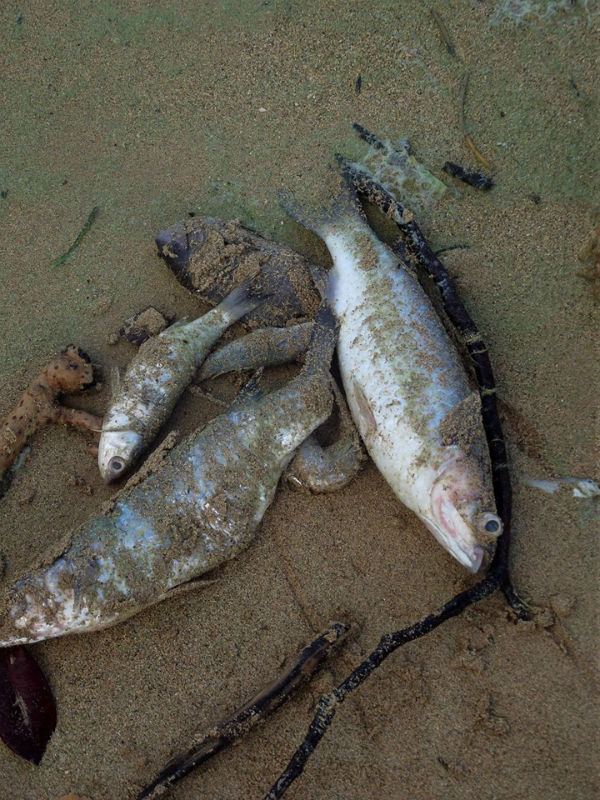
The sea at Neiafutahi beach turned red on Sunday and the colour remained until yesterday before it turned green and muddy followed by a fish die-off.

Locals were warned not to eat fish from the sea area and to keep away from the scene because of the odour while a geologist at Tonga’s Ministry of Natural Resources said they found more similar red blood seas in other sea areas of Vavaʻu.

Picture of dead fishes found at Neiafutahi sea yesterday January 1, 2015. Picture: Filomena Hansen

Various unofficial theories have been proposed to explain why the sea changed its ocean colour but some believed it was caused by an algal bloom – “a rapid increase or accumulation in the population of algae (typically microscopic) in an aquatic system”.

Taniela Kula, the Deputy Secretary of Natural Resources and Geologist said they have yet to determine the cause of the red blood sea and how it can be linked to the fish die-off but investigation was continuing and they would release a statement soon.

He said the geologist in Vava’u has reported sightings of more red blood seas in other areas in  the islands.

The smell was reported as far away as central Neiafu, the capital of Vavaʻu.

A local broadcaster Manu Tapueluelu was at the scene yesterday and she commented on her Facebook page and said: “…Ugly Smells still going through Loto Neiafu right now which is sooo disturbing,message is ‘stay away from eating seafood,fish etc etc for awhile now people”.

Vavaʻu beach sea turns blood red sparking panic

The sight of a blood red sea sparked panic at Vavaʻu’s Neiafutahi beach in Tonga this week.

Villagers were in fear to find the sea had turned crimson and that it happened towards the end of the year 2014.

Some people believed this was a biblical sign the world would end soon or perhaps whales had been killed in the waters.

Filomena Hansen  uploaded pictures of the event to Facebook and she simply commented. “OMG don’t tell me it’s the last dreadful day”.

She told Kaniva News the colour was first spotted on Sunday 29 but it was only widely known to villagers yesterday as the red blood sea increasingly spread in size.

We could not be able to obtain comments from Tonga’s Ministry of Natural Resources.

However the episode is not new as it happened in the past in other countries of the world.

Neiafutahi sea turned red. It was first spotted on Sunday 29 December 2014 Picture: Filomena Hansen

On one occasion in 2012, some of Sydney’s most popular beaches were closed as the water turned blood red but the colour was caused by a bloom of algae.

When such event was caused by bloom of algae people called it red tides but scientists prefer the term harmful algal bloom.

“It is caused by microscopic algae that produce toxins that kill fish and make shellfish dangerous to eat. The toxins may also make the surrounding air difficult to breathe…and often turns the water red”.

Meanwhile there were reports of an underwater vent spotted at north of Nuku’alofa this morning which billowed steam of over 3000 metres high above sea level.

Before last Christmas there were reports of large plume of ash erupted violently at Hunga volcano in Haʻapai.

Lord Luani’s wedding to commoner in Alaska provokes fierce online debate

Queen Nanasipauʻu’s nephew Lord Luani, exchanged vows with ‘Eseta Fukatonga Maka, a commoner, in the United States last week.

Luani’s first cousin, Prince Ata, was guest of honour at the wedding, which was held in Alaska, America’s northern-most state.

Lord Luani’s mother is Lady Luseane Vaea, a younger sister of Queen Nanasipauʻu.

The bride, who is not a member of the nobility, has claimed that she had a child with Mapa Malupō, a younger brother of Hon. Makahokovalu Malupō who has been courting Princess Angelica Lātūfuipeka Tukuʻaho.

The marriage has caused a fierce debate to erupt on social media. There have been exchanges of strong and disrespectful words on Facebook between the supporters of the bride and the groom.

For a noble like Luani to marry a woman who has borne a child to another may cause traditionally minded people to expect a huge reaction of fakalotoloto, or the harbouring of grudges by the families involved in the wedding.

Some of the messages appearing on Facebook show that some people have already taken sides on the issue.

One commentator said on a Facebook group known as Royal Tongan Dynasties/Noble Forum: “My Nephew Lord Noble Luani,ofa lahi atu.(love you heaps) and please No Marriage to Outside Finemotua (a woman who has born a child) hoiiii, temau hae vala pee (we will tear off our clothes to show our dislike) from USA all the Way to Tonga.”

A supporter of Fukatonga wrote in retaliation: “…speak with kindness..be gentle..n loving..n your nephew MIGHT listen to you… .(do not be) ruthless …the olden days are OVER…have you heard of CIVILIZATION? OR your dictionary is missing that word….I GET YOUR POINT…it’s all about that LOVE ..don’t categorized (people)”.

A source very close to Luani’s family told Kaniva News the nobleman had told his mother, Lady Luseane, that his love for Fukatonga had brought him to a situation where they both decided to tie the knot.

The source said Lady Luseane had agreed to the wedding.

According to her Facebook page, Lady Luani was a recruiting and retention NCO with the US Army and Alaskan National Guard.

Members of the kingdom’s nobility have traditionally been encouraged to seek partners among other noble families or the royal family to ensure their social standing. Those who married commoners have been regarded as having degraded their social status within Tongan culture.

It appears, however, that serious changes have affected the royal status quo and young members of nobility no longer want to only seek wives and husbands within the nobility. Instead they are choosing to marry people they love, a trend critics say could slowly undermine the prestige and esteem with which the nobility expects to be regarded.

Lord Luani’s wedding comes after the marriage of Lord Fakafanua, the former Speaker of Tonga’s Parliament to Lady Fane Kite, a commoner, in October.

Lord Luani’s estates are Malapo, Nakolo in Tongatapu and Tefisi in Vavaʻu.

The main points

  • Queen Nanasipauʻu’s nephew Lord Luani, exchanged vows with ‘Eseta Fukatonga Maka, a commoner, in the United States last week.
  • Lord Luani’s mother is Lady Luseane Vaea, a younger sister of Queen Nanasipauʻu.
  • The bride, who is not a member of the nobility, has claimed that she had a child with Mapa Malupō, a younger brother of Hon. Makahokovalu Malupō.
  • The marriage has caused a fierce debate to erupt on social media.

Prime Minister ‘Akilisi Pōhiva unveils cabinet lineup

Prime Minister ‘Akilisi Pōhiva has named his cabinet ministers for the next four years this afternoon.

Newly elected independent MP Siaosi Sovaleni has been chosen as Deputy Prime Minister.

The release of the new cabinet line up came amid  public speculating who in the independent bloc and the nobility voted for ʻAkilisi in the secret ballots on Monday in a Special Parliamentary Meeting to elect the Prime Minister.

Spokesperson Dr. Pōhiva Tuʻiʻonetoa said it was difficult for the Democratic Party to say who voted for ʻAkilisi in the premiership election.

“I cannot say who voted for ‘Akilisi because it was a secret ballot. But you can tell it from the names of those who have been elected to become ministers because that was what we agreed to with those independent MPs and I trust that ‘Akilisi will keep to his promise,” Hon Dr. Tu’i’onetoa told Kaniva News this afternoon before PM Pōhiva announced his cabinet ministers.

The new cabinet lineup shows that five elected independents might have voted for ‘Akilisi. They were MP Siaosi Sovaleni (Tongatapu 3), MP Poasi Tei (Tongatapu 7), MP Sōsefo Fe’ao Vakatā (Niua 17), MP Saia Piukala (Vava’u 14), MP ‘Etuate Sungalu Lavulavu (Vava’u 16)  and Lord Ma’afu.

Since PM Pōhiva and his Democratic Party already had 10 MPs in place before the election and he won the premiership by 15 votes it appeared the five MPs they needed so they could have the number to form the government may have come from the independent elected MPs only.

Lord Maʻafu could have been only elected as one of the cabinet ministers because Tongan constitution  stipulates that a minister for Land and Survey portfolios must be from one of the king’s nobility.

  1. Hon. Samiuela  ‘Akilisi Pōhiva, Prime Minister and minister for:
  • Foreign Affairs and Trade
  • Education and Training
  1. Hon. Siaosi Sovaleni, Deputy Prime Minister and minister for:
  • Environment, Energy, Climate Change, Disaster, Management and Meteorology, Information and Communication
  1. Lord Maʻafu, minister for:
  • Lands, Survey and Natural Resources
  • Tonga Defense Services
  1. Hon. Dr Saia Maʻu Piukala, minister for:
  • Health
  1. Hon. Dr Aisake Valu ‘Eke, minister for:
  • Finance
  • National Planning
  1. Hon. Dr Pohiva Tuionetoa, minister for:
  • Police, Fire Services and Prison
  • Tourism
  • Labour and Commerce
  1. Hon. Semisi Fakahau, minister for:
  • Forestry, Agriculture, Food and Fisheries
  1. Hon. Sione Vuna Fāʻotusia, minister for:
  • Justice and Law
  1. Hon. Etuate Sungalu Lavulavu, minister for:
  • Infrastructure
  • Works
  1. Hon. Sōsefo  Feʻao Vakatā, minister for:
  • Internal Affairs, Women, Culture, Youth
  • Sports
  1. Hon. Poasi Mataele Tei, minister for:
  • Public Enterprises
  1. Hon. Tēvita Lavemaau, minister for:
  • Revenue and Customs

King appoints ‘Akilisi Pohiva as Tonga’s Prime Minister

Samiuela ‘Akilisi Pōhiva, 72, Tonga’s new Prime Minister Designate, was appointed by His Majesty King Tupou VI this morning to become Tonga’s new Prime Minister, a ceremony conducted according to the Tongan constitution.

PM Pohiva was elected yesterday after winning over 50 percent of a secret ballot in a Special Meeting by the legislature.

Spokesperson MP Dr Pohiva Tuʻiʻonetoa said they would have their first cabinet meeting today at 12pm at the cabinet to formalise and confirm all ministerial portfolios before PM Pohiva will inform the king about the new government ministers.

MP Tuʻiʻonetoa did not reveal the ministers for the new cabinet saying that PM Pohiva would formally announce it after his audience with the king this afternoon.

PM Pōhiva: We have to prove to His Majesty that we can work together to build Tonga

Revisited:

Tonga’s Democratic supporters were celebrating the achievement by Tonga’s longest Democratic campaigner in history Samuela ‘Akilisi Pōhiva after he was popularly elected today as Tonga’s Prime Minister.

Now 72 and facing his last terms in Parliament, Pohiva was the first commoner to be democratically elected to the premiership ending a long history of leadership in the government of Tonga that dominated by the nobility.

Today in a heartfelt thank you speech in Parliament Prime Minister Pōhiva thanked the people of Tonga for putting their trust on him.

He promised he would continue to do his best to build Tonga.

Mr. Pōhiva said he would like  all Members of Parliament and the people of Tonga to work together and to show His Majesty that they can work hand in hand from now on for the benefit of Tonga.

The beginning

Pohiva’s political career can be traced back into 1976 when he attended the University of the South Pacific.

Pohiva and six other Tongan students, Finau Tutone, Lopeti Senituli, ‘Uhila Liava’a, Sione Ma’ilei and Tevita Kolokihakaufisi were interested in Tongan politics.

They formed a group called the Kau Loma or the Romans. Pohiva said the group was disliked by some Tongans at the university who thought their political views would destabilise the kingdom.

According to Pōhiva, the late Dr ‘Epeli Hau’ofa, who was later Deputy Private Secretary to the king, was at the university in 1976. During a meeting with the Loma group Dr Hau’ofa told them about a proposal by former Minister of Education Dr Langikavaliku to the King’s Privy Council asking His Majesty to set up a commission to review the constitution.

Pohiva said the Loma group undertook to pursue Dr Hu’akavameiliku’s proposal.

“We met every weekend and talked Dr Kavaliku’s proposal over in our faikava,” Pōhiva said.

“We determined to pursue it and to make sure Tonga’s political system changed accordingly.”

Kenneth Bain quoted Dr Langikavaliku in his book The New Friendly Islander: A Voice from Within:

“…in 1975 I put up a specific proposal to his majesty for constitutional change, designed to give people a greater voice in the course of their affairs. It was debated in cabinet at 12 separate meetings, deferred time after time and eventually dropped… It aimed to change to a fully elected system over a period of time not less than nine and not more than fifteen year …Now (1991) sixteen years later time may be running out. It is vital in my opinion that the government takes that initiative and announces a Constitutional Review Commission. It should just accept the principle of examining these matters and start the process publicly. ..But sometimes I don’t know whether we can afford to wait too long.”

The struggle

Pohiva said the political mission he and his group at USP undertook was challenging because the ideas were absolutely new to the Tongan public.

He said it was not an easy task to change the mentality of people who had lived under a political system in which the ruler was regarded as divine.

Proposals faced often violent resistance to his ideas.

During a faikava (kava drinking ceremony) in Kolomotu’a in 1980 he was physically attacked for his views, but decided it was something he had to accept.

Kolomotu’a is one of the largest towns in Tonga where the royals and high chiefs reside.

One night at the Huolanga club he told the kava drinkers it was not right for the king to rule as almost an absolute ruler without the people having a say in the government’s decision making.

One of the respected villagers in the club was a blind man called Mafile’o. He became furious when he heard Pohiva challenging the monarchy and struck him with his walking stick.

Pohiva was elected to parliament but was arrested many times because of his strong criticisms of the monarch.

Popularity

Pohiva managed to change the way many people voted. Traditionally they supported a candidate either because they were family or friends, were in the same church or because the candidates wooed them with money and gifts.

Pohiva always told voters: “I have no money to give you so that you can vote for me. I can only afford kava to drink with you while sharing my political views for a country that would serve us better.”

The traditional way voting has not completely disappeared, however.

It still exists in some places but most people on mainland Tongatapu and Ha’apai as well as ‘Eua have changed their way of voting and only vote for people with appealing policies.

Monarch

Pohiva always maintained that democracy would provide the people’s right to rule their government and safeguard the monarch from becoming subject to accusations by taxpayers because of any decision he made.

He regarded those who opposed his democratic views as opportunists who used the king and the royals for personal gains and at times over-stepped the social boundaries, which discredited the monarchy.

One night Pohiva was presented on Tongan television as a direct challenge to the king.

On an OBN television programme presented by the late ‘Emosi ‘Alatini before the 2002 general election, ‘Alatini asked his audience whether they would vote for Pohiva or King Tupou IV.

The next day Pohiva was elected to Parliament.

Pohiva said he was unhappy with what OBN Television did because the monarch had been degraded by a thoughtless question.

His teaching

Pohiva was a teacher at government’s primary schools after finishing secondary school and after graduating from USP he was posted by Tonga’s Ministry of Education to teach at the Teachers’ Training College.

He was Senior Lecturer in Social Science and Education.

Tonga’s education curriculum does not allow politics to be taught at schools, but he taught his students about Tonga’s politics and their constitutional rights, particularly their right to know, the right to express themselves and the right to participate in their government’s decision making.

He taught his students about how the government collected taxes and used them without the people’s knowledge of approval.

Pohiva thought classroom teaching was limited to only to a number of people and so in March 1981, he initiated and hosted a radio programme called Matalafo-Laukai.

Matalafo-Laukai

Pohiva said because the programme was a new approach to broadcasting for Tongan listeners he thought that getting the support of the largest religious denominations in Tonga would help it succeed.

He approached two prominent church leaders at the time, Late Bishop Patelesio Finau of the Catholic Church and Late President of the Free Wesleyan Church, Dr ‘Amanaki Havea.

After the two leaders heard about his intention to discuss how the monarch ruled the kingdom they were worried it would cause trouble.

Pohiva told them it would be possible if they would join him in the programme . The religious leaders agreed and on the first programme in 1981 they discussed the right to know.

Pohiva said they were cautious while conducting the first programme and most of the time they used metaphors to avoid causing any offence and to work out how listeners reacted.

The programme was well received by many people, but agitated the royal government leaders and their supporters.

As a result the government took the programme off air in 1983. Pohiva asked the Tongan Broadcasting Commission’s then managing director, Tavake Fusimalohi, to reinstate the programme.

Fusimalohi agreed and told Pohiva he had to write to the government and ask permission from them.

The government approved Pohiva’s request to restore Matalafo-Laukai but Fusimalohi had to strictly monitor how it was presented.

When the programme went back on air they discussed what they called Misinale Fakafonua, or National Church Donation.

Pohiva and ‘Amanaki discussed how the government collected taxes from people through sales tax. They emphasized to the listeners that whenever they purchased goods from whatever type of sales providers, a percentage of what they paid went to government as sales tax.

Pohiva said if people understood how they collected money for the government it would be easier for the programme to discuss how the government distributed and spent that money.

Friends and foes

Dr Freddie Sevele was one of Pohiva’s strongest supporters in the early days. Pohiva said Sevele gave him money to help keep Matalafo-Laukai on air and they became friends.

Pohiva told his supporters to vote for Sevele because he wanted to work with him in the fight for democracy. Sevele was elected to Parliament in 1999, but his relationship with Pohiva cooled in 2005 when he accepted a ministerial post and became Prime Minister the following year.

Pohiva said their relationship became so unfriendly that once, when he met Sevele in Ma’ofanga and tried to strike up a conversation with him, his long- time friend snubbed him completely.

Pohiva has a reputation of being able to work with anybody in politics as long as they are loyal supporters of democracy. He has remained friends with people who have turned against him personally if he thought they still supported democratic ideals.

The veteran politician has attracted his fair share of enemies.

While the late Tavake Fusimalohi was Managing Director of the Tongan Broadcasting Commission, which owned Radio and Television Tonga, he was a fierce opponent of Pohiva, especially after Matalafo-Laukai was taken off air. Radio Tonga ran many programmes demonising Pohiva and his supporters.

Fusimalohi wrote letters to the editor of the Tongan government’s newspaper Kalonikali in the 1990s using the pseudonym Etika.T.Tonga in which criticising Pohiva.

Pohiva surprised many of his followers when, in 2004, he appointed Fusimalohi editor of his newspaper Kele’a.

By then Fusimalohi had retired and the Tongan government was demanding that Tongan newspapers must apply for a license and be edited by a person with a university degree in journalism. Pohiva saw this as an attempt to shut down Kele’a because of its criticism of the government.

When his supporters asked him why he had taken this step, Pohiva told them that Fusimalohi, like many senior civil servants, opposed him because they feared losing their jobs, but really supported the idea of bringing democracy to Tonga.

To prove his point, he later revealed that a Director of Education in Tonga, Paula Bloomfield, was also one of his sponsors. He only said this after he had retired.

Dismissal from public service

However, discussing how the government spent and distributed taxpayers money on air brought Pohiva and its Matalafo-Laukai programme to an end. The Government ordered the programme to be shut down in the Christmas of 1984.

On February 2 1985 he received a letter from Cabinet saying he was dismissed from the public service as a teacher.

Pohiva’s students at Tonga Teachers’ College described him and his followers as politiki (politic), a word they coined to describe him as an outstanding figure engaged in political changes that fiercely challenged the status quo.

The word politiki was later widely used in a disapproving sense to refer to any person critical of anything in Tongan society.

Because Pohiva’s political views were based on democratic principles the word temo was also coined by his opponents to refer to a person who believed in democracy.

The two words are not yet in the Tongan dictionary but are widely used when talking politics in Tonga.

The main points

  •  Akilisi Pohiva, a veteran campaigner for democracy in Tonga, was presented with the Defender of Democracy award by the group Parliamentarians for Global Action last December.
  •    Pohiva said the award was possible because of the support of the Tongan people.
  •    Pohiva has spent 35 years campaigning for democracy in Tonga.
  •    He has been repeatedly arrested and his family harassed, but he did not give up and was elected to the Tongan parliamentarian.
  •    Now 74, he faces what will probably be his last election in Tonga at the end of this year.