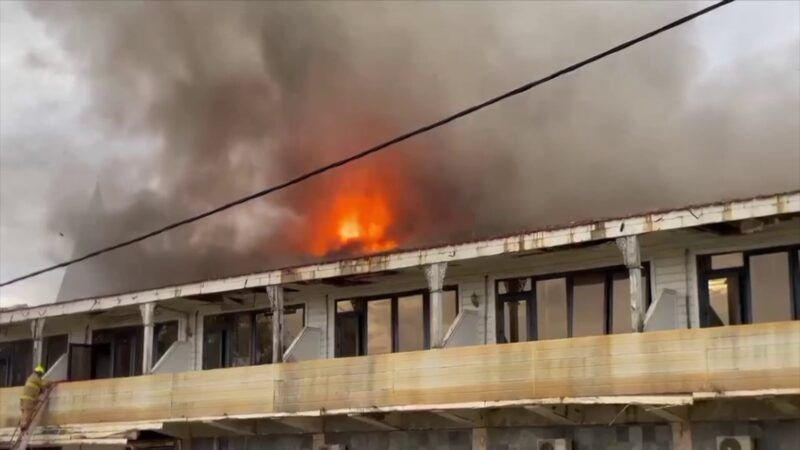
A man has been arrested in Tonga in connection with the recent blaze at Loumaile Lodge, Prime Minister and Minister of Police Lord Fakafanua has confirmed.
His announcement follows growing public concern after a series of fires struck central Nuku’alofa within days of each other.
According to Lord Fakafanua, firefighters discovered a canister inside the burnt structure, prompting police to treat the case as suspicious.
Fire and Emergency Services were able to save around 90 percent of the building despite the blaze breaking out on the second floor of the abandoned commercial property.
The confirmation of the arrest comes as authorities are also investigating another fire that destroyed a significant portion of the Tonga Hou‘eiki Church office, located less than a kilometre from Loumaile Lodge.
That earlier blaze consumed about 60 percent of the office building and sent thick smoke across the capital, prompting evacuations and a heavy emergency response.
The two incidents, occurring just days apart, have heightened concerns in the community as police attempt to determine whether the fires are connected.
A woman has died after a car mounted the curb and ploughed into a cafe in Auckland.
The crash, about 9am on Wednesday, closed William Souter Street in the North Shore suburb of Forrest Hill.
Three people were initially hurt – one critically, one with moderate injuries and one with minor injuries. Two were taken to hospital.
Police have confirmed one of those injured had since died.
Photo: RNZ / Marika Khabazi
“We just heard a massive crash sound,” Jess, who works in a neighbouring store, told RNZ.
“I was out back and I thought maybe some of our shelves had fallen down, so I rushed out to the front of the store, and lo and behold, there’s just a car on the sidewalk.”
Jess said she and her manager both rushed out and could see that the car had “obviously” crashed into the cafe.
“The first thing we saw was obviously the lady that was really injured, she was lying on the ground and there was, like, another girl, it looked like quite a young girl, whose face was bleeding as well so there were like two very noticeably injured,” she said.
“And the first thing was just to call 111, just because obviously we saw that the lady who was hit was in a not so good situation, she was in a lot of pain and she kind of looked super, super confused so we called emergency right off the bat.
Photo: RNZ / Marika Khabazi
“The car obviously has taken out the door area, the whole glass panel, it’s almost like a split glass panel and the one glass panel is literally floating in mid-air.”
Jess said they then tried to keep people away from the entrance so there were no further injuries.
She credited another nearby worker.
“The cat doctor next door to us, there is a cat nurse, she was brilliant in that situation, she ran right across from the cat doctor and she sat on the ground with the injured lady and she just sat with her and talked her through it. She was amazing,” Jess said.
Photo: RNZ / Marika Khabazi
A worker at the cafe that was hit by the car said a woman and her daughter were sitting at the time.
“Very sad news to see today. Thinking of all those involved,” North Shore MP Simon Watts said in a post on Facebook.
St John sent three ambulances and two rapid response units.
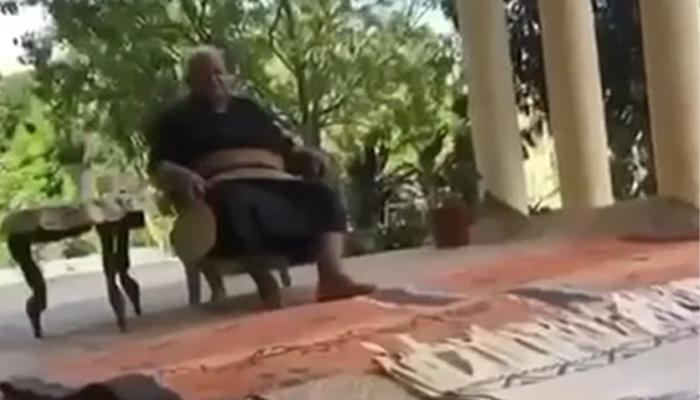
The President of the Free Wesleyan Church of Tonga (FWCT), Dr Tevita Havea, has strongly rebuked Queen Sālote College (QSC) authorities after alcohol was reportedly served at an ex-student centenary ball, calling the incident deeply disappointing and contrary to the values of a church‑run school.
Dr Tevita Havea receives a cultural visit from the Queen Salote College principal and staff, during which he strongly criticised the school’s decision to allow alcohol at an ex‑students’ centenary ball. Photo/Screenshotted.
A video sighted by Kaniva News shows Dr Havea meeting face‑to‑face with school leaders, including the principal, where he expressed deep disappointment over the event and the apparent approval of alcohol as part of the celebration.
Kaniva News also understands that the ball had been publicly announced as part of the centenary programme and was recently held at the Taufaʻāhau Wharf building in Maʻufanga.
Photos circulating on social media at the time became the subject of widespread banter and emotional sharings, showing former students posing beside tables lined with beer and wine.
The FWCT, the largest Christian denomination in Tonga and the owner of QSC, maintains a firm anti‑alcohol stance and strictly prohibits any of its activities from involving alcohol.
Dr Havea told the school authorities that while former students were free to drink in their own time, it was unacceptable for the church‑run institution to allow alcohol to be associated with an official school centenary programme.
He reminded the staff that QSC has always been upheld as a school of high discipline, and allowing such an incident to occur undermined that long‑standing reputation.
While speaking to the staff, he said the Church was deeply disappointed by the incident, adding that although only a small group was responsible, the impact was felt across the entire Church.
“Do something about it,” he said.
Rev Havea also pointed to livestreams circulating on social media showing tables filled with alcohol at the event, implying the footage devastated him.
He reminded the principal that while the school often speaks out on national issues, it has remained silent about its own internal problems and has failed to address them openly.
During the exchange, several women—believed to be the principal and staff members—responded with “io” and “koia” (yes) in agreement, their voices sounding emotional as they acknowledged the president’s concerns.
The President asked the staff to excuse him for speaking so forcefully, explaining that it was better for him to express his disappointment before the main event so that he could feel free and able to lead a proper service on the day, a point with which the women agreed.
It remained unclear whether the principal and staff had visited the president as part of the customary tala fatongia process to formally present and confirm the centenary programme, or whether the visit was prompted by an effort to apologise after learning of his disappointment over the ball.
The centenary main celebration is scheduled for Thursday, beginning with a prayer service expected to be attended by the King and Queen, followed by a series of activities running through to Sunday.
A new law raising Tonga’s legal marriage age to 18 has now come into force, marking a major step by the government to strengthen protections for vulnerable children.
The change follows decades of concern over underage marriages in the country, where previously young people could legally marry at 15—and in some cases as young as 14—with parental consent.
Under the Civil Registration & Digital Identification Act 2025, it is now unlawful for anyone under 18 to marry.
This reform closes the long‑criticised parental‑consent loophole that had enabled forced or coerced marriages under the guise of family approval.
The announcement of the law this week follows a long process that included serious parliamentary debate and extensive scrutiny before the reforms were finally passed.
As Kaniva News reported in 2016, then Deputy Speaker Lord Tuʻiʻāfitu told Parliament he was deeply concerned by the scale of child marriage in Tonga, revealing that 183 underage marriages had been recorded over a three‑year period.
UNICEF classifies marriage before the age of 18 as a fundamental violation of human rights, underscoring the seriousness of the issue.
Voices of Women and Children Heard
The Women and Children Crisis Centre (WCCC) has welcomed the new law, noting that its submission during the consultation process consistently called for setting the minimum legal marriage age at 18.
It said that in August 2025, the WCCC made a formal written submission to the Parliamentary Standing Committee on Legislation as it reviewed the Civil Registration & Digital Identification Bill.
In its submission, WCCC strongly supported establishing 18 as the minimum legal age for marriage in line with international human rights standards, including the Convention on the Rights of the Child and CEDAW.
The recommendation was based on extensive community consultations and national survey findings from women and young women across Tonga, as well as frontline casework from WCCC services involving girls aged 15 to 17 who had entered early marriages and later sought help as survivors of violence, abuse and exploitation.
WCCC also raised several legal considerations aimed at strengthening protections within the law, calling for clearer frameworks for divorce and annulment, stronger judicial safeguards to prevent misuse of nullity provisions, better recognition of the gendered impacts of marriage and divorce on women and vulnerable spouses, and greater clarity around prohibited degrees of consanguinity.
The organisation said it valued the opportunity to contribute to the legislative process and emphasised the importance of continued collaboration between government, Parliament, civil society and communities to improve protections for women and children.
It noted that the reform represents an important step forward in protecting girls from early marriage and ensuring they can complete their education, make informed decisions and reach their full potential.
Five Iranian women’s national football players have made a daring escape from their government minders in Australia, successfully seeking asylum after days of mounting pressure, international attention, and fears for their safety.
The players — who had been competing in the AFC Women’s Asian Cup on the Gold Coast — were at the centre of global headlines after they refused to sing Iran’s national anthem before a match, prompting Iranian state television to brand them “traitors” back home.
According to Australian media reports, the players slipped away from their minders late Monday night, where Australian Federal Police and Queensland Police were waiting as part of a pre-arranged protection operation.
Home Affairs Minister Tony Burke confirmed that the women were escorted from their hotel and taken to a secure location as their asylum pleas were processed.
By 1.30am Tuesday, Australian authorities had finalised their temporary humanitarian visas. Witnesses described scenes of relief and celebration as the players cried “Aussie, Aussie, Aussie!” after receiving confirmation they would remain safely in Australia.
Why They Fled
The team’s anthem protest came at a time of heightened tension inside Iran, where war had broken out and conservative media demanded harsh punishment for the women.
Iranian government officials had been accompanying the team in Australia, closely monitoring their movements throughout the tournament.
The five players — including team captain Zahra Ghanbari — feared returning home as pressure intensified. Some teammates reportedly considered seeking asylum as well, while others hesitated due to fears for family members in Iran.
Australian officials had been positioned on the sidelines of the team’s final match, discreetly signalling that help was available if the women wanted to talk.
Conversations began before dawn on Monday and continued until the players made the difficult choice to break away from their official escorts.
The Albanese government had remained silent publicly, with Minister Burke stating that protecting the women’s ability to express their wishes freely required complete operational secrecy.
International Reactions
The case drew attention from around the world. Former U.S. President Donald Trump criticised Australia’s initial silence and publicly urged the government to grant asylum.
After the visas were approved, he praised Prime Minister Anthony Albanese for “doing a very good job” in a “delicate situation.”
Iran, meanwhile, condemned the players in state media, insisting they had dishonoured the nation by refusing to sing the anthem.
Reports also indicated that Iran’s football authorities had lodged complaints over alleged political interference by foreign governments.
What Happens Next
All five players are now in protective accommodation in Australia.
Officials say they will be supported as they transition to life in the country, with the offer of assistance extended to the rest of the team should they choose to pursue asylum as well.
“These women are great athletes, great people, and they are going to feel very much at home in Australia,” Minister Burke said.
For now, the five athletes who risked everything appear to have found safety — but the fate of their remaining teammates, still under Iranian supervision, remains uncertain.
Auckland, NZ — New doctoral research from Waipapa Taumata Rau, University of Auckland, is reframing the Indigenous Tongan practice of pusiaki—often translated as adoption—as a deeply relational, historically rooted system of kinship that fundamentally differs from Western models of child placement.
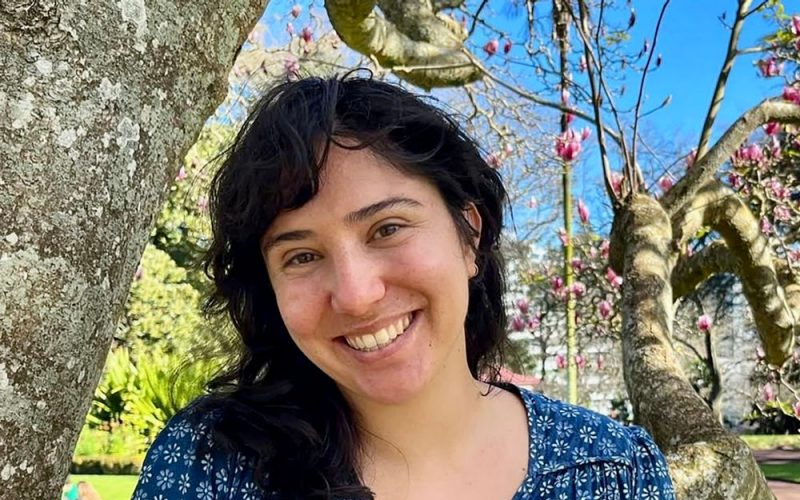
Doctoral candidate Amanda SullivanLee is reimagining pusiaki, Indigenous Tongan adoption.
Pacific Studies doctoral candidate Amanda SullivanLee is leading the study, which positions pusiaki as a practice defined by “historically sustained openness, movement and continued ties between birth and adoptive families.”
Her work challenges the assumption that adoption involves a singular and permanent transfer of parental rights, instead highlighting pusiaki as a fluid, community‑centred model in which children remain connected to lineage, land and extended kin networks.
SullivanLee’s doctoral thesis, Reclaiming Connection: Indigenous Tongan Adoption (Pusiaki) in Historical Perspective, draws on Pacific storywork, talanoa, oral history, and archival research to map both historical and contemporary expressions of pusiaki. Her multi-method approach reflects a growing scholarly movement that centres Indigenous knowledge systems and critically examines archival silences.
SullivanLee, who was raised in San Francisco and is herself an adoptee, says the work carries both intellectual and emotional significance.
“Talking about adoption is intellectually challenging — and it’s also emotionally challenging,” she says. “As an adopted Pacific person raised outside the Pacific, returning to Indigenous frameworks has been both rigorous and healing.”
Her personal journey enriches the wider academic conversation on Pacific adoption practices, particularly the relational philosophies embedded in Tongan culture.
A Kinship System Predating Missionary Influence
Historical evidence shows that pusiaki predates missionary contact and developed within a complex Tongan kinship system structured around reciprocity, respect and collective wellbeing. Far from severing ties between birth and adoptive families, pusiaki ensures that children continue to move within and sustain relationships across households and generations. This stands in stark contrast to Western closed-adoption models that prioritize legal finality over relational continuity.
Children adopted through pusiaki typically retain enduring ties to their fonua (land), fāmili (family), and vā (the sacred relational space), preserving the cultural and spiritual foundations that shape identity and belonging in Tongan society.
In December 2025, SullivanLee presented her findings at the Pacific History Association Conference in Sāmoa, joining fellow Pacific scholars committed to Indigenous-led research methodologies. Their collective work honours pioneering figures such as Linda Tuhiwai Smith, Tui Atua Tupua Tamasese Ta‘isi Efi, Sione Latukefu, Okusitino Mahina, and Albert Wendt, who advocate for Pacific histories that are created “with us, not about us.”
The research contributes to ongoing conversations about identity, belonging and care within Pacific communities, especially for adoptees navigating life across cultures and diasporas.
Restoring Connection Across the Moana
By placing pusiaki in its appropriate cultural and historical context, SullivanLee’s work restores relational care to the centre of adoption narratives in the Moana.
Her study not only deepens public understanding of Tongan kinship but also challenges institutions and policymakers to reconsider how Indigenous adoption frameworks might inform contemporary discussions of child welfare and cultural preservation.
As her research continues, it promises to reshape dialogues across academia, communities and the global Tongan diaspora—grounding them in a framework that honours movement, connection and the responsibilities of kin.
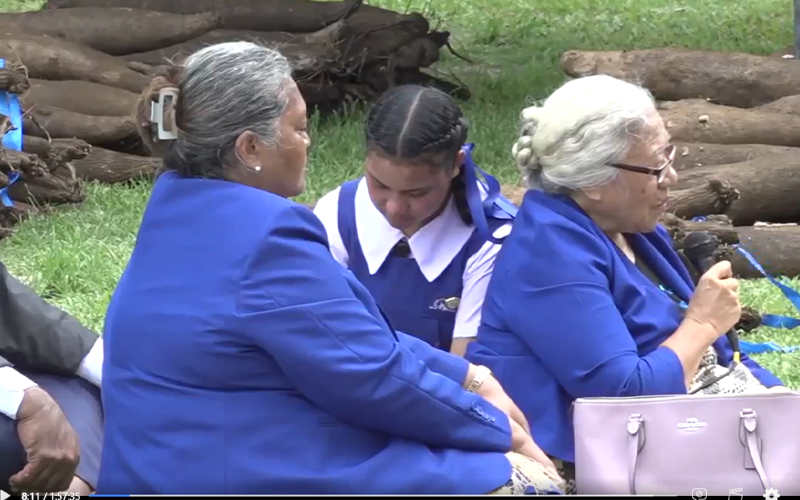
Explainer – As Queen Sālote College (QSC) prepares to mark its historic 100‑year celebration on Wednesday, three major cultural practices have taken centre stage in the lead‑up to the event: fakahā teu, tā lahi, and ‘ave ‘o e hala.
These traditions are core elements of Tongan ceremonial protocol and are always observed before major national or royal occasions.
Last week, cultural festivities signalled the celebration’s momentum as students and ex‑students from Tonga and abroad streamed into the Royal Palace in Nuku‘alofa to make their presentations.
Fakahā teu (literally, formal showcasing of cultural attire) is the formal display of cultural attire, adornments, and ceremonial regalia crafted for the main day, particularly the garments worn by the faiva performers.
Tā lahi or tā lahi ‘o e faiva’ (literally, the big rehearsal) is the full-scale performance that takes place just before the main event. It ensures that performers, dancers, choir members, and cultural groups are aligned in timing, movement, formation, and protocol.
‘Ave ‘o e hala (literally, carry on the path) – refers to the customary act of presenting goods—such as handicrafts, yams, and a hog—carried along a designated space leading to the place (hala) where the event is taking place.
It serves as a way of fakahoko fatongia or updating the most important figures in the nofo ‘a kāinga—in this case, the King and Queen, who is also a QSC ex‑student, and their daughter—on the progress of the main preparations. Although they do not take part in these activities, they are formally informed as they look ahead and prepare for the celebration.
The presentations were also a tribute to the King and Queen, whose attendance on the centennial day will give the kātoanga a uniquely powerful cultural prestige.
This means these cultural activities were not ceremonial events in themselves, but they formed essential components of the larger celebration, demonstrating the practices of feveitokai‘aki (respectful conduct shaped by cultural expectations) and fefuafatongia‘aki (mutual cultural obligations).
It also highlights the custom of mu‘aki e ngāue—the publicly announcing of the finest and most important items among all the goods, food, performance and kava presented. This practice reflects the hierarchical structure at the heart of the nofo ‘a kāinga, where the ‘eiki (the king, nobles, or senior or leading kāinga) hold the cultural right to receive the first and best of everything the community produces.
For the QSC centennial, this practice has showcased the meticulous work of students, families, alumni, and church groups who have contributed their finest garments and cultural wear for the celebration.
The events held last week drew significant online attention as videos circulated showing the fakatū‘uta—the ceremonial arrival of food, pigs, kava, and woven goods at the Palace—followed by the coordinated presentation of the faiva, including the mā‘ulu‘ulu that will feature prominently in the centennial programme.
Southland, NZ — Two teenagers were arrested after leaving a backpack containing cannabis and thousands of dollars at an op shop’s donation pickup area, where staff had mistakenly taken it inside believing it was a donated item
Police said the volunteer worker noticed the bag left at the shop’s front door — something completely normal for a location where donated goods are regularly dropped off overnight.
But when the worker brought the bag inside, it became immediately clear that this was no ordinary donation.
The bag released a strong, pungent smell, prompting the volunteer to check its contents. Inside were multiple bags of cannabis along with a large bundle of cash.
Realising the seriousness of what they had found, the Southland shop worker immediately alerted Police.
Agitated Teens Return for the “Misplaced” Bag
As the volunteer was on the phone with authorities, two teenagers — a 16‑year‑old male and a 16‑year‑old female — entered the store in a highly agitated state, demanding the return of a bag they claimed to have misplaced.
The pair quickly became aggressive toward staff, but thanks to the calm response of workers and the rapid arrival of local officers, the situation was safely contained.
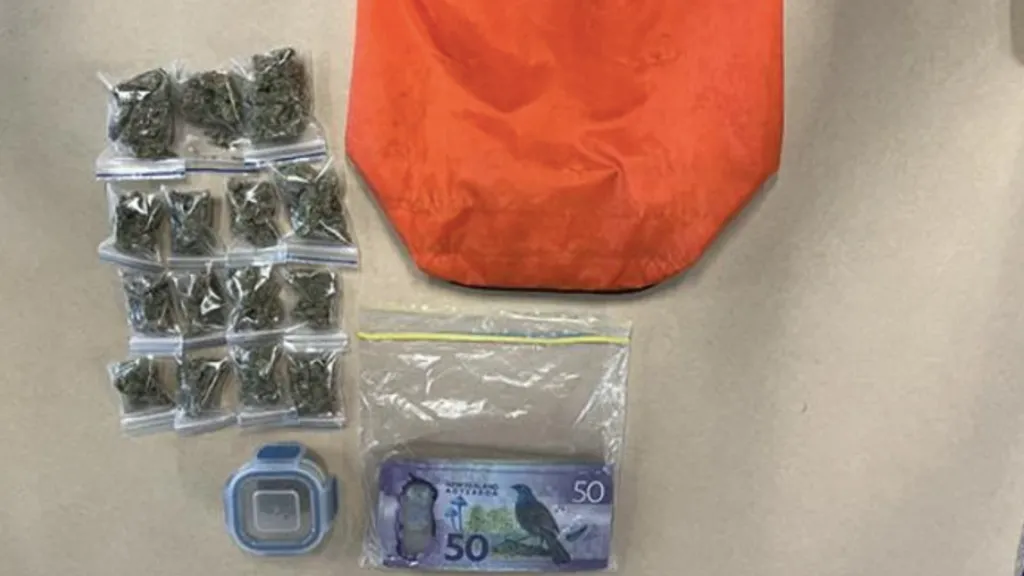
Police detained the teenagers under the Search and Surveillance Act, and a search of the misplaced bag revealed 43.2 grams of cannabis, digital scales used for weighing drugs, several additional ziplock bags, and $3700 in cash.
The teens told officers they had left the bag outside the shop’s donation point while waiting for their car to be serviced at a nearby workshop. This admission led police directly to the associated vehicle.
Inside the teenagers’ vehicle, officers also discovered an air pistol, a police scanner, and a further $810 in cash, all of which were seized as part of the ongoing investigation.
Both youths were arrested and taken into custody, with police seizing a total of $4510 in suspected proceeds of illegal activity.
Community Vigilance Leads to Major Interception
Police praised the op shop staff for their quick thinking, composure, and immediate alert.
Their actions allowed officers to respond before the situation escalated further and ensured the secure recovery of drugs, cash, a firearm‑style weapon, and surveillance equipment.
For a humble second‑hand store accustomed to sorting donated clothing and household goods, the day ended with what police described as an “excellent result” — all thanks to a misplaced bag that ended up in the wrong place at the wrong time.
Tonga stands to benefit from a major AU$150 million Australian Government investment earmarked for Fiji, Samoa and Tonga over the next five years, a package designed to strengthen rugby development across the Pacific under the Veimoana Partnership.
The deal has already been signed by the Fijian and Tongan governments, but remains stalled in Samoa due to political disagreements within Lakapi Samoa’s leadership.
The funding is designed to strengthen pathways, expand competitions and lift high‑performance programmes throughout the Pacific, with Australia’s Department of Foreign Affairs and Trade overseeing the initiative, ABC News reported.
It says that both Fiji and Tonga have already signed the agreement, while Samoa has not yet given approval due to a political standoff between Prime Minister Laaulialemalietoa Polataivao Fosi Schmidt and the leadership of Lakapi Samoa’s board.
Tonga Rugby Union leaders told ABC the package would be a financial “godsend,” emphasising that Tonga urgently needs this investment to rebuild structures, improve development systems and strengthen its national programme.
ʻIkale Tahi Under Pressure
Tonga enters this period of potential investment from Australia at a challenging time for its national men’s team, the ʻIkale Tahi, which currently sits 19th in the World Rugby rankings with 66.66 points, placing the side behind Chile (18th) and just ahead of Samoa (20th).
The ranking reflects years of limited high‑performance resources, infrastructure constraints, and ongoing struggles to retain top‑level talent eligible for multiple nations — factors that have collectively contributed to Tonga’s gradual slide down the global table.
As a result, the AU$150 million Pacific rugby funding package represents a rare and crucial opportunity for Tonga Rugby to rebuild development pathways, strengthen player depth, and restore the ʻIkale Tahi to stronger international competitiveness.
Tonga’s rugby history shows that the ʻIkale Tahi were once global contenders, reaching their highest‑ever World Rugby ranking of ninth in both 2011 and 2012, a peak confirmed in official World Rugby records and historical ranking data.
The early 2010s marked a golden period for Tongan rugby, highlighted by their famous 19–14 victory over France at the 2011 Rugby World Cup, but the nation’s proud legacy stretches back further.
One of the most celebrated moments came in 1973, when Tonga stunned the rugby world by defeating the Wallabies 16–11 in Brisbane, a landmark win recorded in the team’s historical match archive and remembered as one of the greatest upsets in Tongan rugby history. These achievements serve as reminders of the heights Tonga has reached before — and the potential that could be reignited through renewed investment and development support
For Tonga, the funding represents a crucial opportunity to address long‑standing performance challenges facing the national side, the ʻIkale Tahi, whose world ranking has slipped in recent years amid limited financial resources, lack of high‑performance infrastructure and a continuing struggle to retain top‑level talent.
Tonga Rugby Union officials have described the Australian funding as a potential “godsend” for rebuilding the national programme and lifting the team back to competitive international standards if released in full.
A Tongan‑Australian man, Paea I Middlemore Tupou, has been sentenced to 16 years’ imprisonment by a Balinese court after being found guilty of carrying out a brutal attack that left a Melbourne father‑of‑six dead inside a luxury villa.
Coskun and Tupou (above) earlier confessed to assassinating Melbourne gangland figure Zivan Radmanovic
Tupou, 27, was sentenced alongside his co‑accused Mevlut Coskun, also jailed for 16 years, while a third man, Darcy Francesco Jenson, received 12 years for organising logistics for the deadly operation.
Court documents and media reports identify Tupou as one of the two gunmen who stormed Villa Casa Santisya in Badung, Bali, in the early hours of June 14, 2025, during what authorities say was a premeditated attack motivated by a dispute involving debt collection.
According to the court findings, the attackers had been hired to intimidate Sanar Ghanim, a man staying at the villa, but ended up killing 32‑year‑old Melbourne father Zivan Radmanovic after allegedly mistaking him for their intended target.
Ghanim survived the attack but was seriously injured.
Tupou was found guilty of premeditated murder and the illegal possession and use of a firearm. He admitted to shooting Radmanovic, claiming he believed he was shooting Ghanim.
Coskun also fired shots during the attack and was convicted on the same charges as Tupou.
Darcy Francesco Jenson – Logistics organiser
Jenson coordinated the group’s travel and planning — arranging accommodation, vehicle rentals and scooters in the months leading up to the attack. He was convicted of assisting premeditated murder and sentenced separately.
Indonesian police alleged that all three men flew to Bali on instructions from an unnamed Australian man to threaten Ghanim over an unpaid debt. Prosecutors said the operation was meticulously planned, with Jenson supplying weapons and organising the group’s movements.
Radmanovic’s wife, Jazmyn Gourdeas, who was celebrating her 30th birthday at the villa, was present during the attack and survived by hiding as gunfire erupted. Her family travelled to Bali for the sentencing and expressed deep disappointment that the men did not receive longer terms.
The Denpasar District Court ruled the men were “legally and convincingly guilty” of premeditated murder — a charge that carries a maximum penalty of death in Indonesia. Prosecutors had sought heavier sentences of up to 18 years.
Radmanovic’s family described the sentences as “a joke,” expressing frustration that the men might one day walk free despite the devastating loss suffered by the victim’s wife and their six children.