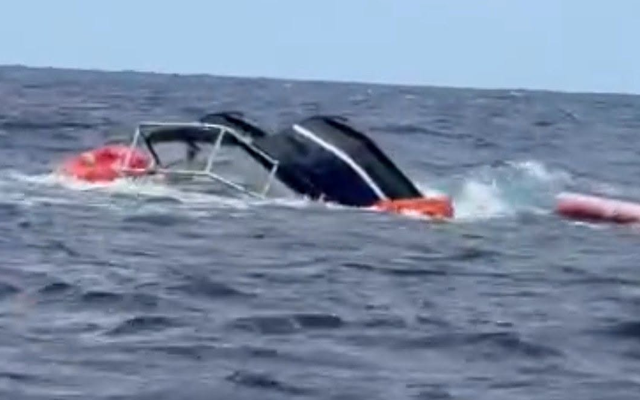
A whale-watching boat carrying passengers has been involved in an accident in Vavaʻu today, raising fresh safety concerns following two other serious boating incidents in Tonga in recent weeks.
A whale-watching boat carrying passengers was involved in an accident in Vavaʻu today. Neiafu Town Officer Vava Lapota told Kaniva News that no loss of life had been reported.
Neiafu Town Officer Vava Lapota told Kaniva News that passengers were on board the vessel when the accident occurred, but no loss of life had been reported.
Images from the scene, obtained by Kaniva News, show the stricken vessel partially submerged in choppy waters, with much of the boat sitting low beneath the surface and its canopy tilted into the sea.
Orange-red flotation or safety equipment can be seen around the vessel. Other boats carrying several people are also visible nearby, including one positioned close to the partially submerged vessel, as waves break around the boats.
Details remained limited, including how the accident occurred, how many passengers were aboard, and whether police were called to the scene.
The licensing status of the vessel involved in today’s accident has yet to be confirmed.
The latest incident comes after the Ministry of Tourism repeatedly sought to distinguish licensed whale-watching operators from other boating activities, clarifying that vessels involved in two recent incidents in Tonga were not licensed to conduct whale-watching services.
The Ministry’s clarifications followed concerns that the incidents could be associated with Tonga’s licensed whale-watching industry. One of the vessels was involved in an incident last month while carrying passengers, including Anglican Church members visiting from New Zealand.
Tonga’s Ministry of Tourism subsequently said the vessel and operator were not licensed or authorised to conduct whale-watching and swimming activities.
The second incident occurred earlier this month and claimed the life of Vaiola Hospital nurse Siokapesi Hefa after a newly launched boat overturned during an outing.
The latest accident comes just over a year after the whale-watching vessel Tethys capsized south of Muʻamoa in Vavaʻu in August 2025. No casualties were reported in that incident, and the vessel was later towed back to port.
At the time, Lapota had raised concerns about the need for closer inspection of some vessels operating in the area.
Kaniva News is seeking further information about today’s Vavaʻu accident, including the vessel’s licensing status and the condition of those who were on board.
Tonga Police arrested 38 people for allegedly driving under the influence of alcohol during an operation carried out last week.
Police said 29 of those arrested were men and nine were women.
The arrests formed part of enforcement efforts targeting drinking and driving and the risks it poses to motorists, passengers and other road users.
Police used the results of the operation to renew their warning against getting behind the wheel after consuming alcohol.
“Alcohol and driving do not belong together,” Tonga Police said.
Police urged people who intend to drink to plan ahead and arrange a safe way to return home rather than driving.
“If you choose to drink, make arrangements for a safe way home and keep yourself and others out of harm’s way,” Police said.
The 38 arrests mean an average of more than five people a day were detained for alleged drink-driving offences during the week.
Police have repeatedly urged motorists to make responsible decisions around alcohol as part of efforts to reduce preventable crashes, injuries and deaths on Tonga’s roads.
Tongan lawyer Lance Talakai has been appointed by Utah Governor Spencer Cox to serve as a judge of the state’s Third District Juvenile Court.
Tongan lawyer Lance Talakai has been appointed by Utah Governor Spencer Cox to serve as a judge in the Third District Juvenile Court. His appointment is subject to confirmation by the Utah Senate.
Talakai’s appointment carries particular significance for Utah’s Tongan community. The Third District includes Salt Lake County, which the 2020 United States Census recorded as having 12,859 people identifying as Tongan alone or in combination — the largest Tongan population of any county in the United States.
The Third District Juvenile Court is a major part of Utah’s state judiciary, serving Salt Lake, Summit and Tooele counties and dealing with cases ranging from serious youth offending to child abuse, neglect, custody and other matters affecting vulnerable children and families.
Talakai was selected to fill the vacancy left by the retirement of Judge David Johnson, after being among five candidates nominated for the position by the Third District Judicial Nominating Commission. His appointment is subject to confirmation by the Utah Senate.
Governor Cox said Talakai’s extensive courtroom experience, including his work on serious youth offender cases, would be valuable to Utah families.
“Lance has spent his career serving people at some of the most consequential moments of their lives,” Cox said in announcing the appointment.
Talakai has spent the past 14 years as a defence attorney with the Salt Lake Legal Defender Association, where he has represented people facing felony and misdemeanor charges as well as serious youth offender cases.
His experience has also included leadership positions as a felony team leader and co-misdemeanor chief, along with recruiting, training and supervising new lawyers.
Talakai said he was deeply humbled by the appointment and particularly grateful for the opportunity to serve the district where he grew up.
He said that, if confirmed, he would carry out the judicial role with compassion, fairness, integrity and humility, while ensuring young people and families appearing before the court were treated with dignity and respect.
Before joining the Salt Lake Legal Defender Association in 2012, Talakai worked with the Utah County Public Defender and served as a law clerk for Utah’s Fourth District Court.
He holds a law degree from Brigham Young University’s J. Reuben Clark Law School and a bachelor’s degree in sociology from the University of Hawaii at Mānoa.
The Utah Senate subsequently sought public submissions on Talakai’s appointment, with its Judicial Confirmation Committee scheduled to consider his nomination before making a recommendation to the full Senate.
The committee formally considered Talakai’s appointment at its September 11 meeting as part of the Senate confirmation process.
A 43-year-old man has pleaded guilty to murdering his wife after shooting her nine times with a .22 firearm at their home in Vavaʻu earlier this year.
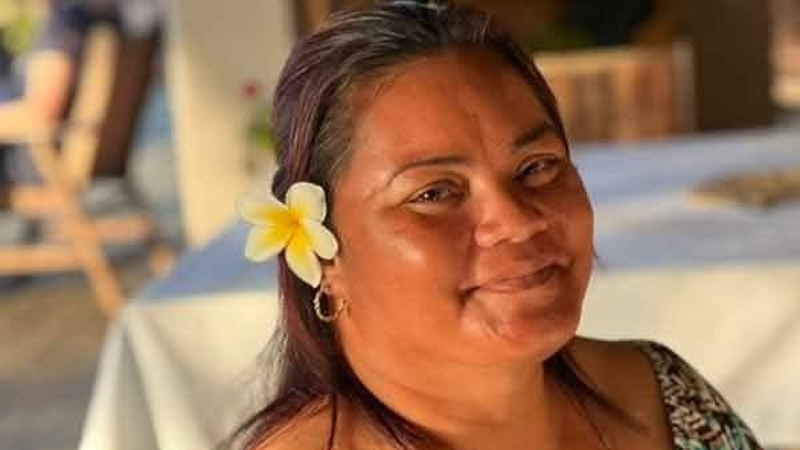
Trina Diana ‘One’one
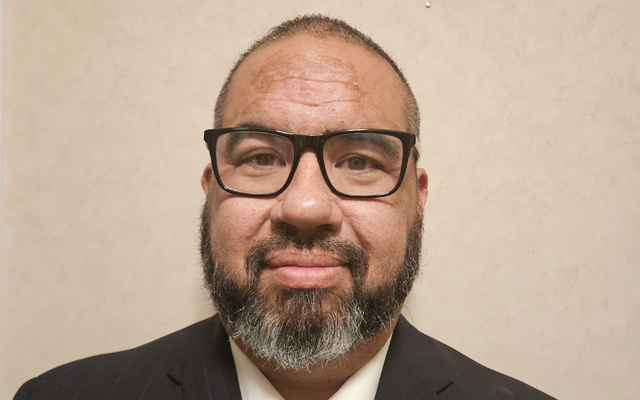
Kilisimasi ʻOneʻone appeared before Justice Tupou KC at the Supreme Court in Neiafu on Wednesday, September 16, where he admitted murdering his wife, Trina Diana ʻOneʻone, also 43.
The accused’s court appearance appeared to be his first since the fatal shooting on May 7, during which one of their daughters was also reportedly injured after allegedly trying to intervene.
Matangi Tonga reported that the court was told that ʻOneʻone caused his wife’s death by shooting her nine times with a .22 firearm.
The murder case shocked communities in Tonga and abroad and has been widely covered by Pacific media, including news outlets in New Zealand and Australia.
ʻOneʻone is expected to be sentenced in January 2027.
Fiji has declared its escalating HIV epidemic a national emergency after new estimates showed one in every 60 adults is living with the virus, a development with particular relevance to Tonga because of the close and longstanding movement of people between the two Pacific nations.
Fiji is an important regional education hub for Tonga, with many Tongan students studying at the University of the South Pacific’s main Laucala campus in Suva over the years.
The two countries also maintain extensive family, educational, sporting, religious and other connections, making Fiji’s worsening HIV epidemic an issue of wider regional significance.
Fiji’s Minister for Health and Medical Services, Dr Atonio Lalabalavu, announced the national emergency after evidence showed the epidemic had reached a level requiring a stronger and more coordinated response.
An estimated one in every 60 adults in Fiji is now living with HIV, compared with one in 167 five years ago.
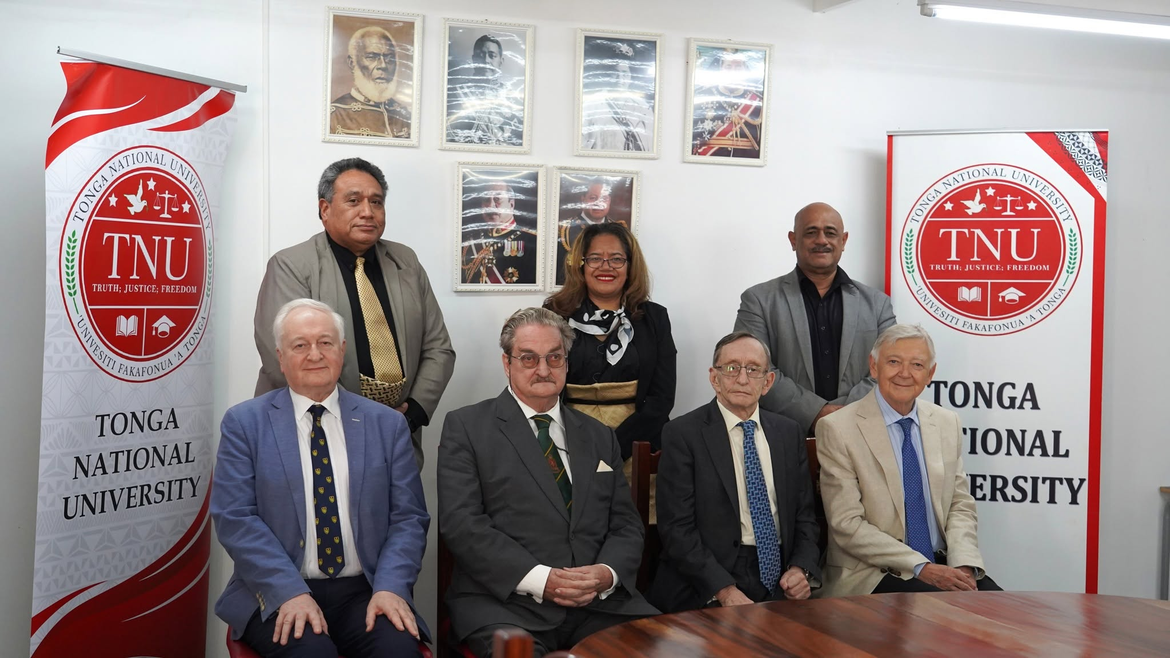
Plans to establish a law school at Tonga National University have received significant backing from some of the Kingdom’s most senior judges, who have offered their legal expertise to help develop the proposed Bachelor of Laws programme.
The judges also regarded TNU as the perfect place to offer these programs. They also supported the Tongan Language and Culture being offered by TNU. Photo/TNU
Lord Chief Justice Malcolm Bishop KC, Justice Edward Targowski KC, Lord Dalgety KC and Justice Tavake Afeaki have expressed support for the university’s efforts to establish the law school.
TNU said the judges had also offered to help scope the development of a curriculum for a Bachelor of Laws degree and related programmes.
The judges visited the university’s Pahu campus on August 27, where they shared experiences from their judicial work in Tonga and overseas.
A central recommendation was that the proposed law programme should teach laws relevant to Tonga and the needs of Tongan people.
The judges regarded TNU as an appropriate institution to deliver the programmes and also expressed support for the university’s teaching of Tongan language and culture.
The initiative could provide an opportunity for students to undertake university-level legal education within Tonga while placing greater emphasis on the Kingdom’s own laws, language and cultural context.
Vice-Chancellor Dr Giulio Masasso Tuʻikolongahau Paunga welcomed the judiciary’s involvement, describing its support as important to the continuing development of the proposed law school.
“I am grateful and honoured for the tremendous support; I couldn’t ask for anything better than this,” Dr Paunga said.
The university has not yet announced when the proposed law school or Bachelor of Laws programme would begin, with curriculum development still being scoped.
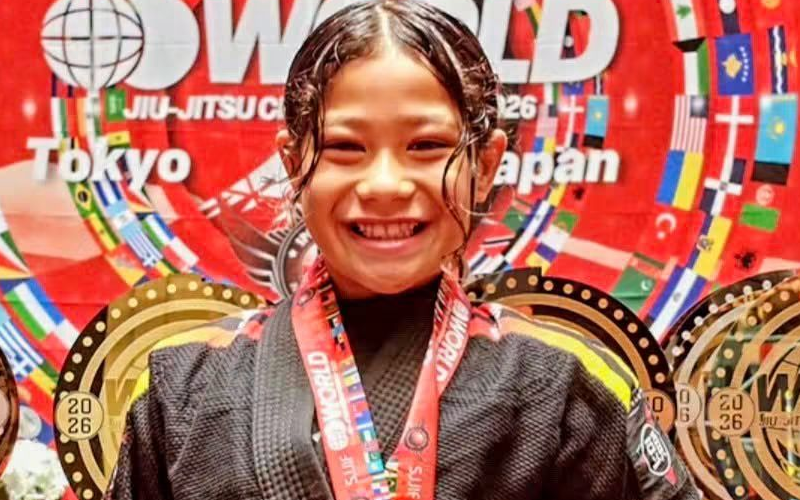
Seven-year-old Tongan-New Zealand martial arts prodigy Achillea Hennessy has claimed her fourth world jiu-jitsu title after another international triumph, this time in Tokyo, Japan.
Seven-year-old Tongan-New Zealand martial arts star Achillea Hennessy has won her fourth world jiu-jitsu title after triumphing at the SJJF World Championships in Tokyo, Japan. Photo / Trevor Hennessy
Achillea won the SJJF World Championships, adding another major title to an extraordinary record that began when she was just six years old.
Her first world title came at the NAGA World Jiu-Jitsu Championships in Texas, United States, last year.
She followed that by winning the IBJJF Pan Kids in Florida, regarded as one of the world’s leading children’s Brazilian jiu-jitsu competitions, before securing another title at the NEWBREED World Championships in Florida a month later.
Her victory in Tokyo is now her fourth world title.
Achillea has Tongan roots through her mother, Hinehina ʻAtelangi Fotofili, whose family is from Pea, Vaikopuna, while Fotofili’s father is from Lapaha. Her maternal family was born and raised in Tonga before moving to New Zealand more than 30 years ago.
Achillea began jiu-jitsu at about five and currently trains at Daredevil Jiu Jitsu under coach Clinton Terry, while her father Trevor Hennessy has trained and guided her from the beginning across the 10 sports in which she participates.
Trevor said Achillea trains every day and, because she is home-schooled, has the flexibility to train several times a day while pursuing multiple sports. Ahead of major competitions, she normally trains at least twice daily.
He attributes much of her early success to consistent family support, hard work and what he describes as God-given talent.
Trevor recalled Achillea crying with emotion after winning her first world title because it was her first victory on an international stage.
Her IBJJF Pan Kids victory was particularly emotional because of the level of competition, he said, but winning world titles has since become more familiar to the seven-year-old.
“She knows what she can do and is very confident,” Trevor said, adding that despite her success, she remains a child who wants to enjoy herself.
Achillea is also being raised with a strong awareness of her Tongan identity. Her family speaks Tongan to her daily, and she knows her family connections, villages and heritage, although she has yet to visit Tonga, Trevor told Kaniva news.
“Representing NZ and an even smaller nation, Tonga, is cool for us,” Trevor said. “She is happy to represent her family and her lineage and to make us all proud.”
Achillea, who lives with her family in Panmure, is already preparing for her next challenges.
In three weeks, she is expected to compete at the New Zealand national championships in freestyle wrestling, followed by the national judo championships.
Her father said victories at both would give her national titles in two more combat sports. She has already competed successfully in Australia in those disciplines.
Achillea is also expected to return to the NAGA World Championships in December, where she will attempt to win another world jiu-jitsu title.
This time, her sister — whom Trevor describes as another highly promising young athlete — is expected to travel with her and pursue her own first world title.
For Trevor, however, the long-term goal extends beyond medals.
He said the family would continue developing Achillea, competing and creating opportunities for her, but their most important aim was “developing her into the best woman she possibly can be”.
The controversial US$6.25 million purchase of Lulutai Airlines’ Twin Otter — a deal that stunned Parliament after it was revealed by the media, was subsequently surrounded by allegations of secrecy, drew serious concerns over its price and due diligence, and was followed by substantial maintenance-related problems — has taken another troubling turn.
Former Prime Minister Hu’akavameiliku and current Minister for Public Enterprises (L), and Prime Minister Fakafanua. Photo/Fale Alea ‘O Tonga
Prime Minister Lord Fakafanua has revealed that the aircraft is struggling to make a profit, partly because the weight of Tongan passengers can restrict the number of people it is able to carry on some flights.
Fakafanua made the revelation at a press briefing yesterday afternoon as he outlined problems his government had identified with the aircraft, purchased by the former Huʻakavameiliku government, and Lulutai’s continuing struggle to operate profitably.
Fakafanua said passenger weight meant all 19 seats could not be filled, with only around 12 passengers able to be carried. This left the airline with the choice of reducing passenger numbers or cutting other loads carried on the aircraft.
The revelation follows earlier complaints — and at times public ridicule — over the aircraft, with critics asking whether this was a brand new or a second hand aircraft, and whether the Twin Otter had been properly assessed for its suitability for Tonga before it was purchased.
Shortly after the aircraft arrived in Tonga, Kaniva News saw livestreamed videos shared on Facebook from inside the Twin Otter in which passengers complained that the seats were too small, with some adults appearing to need two adjoining seats to sit comfortably.
Engine replacement deepens purchase concerns
Concerns over the purchase intensified after the Huʻakavameiliku government resigned, with incoming Public Enterprises Minister Paula Piveni Piukala saying he believed proper due diligence had not been carried out.
He indicated that he had found no record of a feasibility study assessing whether the aircraft would be commercially viable or become a financial burden on the country.
After discovering that both engines were due for replacement barely a year after the aircraft was purchased, Piukala considered seeking the King’s consent to establish a Royal Commission to investigate the controversial deal.
When Kaniva News broke the news of the purchase in August 2023, some MPs were stunned and questioned then Prime Minister Huʻakavameiliku in Parliament about whether the report was correct. He confirmed that the aircraft had been purchased.
The disclosure triggered heated debate in the House, with several MPs claiming the aircraft purchase had not been provided for in the Budget — a claim Huʻakavameiliku strongly disputed, insisting that it had been included.
The controversy became one of the central issues in the 2023 vote of no confidence against Huʻakavameiliku, which he ultimately survived, before resigning amid a second no-confidence motion the following year.
Australian funding fuels controversy
The 2023 motion, led by his premiership rival Dr ʻAisake Eke, also raised questions over US$2 million in Australian Government funding that was used to help finance the aircraft.
The Huʻakavameiliku government maintained that the Australian funding was intended for the Twin Otter purchase.
The Opposition, however, presented a letter from the Australian High Commissioner in Tonga which it said confirmed that the money had been provided to Tonga as budget support rather than specifically to purchase the aircraft.
Experts question aircraft purchase,
As controversy over the purchase intensified, Kaniva News spoke to aviation experts who raised concerns about the aircraft. Some said it had allegedly been grounded in China from 2018 until 2023 and warned that certain aircraft components must be replaced according to calendar time, regardless of whether the aircraft is flying.
One expert questioned why the purchase price had been paid in full while the aircraft remained in China and said Tonga should have conducted its own inspection to ensure the aircraft met the safety requirements applicable in the Kingdom.
Problems continued after the aircraft arrived in Tonga. About four months later, it was grounded after damage to a computer sensor forming part of its Air Data Attitude Heading and Reference System.
By February 2025, the Twin Otter had undergone repeated maintenance groundings, while the Government was confronting the multimillion-dollar cost associated with replacing its engines.
The Twin Otter was also financed with TOP$10 million (US$4.2 million) from Tonga’s Retirement Fund Board — comprising a TOP$6 million (US$2.5 million) loan and a TOP$4 million (US$1.7 million) equity investment — according to the Government’s own Budget Strategy FY2025.
The TOP$6 million loan is guaranteed by the Government. Former Prime Minister Dr ʻAisake Eke previously told Kaniva News that while the guarantee provided security for the Retirement Fund, it transferred the financial risk to the Government.
He warned that if Lulutai failed to repay the loan, the Government would have to find the money elsewhere in its budget — potentially leaving taxpayers to ultimately bear the cost of the guarantee.
Teau ʻi Moʻunga Faletau, 43, was sentenced by Lord Chief Justice Malcolm Bishop KC after being convicted of arranging the transportation of 5,846.98 grams of methamphetamine through an airline baggage handler.
Teau ‘i Mo’unga Faletau
Because the amount exceeded 5,000 grams, Tonga’s Illicit Drugs Control Act required life imprisonment.
The Chief Justice clarified that life imprisonment was not simply the maximum penalty available — it was the only sentence permitted by law for the offence.
Faletau had approached ʻOfisi Ake, with whom he had developed a friendship, seeking his assistance as a baggage handler to get the methamphetamine onto an aircraft bound for New Zealand while avoiding detection, the court found.
However, Bishop said there was no evidence Faletau had previously been involved in drug dealing or was the mastermind of an international criminal organisation.
He described Faletau as not particularly sophisticated and found that he had apparently taken an opportunity to make easy money despite owning a successful business.
The judge also noted Faletau had provided employment in the community and had previously shown bravery while attempting to rescue the late Makisi Tonga when official assistance was unavailable.
While imposing the mandatory sentence, Bishop made an important clarification about what life imprisonment means under Tongan law.
He found that a life sentence without any possibility of future review or mitigation would be unlawful in Tonga.
Under the Constitution, the King, with the consent of the Privy Council, may pardon a convicted person or remit or reduce a sentence.
Tonga’s Prison Rules also provide for life sentences to be considered on their merits after periods including 10, 15 and 20 years, although such reviews do not guarantee release or a reduction.
Faletau’s life sentence was backdated to when he was first remanded in custody, while the court ordered the methamphetamine destroyed.
Co-defendant Mafi Fatongiatau Lutui was acquitted of a similar charge in the case.
Internationally acclaimed Tongan tenor Filipe Manu, who has returned to Aotearoa for a major New Zealand Opera production, has previously revealed another ambition close to his cultural roots — to see the creation of the world’s first opera performed entirely in Tongan.
Tongan opera star Filipe Manu is back in Aotearoa, supporting the next generation of singers at Dilworth School before taking the stage in NZ Opera’s first production of The Pearl Fishers in more than 20 years. Photo / Supplied
Manu is back in New Zealand to play Nadir in NZ Opera’s new staging of Georges Bizet’s The Pearl Fishers, which opens in Auckland on September 23 before moving to Christchurch in October.
His return has also taken him back to Dilworth School, where his journey into classical singing began.
Manu recently donated his performance at a Dilworth fundraising concert supporting the school’s International Music Fund, aimed at creating international opportunities for its young singers. He told PMN that giving back was a way of helping another generation receive opportunities similar to those that launched his own career.
Long before this latest return, however, Manu had spoken publicly about another aspiration for the future.
In an interview published in the Winter 2026 issue of AA Directions, Manu was asked about his dream for the world of opera.
“If I were able to see the creation and performance of the world’s first opera entirely in Tongan, that would be pretty special,” he said.
The ambition reflects Manu’s strong attachment to lea faka-Tonga. In the same interview, he recalled arriving at primary school in Auckland unable to speak or understand English because Tongan was the language spoken at home.
He said a teacher once suggested his mother stop speaking Tongan to him so he could learn English more quickly, but the idea was quickly abandoned. Manu later reflected that otherwise he could have lost an important connection with his language, culture, mother tongue and relationship with his mother.
His path towards international opera began at Dilworth, where he discovered singing and later became head chorister of the founding Fortissimo choir around 2010.
Manu has credited the school with providing the opportunities that allowed his love of singing to develop, before he went on to study music at the University of Waikato and later at London’s Guildhall School of Music and Drama. He subsequently became the first person of Tongan heritage accepted into the Royal Opera House’s prestigious Young Artist Programme at Covent Garden.
His international career has since taken him to leading opera houses including the Vienna State Opera and Paris Opera.
Now his career has brought him back to the country where it began.
NZ Opera’s The Pearl Fishers will feature Manu as Nadir alongside Madison Nonoa as Léïla, Samuel Dundas as Zurga and Anthony Robin Schneider as Nourabad. Auckland performances will be held on September 23, 25 and 27 at the Kiri Te Kanawa Theatre.
The production is particularly significant because it marks NZ Opera’s first presentation of The Pearl Fishers since 2002 and brings its principal internationally based New Zealand singers home for the new staging.
For Manu, the return connects several stages of his journey — from the Auckland school where he first discovered his operatic voice, to an international career, and an earlier dream that one day the language he grew up speaking might itself be heard throughout an entire opera.