The political fallout from Fijian parliamentarians giving themselves a pay rise last week is spiralling out of control after the main opposition FijiFirst – the largest single political party in Parliament – sacked 17 out of 26 of its MPs.
FijiFirst Headquarters Photo: RNZI / Sally Round
Sixteen out of the 17, who voted for an increase to MPs salary and benefits, include the opposition leader Inia Seruiratu, who told Parliament that MPs had “wants” and “needs” and “church commitments” to justify the salary bump.
One MP, Alvick Maharaj, who was part of the special parliamentary committee that recommended the raise, and had abstained, was also handed the termination letter.
The FijiFirst party has written to the Speaker of Parliament, Ratu Naiqama Lalabalavu, informing him that the MPs have been expelled for not following a party directive on 24 May to vote against or abstain on the motion for the pay increase.
The letter, signed by the FijiFirst leader and convicted former prime minister Frank Bainimarama (who is serving a one-year jail sentence) and the party’s acting secretary-general-secretary Fiayaz Koya, was reportedly handed to the Speaker on Thursday afternoon.
“Given the immediate vacancy of these seats, we have copied the Electoral Commission in this letter so it can, as per sections 64 of the Fijian Constitution, award the 17 vacant seats to the remaining FijiFirst candidates…to fill the vacant seats at the earliest,” the letter stated.
“We are disputing the legality of the termination letter and as far as we are concerned we are still Members of Parliament,” he said, adding they will “await the full process of the law to take its course.”
According to the 2013 Fiji Constitution, section 63(1)(h) states: “The seat of a member of Parliament becomes vacant if the member; votes or abstains from voting in Parliament contrary to any direction issued by the political party for which he or she was a candidate at the time he or she was elected to Parliament, without obtaining the prior permission of the political party”.
There are concerns in Tonga whether a housing development planned to provide accommodation for people attending the 53rd Pacific Islands Forum Leaders Forum in August will be completed in time.
Work to clear the land at Popua, which is adjacent to the historic Sia Heu Lupe site, has been underway through May.
The government hopes to erect 100 prefabricated houses at the site to provide additional accommodation for those attending the summit.
They will be allocated to the elderly after the event.
“The site preparation, now into its third week, will continue until the end of May, before construction begins in June,” according to a report by Matangi Tonga last week.
RNZ Pacific’s correspondent in Tonga, Kalafi Moala, said the Forum meeting will put a lot of pressure on Tonga’s accommodation facilities.
“All the hotels have been booked and so they have to build the houses, new houses,” he said.
“So again officially the word has come out that they have got a location where they are going to build 100 pre-fab houses. I think that’s great but you have to order those houses to be pre-fabricated overseas.”
Work is also underway on another site near the heart of Nuku’alofa, where more housing is being built.
But Moala said the issues facing the government also include finding a site to hold the forum meetings.
The Tongan government has appealed to China to hurry the construction of an indoor stadium in Nuku’alofa so it can be used for the meeting.
Moala said the government is also eyeing the new indoor stadium being built near Tonga High School, asking if it could be finished and ready in time for the summit.
“It was supposed to be finished by December so they are going to finish by August.
“I talked to the Chinese officials here they say, ‘Yes they can finish it for the Forum but it means that it’s going to cost more money, it means they are going to have to bring in more labour from China’.”
While some of it is up for debate depending on what side of the political spectrum you lean towards, here are a few of the outcomes of the government’s funding divvy-up this year.
The ‘winners’
‘Back Pocket Boost’ is back
The Budget documents stated 1.9 million households would benefit from the overall relief package by an average of $30 a week. Households with children would benefit by $39 a week on average.
A minimum wage worker can expect about $12.50 a week, while superannuitants will take home just $4.50 a week.
The Independent Earner Tax Credit is also being expanded, with the upper limit for eligibility rising from an income of $48,000 to $70,000, with amounts reducing from $66,000+ instead of $44,000+.
The in-work tax credit will also go up by up to $25 a week from 31 July. National had campaigned on that kicking in from 1 April.
The relief package also includes a childcare payment for low-and-middle-income households as already announced by Willis in March.
Roads
The government is pumping $2.68 billion in to transport over four years, and more than two thirds of that’s being spent on roads.
There is $1b over four years to accelerate Roads of National Significance and $939.3 million over four years to repair roads damaged during North Island weather events.
Health
Healthcare’s getting a whopping $16.7b in new funding – though that’s spread over three Budgets.
Among the standout amounts there are:
$3.44b over four years for Health NZ hospital and specialist services
$2.12b over four years for primary, community and public health
$1.77b over four years to maintain Pharmac funding
$1.1b over five years to address demand and cost pressures for the Ministry of Disabled People Whaikaha
Landlords
There’s $729m being spent on restoring interest deductibility for residential rental property.
Police
Police are getting $226.1m over four years for an extra 500 police and there’s also $424.9m over four years to support frontline policing.
Education
Schools and kura kaupapa property are getting a $1.48b boost over four years and there’s also $200m in grants for operating schools, too.
There are also boosts for school IT infrastructure and subsidies for ECEs and tertiary tuition and training.
Māori
There’s $12 million over four years for Kōhanga Reo property maintenance.
Te Matatini received another boost in this years budget, from 2025 they will get $48.7m over three years. That goes with the $34m over two years the National kapa haka festival received in Budget 2023.
Natural disaster response
There’s a fair bit in the Budget for this sector and it’s perhaps no surprise, coming in the wake of the mop-up for events like Cyclone Gabrielle.
This $939.3m is clearly that – spread over four years, it’s to repair roads damaged during Cyclone Gabrielle, the Auckland floods and other North Island weather events.
There’s $200m for flood infrastructure upgrades in the $1.2b Regional Infrastructure Fund.
In the same sphere, there’s $5m for the creation of the National Infrastructure Agency and the somewhat adjacent $106.9m over four years operational funding for GeoNet and the National Seismic Hazard Model.
There’s also $23.1m over four years for critical frontline rescue services to respond to severe weather events and emergencies.
In addition, the Climate Emergency Response Fund is getting $597m, paid for through the ETS.
Local councils
The Waste Disposal Levy is being expanded to cover a wider range of projects with an expected result of $1.195b over four years.
The ‘losers’
The country’s debt level
The government borrowing programme over the next four years was increased by $12b from December’s forecast.
Net debt is forecast to peak at 43.5 percent of GDP in 2025 and is forecast to remain above the government’s 40 percent ceiling for the following three years.
Tax evaders
It’s not a good day if you’re a tax evader – the government is pumping $147m into cracking down on tax evasion.
The next lot of first-year uni students
The government is switching fees-free from first year to final year of university – with an expected saving of $220m.
Overseas student loan borrowers
Interest rates for overseas borrowers are set to increase from 3.9 percent to 4.9 percent from 1 April 2025.
Online gambling operators
It’s expected there will be $47m extra from taxing online casino operators.
Māori
The disestablishment of Te Aka Whai Ora, the Māori Health Authority is set to save the government $35.5 million.
Ongoing funding of $40 million for new supply and capability of Māori housing has been cut. This returns uncontracted funding.
And $20 million of funding for Rangatahi transitional housing has been returned to the Ministry of Housing and Urban Development, this funding was also uncontracted.
NZ Film Commission, NZ Symphony Orchestra, and Nga Taonga Sound and Vision
The government’s saving $5.55m over four years by spending less on these institutions.
The Consumer Advocacy Council
It’s being scrapped – that’s a saving of $5.72m over four years.
Energy programmes
The government’s saving $38.27m over four years by scaling down initiatives like the Community Renewable Energy Fund.
There’s also $178m over four years in savings from the Energy Efficiency and Conservation Authority, including discontinuing new Warmer Kiwi Homes subsidies for hot water heaters, energy-efficiency measures, an LED lighting scheme, and community-focused outreach for hard-to-reach households.
The Wellington Science City project
It’s gone – and being scrapped to the tune of $462.8m of savings over four years.
Pharmac
During the campaign, National pledged to give Pharmac an extra $70m a year over four years in ring-fenced funding to target 13 specific cancers.
However, that hadn’t been possible this budget, Willis said – but noted the coalition remained committed to following through on its commitment in future Budgets.
By Ric Stevens of Open Justice reporter of NZHerald
A woman who said she would make history as “one of the biggest scammers in New Zealand” is believed to back in the game, promoting a new scheme promising untold riches to would-be investors.
Shelly Cullen has previously promoted a pyramid scheme – an illegal form of “investment” that can leave most of the investors out of pocket when the scheme collapses.
The verdicts were handed down by Judge Anna Skellern in the North Shore District Court on 12 April, after a judge-alone trial that went ahead without Cullen attending. She is believed to be overseas.
Now the Commerce Commission has alleged Cullen is linked to another bitcoin-based investment being marketed online and within New Zealand.
“Ms Cullen has been promoting a new investment opportunity known as ‘MaVie’,” said the Commerce Commission’s fair trading general manager, Vanessa Horne.
“The commission is urging communities to exercise caution around this and similar schemes.
“We think this is particularly important following the court’s finding that Lion’s Share was a pyramid scheme, and Ms Cullen’s conviction for promotion of that scheme.”
Although Cullen did not show up for her own trial, comments she had made in a Facebook Live video were viewed by Judge Skellern and quoted in her written decision.
“I am going to make history as one of the biggest scammers in New Zealand,” Cullen said in the video posted in January 2021.
“F*** the consequences, I ain’t scared.
“I jump from scam to scam because I can. What’s the consequences? $600,000 slap on the hand.”
The reference to $600,000 matches the maximum fine under the Fair Trading Act for promoting a pyramid scheme.
More than 200 potential investors in the MaVie scheme took part in an online meeting this week in which a promoter – not Cullen – suggested they could tap into millions of dollars of wealth generated by bitcoin for investments from $1000.
The Commerce Commission said the earlier Lion’s Share scheme targeted Māori and Pasifika communities in New Zealand during 2020 and 2021.
The participants in Monday’s MaVie online meeting also appeared to come largely from those communities.
The presentation gave the impression there are huge profits to be made through a relentless increase in the value of bitcoin and other cybercurrencies.
The Lion’s Share investment, which was found to be a pyramid scheme, was also supposedly based on cryptocurrencies.
83 percent of investors lost money
A pyramid scheme is a fraudulent way to make money based on an ever-increasing number of “investors”.
The initial promoters recruit investors, who in turn recruit more. The structure resembles a pyramid because the number of players increases at each level.
Sooner or later, however, the scheme runs out of people to recruit and collapses, leaving the latecomers out of pocket.
In the Lion’s Share scheme, more than 83 percent were found to be “losers”.
In the online meeting for the latest scheme, a woman designated as a co-host said there were people online from New Zealand, Australia, the Cook Islands and Cyprus. Members of Cullen’s family are understood to be in Cyprus.
Shelly Cullen was not obviously present in the list of attendees but the co-host described the online meeting as “Shelly’s community”.
The online meeting was given a presentation by a promoter, Neo Anderson, who described coming from a poor background in upstate New York and making a fortune out of bitcoin.
It is unclear if his name is real. The character Thomas Anderson in the 1999 science fiction movie The Matrix is known by his computer hacking alias, Neo.
Anderson did not reveal his face but showed the meeting a series of slides for a promotion called FinUp.
One of these slides directly linked FinUp with the MaVie scheme that was the subject of the Commerce Commission warning.
Anderson suggested investors could make millions of dollars through investing in the bitcoin-driven promotion.
At one point, Anderson used an online compound interest calculator to suggest that an initial investment of $1000 could grow to $1.2m in five years.
In fact, to achieve such a return an investor would need to make continuing deposits of about $1000 a month, and earn an interest rate of 8 percent per month, compounding every month.
But Anderson described his proposal as a “tool that attracts money”.
“Money is an energy, and if you have the energy which attracts money, then people will always want to bring it to you,” Anderson told the online meeting attendees.
“Now, you have a tool that attracts money, because it is a profitable tool that is making profits for the people.
“So, you are getting in the vibration of attraction to wealth, and you get yourself into that vibration and it starts to become contagious,” Anderson said.
“People want to be around successful people. People want to be around people that have a solid, strong mindset to generate wealth.”
The Lion’s Share scheme was also promoted through online meeting sessions, as well as on YouTube.
In one YouTube video in August 2020, Cullen claimed to have earned more than $150,000 in 11 days. The video attracted tens of thousands of views.
In September 2020, Cullen told an online meeting she had made $204,000 within five weeks.
In October 2020, Cullen posted a YouTube video in which she said the “Etherium” platform of the Lion’s Share scheme had paid out $15m and the “Tron” platform $12m.
Etherium and Tron are systems for crytocurrency trading.
A financial analysis made for Cullen’s district court prosecution found there were 116,383 participants in the Lion’s Share scheme on the Tron platform and the top 1 percent of them made 92.2 percent of the profit.
Overall, 12.4 percent were winners and 83.6 percent losers. The other 4 percent were “neutral”.
The winners made $10.363m between them and the losers lost $10.509m.
Pyramid schemes evolving
Vanessa Horne of the Commerce Commission said pyramid schemes were evolving with the use of social media and cryptocurrencies, and could give the appearance of legitimate revenue-generating opportunities.
“This case was a particular focus of the commission as 83 percent of participants lost money from the global [Lion’s Share] scheme, with the total lost worldwide estimated to be almost $NZ17 million,” Horne said.
“But it also highlights a much broader risk for Kiwi consumers.
“We take pyramid scheme cases seriously because of the harm they can cause in our communities.
“People are often misled about the financial benefits of membership and the level of risk.
“When these schemes collapse, the impacts on most of those involved and their families can be devastating.”
Attempts to reach Cullen for comment via social media have so far been unsuccessful.
Judge Skellern said in her written decision that no one involved in her prosecution had any contact with her after September last year.
“She has apparently left the country and not returned.”
The Commerce Commission, which was also the prosecutor in the Lion’s Share case, said it was “taking steps to contact international agencies” ahead of Cullen’s scheduled sentencing date in the North Shore District Court on 24 June.
The commission also said it had started sending out letters to those within New Zealand thought to be promoting MaVie.
The letters inform of the risks of participating in and promoting pyramid schemes, and which may give rise to a breach of the Fair Trading Act.
“We encourage all consumers to look closely at any investment opportunities before signing up,” Horne said.
“If it looks too good to be true, it probably is.”
The Reserve Bank issued the statement after the Tonga Development Bank (TDB) issued a statement defending itself after its CEO was sacked and police raided its offices.
Tonga Development Bank. Photo/Kalino Lātū (Kaniva Tonga)
“We wish to assure the public that the NRBT remains committed to maintaining a strong and stable banking system in the country, stabilising the price of goods and services, managing our foreign reserves and exchange rates, for the benefit and safety of its customers and the Tongan economy,” the Reserve Bank said.
As Kaniva News reported yesterday the Reserve Bank accused the Tonga Development Bank of endangering the economy.
It said the Development Bank had behaved imprudently.
“One of the primary functions of the NRBT is to regulate and supervise banks and to ensure that they promote and conduct sound and safe banking practices,” the Reserve Bank said.
“The NRBT is also responsible for keeping the prices of goods and services stable and inflation low, managing of the foreign reserves and exchange rates and combating money laundering.”
The Reserve Bank said earlier the TDB was conducting unsafe and unsound banking practices which could threaten the financial system.
Police raided the Development Bank on May 24.
Polie said they were responding to a complaint about an alleged breach of the Banking Act.
In turn, the Reserve Bank said it was taking legal action against the police.
The National Reserve Bank has permanently banned Development Bank CEO ‘Emeline Tuita from holding any position with the TDB.
The Reserve Bank also wants to remove the Development Bank’s chairman, Peni Vea.
President Joe Biden quietly has authorized Kyiv to launch US-supplied weapons at military targets inside Russia that are supporting an offensive against the northeastern Ukrainian city of Kharkiv, four US officials said on Thursday.
Joe Biden recently directed his team to ensure that Ukraine is able to use US-supplied weapons for counter-fire purposes in the Kharkiv region, one US official said. (File picture) Photo: AP / Alex Brandon
The decision marks a policy shift by Biden, who had steadfastly refused to allow Ukraine to use American weaponry for strikes inside Russia.
Russia’s embassy in Washington and Russia’s mission to the United Nations in New York did not immediately respond to a request for comment.
The US officials, speaking on condition of anonymity, said Biden’s decision applies only to targets inside Russia near the border with the Kharkiv region, where an offensive launched by Moscow on 10 May has overrun some villages.
“The president recently directed his team to ensure that Ukraine is able to use US-supplied weapons for counter-fire purposes in the Kharkiv region so Ukraine can hit back against Russian forces that are attacking them or preparing to attack them,” said one US official.
Russia is building up forces near the northern part of the region, but it lacks the troop numbers to stage a major push, Ukraine’s top commander said on Thursday.
Kharkiv, Ukraine’s second largest city, is 30km (19 miles) from the border with Russia.
It is the second time this year that Biden has quietly relaxed his policy on weapons supplies for Ukraine, bending to calls to send long-range missiles known as ATACMS to Kyiv.
“The Biden administration has come a long way from their hypersensitivity to and misunderstanding of the risk of escalation,” said Alexander Vindman, a retired Army lieutenant colonel and former director for European affairs at the White House National Security Council under the Trump administration.
He applauded the shift in Biden’s policy, which he said “unties Ukraine’s hands.”
“Of course it’s the right move,” Vindman said.
The US is the biggest supplier of weapons to Ukraine in its battle against the full-scale invasion launched by Russian President Vladimir Putin in February 2022.
The officials said that US policy would continue to prohibit the Ukrainian military from using ATACMS, which have a range of up to 300km (186 miles), and other long-range US-supplied weapons for deep strikes inside Russia.
Biden’s decision also does not mean the US now approves of drone attacks that Ukraine has been launching against Russian petroleum facilities, they said.
Some NATO allies and US lawmakers have been calling on Biden to relax the restriction on US weapons to allow Ukraine to strike missile launchers and other military sites inside Russia that are backing Moscow’s drive toward Kharkiv.
Russia jetfighters flying inside Russia out of reach of Ukrainian air defences have been supporting the offensive by loosing highly precise glide bombs at Ukrainian defines lines and into Kharkiv, where they have caused numerous civilian casualties.
Putin on Tuesday warned NATO members against allowing Ukraine to fire their weapons into Russia and he raised anew a risk of nuclear war.
Some experts dismissed his remarks as bluster. They noted that Putin has failed to act on similar threats in the past and already has committed the bulk of his conventional forces to Europe’s biggest land war since World War II.
“I don’t think we can or should be bullied by Vladimir Putin,” said US Representative Gerry Connolly, a Democratic member of the House of Representatives Foreign Affairs Committee. “Is he really willing to risk nuclear war and a conflict with NATO?”
Connolly co-signed a 20 May letter with Representative Michael Turner, the Republican chairman of the House Intelligence Committee, and other lawmakers urging the Biden administration to allow Ukraine to use US weapons to hit strategic targets inside Russia.
For some time, critics have urged NATO allies to relax restrictions on use of their weapons against military targets inside Russia. Those voices have grown within the alliance since Russia launched the Kharkiv offensive.
Countries that have called for relaxing restrictions or done so for their own arms sent to Ukraine include Britain, the Netherlands, Sweden, the Baltic states, Finland, Denmark, Germany and France.
Biden faced the potentially embarrassing prospect that as he hosts a NATO summit in July, Russian forces would be advancing on Kharkiv and in Ukraine’s east as the alliance marks its 75th anniversary, analysts said.
By Iliesa Tora, Senior Sports Journalist of rnz.co.nz and is republished with permission
The Tongan Tala netball team that will defend the Pacific Netball Series 2024 title in Brisbane next weekend will include eight under-21 players.
The Tongan under-21 netball team in Brisbane earlier this month. Players from the squad have been named in the Tala squad. Photo: Tonga Netball
Head coach Jaqua Pori-Makea-Simpson says they have taken a different approach this time around by giving their youth players the chance to taste game time at the event.
Four new players have made it into the squad travelling to Brisbane next week.
The players have been part of the Tongan under-21 team preparing for the World Youth Cup qualifiers in September.
Pori-Makea-Simpson has been working with the squad over the last few weeks, including their trials held at the Bond University High Performance Training Centre earlier this month.
Toughest challenge yet
Calling it their “toughest challenge so far”, the coach said they will be competitive in Brisbane, as they aim to win their fourth series title since 2022.
“It’s an interesting time of the year for us to have another Pacific Naples series, you know, and the season can be difficult when we’ve got contracted players,” she told RNZ Pacific.
“Our approach is probably a little bit different for this tournament and we are using it as an opportunity to bleed in some new and young players and give them some experience.
“We’ve got the World Youth Cup qualifiers in September for under-21s, so we’ve got quite a young squad this time.”
That will mean inspirational captain Hulita Veve and Kelela Iongi, who are both on contract, will not be appearing for the champions.
World Cup squad members Mo’onia Gerrard, Jessyka Ngauamo and Salote Taufa are out of the squad.
Alice Cocker, Lata Holi, Liesl Hopoate and Emma Mateo continue the tradition alongside the Palavi sisters of Beyonce and star shooter Uneeq.
“In total, with this group, we’ve got eight players that are under-21 but my squad in the past have been generally quite young, which people probably don’t know,” Pori-Nakea-Simpson said.
“But to carry a squad of eight under-21s is really exciting for us moving into the next cycle, and the future of netball in Tonga.”
She said it is going to be tough and the hardest challenge for the team, compared to the past three tournaments.
But she believes giving young players the opportunity now will put Tonga netball in good stead looking forward to the future.
“I think it is about just giving them the court time and experience and you don’t know what you don’t know. And the only way you get experience is by actually doing it.
“We’ve got some new ones coming through that will give us an opportunity to look at some different combinations.
“But carrying experience around them also gives them the opportunity to see better, do better and try different things with different players.
“It’s a really, really exciting time for us. We’re going to be competitive, and it’s just an incredible opportunity moving into the World Youth Cup qualifiers in September.”
The Tongan Tala netball team after winning the gold medal at the 2023 Pacific Games in Honiara last November. Photo: Tonga Netball
Excited to be back
Pori-Makea-Simpson said the team is excited to get together again next week, following a long break, after their gold medal win at the 2023 Pacific Games in Honiara.
She has called on Tongans in Brisbane and surrounding areas to turn up at the Nissan Arena, Brisbane from June 10 to cheer the team on.
Tonga is set to meet Fiji, Namibia, Samoa, Singapore and for the first time the Australian First Nations team.
They start their campaign on June 10 against the First Nations team, meet Namibia on June 11, Samoa on June 12 and Tonga on June 13.
The final is scheduled for June 15.
The Tongan Talas full squad: Luana Aukafolau, Alice Cocker, Lose Fainga’anuku, Lucia Fauonuku, Marie Hansen, Lata Holi, Liesl Hopoate, Ana Kailahi, Emma Mateo, Beyonce Palavi, Uneeq Palavi, Silia Setefano, Peti Talanoa, Valu Toutaiolepo, Tali Uia.
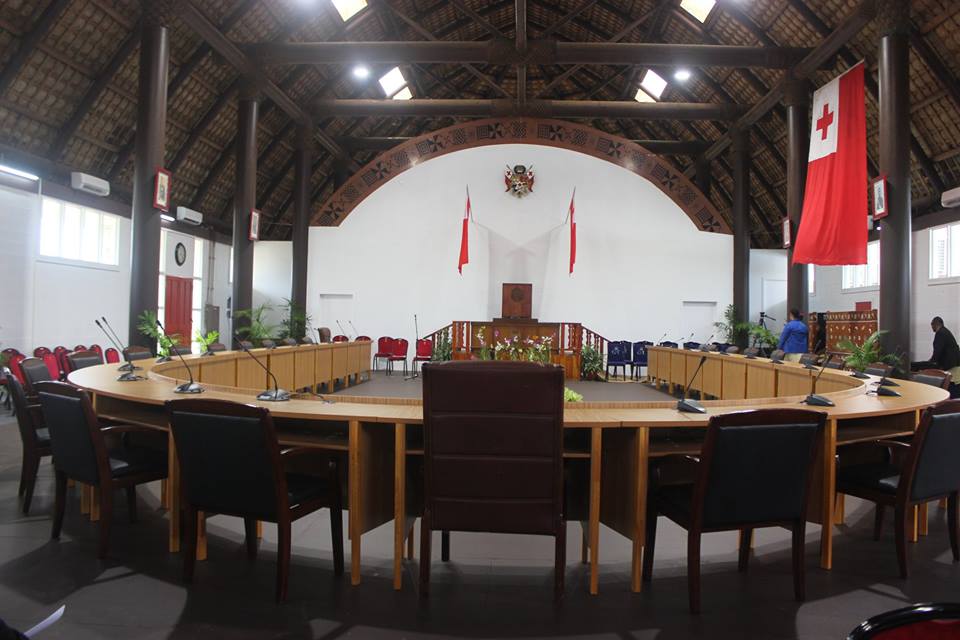
A public debate in Parliament this week rejected a suggestion that the death penalty be used to deter drug offenders.Tonga’s Legislative Assembly at its temporary location in the Tongan National Cultural Centre Photo: VNP / Daniela Maoate-Cox
Tonga has been combatting a growing drug problem for the past several years, leading to the Speaker of Parliament, Lord Fakafanua, calling for a debate on the topic, ‘Capital punishment is the best deterrent for illicit drugs offences.’
But the debaters voted 38 to 8 against the proposal.
RNZ Pacific’s Tonga correspondent Kalafi Moala said the death penalty remains on the law books in Tonga, but has not been applied for more than 40 years.
He said many in the community feel there are alternatives when trying to deal with the drug problem.
“They feel that in dealing with the drugs situation they have many other things that can be a solution rather than trying to bring in capital punishment as a deterrent,” he said.
“For example there is now someone who is serving a life sentence for drugs in Hu’atolitoli Prison, so there was a call ‘why bring back capital punishment if the extreme things happen.”
Former New Zealand prime minister Helen Clark said on X (formerly Twitter): “Death penalty cannot be justified in any circumstances.”
Capital Punishment Justice Project (formerly Reprieve Australia) also raised concern that the Tongan Parliament was debating on the topic, saying “even contemplating [death penalty] is a regressive step for a de facto abolitionist state”.
Moala said the last use of capital punishment in Tonga was in 1982 when three people were hanged for murder.
This is not the first time that capital punished has been suggested as a drug deterrent in the Kingdom.
In 2004, the Tongan Legislative Assembly, prior to the country becoming more democratic, had voted narrowly, 10-7, against a proposal to use it for possession of illicit drugs.
The Tonga Development Bank is trying to reassure its customers after police raided its headquarters and its CEO was sacked.
Tonga Development Bank. Photo/Kalino Lātū (Kaniva Tonga)
It said customers could be fully confident that the bank was financially well positioned and claimed “confidential communications” with the Reserve Bank had been deliberately leaked.
The National Reserve Bank has permanently banned Development Bank CEO ‘Emeline Tuita from holding any position with the TDB.
Any replacement appointment will have to be approved by the Reserve Bank.
In a statement last week the Reserve Bank said the Development Bank had breached the single borrower limit, had a high percentage of non-performing loans, had weak liquidity and was not complying with regulatory directives.
The Reserve Bank said if the Development Bank continued with these practices it would drain the bank’s profitability, threaten the safety of its customers and threaten the financial system.
The Reserve Bank said it no longer had confidence in the Development Bank’s management or board resolving these concerns.
Last Friday, May 24, Police raided the Development Bank.
Police said they were responding to a complaint about an alleged breach of the Banking act. They said it would not say anything further to protect the investigation.
In response, the Development Bank issued a statement reassuring its customers.
“We wish to assure our customers that your investments continue to be safe with TBD,” the bank said.
“TDB has filed legal proceedings against the police on the basis that TDB believes the warrant was obtained and executed unlawfully by the police.
“TDB has dealt with this issue through the proper channels and in a professional manner to ensure Tonga’s only locally owned bank continues to serve the kingdom and its people.”
The Development Bank said its liquid asset ratio was 15%, three times the required minimum.
It said it maintained a risk-weighted capital position of 23%, well above the required 15% minimum.
For more information
Police launch investigation into Tonga Development Bank after complaints
EDITOR’S NOTE: An earlier version of this story said the number of MPs who signed the “Parliamentary Resolution” was 14. The correct number is 18. It also said it was Parliamentary Resolution circular number 58/A-2018. The correct resolution number was 60A/2018.
The names of Tongan MPs who signed the controversial circular letter that approved a pay rise dating back three years to 2018 can now be revealed.
A copy of the Parliament Resolution document number 60A/2018, seen by Kaniva News, which was apparently issued to solicit the MPs’ signatures was dated May 22, 2018.
The document appeared to be an A4 sheet folded in half. One half contained a list of four points describing the requirements which sought the MPs’ approval.
It was signed by the Chief Clerk Gloria Pole’o and it bears two different stamps of the Legislative Assembly.
It suggested that MPs, whose names were listed in a table on the other half of the document tick boxes with labels “loto ki ai” (agreed) or “’ikai loto” (disagree). More boxes were made available beside their respective names for their signatures and dates.
Eighteen MPs who signed the circular were:
Lord Tu’ilakepa
Semisi Kioa Lafu Sika
Pōhiva Tu’i’onetoa
Penisimani Fifita
Semisi Tauelangi Fakahau
Sione Vuna Fa’otusia
Akosita Lavulavu
Lord Tu’ivakano
Lord Vaha’i
Lord Tu’i’afitu
Lord Tu’iha’angana
Lord Nuku
Lord Fusitu’a
Tevita Lavemaau
Mo’ale Finau
Siaosi Ofa Ki Vahafolau Sovaleni
Samiu Kiuta Vaipulu
Vātau Hui
Only one MP who rejected the resolution, signed and ticked disagreed was Losaline Mā’asi.
The rest of the 27 MPs did not sign the document and left the boxes blank. No reason was recorded for why they did not sign.
This included:
Lord Fakafanua
Samuela ‘Akilisi Pōhiva
Mateni Tapueluelu
Saia Ma’u Piukala
Poasi Mataele Tei
Tevita Tu’i Uata
Lord Ma’afu
Veivosa of Life Taka
Secretive approach
Parliament previously told Kaniva News that using the circular to seek MPs’ approval and endorsement outside the Legislative Assembly was a long-standing communication procedure used by the Speaker’s office.
However, after Kaniva News leaked details of the pay hike to the public, it triggered an outrage with many calling it an old-fashioned way of communication that should not be used anymore on matters that required decisions to spend millions of dollars of taxpayers’ money.
Many called the circular “secretive” and said Parliament should no longer use such procedure.
The most recent revelation came after the king called for transparency on government’s spending.
His Majesty also called on Parliament to monitor and check government spending and ensure that the grassroots benefited from all government services and projects.
“Government is answerable to the people who elected them into Parliament,” the king said.
“Parliament needs to monitor how government uses taxpayers’ money in accordance to the law”.
He also asked why the government was operating and managing its Lulutai airlines in “secrecy”.
Court decision
The pay hike has been recently the focus of the Court of Appeal after MP Māteni Tapueluelu fought unsuccessfully to declare it unlawful at the Supreme Court.
The Court of Appeal was told that the resolution approving the pay rise was passed by way of circulars in breach of the Rules of Procedure of the Assembly and Clause 62 of the Constitution.
It was argued that there was no provision in the Rules for the use of circulars and that the resolutions should have been put formally to Parliament via motion by an MP so they could be debated.
MP Tapueluelu argued that as a result the resolutions were unlawful and of no legal effect.
The Speaker and the Legislative Assembly applied for a declaration that the Supreme Court had no jurisdiction in respect of the MP’s claim. They contended that the Court had no jurisdiction to inquire into the internal proceedings of the Assembly and that, to do so, would breach common law privileges of the Assembly.
It was further argued that Clause 90 of the Constitution permitted the Court to inquire into the internal proceedings of the Legislative Assembly only where the Constitution had been breached. It was also argued that Clause 62 of the Constitution had not been breached.
However, as Kaniva News reported on Monday, the Appeal Court released its decision in favour of the Speaker.
It said the Supreme Court had jurisdiction in all cases in law and equity arising under the Constitution and the laws of the Kingdom of Tonga.
There was no justifiable basis for the intervention of the Court. The Assembly was given wide powers under Clause 62(1) to make its own rules for the conduct of its business and the Speaker had been given the primary role of interpreting and applying the Rules whenever any question arose. His decisions were final and it was not for the Courts to function as a form of review.
“Given the constitutional importance of Parliamentary supremacy and the doctrine of the separation of powers, we are satisfied that leave to bring judicial review proceedings in this context should only be given where a compelling case is established to warrant the grant,” the Court was told.








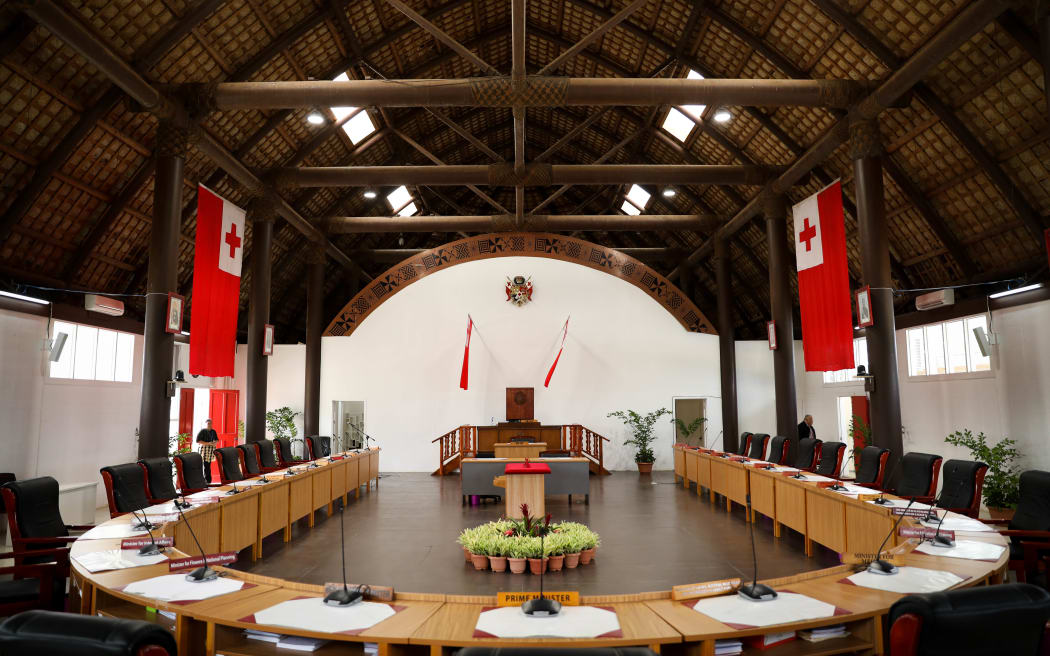 Tonga’s Legislative Assembly at its temporary location in the Tongan National Cultural Centre Photo: VNP / Daniela Maoate-Cox