With King Charles’ real birthday coming late in the year, why does New Zealand still mark the monarch’s birthday in June?
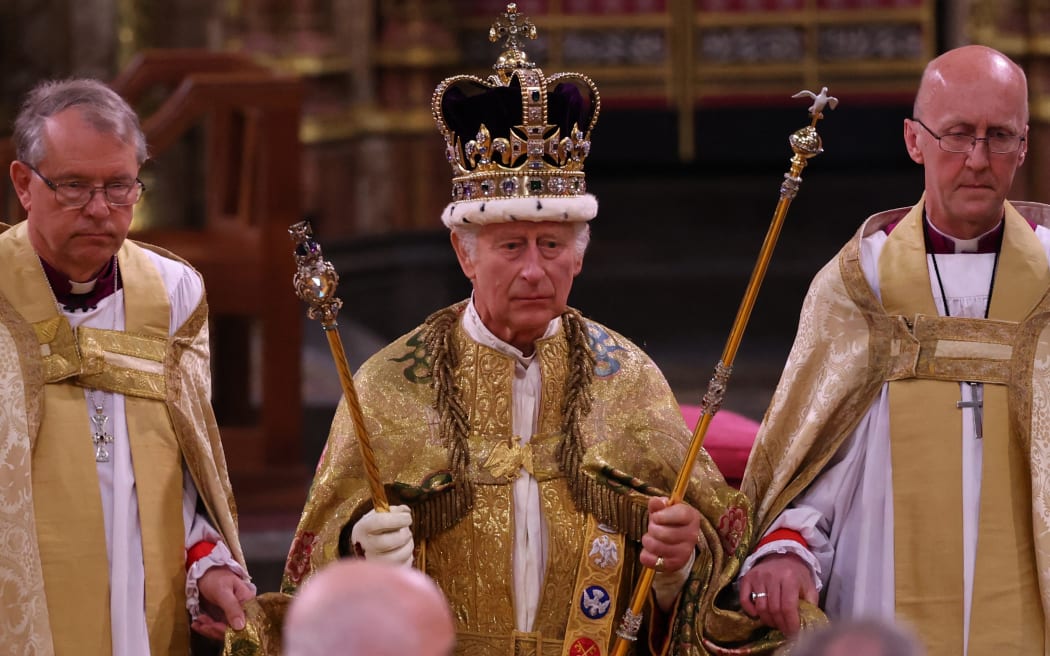
King Charles during his coronation. Photo: RICHARD POHLE / AFP
King Charles will officially celebrate his 75th birthday on 14 November, but now that he has taken the throne he receives the privilege of celebrating his birthday not once, but twice every year.
It was the same with Queen Elizabeth. Queen’s Birthday Weekend was celebrated on the first Monday in June each year, even though the Queen’s birthday was on April 21.
The Department of the Prime Minister and Cabinet were quick to confirm that the timing of the holiday weekend in June, formerly known as Queen’s Birthday, would remain the same under King Charles.
And the reason? Britain’s fickle winter weather.
It is traditional for British monarchs who are not born in summer to celebrate twice, with a second official birthday. Once on their actual date of birth, and then later in the British summer with a grand parade.
The belief is having a summer birthday means a higher chance of good weather during the Trooping the Colour parade, which marks the official celebration for the monarch’s birthday in the UK. Trooping the Colour is held outside Buckingham Palace on a Saturday in early June and has marked the celebration for over 270 years.
The tradition was started by George II in 1748. With a November birthday being too cold for a celebratory parade, he tied his celebrations in with the annual Trooping the Colour military parade.
Summer ‘official’ birthday celebrations were standardised during the reign of Edward VII, who also had a November birthday, according to Royal Museums Greenwich.
In 2022, the Trooping the Colour parade was held on a Thursday to mark the beginning of Queen Elizabeth’s platinum jubilee and UK citizens were given a bank holiday.
This year, the event will not be marked with a bank holiday as the parade returns to its usual scheduling of Saturday, 17 June.
COMMENTARY: The Tongan government should not have granted disgraced politician Etuate Lavulavu a radio license until the verdict in his retrial in the Supreme Court has been handed down.
A new FM Radio Broadcasting License was handed over to Tonga People’s Radio Limited (Ltd) FM 87.1 from the Department of Communications (MEIDECC), on May 29 at MEIDECC’s conference room. Photo/MEIDECC
Lavulavu has been granted a broadcasting license by the government even as he is awaiting a new trial.
The law presumes that everyone is innocent until proven guilty and the Supreme Court has made every effort to ensure that his new trial will be fair.
However, what will happen if he is found guilty and sent back to jail?
Will the government revoke his license? Or will it think it is appropriate to allow a convicted criminal to own a radio station?
The Tongan Government portal recently published a photograph of the Director of the Communications Department, ‘Alifeleti Tu’ihalamaka and others with Lavulavu at a ceremony to hand over a broadcasting license.
The license is for an FM radio station, Tonga People’s Radio Ltd, which Lavulavu jointly owns with Mahealani Kaufusi.
Lavulavu bought the government’s Kalonikali newspaper and was accused of publishing libelous material about former Deputy PM Semisi Sika.
Lavulavu and his wife ‘Akosita, were convicted of corruption and fraud in the Supreme Court and jailed in July 2021. However, that verdict was later overturned by the Court of Appeal and the couple will now face a re-trial on an amended indictment.
Lord Chief Justice Whitten said the charges were serious and there was a powerful public interest in ensuring that they were tried properly, fairly and according to law.
An application by ‘Etuate Lavulavu to strike out his prosecution, claiming it was an abuse of process, was struck out by the Lord Chief Justice on May 19.
Last December, the Supreme Court refused to return a passport to him when he wanted to travel overseas.
This is not the first time that the treatment the Lavulavus have received from government officials has upset the public. There was an outcry in 2021 when the Lavulavus were temporarily released to go home shortly after they were jailed.
Former Prime Minister Tu’ionetoa devoted an enormous amount of time defending former Infrastructure and Tourism Minister ‘Akosita Lavulavu.
The current outcry is something in the same vein and it has occurred because once again government officials have failed to understand that their actions must not only be completely above board at all times, but they must be seen to be that way.
Some members of the public might well think that it was reasonable to grant Lavulavu and his partner a license since he must be presumed innocent until proven guilty and that there is no proof that he will do anything to abuse his license.
However, for the Director of Communications to pose for a photograph on the official government portal was not appropriate. It is difficult to think of any other license owner who has been treated this way.
The problem is that by placing him on a government page with government officials, some people may think that the real purpose of publishing the photo was to rehabilitate Lavulavu and to indicate that he had some level of official support.
It was extremely unfortunate for the Department of Communication to create a situation – however inadvertently – where any members of the public might be tempted to think that the government was acting in a way that contradicted the aims of the judiciary.
If the Lavulavus are to be rehabilitated, that is properly a matter for the Supreme Court, which will either find them not guilty or send them back to jail.
Auckland Mayor Wayne Brown says he did not forward councillors a string of abusive emails that called them “dip shits”, saying they were sent by staff “in a fit of excitement”.
Auckland Mayor Wayne Brown presented his budget proposal at Auckland Transport headquarters on Thursday. Photo: RNZ / Marika Khabazi
“I neither wrote the emails, nor sent them, nor even know my staff had done so in a fit of excitement,” Brown said in a message to the New Zealand Herald today.
His head of communications, Kate Gourdie, backed this up saying “a member of the team that has control of his inbox” sent the email to councillors. She would not name the person responsible.
Attached to the email is a PDF of a collection of 18 critical and insulting comments aimed at councillors who do not support Brown’s budget and the media.
“Can l ask which of the dip s*** councillors are against the sale of the airport? Shame you can’t kick their ass as that’s where there [sic] brains are. Keep up your good work Mayor Brown. Regards Jim,” said one.
The attack on councillors who do not support offloading the airport shares to help plug a $325 million budget hole and keep household rate increases at 6.7 per cent (rate of inflation) has been called a “sign of desperation”, “highly inappropriate” and a “blitzkrieg attack” by stunned councillors.
Waitakere councillor Ken Turner today said that, like himself, Brown blurts out crazy stuff he hasn’t thought through at times, but the mayor is practical and brilliant at times and “has my full support”.
“He’s a disruptor and right now we need a disruptor,” said Turner.
But the first-term councillor said just because he supports the mayor, it doesn’t mean he will vote for everything he says.
Turner does not support the airport sale, saying the clear message coming out of West Auckland is not to sell the shares.
He cited a slip on his road in West Auckland on Monday that brought down the equivalent of 200 six-wheeler truckloads of material that is being moved to north of Waimuku at a cost he believes of $200,000, when it could cost $20,000.
“Selling the shares will release a whole bunch of money and it’s going to be sucked up like a sponge by this sort of unreasonable action. My job is to fix that, not sell the airport shares,” said Turner.
Wayne Walker, one of four councillors Brown called out on Thursday to keep a pledge they signed to hold rates to inflation, said the mayor is not building the collegiality and cooperation he needs to get the budget across the line.
Walker agreed with Turner that the culture of over-spending has to be addressed before considering a sale of the shares and said other alternatives should be looked at, including using a $1.25 billion budget to upgrade and replace assets, known as depreciation, and increasing revenue streams at venues like the zoo and Auckland Art Gallery.
Other councillors singled out were Mike Lee, Christine Fletcher and John Watson, who said the attempt to unleash vitriol on some councillors was distasteful.
“As far as the shares go I’m endeavouring to keep an open mind, but it doesn’t mean just capitulating to the kind of blitzkrieg attack that has been launched with the imperative to sell the shares and very quickly,” Watson said.
“There is a great degree of distrust with the way this has been administered and the contestability of the advice that has been presented.”
Manukau councillor Alf Filipaina from Manukau has said Brown’s action was “a sign of desperation”, adding: “It’s really unbecoming”.
Maungakiekie-Tāmaki councillor Josephine Bartley, who has also been the target of criticism by the mayor, posted an email on social media sent to the mayor with the message “since we’re sharing emails n all”.
The email, from an airport shareholder and airline captain, said “I’m sick to my back teeth of the petulant and childish manner in which you conduct yourself. It’s deeply unbecoming of a holder of such an office.”
Yesterday, Bartley criticised Brown’s way of getting his point across, saying he is just adding noise.
“We’re supposed to make decisions on behalf of our city and this isn’t helping,” she said.
The Auckland Harbour Bridge wobbles when enough people walk on it, to the extent it could result in “serious crushing injuries”.
Photo: Supplied / NZTA
Despite this, the Transport Agency this year organised mass celebratory walks across it – cancelled in March due to weather disruption.
Documents show the agency was told years ago how to fix the wobbles but has not done it.
A crowd of walkers of more than 250 per bridge span sets up a vibration that leads to slight swaying, enough to open and close a gap in the deck 58mm wide, documents released under the Official Information Act to Bike Auckland say.
The 1975 hīkoi land marchers led by Dame Whina Cooper first experienced the wobbles, and another land march in 2004, too – but it was little reported on.
A short smartphone video shows people walking where the clip-on lane joins the other lanes on the west side, exclaiming in surprise as the gap opens and closes beneath their feet.
“It’s terrible,” says one man.
“Is it shaking over there?” another calls out to a girl, who replies, “No, this one feels good.”
“The bridge is about to fall over,” a woman appears to say, laughing.
Shortly after, in May, an internal memo on NZTA letterhead said:
“The opening and closing of the gap at deck level … due to both pedestrian-induced vibration and strong wind events, is a significant pinch-point safety risk to pedestrians and could result in serious crushing injuries.”
Walkers stumbling presented an “extremely high” risk if traffic was using other lanes, it said.
“While structural failure is not anticipated from such resonant vibrations, there is a risk that if left uncontrolled, the vibrations may lead to the box girder banging against the truss deck which could cause some local damage.”
In a separate email, engineers Beca told Waka Kotahi that “any walking path” would require damping on multiple spans.
Cycle advocates engaged in a long struggle to use the harbour bridge expressed scepticism, perceiving this as another excuse for NZTA to keep walkers and cyclists off the bridge.
The video was released in an OIA response to Bike Auckland, which is lobbying for a single outer lane to be devoted to walking and cycling.
Waka Kotahi had told the group that the bridge wobbled for walkers, so it would need strengthening first, said chief biking officer Fiáin d’Leafy.
The OIA information proved devoting a single lane was no threat, they said.
“It will be safe, it will be cheap, it can be done now.”
Richard Young, an independent engineer and keen cyclist who is assessing the practicality of trailing such a lane, said the gap opening and closing “could be quite alarming”.
But “it doesn’t look like there needs to be any strengthening work on the bridge”, he said.
“The bridge only swings when there’s very large numbers, we’re talking thousands of people, crossing on the clip-ons.”
Still, both Young and d’Leafy said the Transport Agency might do well to adopt the simple engineering fix laid out to it back in 2010 to damp down the swaying.
“They seemed to genuinely believe” it needed strengthening, d’Leafy said of NZTA.
In a 2010 investigation, Beca told Waka Kotahi that two “low-to-modest cost” options could fix the problem.
A plan showing how it was recommended to install plastic tanks under the bridge, filled whenever there was a walk, with the liquid sloshing about acting to dampen the vibrations. Source: NZTA report 2010 Photo: Supplied / NZTA
Another option uses other dampers.
This work has not been done.
Subsequently, there have been other protest marches and cycling on the bridge.
In March this year, Waka Kotahi organised a three-day ‘Walk It’ event, with free tickets for 20,000 people a day to walk and bike over it, but called it off due to the storms around that time.
The agency said public safety was the top priority on the bridge.
The march was restricted to 60,000 ticket holders in total, and security guards would have controlled the number of people on each span “to mitigate any risk of bridge movement”, Waka Kotahi told RNZ on Friday.
The May 2022 memo in the OIA said that limiting the number of walkers to 250 per span should prevent the wobbles.
The Auckland Marathon is different, as running does not set off the vibrations.
The second crossing is hugely problematic, having sparked several attempts over the years to get to a solution, only to end in cul-de-sacs after spending millions of dollars.
One attempt was the Skypath, and it crops up in one wobble email.
The Skypath was to have hung on the side of the harbour bridge. It got consent, then was binned.
“The lateral sway induced by synchronous pedestrian footfall at the natural frequency of the bridge has been observed on this bridge several times and is a known issue for the extension bridges,” Beca emailed in March 2022.
“This was one of the key considerations for Skypath and a very high level assessment of possible damper solutions was carried out some years ago [the 2010 investigation].”
Though the bridge’s swaying was little reported here, it got the attention of researchers in Britain in 2001.
Looking into the alarming swaying at London’s Millennium footbridge, they noted the 1975 hīkoi’s experience in Auckland.
Auckland was “particularly significant because it is a large roadbridge with a conventional structure”, compared to two other smaller UK bridges they had looked at.
“In all of the above cases, the phenomenon was not fully researched or analysed, and its occurrence was not widely disseminated within the engineering profession,” the research said.
It concluded synchronous lateral “excitation” could occur on other bridges with a frequency of less than 1.3Hz and “loaded by a sufficient number of pedestrians”.
Public transport advocate Bevan Woodward said yesterday that any talk of injury from swaying on Auckland Harbour Bridge was “hyperbole”.
“This is just one of many, many examples by the Transport Agency to block progress on walking, cycling on the harbour bridge,” he said.
The government and councils will offer a buyout option to property owners whose land is too risky to rebuild on, and co-fund protection works for those who need it.
Grant Robertson Photo: RNZ / Samuel Rillstone
Cyclone Recovery Minister Grant Robertson and Associate Finance Minister Michael Wood announced the move on Thursday afternoon, saying they expected details to be worked through with councils and finalised this month.
Wood said initial indications showed about 700 properties would not be built on again, with up to 10,000 needing additional protection works before homes could be rebuilt.
Indicative estimates were that around 400 of those homes were in Auckland, he said.
“That particularly pertains to homes which are in the flood-affected areas.”
“We have a number of homes in Auckland who [sic] are facing instability issues.”
Hawke’s Bay councils were revealing final decisions on which properties are in the low-risk category from today, and providing estimates of the numbers of higher-risk properties.
Robertson said his understanding was Auckland Council expected to talk to property owners from 12 June.
Tai Rāwhiti councils had already begun contacting some high-risk property owners, Wood said, and would finalise the remainder over coming weeks. Properties in other affected regions like Northland and Wairarapa.
Hundreds of homeowners facing the prospect of rebuilding after Cyclone Gabrielle and the Auckland floods damaged or ruined their homes have been eager to get details from the government on whether they can rebuild on their property.
Robertson at the start of May announced a three-category system would be applied to properties. They include Category 1 “low-risk” which means homeowners can rebuild on the same site; Category 2 “managed risk” where flood management work will need to be done first; and Category 3 “high-risk” areas considered unsafe to rebuild in at all.
This is different to the red- and yellow-sticker system, which only warns whether a property is currently safe to enter or stay in.
Provisional categorisation of managed and high-risk areas suggested more than 2500 Hawke’s Bay properties would need work before rebuilding could begin, and more than 200 would never be built on again – nearly all of them in Hastings.
These would need to be finalised before works could begin.
Robertson on Thursday said the government would work with councils to help build flood protection and other resilience measures to protect the homes designated under Category 2.
“The initial support for this is already in place with $100 million initial funding announced in Budget 2023,” he said. “We cannot meet all the costs, particularly knowing that we will see more extreme weather events like this.
He said the government needed to strike a careful balance between supporting communities and forcing taxpayers to bear the costs.
“But the affected communities can be assured we are committed to making this approach work.”
Those with Category 3 properties would be offered a voluntary buyout by councils, with the costs shared between councils and government. He said decisions on the split of costs and how uninsured properties would be handled would be made in coming weeks.
Robertson said the response had been locally led, with the cyclone taskforce’s risk assessments completed.
“From here the councils will lead engagement with their affected property-owners,” he said. “Today’s announcement will help councils get the right solution in the right place and avoid significant financial hardship for property owners.”
In a statement, Hawke’s Bay mayors Sandra Hazlehurst, Alex Walker, Kirsten Wise and Craig Little and Hawke’s Bay Regional Council chair Hinewai Ormsby said they were pleased with the announcement.
They said it was just the start of the process for some of the most affected areas, but would allow those in low-risk Category 1 areas to “move on with their recovery with confidence, and to move forward with their lives”.
“The reality is that Categories 2 and 3 cover a wide spectrum of scenarios and circumstances, including properties that weren’t damaged because of the cyclone, and we want to work closely with our impacted residents,” they said.
However, they again urged more government funding to support the rebuild.
“All of this important mahi will only be able to progress with strong government support and, although the funding confirmed through Budget 2023 is a step in the right direction, as weve stated before this is significantly less than we need as a region if we’re going to build greater resilience.”
Robertson said the government was also working with commercial sectors and property owners on providing additional support.
A separate process was under way to handle whenua Māori by the Cyclone Response Unit, Te Arawhiti and local councils.
“There are significant complexities and issues with multiple ownership of land,” Robertson said, noting that significant sites like marae and urupa had been affected in some areas.
“We want to work through that in a careful and considered way.”
Robertson had warned in March that although the government expected to have data from a taskforce and insurance companies within weeks, it needed to be collated and compared with council risk assessments for the government to start making decisions from mid-April.
He said at the time the government wanted to make its decisions faster than the four months National took after the Canterbury earthquakes, but also wanted to provide certainty rather than making fast decisions that may need to be re-assessed later.
Decisions on higher-risk properties will however take longer – aiming to be done “as soon as possible” – and Robertson this week said the categories would only be a starting point anyway: Discussions with individual homeowners would be “ongoing”.
Robertson said he wanted to acknowledge how difficult the past few months had been for those affected by the extreme weather events.
“Those families who have been impacted have been carrying with them the trauma of what happened on those days … I want to acknowledge that this has been a tough period of time for them.”
He said both central and local goverment “continues to be with you and stay with you throughout this process”.
“Today is a big day, but there are more big days to come.”
It is shaping up to be a damp weekend over much of the country for the first King’s Birthday weekend.
MetService’s severe weather outlook indicates a period of snowfall on Sunday for South Canterbury and inland Otago. (File image) Photo: RNZ / Tess Brunton
MetService said Saturday appeared to be the best day, and any plans for Sunday onwards should include a raincoat, an umbrella and a check of highway conditions.
Forecaster Clare O’Connor said a front moving up the country from Friday would bring snow to the south and rain.
“No doubt this snow is good news for South Island ski fields with opening weekends fast approaching.”
The North Island could also expect showery weather on Friday and strong winds in places.
Another front arrives on Sunday, with more wet weather set for the North and South Islands.
MetService’s severe weather outlook also indicates a second period of snowfall on Sunday for South Canterbury and inland Otago, with a possibility of snow to lower levels.
“Everyone’s going to get a bit of the wet stuff this weekend,” MetService meterologist John Law told Morning Report.
“For Saturday, most of us should be in for a decent day,” Law said.
“As we head towards Monday, perhaps head down to that western coast of the South Island, they’ve had a bit of wet run recently but for Monday they look like the pick of the spots in New Zealand.”
MetService said the forecast was in line with a wetter than usual outlook for many regions, as was the case for May.
Among the rainfall records which were broken last month, the Hokitika Airport weather station recorded 618.2mm, which was the third-wettest month on record there since records began in 1963.
The trimaran was the brainchild of the late Dr Sitiveni Halapua, a former academic and Member of Parliament.
The project was intended to offer a cheaper, faster alternative for shipping food and cargo to the Niuas.
It was designed to take about 48 hours to sail the more than 600 kilometers to the outer islands from Nuku’alofa, carrying 12 people and two tonnes of cargo.
The wind-powered vessel is undergoing maintenance in Nuku’alofa after it was damaged for the third time since it was launched in New Zealand in 2017.
During Cyclone Harold in April 2020 the powerful wind lifted the trimaran and threw it onto the land where it was rammed into an object like an iron rod.
That damage was assessed in March and April and some people from New Zealand are currently in Tonga to repair it.
The cyclone damage came after a large ship smashed into the 50-foot vessel while it was anchored at the Fāua wharf.
In 2018, after the trimaran returned from a test voyage to the Niuas, the Category 5 tropical cyclone Gita damaged it.
The boat was also robbed and the project managers had to call on the public to return the stolen items, saying they were of no use to anyone who did not own a trimaran.
It was a success
Dr Linitā Manu’atu, a researcher at Auckland University of Technology, said she was confident the $900,000 trimaran project was a success despite the series of mishaps which caused it to be out of service several times.
The boat is compartmentalised, meaning it was designed so that any damage caused to it would be restricted only to that area and not to the whole boat.
Dr Linitā Manu’atu. Photo/Supplied
“That’s one of the very excellent aspects of the artistic design used to construct the trimaran”, Dr Manu’atu, who is a member of the ‘Utuma’atu project organisers, told Kaniva News.
“It was designed to make it difficult to sink”.
She said Dr Halapua had been in contact with Tonga’s Fokololo ‘O e Hau Maritime Poly-Technical Institute in an attempt to create a course to train locals how to navigate sailing ships.
Dr Manu’atu told Kaniva News last week they were advised by experts in New Zealand that qualified navigators of normal ships and larger vessels could not sail the trimaran appropriately.
In 2020 Dr Halapua told media that training new crew was critical factor for the project.
“It is something we don’t have in Tonga and it’s very difficult, extremely difficult, to find young people or people who are interested,” he told Radio New Zealand International.
“So, that’s another thing that I have learned from this project that we have to start teaching young graduates from high school in the arts of sailing.”
Dr Manu’atu said they had approached a number of navigators including a qualified Tongan woman, but the salary she wanted was too high for them.
She said the other option was to employ palagi people to sail the boat, but they wanted to see if the idea of giving locals a formal training would work.
“One of the project’s aims was to establish a training ground for our youth and future generations”, she said.
Dr Manu’atu said the project was also intended to revive the skills of sailing ships.
“We had these skills in the past but they have gone,” she said.
A prototype for the trimaran was acquired after the ‘Utuma’atu was designed.
“So the possibility for more trimarans to sail in Tonga in the near future is already there,” she said.
Dr Manu’atu said when the current maintenance work was completed they would continue looking for a navigator.
She estimated that a salary of a qualified navigator could be around TP$100,000 after they turned down a navigator who wanted TP$60,000 in 2016.
The ‘Utuma’atu was funded through a campaigns organised by the Niua international community and the Halapua family.
The MV Ko e Kelesi Pe
The Niuas are currently served by a recently purchased vessel, the MV Ko e Kelesi Pe.
The passenger and cargo ship has a 469 gross tonnage, is 62 metre long and 11.09 metres wide. It was built in Tokyo in 1998
Dr Manu’atu said the MV Kelesi was a project that was intended to serve large needs for the Niuas. This included sending vehicles, building materials and larger cargo, such as the six 10,000 litre water tanks carried to Niuafo’ou last December.
She said the MV Kelesi was subsidised by the government subsidy while the ‘Utuma’atu was funded by the project management.
A man has been sentenced to a total of 30 months imprisonment after being convicted in the Supreme Court of serious indecent assault on a child.
Lord Chief Justice Whitten ordered that the identity of the complainant and her evidence in the proceedings not be published in the Kingdom.
While Kaniva News is based in Auckland, we are aware that we have many readers in Tonga and will accordingly limit ourselves to an outline of the case.
The court was told the two assaults occurred in November 2018 and February 2019 in a house in Longoteme.
In both cases the man told the complainant not to report the incidents. Shortly after the second incident he moved out of the house where the events had occurred. The complainant told her mother what had happened. Her mother then took her to the police to lodge a complaint.
The defendant first appeared before the Supreme Court on October 8, 2019. He was granted bail on condition that he not leave Tongatapu and was to return to Court on October 22, 2019 for a trial date to be fixed.
However, he did not appear on the 22nd and instead ran away to ‘Eua. It was nearly three years before he was arrested there in September last year.
During his trial the man asserted that it was the complainant who had effectively molested him. He made a similar claim when originally interviewed by police. His version of events was rejected.
“A moment’s reflection on the proposition that a young girl would fabricate complaints of serious indecent assault and put herself and her family through the exposure and risk of humiliation at trial, for no discernible reason or benefit, belies the dishonesty, irrationality, and callousness of the Defendant’s position,” Lord Chief Justice Whitten said.
“[The defendant’s] statement to the probation officer that all he has learned is to not get involved with teenage girls also reflects his lack of remorse. His breach of bail by moving to ‘Eua shortly after arraignment, no doubt seeking to evade justice in this matter also reflects a flagrant disregard for the law.”
In his summing up, Lord Chief Justice Whitten ordered that the final 12 months of his sentence was to be suspended for two years from the date that the man was released from prison on condition that he was placed on probation and completed courses on sexual abuse and domestic violence.
The court was told that the defendant had not honestly co-operated with the authorities, had not shown any remorse and had not apologised to his victim.
There are 94 clickable links of stories on Covid-19 further down below. All these 94 stories were written in English and translated into Tongan before sharing them to our Facebook accounts
The following links will connect you to our Facebook accounts. Please note that when you click each link you will be redirected to either our Facebook group or our community Facebook page. You can only see some of the Covid 19 stories we had shared to the accounts as a result of a search we did under the key word Covid. However, you can do your own search by tying your own key words such as virus or corona virus to find out more stories.
A 30-year-old man has been arrested after another man was allegedly stabbed and received medical treatment at Vaiola hospital on Sunday morning.
Police were called to an address in Ma’ufanga following a report of a man being injured at around 4am.
Police said the incident was spurred by a dispute over alcohol.
“The victim and the suspect were drinking alcohol with others where they got into a dispute, which led to the suspect stabbing the victim on his left thigh with a knife”, Police said.
“The victim remains hospitalised at Vaiola hospital where his wound is being treated.
“Police investigations into the incident continue while the suspect is in remand under a criminal charge for causing bodily harm.
We acknowledge our partnership with the communities to prevent crime. Call 740-1660 or 922 to report a crime”.