The principal of a New Plymouth school which has lost three staff members in a horror crash in Horowhenua says the community is reeling at the news.
Photo: RNZ / Claire Eastham-Farrelly
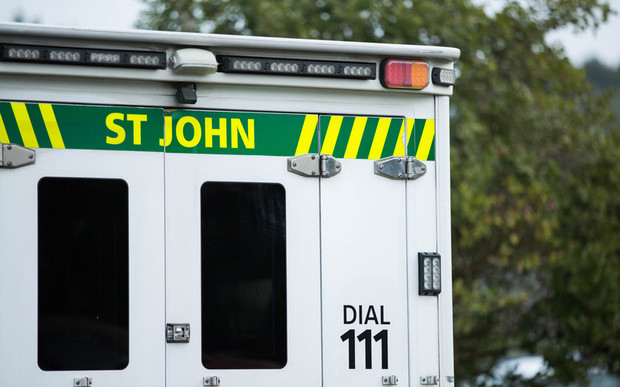
Four people died when a truck and another vehicle collided at Kuku on State Highway 1 just after 3pm Tuesday.
Devon Intermediate principal Jenny Gellen said the school’s caretaker, a teacher aide and a classroom teacher had died in the accident.
“Staff and students and the wider Devon whānau are absolutely shocked.”
Gellen said the three staff members were integral parts of the school community.
“They’re just extremely valued and important members of staff who are going to be really sadly missed by not only at the school community but the whānau, extended whanau and our school community.”
Gellen said the school was getting support from the Ministry of Education trauma team and would stay open today.
“Absolutely we are. We are a community school and it’s an awesome place to actually have our kids supported and our whānau supported at the school.
“This is the kids’ normal and it’s about the kids and the whānau and if we close the children have nowhere to express [their feelings] other than their families – which are really important — but we’re keeping the school open.”
Gellen said the wider Taranaki community had been generous in their support.
“We’ve been inundated with messages and letters of support so just a huge thank you at this really difficult time for the school.”
New Plymouth Principals’ Association co-chair Brigitte Luke said the whole education community was affected by the deaths.
“We’re shocked and deeply saddened and our thoughts go out to the respective whānau at such a tragic time and obviously the school that’s dealing with this.”
She said the impact at Devon Intermediate would be immense.
“Well it’s huge … because it is the sudden loss of three staff members within a school setting in terms of the children, the staff and the wider … it’ll be huge.
“The priority will be ensuring the safety and well being of all mentally and emotionally and spiritually at this point of time.”
Police earlier confirmed the four deaths, and said officers had contacted next of kin.
Officers investigating the crash want to hear from any witnesses, and in particular from anyone on the road at the time who may have dashcam footage.
Central District road policing manager Inspector Ashley Gurney was at the site on Tuesday and described it as a complex and challenging scene.
State Highway 1 was closed in both directions for several hours after the crash.
Horowhenua Mayor Bernie Wanden said the stretch of State Highway 1 between Levin and Ōtaki was a risky and dangerous road that had been the site of numerous accidents.
He said the section of road combined open stretches with bends and bridges that catch drivers out.
Waka Kotahi said it had has planned a number of safety improvements for the stretch of SH1, including wide centre lines, stretches of side barriers and a review of speeds.
Work was scheduled to begin on this in mid-2022, but the transport agency was looking at bringing that forward.
There have been 147 new cases of Covid-19 reported in the community today – including 14 in Waikato – with another death of someone with Covid-19 who was isolating at home.
Photo: AFP
The Ministry of Health said 63 of today’s cases are yet to be linked. The suburbs of interest in Auckland are Ranui, Sunnyvale, Kelston, Birkdale, Manurewa and Māngere.
At today’s Covid-19 briefing, Director-General of Health Dr Ashley Bloomfield reported the sudden death of a man in his 60s who had Covid-19 and was isolating at a home in Glen Eden.
“The cause of his death will be determined by the coroner, including whether it may have been Covid-19 related.
“This is a sad reminder that Covid-19 is potentially very serious – and fatal – if you’re not vaccinated.”
He said any Covid-19 deaths would be looked into fully, whether they happened in a hospital or at home.
“We’re looking back at each of these deaths to see what was the level of interaction, exactly what happened in those cases, was there any problem with the clinical assessment and also the clinical handover – there’s nothing to suggest so yet and the third one which came in overnight, we don’t have detail on but we’ll look at any opportunity to improve both the initial assessment and the allocation of someone, but also how the system is working.”
He said pulse oximeters were also being used to monitor those who might need more help “because some people can deteriorate quite quickly even if they have a history of being well”.
Of the 14 new cases in Waikato being reported today, 10 are from Ôtorohanga – including six people in one household who are known contacts – three from Hamilton and one from Ngâruawâhia.
There were also two new cases to report in Northland, both in the same household in Dargaville, with links to known cases.
“One of the cases is a child, which highlights the importance of getting vaccinated to protect our tamariki who aren’t yet eligible to get the vaccine. The more of us who are vaccinated in our community, the greater our immunity.”
There are 81 people with Covid-19 in hospital, including 11 in intensive care.
Dr Bloomfield said there were more than 1700 hospital beds across Auckland and more than 100 ICU beds.
“Hospitals in Auckland will have and do have capacity – so anyone who needs care for any reason, do not delay in seeking it. The hospitals are safe.”
There were also two cases reported in managed isolation today.
There have been 4813 cases in the current community outbreak and 7561 since the pandemic began. The seven-day rolling average of community cases is 154.
There were 22,178 Covid-19 vaccine doses given yesterday, made up of 5,103 first doses and 16,089 second doses. The Ministry said 89 percent of New Zealanders aged over 12 years have had their first dose and 79 percent are fully vaccinated.
On Tuesday there were 125 new community cases, and of those 117 were in Auckland, two were in Waikato and six in Northland.
Dr Bloomfield also said today the Ministry was changing the way Covid-19 deaths would be reported.
“The clinical criteria will continue to be guided by WHO definition which is basically to report any death where the person had an acute Covid-19 infection regardless of what the cause of death might be.
“We will be now publicly reporting confirmed deaths as those where the death documents or an investigation has shown that the cause was Covid-19 and we will report other deaths where the cause of death is not certain but the person has Covid-19. We will report them separately, and the latter group will be classified as ‘under investigation’ while we await further information from clinicians or a coroner’s follow up.”
The mood within the country, however, is very different. No doubt there is abundant fear, but this has centred on the vaccine itself.
Many Papua New Guineans have access to the vaccine, even in some of the remotest corners of the country. They are also fully familiar with injected medicines and vaccinations against diseases like polio and measles.
But millions of Papua New Guineans are not getting vaccinated against Covid because they are terrified of this specific vaccine. This is not “vaccine hesitancy”, but full-blown opposition, a genuine antipathy.
So, why is there such a fierce resistance to the Covid vaccine? The key difference, as any good anthropologist will tell you, is cultural context.
Spiritual sickness
Any attempt to understand local views on the Covid vaccine must first appreciate that, within Melanesian societies, physicality is intimately connected to morality and spirituality. Because of this, biomedical explanations for disease are usually secondary to other causes or irrelevant.
This is mainly due to the small, sometimes non-existent role played by government education in the lives of most Papua New Guineans, especially the roughly 80 percent that live in rural villages.
For example, should an otherwise healthy person suddenly become ill and die, sorcery or witchcraft may be deemed the cause. Accusations are linked to interpersonal conflicts and jealousies that may have precipitated the mystical assault.
Such interpretations usually occur with individual misfortunes – not much larger events like a global pandemic. This is where Christianity becomes hugely important, making sense of broader problems like this.
The role of Christianity
Nearly all Papua New Guineans (99.2 percent) are Christian. And the religious landscape in the country is powerfully influenced by Pentecostal and evangelical churches.
In PNG, Christianity provides not only the promise of eternal salvation, but biblically inscribed frameworks and prophetic ideas that inform how people live and view the world around them.
Many Christians, especially those believing in the Pentecostal and evangelical traditions, have a strong interest in the end of the world, as this signals the return of Jesus Christ.
Crucially, the imminent return of Christ is heralded by the world’s rapid moral decline and humanity being branded with the mark of the beast – a process mandated by Satan. As such, many Papua New Guinea Christians continuously and fearfully scan the horizon for this definitive sign.
Photo: Supplied/ PNG Department of Health
Years ago, some Papua New Guinean friends declared barcodes were the mark. More recently, they insisted it was the government’s national ID card initiative. Now, in a completely different order of magnitude and intensity, it is the Covid vaccine.
As one group protesting a vaccine drive recently chanted, “Karim 666 chip goh!”, or “Get out of here with Satan’s microchip”.
From this perspective, the vaccine is a vehicle for much larger forces of global and cosmic tyranny. The speed with which the vaccine was developed, its global reach, and the apparent coercion of vaccine mandates all further strengthen suspicions of its evil origins.
However, Christianity is not the sole factor spurring anti-vaccination sentiment. Indeed, powerful misinformation on social media has also been influential, such as rumours the vaccine carries a microchip or commonly causes death. People also have a well-founded distrust of outsiders, and they view both the virus and vaccine as foreign assaults on PNG’s sovereignty.
In the absence of Western biomedical knowledge or a lack of faith in its validity, these theories flourish. Those with more sustained exposure to Western culture often try in vain to convince their compatriots against this kind of thinking.
Alternative treatments
While defiantly resisting vaccination, many Papua New Guineans nonetheless acknowledge Covid-19 is real and that it causes sickness.
With infection rates, hospital admissions, and deaths now surging, it would be hard to ignore this reality. The rising Covid-19 mortality across the country has scared some into receiving the vaccine, but even those open to vaccination are easily spooked by rumours of subsequent death.
In the absence of vaccinations, Papua New Guineans have turned to three main methods of treatment: prayer and healing, organic remedies, and reliance on a claimed strong natural immunity to disease.
As Christians strongly influenced by the evangelical and Pentecostal traditions, many people pray to God, Jesus, and the Holy Spirit to not just mitigate, but annihilate, the evil sickness.
In addition, many are turning to organic traditional remedies to ward off illness. This mainly consists of spices and leaves used in drinks and steaming.
Finally, there is a strongly held belief that Papua New Guineans possess an intrinsically strong immune system, buttressed by a diet of garden food, which makes them more resistant to the incursion of the Covid virus.
What can the authorities do?
For most westerners, vaccines are an obvious and intrinsic good. For many Papua New Guineans, vaccines are a dangerous, unknown, and sinister threat. This is due to a combination of forces – governmental neglect, strong religiosity, and a justified distrust of outsiders.
This local position needs to be very sensitively understood and respected, not dismissed or criticised.
At the same time, deaths must be prevented and the thick fog of opposition surrounding the vaccine must be dissipated. But how?
Detailed information about the vaccine, including its creation, contents, efficacy, and potential side effects, must be made fully known to people before asking them to be vaccinated. Insisting a population with minimal information be vaccinated is not ethical or fair.
Likely in response to the widespread apocalyptic interpretations of the vaccine, the PNG Council of Churches is now actively promoting its safety and benefits. The government also needs to step up its efforts and commit to a nationwide educational campaign if hopes for substantial vaccine uptake are ever to be realised.
The success of the whole endeavour – and steering Papua New Guinea away from a public health catastrophe – will likely turn on persuading ordinary people the vaccine is a divine blessing and not a Satanic curse.
* Fraser Macdonald is a senior lecturer in anthropology at the University of Waikato
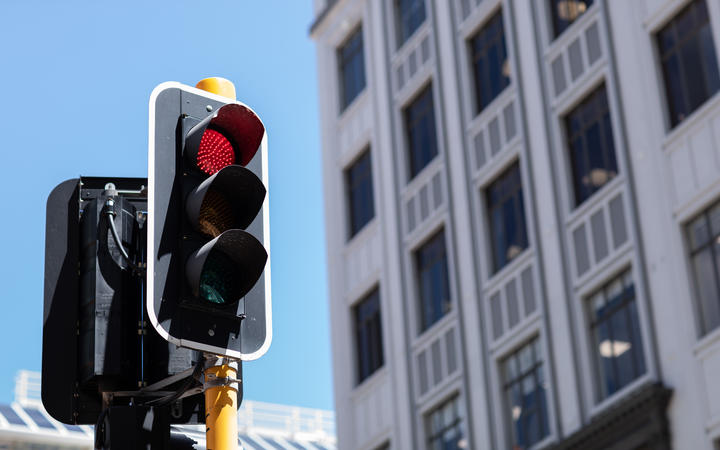
Aucklanders have been all but promised more freedoms from the end of the month, with a move to the new traffic light system.
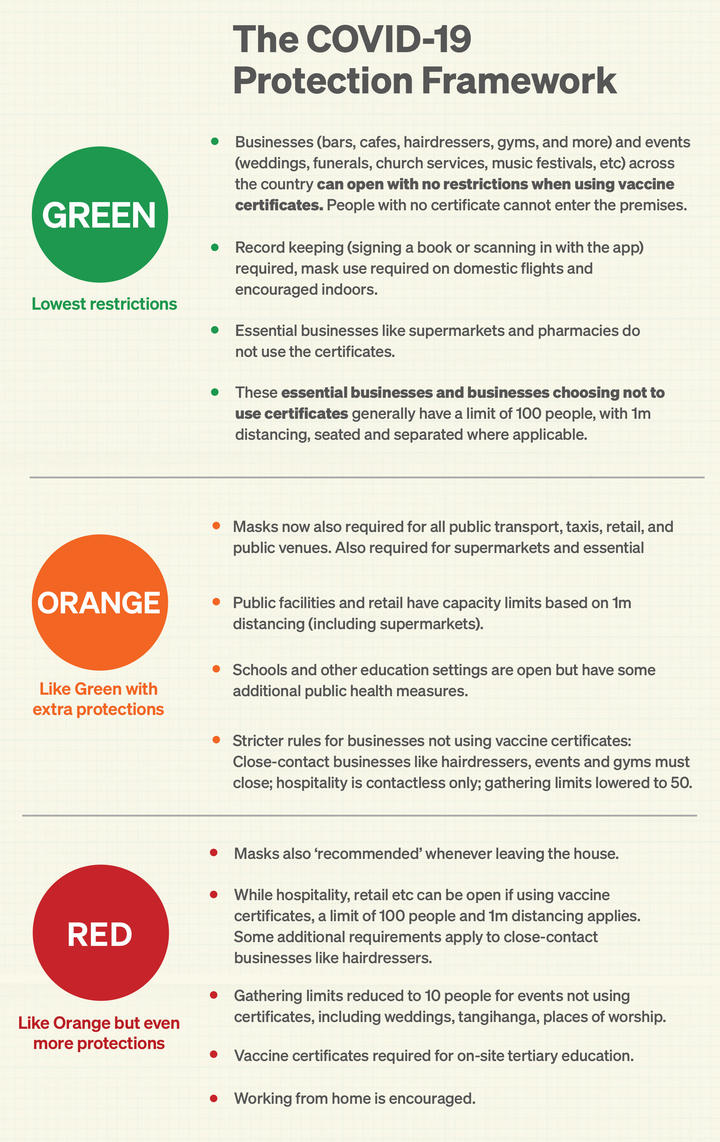
The Covid-19 Protection Framework starts with ‘red’ when retail opens with capacity limits based on 1 metre distancing. Photo: RNZ / Samuel Rillstone
The region is ticking off two milestones this week, with 90 percent in all its DHBs having had their first dose of the vaccine, and a moves to level 3 step 2 from midnight.
Many cafes have remained closed during Auckland’s lockdown, including Remedy Coffee opposite the Civic Theatre on Wellesley Street.
O’Hanlon said he would re-open this week for takeaways but was banking on being able to welcome customers back to tables from December.
“There’s only so much turnover you’re going to get, the city’s a ghost town at the moment. I can’t see too many more people coming back to the CBD just because the shops are open, maybe at the weekend but not during the week.
“I think people will be hesitant until – fingers crossed – the first of December reopening day when the vaccines are in place and everyone’s on board.”
Under the traffic light system, even at the most restrictive ‘red’ level, hospitality and other businesses can open with vaccine certificates, number limits and distancing. For the unvaccinated though, heavy restrictions remain.
Auckland hairdresser Simone Jones is on the board of Hair and Barber and said there was some uncertainty in the leap into the new system.
“To go from nothing to the red light system in a day is not going to give us enough time.
“I’ve had salon owners calling me today to say ‘what should we do, should we start booking our clients in from the first of December or should we do it from the end of November what do you think?’ And I really don’t know.”
“It sounds really stupid but a day makes a huge difference to us.”
Auckland resident Rose, a hospitality worker, is hoping for the new eased restrictions.
“It definitely feels like we are ready for it and it means the businesses can prepare for the opening. It gives us a little bit of a push to get ready.”
For another Auckland resident, Michael, now was the time to “wind back the extreme measures” given the high vaccination rate.
Business is not expected to pick up in the city until thousands of office workers and domestic travellers return, which could be next year.
Photo: RNZ / Vinay Ranchhod
Auckland business association Heart of the City chief executive Viv Beck said a move to red was unlikely to bring people back in droves, and it would not be until the traffic light system reached green that things would really change.
“We’re hoping to get from, say, $3.5 million revenue a week to $10m – that would be a step up. But that’s still around 60 percent down on our normal level so that’s a big impact.”
Beck wanted clarity on how the period in ‘red’ would be managed; on support for businesses, plans to re-activate the city, and what would happen with MIQ and the border domestically and internationally.
“Businesses will need that because it’s going to be a long haul for them.”
By Rowan Quinn of RNZ.co.nz. Republished with permission.
The government is being urged to put the brakes on letting Aucklanders hit the shops this week, as case numbers soar.
It will confirm after its Cabinet meeting today whether to go ahead as planned and allow shops to open and increase the outdoor gathering limit to 25.
But with 319 new cases over the weekend, and more than 1000 in the past seven days, health experts fear daily numbers cases could hit 1000 a day by Christmas if the spread is allowed to escalate further.
Public health lecturer Collin Tukuitonga said it was not the right time to ease restrictions.
“The outbreak could explode and spin out of control,” he said.
Covid modeller Shaun Hendy agreed, saying the virus was outpacing the vaccinations designed to slow it down.
The gains from the roll-out were being eaten away at by the loosening of restrictions – and possibly by a lack of compliance from some lockdown-weary Aucklanders, he said.
It was possible, with fewer restrictions, for daily case numbers to keep doubling every fortnight or so, getting to four figures in December.
But modelling was difficult with so many factors and it was possible the outbreak could peak as early as two weeks’ time if there were tight controls, he said.
A loosening of restrictions would mean more cases and more serious illness – there were already a record 74 people in hospital.
“We’re starting to get to the point where we will be putting severe strain on hospital beds and staffing capacity so we do need to put the breaks on at this point and have a rethink or we could be facing a much worse scenario,” he said.
All the experts said they understood Aucklanders were over it and that put the government in a tricky situation.
Public health lecturer Collin Tukuitonga says the outbreak could ‘spin out of control’ if restrictions are eased Photo: supplied by University of Auckland
The National Māori Pandemic group Te Rōpu Whakakaupapa Urutā co-leader Sue Crengle said the government brought in level 3 too early and should avoid the same mistake.
“Being in lockdown is hard and so people are getting weary of it. We understand that there are those other political considerations that the government has to take into account but we still think we need to stick to the science – just for a little bit longer,” she said.
The Urutā group had wanted level 4 in place for longer, hoping to avoid more cases and a drawn out lockdown.
Māori now made up about half of all cases.
Coupled with low vaccination rates, they were now the most vulnerable to getting sick if the current controls were loosened, she said.
Just a few more weeks were needed to improve Māori immunisation, with Māori-led vaccinators catching up fast, she said.
Ministry of Health figures showed signs the system was already under strain.
The vast majority of the 2564 people currently with Covid were at home – only 401 were either in quarantine or hospital.
But the ministry said it was supporting only 816 of them to isolate at home – leaving a question mark over who was overseeing more than 1300 others.
Dr Tukuitonga said so many self-isolating people was risky for the patients in terms of making sure everyone got good care, but also for their families who could catch the virus.
And there was the added risk that some people may not understand or follow the self isolation rules, he said.
Experts said if Māori rates were lifted, and restrictions stayed in place a little longer, that would allow the roll-out to have the best chance to cut cases and save lives.
By Louise Ternouth of RNZ.co.nz. Republished with permission.
First doses in the Counties Manukau DHB ticked over to 90 percent yesterday – joining the other two Auckland DHBs.
Photo: RNZ / Simon Rogers
If all return for their second jab, in three weeks Auckland could move to the new traffic light system and the freedoms that come with it, just in time for the Prime Minister’s planned check-in on the cities vaccine rates.
But getting Counties Manukau DHB to 90 percent first doses had not been easy.
Manurewa Papakura ward Councillor Daniel Newman has being going door to door getting people on board.
The first jab was just the first hurdle, he said.
“We’ve got nearly 10 percent of our population have got a first jab, but are yet to get the second dose. That is nearly 50,000 people in Counties Manukau. That is a huge challenge. We’ve got a long, long way to go.”
He would be back knocking on doors to make sure people return for the second.
“We’re having to being on the same doors several times over and that will continue for as long as it takes to get people to the point where we have good protection against Covid-19.”
Newman told Checkpoint more vaccine events were needed.
That was echoed by the CEO of South Seas healthcare Lemalu Silao Vaisola-Sefo, who said it would be more work for their South Auckland community to reach the 90 percent double dose target.
“It’s getting harder to you know, just to put up a pop up in and for people to expect people to come through. So we reached out to our church ministers and co-ordinators from churches, and they just they organise their own people so they reach out to their groups, youth and you know, make it a bit more of a competition amongst churches in sports clubs.”
That worked in the past with drive through events like Rally Your Village giving out over 7000 vaccines over five days in October.
Lemalu said it was important to make it less about the vaccine and provide incentives for people to come through.
But he was less worried about the general population in Auckland reaching 90 percent double dosed and more worried about pasifika rates which are sitting at around 72 percent fully vaccinated.
“We are slowly moving up in the right direction in terms of Pasifika, it’s just it’s gonna require a wee bit more work to be honest. Our priority is we’re not gonna stop at 90 percent so we’re gonna have to keep going. I guess the thing that’s not on our side is time.”
In Waitematā – 92 percent of people have had the first dose, whilst 83 percent have had their second.
Te Whānau o Waipareira Trust has delivered more than 120,000 vaccinations since the roll out began in April.
CEO John Tamihere said mixed messages about when second doses should be has caused confusion.
“People then started reading into it, the longer you wait for your second jab, the better. They’re taking their time because they don’t believe that the second one needs to be taken you know, when times up.”
He told Checkpoint it was often a guessing game working out who was coming back – making it difficult for providers juggling appointments and preparing vaccines.
There needed to be more effort to make it clear anyone who had reached three weeks since their first dose should not delay their second, he said.
But he was confident if they could get to 90 percent first doses, they would get to 90 percent fully vaccinated.
There is now a three week wait to find out if Auckland is moving to the traffic light system – with Cabinet set to check in on the settings on the 29 November just as all those recently jabbed should be getting their second.
The government expects Auckland to move to the traffic light system later this month.
Prime Minister Jacinda Ardern said at the post-Cabinet media briefing this afternoon that Auckland is oncourse to move after the 29 November check-in.
Cabinet is due to meet that day to approve the decision.
“Moving to the new framework at that time will mean certainty for Auckland. It will mean all businesses can be open and operate, it will mean we will manage Covid safely, but differently,” she said.
She said daily cases will grow but this is not the only consideration, with hospitalisation and intensive care usage becoming more important.
Asked if the 29 November date is when Auckland can expect to move or it would be some days after the decision, Ardern said Cabinet is aware of the pressures in Auckland and will be looking to move quickly, and will be pragmatic about it.
The prime minister has also announced that Auckland will move to alert level 3, step 2 from 11.59pm tomorrow.
There have been 190 new community cases reported in New Zealand today, with 182 in Auckland, seven in Waikato and one in Northland.
Photo: RNZ / Nate McKinnon
There was no media conference today. In a statement, the Ministry of Health said 110 of today’s cases are yet to be linked.
The ministry also said that a person in their late 60s died in Auckland City Hospital on Saturday.
The patient was admitted to hospital on 23 October for a trauma incident and tested positive on admission, it said.
“The cause of the person’s death will be determined by the coroner, including whether it may have been Covid-19 related.
“Our thoughts are with the patient’s whānau and friends at this deeply sad time.”
The ministry said the person’s death has not been officially reported as it is still under investigation.
There are 81 people in hospital today.
On today’s cases, the ministry said two are border-related and are on board a bulk carrier vessel which recently arrived in in Bluff from Malaysia.
“These two cases are being investigated as likely historical cases.
“The crew members were tested as part of the process for allowing a crew member to depart the vessel and fly home on compassionate grounds. All crew members remain aboard the vessel.
“Testing of the 23 crew has identified two weak positive cases. The bulk of the crew are vaccinated. None of the crew have symptoms or have reported a recent illness during the voyage.”
Results from repeat testing are expected tomorrow, it said.
Cabinet is meeting today and Prime Minister Jacinda Ardern will have a press conference at 4pm to announce future changes on Auckland and Northland’s alert levels. Auckland is in its 83rd day of level 4 or level 3 lockdown.
Watermelons from Tonga are now ready at some dairies in Auckland with Tongan customers quipping about buying them only because they wanted to help the growers but the prices were too high.
Tongan watermelons sold at Central Fruit Shop, Massey Rd, Māngere. Photo/Kaniva Tonga
The eye-watering price of NZ$55 melons with some at NZ$40s were being sold at the Central Fruit Shop at Massey Rd in Māngere.
It was the same size which was sold in Tonga for around TOP$15 each. Last week some watermelons were sold at $10 a 60L plastic bag in the kingdom.
Meanwhile, food costs have risen strongly on the back of a seasonal surge in fruit and vegetable prices in New Zealand.
“Notable rises were for tomatoes, cucumbers, lettuce, broccoli, and capsicums, which peaked at a record $24.16 a kilo”, Newshub reported in July.
The arrivals of the watermelons in Auckland came after New Zealand authority issued Tongan exporters a temporary approval permit, allowing them to send watermelons to the country under special conditions in December.
The issuance provisionally lifted the suspension of such produce which came after the discovery of live fruit fly at the New Zealand border in a shipment of Tongan watermelons in October 2020.
Tonga has lifted almost all of its coronavirus restrictions after reporting all health workers and airport employees working on front-line were tested negative.
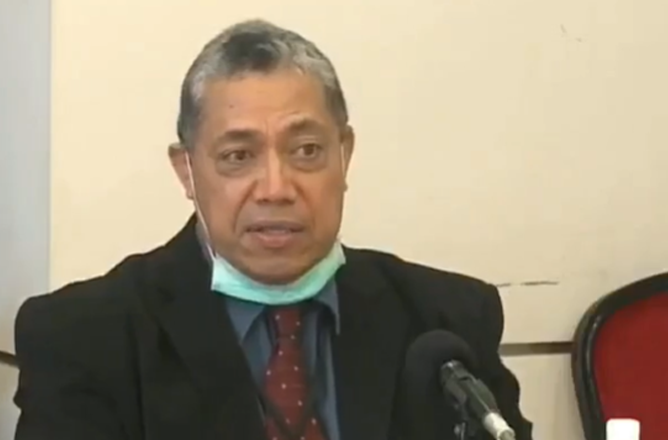
Health CEO Dr Siale ‘Akau’ola
At 11.59 pm tonight local time, all of Tongatapu main island moved to what could be a level two, the second to lowest of a four-tier alert system being used in New Zealand.
In announcing the lift the Prime Minister said the government after receiving advice from the Ministry of Health and Covid-19 National Committee agreed to lift the one-week restrictions because the front-line workers were cleared in their test.
Police Commissioner Lord Fielakepa said the state of emergency which was previously renewed for another month to prevent the spread of COVID-19 would remain in force.
Tongan health workers and airports employees working on front-line were cleared after tests showed they no longer posed a Covid risk, Dr ‘Akau’ofa told a press conference this afternoon attended by the Prime Minister and a team of government officials.
They had been tested to make sure they did not breach the aircraft safety when the flight arrived in Tonga on October 27, Dr ‘Akau’ola said.
He said the series of tests recently carried out on the suspected case showed it was a historical case.
Analysis of data from a series of test results showed the patient arrived in Tonga without infection, Dr ‘Akau’ola said.
“It was not a new infection”, Dr ‘Akau’ola said.
He confirmed the patient was tested positive in Tonga. He previously said it was a “weak positive case”.
Since Tonga was still safe the Ministry treated him as a new case.
He will remain at the Mu’a MIQ until his initial 21-day quarantine was over.
Last week he said the person was tested positive the week before and tested negative on Monday last week.
The Health Ministry chief executive Siale ‘Akau’ola said on Friday the person had recorded a very weak positive result which likely reflects a historical infection.
He described the second positive result as “weaker than the first weak positive result”.

 Opinion – Only
 A Flourish data visualization