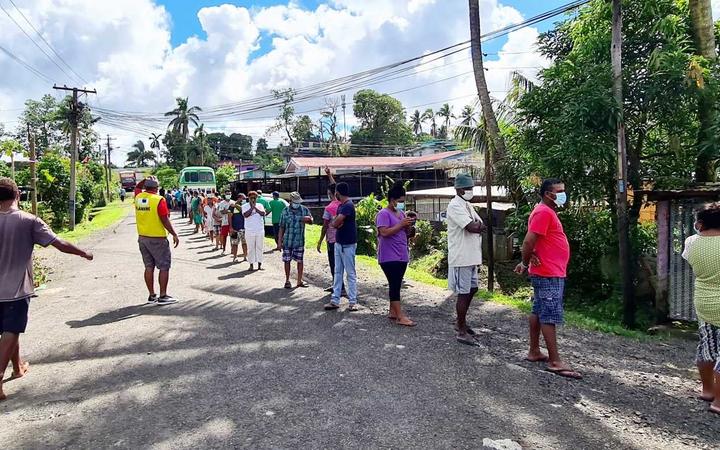
By One News/TVNZ and is republished with permission
A health worker who recently gave birth is among nine people who died from Covid-19 in Fiji.
Source: 1 NEWS
The government also confirmed 626 new cases of Covid-19 for the last 24 hours to 8am yesterday.
That compares to 684 infections and five deaths in the previous 24-hour period.
Health Secretary Doctor James Fong said the 44-year-old pregnant woman from Suva presented to a medical facility on July 16 with shortness of breath and chest pain.
She was taken by a medical team to the Colonial War Memorial Hospital and was assessed by specialists, he said.
“Her baby was safely delivered by emergency Caesarean section two days later. Sadly, her condition worsened and she died five days after admission on 21 July,” Dr Fong said.
READ MORE
Fijian settlement reeling from Covid-19’s devastating impact
The other victims are:
* A 72-year-old man from Muanikoso in Nasinu who died at home on 23 July.
* A 50-year-old man from Suva died at home on 25 July.
* A 61-year-old woman from Tacirua presented to a health facility in severe respiratory distress. She was taken to the Colonial War Memorial Hospital. Her condition worsened and she died 11 days after admission on 24 July. Her family reported that she had a cough, fever, shortness of breath and a reduced appetite one week prior to her going to the health centre.
* A 62-year-old man from Suva died at home on 24 July.
* A 60-year-old woman from Vatuwaqa in Suva also died at home on 24 July.
* A 75-year-old man from Nausori presented to a medical facility in severe respiratory distress on 24 July. His condition worsened and he died on the same day.
* A 74-year-old man from Nasova in Suva died at home on 24 July.
* A 53-year-old man from Naitasiri died at home on 23 July.
Dr Fong said 79 cases of the latest Covid patients are from the western division while the rest are from the Central Division.
Seven other people who tested positive to Covid-19 had died however Dr Fong said their deaths were not caused by the virus but due to “serious pre-existing medical conditions”.
“There have now been 186 deaths due to Covid-19 in Fiji, with 184 of these during the outbreak that started in April this year,” Dr Fong said.
“The ministry also has recorded 94 positive patients died from the serious medical conditions that they had before they contracted Covid-19 and these were not classified as caused by the virus.”
Meanwhile, Dr Fong said some people are more focused on undermining the ministry’s efforts to combat Covid-19.
His comments come amid a video that surfaced on social media recently, which showed how dead bodies were being kept at the country’s main hospital, the Colonial War Memorial Hospital’s temporary morgue.
The video showed a container located outside the mortuary full of dead bodies.
“Fortunately, together with our private sector partners, we have expanded our morgue space to address this issue,” Dr Fong said.
“This supportive effort by Suva Morgue Services highlights the positive spirit that is well appreciated by the Ministry of Health and Medical Services.”
He said there was group tasked by the ministry to facilitate funerals of Covid patients.
Dr Fong said the seven-day average of new cases per day is 1046 or 1182 cases per million population per day.
He said with the high numbers of new daily cases, the ministry was also seeing increasing cases of severe disease and deaths.
Fiji now has over 17,000 active cases in isolation.
This story appears on RNZ.co.nz. RNZ reports are republished by Kaniva Tonga in partnership.
Young people are at “considerable risk” from the Delta variant of Covid-19, an expert warned after the death of a Sydney woman in her 30s.
The woman, from the Sydney CBD, had no pre-existing conditions. She died at Royal Prince Alfred Hospital overnight.
A woman in her 70s from south-west Sydney also died at Campbelltown Hospital.
There have been eight Covid-related deaths in NSW during this current outbreak.
Nobel Prize-winning immunity and infection expert Peter Doherty said Covid-19 was much less a disease of the elderly than had previously been the case.
“It’s very sad that a young woman should die from Covid, or from anything for that matter,” Doherty said.
“But I think it highlights that particularly this Delta variant that’s circulating now is really quite problematic in younger people.
“The message is that young people are at considerable risk and at higher risk than with the earlier variants of Covid.
“Young people shouldn’t think they’re at no risk or even minimal risks. Because it’s going to kill.”
New South Wales Premier Gladys Berejiklian warned young people could fall victim to the “cruel disease”.
“If anybody thinks this is a disease just affecting older people, please think again,” she said.
“Again, I want to extend my heartfelt condolences to those families, their loved ones who are grieving today, but please note that younger people without pre-existing conditions can also fall victim to this cruel disease.”
Thirty-eight of the new cases were in the community while infectious and a further 24 cases were in the community for part of their infectious period.
NSW Health’s Jeremy McAnulty said a teenager was one of 43 people currently in intensive care in NSW.
He said of 43 people in intensive care, one was a teenager, seven were in their 20s, three were in their 30s, 14 were in their 50s, 12 were in their 60s and six were in their 70s.
“So this is affecting people of all ages with very serious disease,” Dr McAnulty said.
Professor Doherty warned that patients would “never be the same” after leaving intensive care.
“After you’ve been hospitalised and in ICU, and you’ve had a lot of damage, probably heart and lung damage, and so forth, your life will never be the same,” he said.
The president of the NSW Australian Medical Association said the death of the woman in her 30s was a “really strong reminder” of how serious an illness Covid-19 was.
“Any death from Covid-19 is tragic, and particularly one of someone taken so young, I think is a really strong reminder to all of us that Covid-19 is a serious illness,” Danielle McMullen said.
“We know it’s been really hard on young people, I’ve had lots of feedback from younger patients that they’re really keen to get vaccinated.
“And it’s been frustrating that those who know that they can be affected by Covid haven’t had access to a vaccine.”
Dr McMullen urged young people to consider asking for the AstraZenica vaccine.
“I think it’s important that people have that discussion with their GP who they trust to work through the pros and cons and come up with the best decision on an individual basis.”
Several leading opposition politicians in Fiji have been arrested following their criticism of government moves to amend land legislation.
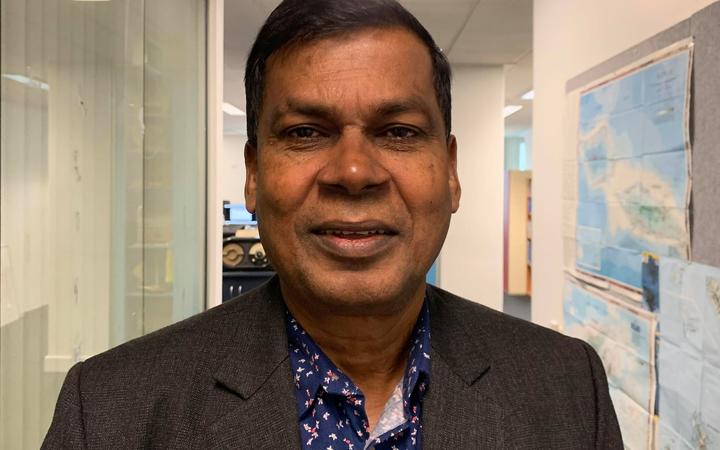
The deputy leader of the opposition in Fiji and NFP president Biman Prasad. Photo: RNZ Pacific/ Koroi Hawkins
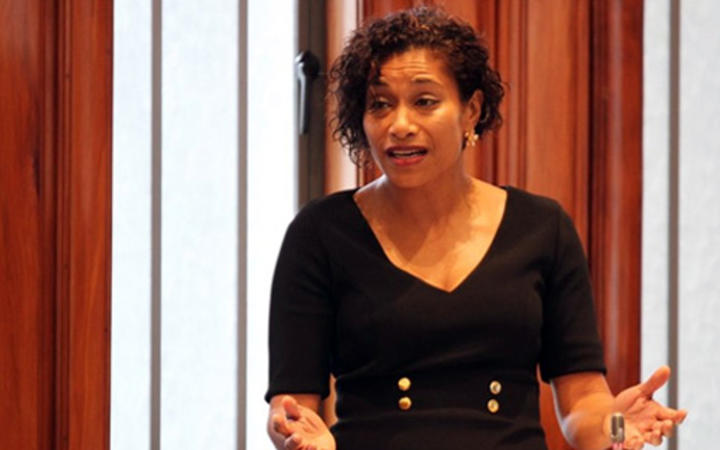
The National Federation Party leader Professor Biman Prasad, Sodelpa Party MPs Lynda Tabuya and Adi Litia Qionibaravi, as well as former prime minister Sitiveni Rabuka, were among those taken in by police in Suva today.
It was confirmed to local media by Acting Police Commissioner Rusiate Tudravu, and reported by some of the MPs themselves on social media.
En route to the police station, Prasad posted on Facebook that he was wanted in relation to his party’s criticism of government moves to amend the iTaukei Land Trust Act in parliament in recent days.
The moves have met with criticism from opposition parties and human rights advocates who claim the Fiji First government has not consulted properly over the bill.
At least seven politicians have been taken into custody, including those who have been vocal over the government’s handling of the Covid-19 crisis in the country.
Police have not yet found the illegal firearm used in an attack in Haveluloto in which a man had been allegedly shot in his arm earlier this month.
The accused Timote ‘Aho’atu has been remanded in custody after he appeared in court recently for allegedly shooting Siaosi Na’a.
Na’a was shot at least once in his arm with what local media have described as a prohibited type of pistol.
He was taken to hospital before he was later discharged.
The accused and the victim were known to each other. They became involved in a drunken fight in Havelu which led to ‘Aho’atu’s injury, the Kakalu ‘O Tonga Newspaper reported
It appears Na’a was seeking revenge later after the fight.
‘Aho’atu reportedly told Police he threw the prohibited gun into the sea.
Two men have appeared in court charged with murder, over a drive-by shooting at a Melbourne pool hall in February.
Ikenasio Tuivasa
Father-of-five Ikenasio Tuivasa was fatally shot while he was standing outside the All Star Lounge in Ravenhall with his family and friends just after midnight on January 27.
A 24-year-old Endeavour Hills man was also shot and seriously injured during the incident.
Hoppers Crossing man Nikola Latuhoi, 26, and Sekomain Vave, 26, of Cairnlea, appeared in Melbourne Magistrates Court on Wednesday charged with murder and intentionally causing serious injury.
The court heard text messages need to be translated as part of the prosecution case.
Latuhoi is facing car theft and drug charges, while Vave is also facing a drug charge.
The men are in custody, did not apply for bail, and will return to court in November.
But it’s not the competition or the threat of Covid-19 that’s giving the Oceania gold medalist sweaty palms.
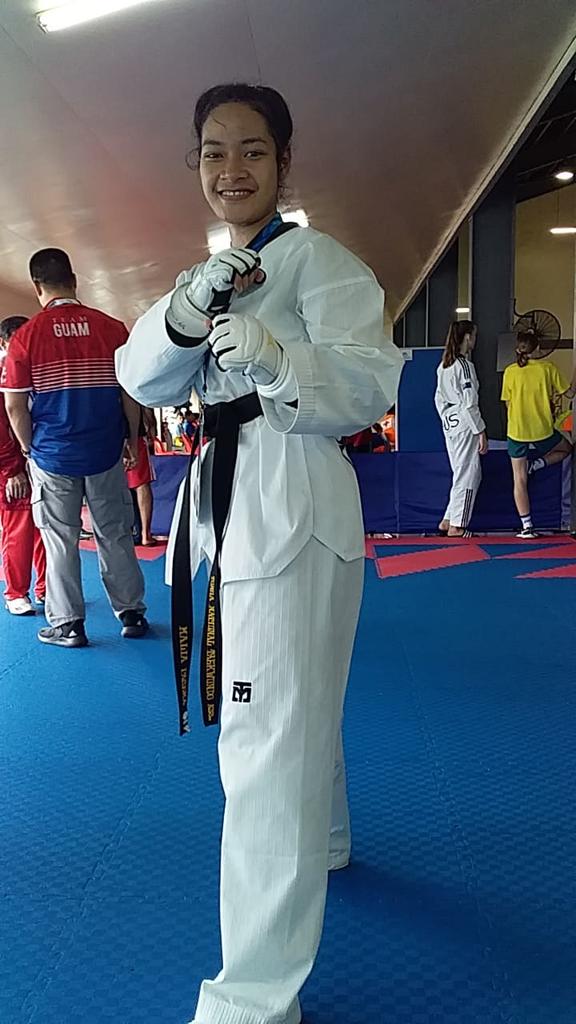
The Tongan taekwondo star will walk out as Tonga’s flagbearer in front of an estimated worldwide audience of somewhere between 1 and 2 billion people. Photo: Supplied.
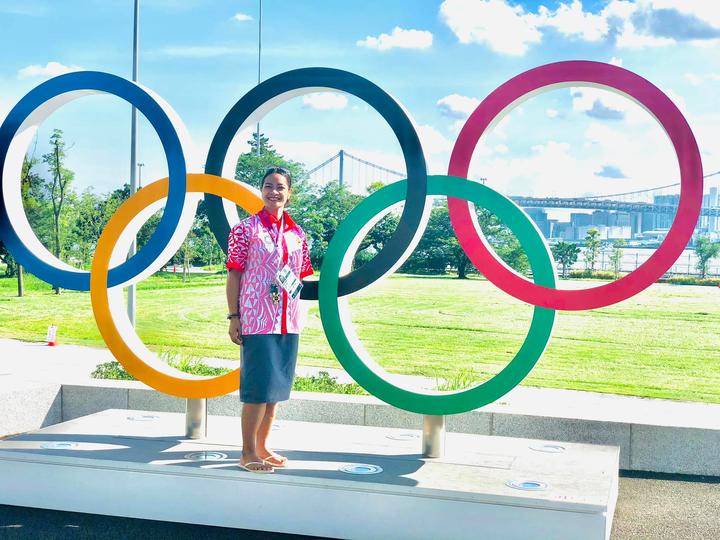
On Friday, the 21-year-old from Fua’amotu will walk out as Tonga’s flagbearer in front of an estimated world-wide audience of somewhere between 1 and 2 billion people.
That’s daunting enough, she admits. But having to follow in the footsteps of Pita Taufatofua whose shirtless entrance in Rio five years ago “broke the internet” has raised the stakes and the pressure is on.
“When the Chef de Mission announced that the one officially chosen to be the flag bearer was from taekwondo I was like ‘oh yeah, it will be Pita,’ but to my surprise they said it would be me. I was really happy and honored, but I was also quite shocked,” she said.
“I’m really excited but a bit nervous too because this is really new for me. I’ve been to many competitions before, but this is my first Olympic Games and I’m just thankful really for the opportunity to be representing my country and that they trust me to be the flagbearer.”
Paseka said there’s some relief though, with her team mate and mentor walking alongside her.
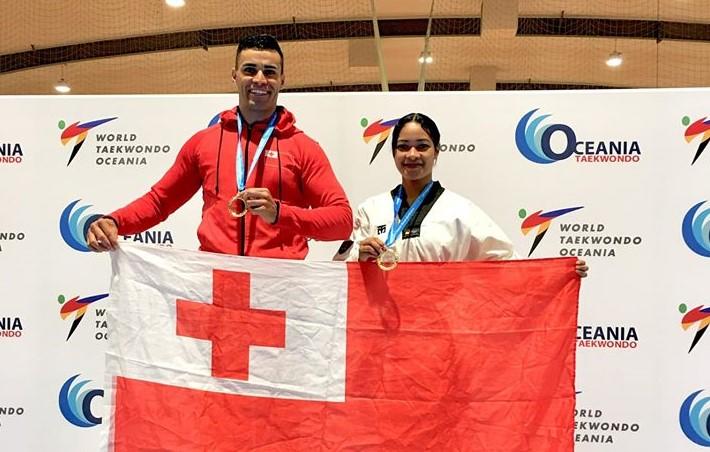
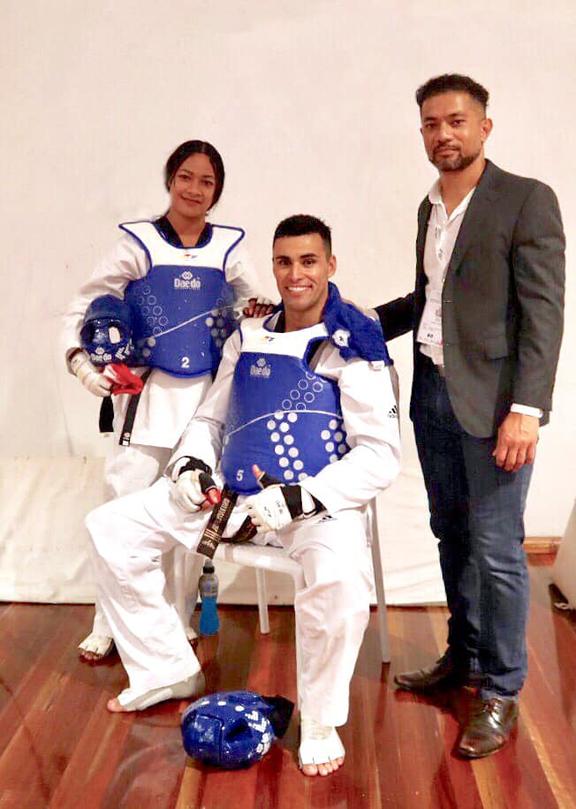
Tonga’s Pita Taufatofua and Malia Paseka qualify in taekwondo for the Tokyo Olympics. Photo: Pita Taufatofua
“Pita and I will be the flag bearers together so it’s good that I have him because he can tell me what to do and stuff… I’m actually happy to have him and my coach Master Paul [Sitapa] because they’re really good at all the advertising and those things,” she quipped.
Paseka will be Tonga’s first female Olympian to compete in Taekwondo.
Photo: Supplied
She qualified early last year by winning gold in the Women’s 67kg division at the World Taekwondo Oceania 2020 Olympic Qualifications tournament held in Australia. She also claimed gold and bronze medals at the 2019 Pacific Games in Samoa.
But the road to Tokyo hasn’t been easy.
Covid-19 meant overseas training programmes were terminated, and her Australian based coaches were forced to train her virtually. The lack of resources didn’t help either, she explained.
“Being a local women on the island training for [the Olympics] there have been much great challenges because you don’t have much things. We didn’t have much equipment needed for training, there isn’t very many women who can be my opponent when training and sometimes even people aren’t supportive because they might see it as a dangerous sport.”
“But in Tonga, money is not really a big problem, your heart is, and what you give and how you commit to the sport is what’s important… all I can say is life is quite challenging sometimes but you got to get used to it and fight for your dreams.”
Luckily for her, Master Paul’s younger brother, who is also a master in the sport, was in the country to help her prepare for the Games.
“Master Paul and Pita were in Australia and they were trying to get me to Australia but because of Covid I couldn’t get there. I would say I was very lucky because Master Paul’s little brother was in Tonga so he became my coach and I’m so thankful for him.”
“It was good because I was able to coach with him in person but then Master Paul was also sending his training schedules for us to follow and I’m here now, I’m where I’m meant to be and it’s really something I could have only ever dreamed of.”
Training aside, she also needed to convince her parents that she would be safe to travel to Japan.
Tonga’s Maila Paseka, Pita Taufatofua and coach Master Paul Sitapa. Photo: Pita Taufatofua
“It was quite hard for them to accept me to come here because of Covid and everything that is going on and my mum and dad didn’t agree for me to come here at first.”
“Even though they didn’t want me to come, they wanted to encourage me and support me with my dreams and they’re always calling me and checking in on me so I’m grateful they let me come in the end.”
Paseka admits there were many times where she felt like giving up, but thanks to the support of Taufatofua and Sitapa, she’s gained not just a team of friends, but family.
“They’re really special. We’re not a team, we’re family and they’ve really been an inspiration because it has been really hard, it’s been really difficult, but these guys they never left me. They always encourage me to be strong and have just been really positive through it all.”
“For them to arrive here and be [reunited] finally with them here in Japan it really has just made this whole experience better already because I wasn’t even sure if they would make it, so I’m lucky to have them here by my side.”
Now Paseka is more prepared than ever on the task ahead and she’s aiming for gold.
“I’m hoping to bring home some medals for Tonga, but at the end of the day it’s not all about winning and losing.”
“For me to be here, to be representing my country, to be part of the 2021 Tokyo Olympics, it’s really an honour and there’s only a few who get this opportunity and so I’m very blessed.”
Williams told Q+A there are “opportunities for us to do things in other ways” when it comes to keeping our officers safe.
“Police have access to weapons, they have access to training, but I do not [support general arming of police] as a principle,” she said.
Williams said there would be “a different dynamic if we arm our police generally”.
“I don’t think our community supports general arming of the police, I certainly don’t,” she said.
Q+A host Jack Tame asked the minister why there had been so much gun crime if the Government’s gun buyback had worked.
She defended the scheme, saying the Government had removed 60,000 military-style semiautomatic weapons out of the community.
Williams also said the Government needs “to continue with the arms register reform”.
“What we need to get a good handle on is how many weapons are in our community, and by registering those weapons, police will know when they go to an incident what they are facing.”
The ACT Party is promising to repeal laws introducing a firearm register.
Police Commissioner Andrew Coster told 1 NEWS on Friday officials were “looking at options” around the deployment of specialist groups, such as the armed offenders squad, in the wake of a “bad run” of gun violence.
“We need to improve the availability of specialist groups to respond in the course of a shift,” Coster said.
“Our armed offenders squad are only available on a call-out basis at the moment, so we are looking at options.”
Coster has ruled out a return of the controversial armed response teams, which were cut after public backlash.
The New Zealand government is pausing the travel bubble with all of Australia for at least eight weeks as the Covid-19 Delta variant continues to spread in the country.
Prime Minister Jacinda Ardern has confirmed that quarantine-free travel with Australia will be suspended from 11.59pm tonight for at least four weeks.
Ardern, Minister for Covid-19 Response Chris Hipkins and Director-General of Health Dr Ashley Bloomfield have addressed media.
Watch the government’s announcement here:
Ardern said the government has been keeping a close eye on the situation across the Tasman.
She said New Zealand will continue to act with an abundance of caution at every turn.
Immigration NZ staff are being deployed to Australian ports to check pre-departure tests, Ardern said.
“Every traveller will be stopped and checked before they can fly.”
She said more than 200,000 people have flown between New Zealand and Australia since the bubble opened in April.
But the Delta variant has “materially changed the risk profile”. A seven-day average of more than 42,000 new daily cases in the UK showed 99 percent have have the Delta variant.
Cabinet agreed to Director-General of Health Dr Ashley Bloomfield’s recommendation to suspend quarantine-free travel with Australia for at least the next eight weeks.
“For New Zealanders in Australia we are absolutely committed to getting you home,” she said.
Managed return flights for New Zealand citizens and those ordinarily resident in New Zealand will be set up for all Australian states and territories.
Two states will have extra conditions on returning – NSW flyers will still have to return via Sydney and be required to enter MIQ for 14 days, while those arriving from Victoria will also need a negative pre-departure test and must immediately self-isolate upon return to New Zealand, and return another negative day-three test before exiting isolation.
Ardern said New Zealanders flying from all other states will be able to return under the usual arrangements.
“There is considerable pressure on our managed isolation facilities at the moment and my strong urging to everyone is do not travel to Australia in the next eight weeks.”
She said the government did want the bubble to resume and remained committed to it, and she had conveyed that view to Australian Prime Minister Scott Morrison this morning.
Ardern said it must be safe, however, and New Zealand would want to ensure the elimination strategy would not be at risk from resuming quarantine-free travel.
“This is not a decision we have taken lightly but it is, we believe, the right one.
“This will mean many people will find themselves for a time once more separated from friends and families in Australia, and I know this announcement will be a disappointment to them.
“Our team of five million has worked hard to put us in a strong position both health-wise and economically and we will not risk that.”
Dr Bloomfield said the ministry had advised that the overall public health risk from Australia is low, but increasing.
“We have seen Covid-19 which is predominantly the highly transmissible Delta variant has now spread interstate in Australia, mainly from the larger outbreak in New South Wales.
“While outbreaks in Queensland, Victoria and South Australia currently appear to be contained, the outbreak in New South Wales clearly is not.”
Bloomfield said the number of cases who were in the community while infectious was of concern.
A suspension is intended to provide time for Australia, particularly NSW, to contain the outbreak, he said.
It will also allow New Zealand to learn from their experience in handling the Delta variant.
“Experience in New South Wales makes it clear that even jurisdictions with very strong public health capabilities and capacity for testing and contact tracing have been unable to get ahead of this variant and this has been a very important factor in the advice we’ve provided to suspend the travel bubble.”
He said handling the Delta variant will require a swift response, and the ministry’s advice is that all travellers returning from Australia should monitor their health, and keep track of all Australian locations of interest. If they have been in the locations at the specified times they need to follow the health advice.
Anyone in New Zealand who has been in locations of interest should immediately self-isolate and contact healthline for testing advice, which is a legal requirement, he said.
People returning from Victoria will be contacted through the contact tracing system and anyone who has not returned a negative day-three test will be followed up.
Bloomfield said NSW has one of the best contact tracing systems in the world, but a study from Guangdong suggested the Delta variant means people who are infectious shed about 1000 times the amount of virus.
He said the bubble was intended to be in a situation of low or no transmission, but lately that had not been the case.
The spillover of the outbreak into other states has put a lot of pressure on officials including in health and transport, he said.
Ardern said comprehensive test checking has been in operation today, and it was being ensured that it is in place across all of Australia, not just high-risk locations.
She said about 100 travellers have tried to come into New Zealand through states they are not meant to be travelling from.
“That does demonstrate to us that despite our best efforts of checking – we are picking those individuals up, but they do still pose risk.”
She said they were being picked up by the checking system and sometimes ended up in quarantine as a result.
There was no requirement for quarantine being added, she said, it’s just that travellers from Victoria have some additional requirements.
She said the advice to anyone currently in Australia and does not intend to stay in the long term, is they should come home.
“We’re giving you seven days so we can clear the demand for any New Zealander who is currently in Australia and does not intend to stay.”
She said returning later would risk having to go into MIQ and due to demand they may not be able to get a spot.
Hipkins said statistics suggested more than 20,000 New Zealanders who have travelled into Australia since the bubble opened have not yet returned.
“MIQ is pretty full and we’re not gonna have a lot of extra rooms available … if they want to guarantee they can come back they should do that in the next seven days.”
Ardern said the status of the outbreaks in NSW and Victoria were vastly different, which is why the approach for each state is different.
Flights will cease from midnight tonight, she said.
Ardern said the decision to suspend the bubble was only revealed now – after Cabinet met to discuss options yesterday – because the government had to notify airlines, airports and operationalise the arrangements needed to shut down for eight weeks.
There is a seven-day window for returnees.
“When we have an immediate concern we pause straightaway. Here, we see the risk growing so we’re stopping the flights for Australians, preparing to bring New Zealanders come back, and then we’re holding for eight weeks.”
Asked if this means Australia is not trusted to contain the outbreaks, she said it was that the government doesn’t trust Covid-19.
“There is no judgement here. This is New Zealanders making a decision that’s in the best interests, we believe, for us but also for the future of trans-Tasman arrangements.
“It is only for us to wish them the very best as they work to manage this delta outbreak but to make decisions that are in the best interests of New Zealand.”
Hipkins said if people have queries about bookings or flights, they should contact airlines or airports – not health or Covid-19 test booking lines. People with questions not related to an airline booking should call 09 9521695, or 048303599. People in New Zealand should call 0800 537 726.
“Please call those numbers and not healthline,” he said.
Airlines will be looking to put bigger and potentially additional flights on to return New Zealanders, he said, and data on the number of New Zealanders in Australia has been shared with them.
Bloomfield said the eight-week period both allowed time for the outbreak to be brought under control, and also gave some certainty.
Hipkins said he and Bloomfield have had conversations about reviewing high-risk countries, but no decisions have been made
Ardern said the government customised its response each time there is a risk of outbreak in New Zealand, depending on what that risk was.
She said the economic cost to tourism is far outweighed by the economic risk of allowing Covid-19 back into New Zealand.
Higher vaccination rate would have meant more options – National
National health spokesperson Dr Shane Reti said further steps did need to be taken as the risk in Australia escalated, but a different discussion may be had if the level of herd immunity was higher.
“It would give us more options … might it be six weeks instead of eight weeks; could we have had some nuancing of people who are vaccinated returning home … it just seems to be off the table.”
He said with MIQ booked up for three or four months, it’s going to be hard for the government to manage.
“It’s been stretched before today, it’ll be stretched even further with this announcement.”
Photo: RNZ / Dom Thomas
He said checks on 100 percent of predeparture tests should have been brought in far earlier, and the protocols for returnees from Victoria needed more work.
“Predeparture testing being [checked] for everyone, yes, very late, of course that should happen … pleased to hear that’s being done on every single person, should have happened before now.
“This [Victoria] variation … I think there’s some workflow attention that really needs to be looked at there.
“That all sounds a little bit loose to me. What happens between day three and day five? What is the reporting time between having the test and having it appear in the system? In whose system? If it’s on a weekend and it’s appearing in a GP’s system are they gonna be involved?”
The travel bubble had already been paused for New South Wales, Victoria, and South Australia.
There were no cases of Covid-19 reported in the community in New Zealand today.
A brave witness at the Abuse in Care Royal Commission of Inquiry Pacific Investigation has shared her experience of coming forward to the Catholic Church and police about the abuse her relative suffered by a Catholic priest.
Photo: RNZ / Richard Tindiller
The witness known as Ms CU spoke on behalf of her niece, who was 15-years-old at the time of the abuse.
She explained the Tongan society is very hierarchical, saying that ministers, priests and nuns elevate in both status and authority because of the godly factor.
“They are a representation of God on Earth,” Ms CU said.
It was at Ms CU’s family reunion that took place in New Zealand where the priest met her niece, who had travelled from Tonga for it.
The reunion started with a mass, which was led by Father Sosefo Sateki Raass, and he attended all the programmes that took place.
This was where he had met Ms CU’s niece.
“In Tonga, before the end of each year, members of the Catholic Church have confession with their priest.
“My niece later confirmed she was expecting to have confession in New Zealand during the family reunion.
“This is how she and Sateki got talking,” Ms CU stated.
In the statement Ms CU shares that following the conversation, Sateki started paying her niece attention at the reunion and messaging her on Facebook Messenger. He also took photos of her during the reunion on his mobile phone.
A few days after the family reunion ended, a family member approached Ms CU to show her mobile phone.
“My niece had used the family member’s phone to log into her Facebook account, but had forgotten to log out afterwards.
“I saw a long chain of messages between Sateki and my niece. All the messages were in Tongan,” Ms CU recalled.
“Throughout the messages he called her ‘beautiful’ and told her she looked nice. He sent her some of the images he had taken of her at the reunion.
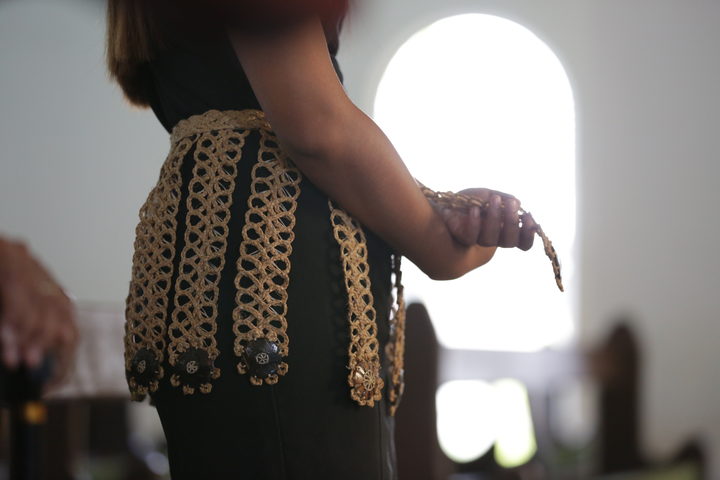
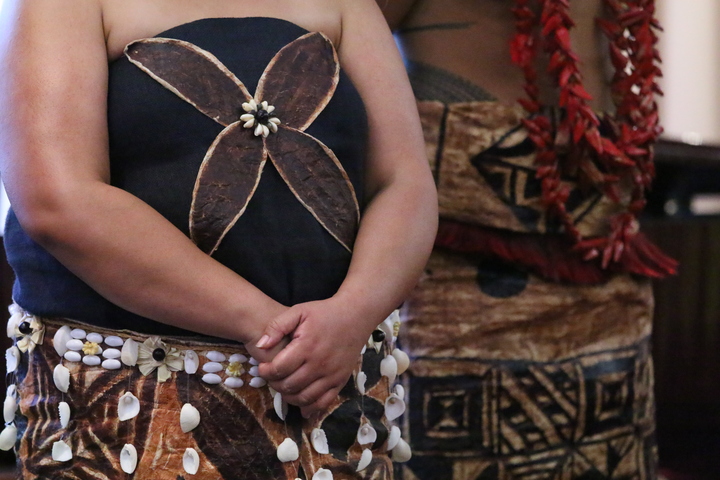
“At one point, he asked her to send him a photo of herself, and she sent him a nice church photo of herself in a *kiekie”. He replied that he wanted a ‘sexy’ photo.
“He kept asking until it got to a point where my niece just went offline,” she said.
Not long after Ms CU saw the messages, she wrote to Sateki from her niece’s Facebook page letting him know who she was and that she had copies of all his messages with her niece.
“I told him that I would be submitting a formal complaint to the Diocese and was seriously considering further actions.
“I told him not to contact my niece again,” she said.
A ‘David & Goliath’ situation
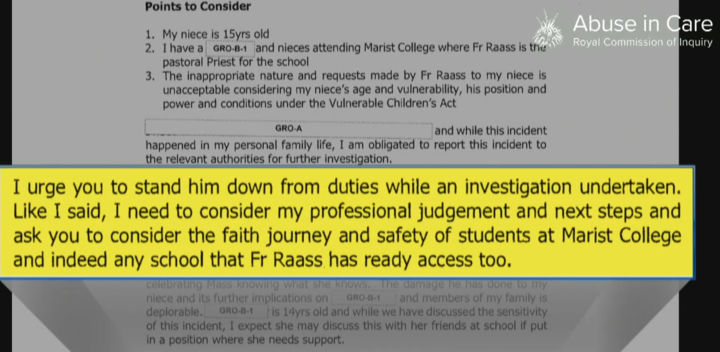
Ms CU sent an email to the Diocese on the 10 January 2018 as an official complaint regarding the actions of Sateki Raass.
Ms CU urged the Church to stand Sateki Raass down from duties while an investigation was undertaken. Photo: Screenshot
However, she admits that going up against the church felt like going up against Goliath. “I knew what I was up against, but I had to do it,” she said.
From there, Ms CU went straight to police and filed a complaint on 16 January 2018.
She understands that following the complaint to police, Sateki was arrested and they took his computers for inspection.
The niece returned to Tonga and Ms CU acted as the middle person between her family and police.
Sateki resigned from the priesthood during the court process. However, the Catholic Church still paid for a lawyer to defend him throughout the prosecution and later at his sentencing, Ms CU understood.
There continued to be a lot of back and forth between the lawyer and police, which carried on for a whole year. Ms CU said police were very helpful throughout the process.
But a trial date was set, and the judge sent the matter to the Crown Prosecutor’s Office. This meant it was no longer a police matter.
“The crown prosecutor never tried to communicate directly with me and explain what was happening,” Ms CU said.
According to reports from Stuff, Sateki pleaded guilty to indecent communication with a person under 16 and was sentenced to 100 hours of community service. Ms CU later understood that because he did not get a prison sentence, his name was not placed on the Child Sex Offender Register.
Ms CU said the delay betwen the charges and his guilty plea took its toll on her niece and family because rumours and lies were circulating in the community.
“We waited for a whole year to get to court, only for him to plead guilty to a lesser charge.
“It was a farce. There was no justice in what happened.
“Justice delayed is justice denied.”
Reflection on Catholic Church complaints process and prosecution
Ms CU said she felt that throughout the process, the people involved had lost sight of what they were there for.
“We were not there for what happened to my niece. Instead, we were there to protect this guy or make up some story to make what he did okay.
“The church lost sight of what the actual sin was. I feel that the church failed in its duty of care in every shape and form to help my niece, me and our families restore and recover.
“Rather, we are all left to just do it on or own and in our own way,” she said.
Impact on Ms CU’s family
“In telling my story I think it’s important that I don’t put words into my niece’s space because that’s her story to tell,” Ms CU said at the public hearing before the Royal Commission of Inquiry.
Photo: RNZ / Patrice Allen
Ms CU said the impact of her niece’s life and those closest to her cannot be underestimated.
She shared that this incident has affected the degree to which the family are involved with the church.
“We just don’t do it anymore,” she said.
“My husband and I no longer take up leadership roles within the church and I’ve pulled away from the Tongan community and those events.”
Ms CU shared that a big fallout happened in her extended family where members were angry that she had gone to the police.
“They thought that by reporting the matter to the police, I disrespected my niece and our family.
“Family members told my niece’s father, my cousin, to change my niece’s name so that she didn’t carry the family name. They told him “to’o hingoa”, which means to remove the family name.”
Photo: RNZ / Daniela Maoate-Cox
She said the directive brought fakamā (shame) on the family. “They cut ties with me and disowned me as family.”
However, she said her niece is the victim and continues to be a victim and that is what motivates her above everything else to speak out about this.
“If I did not come forward and Sateki was still a practising priest, I would have felt guilty that I didn’t say something.
“I would have felt horrible that it has happened to another young girl, sick to my stomach that he remains a public predator, that I knew about it and did nothing.”
*Kiekie – a traditional Tongan ornamental girdle that you wear around the waist, mainly worn by women on semi-formal occasions.
Eighty-seven crew members and passengers have been placed into isolation on four inter-island ships in Fiji, health authorities said.
They are the latest group amongst more than 4000 Covid-positive people to have been turned away from hospitals because there are not enough beds.
.. Photo: Facebook/Fiji govt
Fiji’s chief medical adviser, doctor Jemesa Tudravu, said the health ministry has set up a homecare support system for those isolating on the ships and at home.
This includes delivering food and medical supplies to the ships.
Dr Tudravu said the ministry is also monitoring people at home with follow-up telephone calls.
Yet, more pressure is mounting on the Fijian government to impose a national lockdown amid the worsening Covid-19 crisis in the country.
Over 16,000 people infected with the virus are in isolation – with over a quarter of them at home.
Despite calls from the opposition and civil society groups in Fiji, the prime minister says he will not enforce a national lockdown because it will only cripple the economy and impact jobs.
Frank Bainimarama maintains a complete shutdown of the main island Viti Levu would affect Fijians living in informal settlements and who are reliant on daily wages.
The government is also concerned the tens of thousands of people who live in these informal settlements – where most of them are within the containment/red zones – would not be able to access essential services during any lockdown.
But a New Zealand-based Covid-19 modelling expert says Fiji should have a national lockdown.
Professor Shaun Hendy said a lockdown is a logical way of trying to get the virus under control, and New Zealand should be helping out financially.
“We should be looking at helping them with financial assistance to ensure that their economy can weather this. Whether they have a lockdown or not.
“It is going to be a very very difficult period for them in terms of their economy and of course their healthcare system is already under extreme stress.”
New Zealand should be moving faster to get Fiji the AstraZeneca vaccine, professor Hendy said.
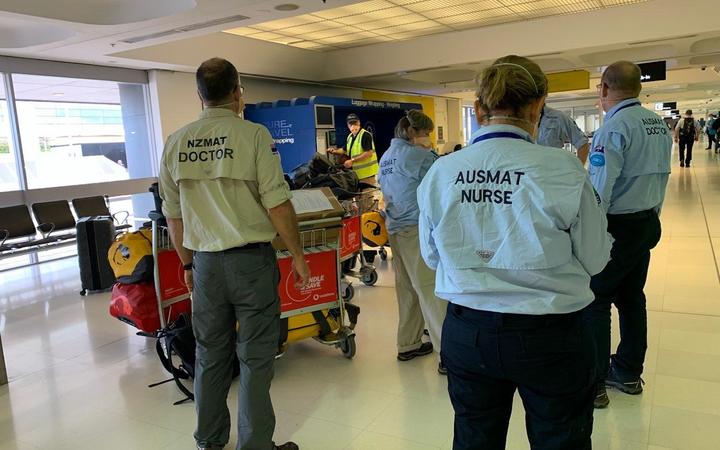
Members of the AUSMAT team arrive in Fiji. Photo: Supplied
New Zealand has pledged 500,000 doses of vaccines to Fiji, and Foreign Minister Nanaia Mahuta said both the AstraZeneca and Moderna vaccines are due to be sent to the Fijian capital, Suva, from next month.
“By our calculations of those vaccines that have been pledged and committed, they may not have to draw on the full 500,000 doses however they are still for Fiji at this stage.”
The New Zealand government is still awaiting approval from Medsafe for the vaccine.
The Pasifika Medical Association of New Zealand said there was a real need for more outside medical staff on the ground in Fiji.
Its chief executive, Debbie Sorensen, said colleagues in Fiji had been telling her they are exhausted and overworked.
She said New Zealand has sent PPE and other equipment, but the health system in Fiji now needs hands-on help.
“They are probably in desperate need now for actual human bodies to help them respond and talking with our health professional colleagues, doctors and nurses in Fiji, they tell us they are very tired. That they have been working virtually without a break and really could do with extra support.”
Sorensen said New Zealand had sent a significant number of medical staff to Samoa during the measles epidemic there and Fiji just needs to make a formal request for help.
About 20 medical specialists from New Zealand and Australia are in Fiji helping their colleagues there.
Christchurch anaesthetist Wayne Morriss said doctors and nurses there were working incredibly hard, often seven days a week.
The NZAUSMAT teams have been helping Fijians to improve systems so the hospital can manage severely ill Covid-19 patients as well as people who need urgent surgery, like emergency caesareans.
Over the past two weeks, some less sick Covid-19 patients were moved from the hospital to the national gymnasium in Suva, where they could be monitored but transferred back to the hospital if needed, Morriss said.
There were also clinics at a sports arena and tents outside it.
.. Photo: Fiji govt
Getting the whole country vaccinated was critical, and it was going very well so far, with about 80 percent of people having their first dose of the Astra Zeneca vaccine, Dr Morriss said.
He said Fijian health authorities were doing their best in trying circumstances, but the situation was grim.
“It’s been a really sophisticated response from the Fijian health authorities, but I think that this sort of outbreak would stretch any health system. We’re obviously very worried about the increasing number of cases and deaths, and it’s fair to say it’s really stressing the system.”
As the outbreak grew in Fiji and a cluster of cases emerged among health workers the main hospital in Suva, the Colonial War Memorial Hospital, was restricted to almost exclusively Covid-19 patients.
But this has had a serious impact on the rest of the health system, Dr Morriss said.
“The main hospital was effectively closed down a month ago… to patients other than Covid cases, and we know there are ongoing health needs even during a pandemic.
“So there’s still lots of patients with medical or surgical problems that need treatment.”
The purpose of the Medical Assistance Team is four-fold, he said.
“We are assessing the capacity of the main hospital and will assist with re-opening it for non-Covid patients.
“We’ve also been asked to support the Fiji Emergency and Medical Assistance Team which is currently working in the Vodafone Arena, and for the next couple of days the National Gymnasium is also going to be opened to take moderately sick Covid patients.
“Those patients will be monitored so that if they deteriorate they will be transferred for more advanced care, to the Colonial War Memorial Hospital.
“The fourth area the team are working on is advising Fijian health authorities to upgrade health workers’ PPE.
“The other area that is really important is infection prevention and control, so that’s the use of PPE and other measures to reduce the spread of infection within the health facilities. It’s really important that the staff and the patients have faith that the PPE and other equipment is going to keep them safe.”
Mandatory vaccination
With no change to its strategy to combat the pandemic, the Fijian government has embarked on a ‘mandatory vaccination’ campaign instead.
Workers have been told they must be fully vaccinated by November or face losing their jobs.
The head of Fiji’s vaccination taskforce, Dr Rachel Devi, says with the widespread transmission of the virus on the main island of Viti Levu, priority will be given to pregnant women.
Dr Devi told a recent panel discussion on Fiji that people need to get vaccinated and practise Covid-safe measures to help in the fight against the coronavirus.
A total of 428,524 Fijians (73 percent) of the target population have received their first dose of the AstraZeneca vaccine, while 90,531 (15.4 percent) have got both jabs.
Fiji’s daily average test positivity rate is now at 29.7 percent – the World Health Organisation threshold is 5 percent.
There are over 16,000 active cases in isolation, with more than 160 deaths reported.