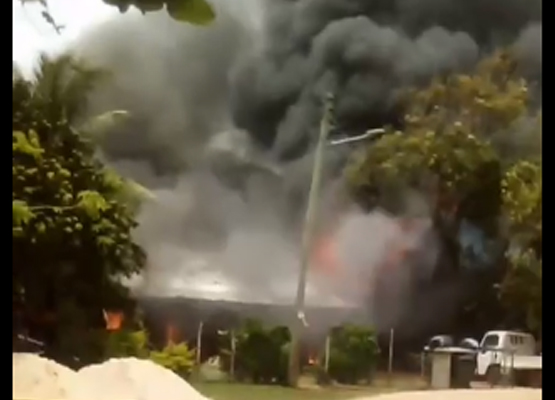
Plumes of black smoke and flames can be seen in a video reportedly coming from a house in Tu’anekivale this afternoon.
House fire in Tu’anekivale. Photo/Screenshot
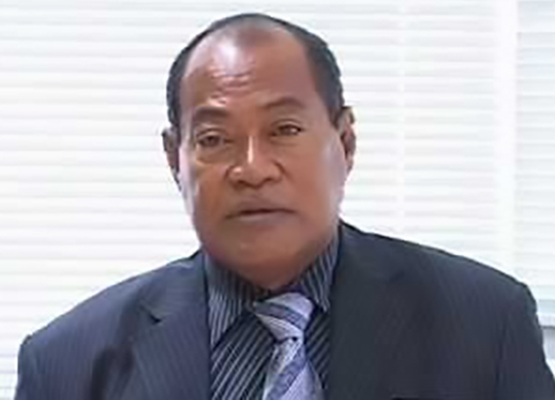
Holeva Town Officer Uele Moala who was recording the incident live on Facebook was overheard as saying the house belonged to the Tu’anekivale town officer.
He later told Kaniva News the fire destroyed the house and all its content.
He said firefighters arrived but they were too late to help control the blaze.
The cause of the fire was still unknown.
Locals are commenting on social media that it’s about time to ask the government to establish a fire station in the area.
It’s not yet known if there are injuries or the extent of damage.
(By New York Posts) Moderna said it will ask the feds to clear its experimental coronavirus vaccine for emergency use on Monday, adding to hopes that two inoculations could be available by the end of the year.
A shot that is part of a possible COVID-19 vaccine, developed by the National Institutes of Health and Moderna is preppedAP
The biotech firm will be the second drugmaker to seek a so-called emergency use authorization for a COVID-19 vaccine from the US Food and Drug Administration after Pfizer and BioNTech submitted their request earlier this month.
Moderna announced the move Monday as it revealed new data showing the vaccine was 94.1 percent effective in its late-stage clinical trial — similar to Pfizer’s efficacy rate of 95 percent — and posed no serious safety concerns. The FDA’s vaccine advisory committee is expected to review data from the Phase 3 study at a Dec. 17 meeting, Moderna said.
“We believe that our vaccine will provide a new and powerful tool that may change the course of this pandemic and help prevent severe disease, hospitalizations and death,” Moderna CEO Stéphane Bancel said in a statement.
Moderna’s submission will come as US officials and drug companies prepare to distribute coronavirus vaccines to vulnerable people around the country as soon as they’re approved.
The Massachusetts-based company said it will have about 20 million doses of its vaccine available in the US by the end of the year, while Manhattan-based Pfizer expects to have produced up to 50 million doses of its shot globally. That would be enough to inoculate about 35 million people in all because the vaccines are each administered in two doses.
The FDA did not immediately respond to a request for comment Monday.
Plans to send New Zealand watermelons from Tonga last week were postponed, sparking claims the information released about the arrangement was just made up to arouse growers’ hopes.
Trade Minister Hon Sāmiu Vaipulu
A reliable source claimed the information, which was released by the Tonga Broadcasting Commission, was made up by authorities to deflect the growers’ demand for government and private company compensation.
As Kaniva News reported earlier, some growers borrowed thousands of pa’anga to grow watermelons. It is understood Tongan farmers planted a large number of acres of watermelons for export to New Zealand.
Exports to New Zealand were blocked after fruit flies were found on the melons.
Watermelons have flooded small local markets in Tonga. Photos seen by Kaniva News showed watermelons stacked up at tax allotments and residential properties. Watermelons were also seen being used to feed pigs.
Kaniva News followed up the news with New Zealand’s Ministry of Primary Industry two weeks ago.
We asked the MPI whether or not it was true there was a plan in place to lift the ban soon.
“The suspension remains in place and we are working closely with the Tongan Ministry of Agriculture on the fruit fly issue,” the Ministry said.
“That work is currently being done virtually due to COVID related travel restrictions.
“The length of the suspension will depend on how quickly Tongan authorities can investigate the situation and put measures in place to assure New Zealand that their treatment processes are working. That said, the work is progressing well.”
A source claimed the Ministry of Quarantine was disorganised and lacked people with the right skills to do the jobs.
The source also claimed it appeared attempts to unblock exporting of watermelons to New Zealand was not a priority for the government.
The source said attempts to convince New Zealand authorities that Tonga would only send watermelons that were safe from any infection appeared to be taking longer than expected.
Kaniva News asked Trade Minister Sāmiu Vaipulu to comment on the matters and explain why last week’s plan to resume exports was postponed.
He said there were things that still needed to be completed in the process.
Growers who exported their melons through the government had been paid 50 percent of their price and the government was looking at paying for the melons which were destroyed in New Zealand.
“We have made an agreement with the growers,” Hon. Vaipulu said, but did not give any details of the agreement.
He said the shipment containing the infected melons was from a private company and it affected Tonga’s permit to send any more melons to New Zealand.
“Work was underway to establish a more organised system because it was a private shipment which was infected,” Hon. Vaipulu said in Tongan.
“So there was need for the government and the growers to work together on this.”
The government should stop travelling to the outer islands and do its prayer and fasting meetings via the internet, a Tongan pastor said this weekend.
Pastor Sioeli Kalekale (R), PM Pohiva Tu’i’onetoa
Pastor Sioeli Kalekale, an Upper Room Church minister in Christchurch said going online would save hundreds of thousands of pa’anga.
Rev. Kalekale’s comments join a barrage of criticism that has been made against the government’s tours of the outer islands, with critics saying they are simply a way for ministers to collect gifts.
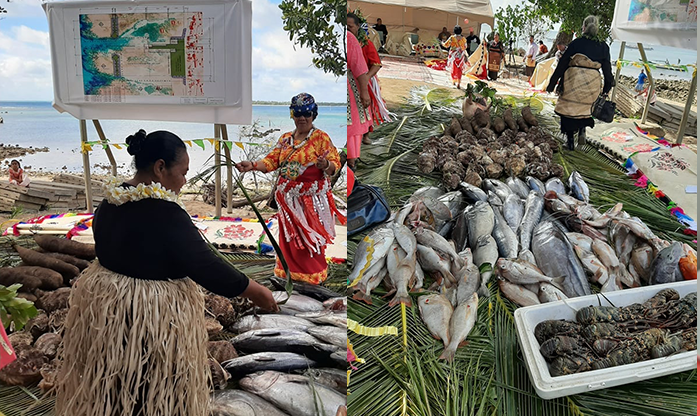
Photographs taken on Nomuka island at celebrations to launch construction of a new wharf show fish, mats and other gifts lined up in front of the official stand.
“I do not believe in what they do,” Pastor Kalekale said.
“If they regarded it as the way to show their love for the nation they should pay for their fares because they have huge amounts of salary.
“To say this is true prayer and fasting it is untrue.
“That money should have been saved to buy tar to build the roads. Stop obliging the people to buy tar and stop traveling to the outer islands.
“That is how I see Christ’s soul in this.”
The administrator of the Ministry of Infrastructure Facebook page described the hā’unga presentation on its Facebook page as “beautiful” and said the people of Nomuka “welcomed the tour courteously.”
He made a call earlier for the government to use the money to help growers whose watermelons were blocked from entering New Zealand.
He also criticised the government’s collecting handicrafts from poor people and called on them to “stop lying to people as they are pitiable.”
Rev. Kalekale told Kaniva News he was not interested in politics. He said his role was to provide spiritual and leadership advice.
The administrator of the Ministry of Infrastructure Facebook page described the hā’unga presentation on its Facebook page as “beautiful” and said the people of Nomuka “welcomed the tour courteously.”
It said the tour was made because of an immense (“kāfakafa”) project.
In response to earlier criticism of the tours by veteran journalist Kalafi Moala, the Prime Minister said it was important for him to meet the people personally.
He said it was an occasion in which family and friends who had not seen each other for a long time met.
“That’s what keeps our love each other, our culture, our unity and working together to build the nation,” he said.
“That’s our Tongan philosophical ground upon which Faa’i Kaveikoula (Tonga’s Pillars) of respect, loyalty, keeping the relationships well and humility stand.”
Moala’s comments are part of the storm of comment and accusations that have flown back and forth since he attacked the Government’s prayer and fasting tours as a waste of time and money.
It has also been reported that Hon. Tu’i’onetoa believes Tonga has been kept free from the global pandemic because of fasting.
The Prime Minister appears to have been particularly incensed by claims that the tours have cost TP$100,000 each and questions about whether wives who accompanied Cabinet members on tour were paid travel allowances.
In a startling accusation, the Prime Minister has labelled critics and opponents of his government as wife beaters.
Without naming anybody, he said some of his critics had beaten their wives until they suffered a miscarriage.
He claimed that one in four women were abused and that number doubled after the lockdown restrictions.
“It appears that your accusations reflect the fact you agreed to support abuse and violence against mothers and women by violating them,” Hon. Tu’i’onetoa said in Tongan.
“No wonder why these critics are doing this because most either had marriage break-ups or were wife beaters.
“I appeal to you leaders of the country and those of you who regarded themselves as leaders and people trusted you to take your wives with you during the government tour. Stop looking down at them.
“Stop beating your wives otherwise they will miscarry their baby and you will be sued and you might end up being imprisoned.”
Ministers’ wives pay
He said the pay per diem for a Minister’s wife if they went on tour was TP $95.
“You cannot buy peanuts with that money,” he said.
“It can only be used to reward dancers during ceremonies to celebrate construction of new wharves or building of new women’s weaving houses. If we offered to do a dance during that ceremony it’s my own money and handicrafts I used to pay for the expenses.”
However, the Prime Minister has not denied the basic thrust of the allegations about the tour.
Instead he downplayed the accusations, which were first raised by Opposition MP and former Minister of Police Mateni Tapueluelu.
The Minister of Finance was not allowed by the Prime Minister to answer queries in Parliament about the traveling allowance allegations.
The Minister of MEIDECC said he travelled with his wife and she was not paid.
The House was told the Acting Minister of Law, who is also the Minister of Labour and Economic Development, Samiu Vaipulu, would answer MP’s queries regarding the accusation.
Kaniva News has asked Hon. Vaipulu whether the leaked information was true or not. He did not deny it. Instead he said he had no wife therefore he did not know who made the payments.
In Tongan he said: “‘Oku ikai haku hoa keu ilo pe ko hai naane totongi.”
Personal attacks
The Prime Minister also launched a series of personal attacks on Moala.
Moala denied personally attacking the Prime Minister in a way that might lead him to respond so personally.
Moala described the Prime Minister’s attacks as disparaging and pointless.
He said the Prime Minister did not like to be criticised and this was why he made personal attacks.
He alleged Tu’i’onetoa relied heavily on ousted Cabinet Minister ‘Etuate Lavulavu on ideas of how to run the government.
Moala also warned the Prime Minister that his attack on journalists would not deter them from working to expose government misdeeds and raising questions about issues like Lulutai airlines.
The main points
Tongan Prime Minister Pohiva Tu’i’onetoa is more dangerous than Covid-19, veteran publisher Kalafi Moala has claimed.
In a startling accusation, the Prime Minister has labelled critics and opponents of his government as wife beaters.
Tongan Prime Minister Pohiva Tu’i’onetoa has warned critics of his government’s prayer and fasting tours not to resist “religion and the government.”
PM Pōhiva Tu’i’onetoa. Photo/Kalino Lātū
The Prime Minister and Cabinet have travelled around the kingdom promoting fasting , but opponents of the government say the real purpose of this initiative is to allow the Cabinet and government staff to receive travelling allowances and collect gifts such as yams, fish and valuable Tongan handicrafts such as fine mats and ngatu from the people in the outer islands.
This is normal practice in welcoming ceremonies of any tour by the government from main island Tongatapu.
The government has been attacked online, with many deeming it hypocritical and pharisaical and claiming the tours were a cover for other activity. The tours have also been criticised as really being a political campaign by the government’s People’s Party because of next year’s general election.
“This government is lucky they collected money and handicrafts,” one critic said.
Another said this was the only Tongan government to have amassed such a large collection of cultural items.
Hon. Tu’i’onetoa believes Tonga has no cases of Covid-19 because of the fasting.
The Government’s fasting and prayer tours have not come without a price.
The visit to ‘Eua, which ran from October 10 -11 is estimated to have cost TP$100,000. Tongatapu no. 1 MP Siaosi Pohiva said the visit to ‘Eua was a “waste of money”.
It is understood that about TP$100,000 was also spent on a tour to Ha’apai on November 14-15.
Parliament had to close while Cabinet toured the outer islands.
Other tours are scheduled for Vava’u, Tongatapu and the Niuas over the next three months. Cabinet will be in Vava‘u for fasting and praying on December 5-6.
In the New Year there will be fasting and praying in Tongatapu from January 18-19 and in the Niuas from February 8-9.
The Prime Minister justified his fasting policy in Parliament. Speaking in Tongan he said:
“There are many people on Facebook who have made fun of the government’s national fasting and prayer initiative. One of the things the government used to protect us from Covid-19, was to pray and fast every month.
“Some people took it lightly and some regarded it as fake prayer. Some people of the nation said it was mischievous and made comments which were discouraging and bad.
“These will cause people to be more disobedient against government’s decisions and I am asking you please do not do that as it did not contribute any good to our preparedness to fight against this global disaster and the way we do to protect Covid-19 from entering Tonga.
“Please do not resist religion and the government together with the churches here in Tonga in our fasting policy as I believe that is not prudent.”
The government organised a national fast and day of prayer backed by the Wesleyan and Catholic churches in April.
Fasting
There appears to be no agreement on what effect fasting has on the immune system. Recent studies have shown contradictory results depending on what type of fast is used and for how long.
Studies have been based on experiments on animals, including mice, with one Sydney-based researcher saying there wasn’t “any scientific evidence to justify” one type of fasting over another and that in any case it was hard to apply the results of animal tests to humans.
Studies at Yale University have shown that fasting induces different responses to bacterial and viral infections, while work in the UK has argued that results are dependent on what type of fast is used.
In Muslim countries, where the faithful are expected to fast between sunrise and sunset during the months of Ramadan, illness has long been accepted a reason not to fast.
Former members of the Tokaikolo Church who split from the body and set up their own congregation, attended memorial services for the late Rev. Dr Liufau Vailea Saulala, Kaniva News has learned.
Dr Saulala, who founded the Tokaikolo church, was a controversial figure whose teachings and behaviour have been blamed for several groups leaving his congregation.
However his son Sangstar, a former MP and Cabinet Minister, said his father was “a silent person” who tolerated any criticism against him.
He said after his death members of the Mo’ui Fo’ou ‘Ia Kalaisi Fellowship, which split from the Tokaikolo Church over Liufau’s leadership, paid tribute to him.
Some of them attended the funeral sermons and prayer services at the church’s Lavengamalie college and shared their memories and stories about Liufau.
“These people were tearful and remembered how Liufau helped them and their living,” Sangstar said.
He said other churches and schools had asked for a time for them to perform prayer services.
Sangstar said his father’s body would be buried in Auckland this week. It was hoped the church’s General Secretary could come from Australia for the funeral.
Rev. Saulala left Tonga just before the border closed due to the Covid-19 pandemic in March this year. He died in Middlemore Hospital.
Rev. Saulala died just before Lavengamalie college was to celebrate its 40th anniversary. The school was founded on February 6, 1980.
Sangstar said former students of Lavengamalie in New Zealand would celebrate the school’s anniversary this Sunday, December 29.
Former students in Tonga will celebrate it on February 6 next year.
Christ’s University, which Rev. Saulala founded in 2004, has issued a tribute mourning his death.
The university was accredited by the Tonga National Qualification Accreditation Board in 2018.
Rev. Saulala is survived by five sons and one daughter and several adopted children. His wife, Falamoni Naitoko Saulala, died last year.
The president of the Tokaikolo Church, the Reverend Dr Liufau Vailea Saulala, who died on Thursday will be buried in Auckland.
President Rev Liufau Vailea Saulala. Photo/Cathnews
Rev. Saulala’s son Sangstar, a former MP and Cabinet Minister, said vigils and prayer services by the family would start today at the Nasaleti Church in Mangere, South Auckland. The church was expected to begin theirs later this week.
In Tonga a prayer service organised to begin the celebration of Lavengamālie College’s 40th anniversary was held as part of President Liufau’s funeral services, Sangstar told Kaniva News.
Former students of the College were expected to celebrate the school’s 40th anniversary this week, but this has been postponed because of the funeral.
Sangstar said ex-students in New Zealand will celebrate the school’s anniversary on December 29 while ex-students in Tonga will celebrate it next year on February 6, the day the school was established in 1980.
The president is survived by five sons and one daughter, and several adopted children. His wife, Falamoni Naitoko Saulala passed away just over a year ago.
Controversial
Rev. Saulala was a controversial figure whose behaviour drove many members away from the church. Serious questions were raised about his financial management, what was said to be his departure from the church’s original principles and even accusations of heresy.
The origins of the Tokaikolo Church go back to 1965 when the Scripture Union, an interdenominational evangelical Christian movement started working in Tonga. Between 1965 and 1970 the movement spread to many schools both in Nuku’alofa and beyond.
In 1970 the Rev. Senituli Koloi was appointed Chairman of the Union. Rev. Koloi distinguished himself by his piety, his diligence and his teaching and leadership abilities. He obtained a diploma in theology from the Pacific Theological College in Suva in 1968. In 1970 he was ordained.
In 1978, at the request of the New Zealand branch of the Scripture Union he established a new Bible College in Auckland. Senituli Koloi was the first principal of the college which he named “Tokaikolo Bible College.”
Koloi criticised the Wesleyan Church and condemned lavish feasting, annual donations (misinale) and the assumption by ministers and others of a higher status than ordinary people:
In September 1978 Koloi resigned from the Free Wesleyan Church and the following year gathered thousands of followers around what was named “The Tokaikolo Fellowship in Christ” or “Feohi’anga Tokaikolo ‘ia Kalaisi”.
Koloi died in February 1980, a week after the Tokaikolo Fellowship opened Lavengamalie College.
The rise of Dr Saulala
The principal eulogy and sermon at Koloi’s funeral were delivered by Dr Saulala who told the congregation that Koloi had told him in 1978 that God had revealed to him that Dr Saulala was to be his successor.
Koloi’s widow Luseane, her family and several others did not accept Dr Saulala’s assumption of the leadership and left.
The Tokaikolo Fellowship developed into a fully-fledged Church. The first ordained minister was Dr Saulala and further ordinations of ministers and deacons followed. Annual conventions were held, new organisations within the fellowship were established: youth groups, Sunday schools and a women’s group. A radio programme was launched in 1989, an evangelism office was opened in 1990 and a newspaper, Ofa Ki Tonga, began publication in 1991. In 1993 the Mother of the Year programme was launched, the first winner being Late Queen Halaevalu Mata’aho.
In 2018 the church established the Christ’s University which has a variety of courses available and currently caters to around 50 students with the aim of accommodating around 200. Degrees in computer science, education, theology and business management are being offered with law courses expected to be added the following year.
At the Fellowship’s 1994 annual convention in Sydney Dr Saulala was given the title of President.
During the next few years several branches of Tokaikolo Church were established overseas, including in New Zealand, Australia, California and Hawai’i.
Break away
Over the years several groups of members and clergy broke away from the church. Some of the members disliked the way Dr Saulala led the church, while others disliked the direction in which he led it. Many felt he led the church away from Koloi’s original positions, sanctioning feasting, extravagant celebrations, expensive gifts and increasing deferment to Nobles and the royal family.
It was claimed that in November 2004 Dr Saulala gave a cash gift of TP$100,000 to King Taufa’ahau Tupou IV when he visited Lavengamalie.
The church’s 2004 constitution gave Dr Saulala the right to make investments of up to TP$1 million.
The church launched a number of business adventures, including the purchase of a TP$700,000 fishing boat, but none of them prospered. By October 2007 the church owed just under TP$1.5 million in bank loans.
In October 2006 Dr Saulala spoke to a meeting of the Tokaikolo Church in Auckland in which he made a series of extravagant claims about the church’s financial position, mystery Chinese investors and the miracles supposedly being worked by a New Zealander called David Hobbs, who was described as “an international financier.”
In fact the Australian Securities and Investments Commission found Hobbs to have contravened numerous provisions of the Corporations Act 2001 by carrying on a financial services business without a licence and by engaging in misleading and deceptive conduct.
There was also deep disquiet over schemes involving pills that were supposed to cure every illness and a holy water dispenser that members were pressured into buying for TP$3980 a time.
Doctrine
Dr Saulala then caused even greater controversy by declaring a new doctrine that salvation was household based and that as long as the parents converted everybody in the house had converted. This was seen by some as being heretical and flying on the face of Luther’s declaration of justification by faith alone.
More departures and controversies were to follow, with court cases to resolve disputes over the ownership of churches in Halaano and Ha’ateiho, Tongatapu which were occupied and used by the Mo’ui Fo’ou ‘ia Kaiaisi Fellowship. The cases ended with the supreme Court awarding the churches to the Tokaikolo Church.
Two of Tonga’s most senior Nobles will return to court on December 3 for the next stage of a case for defamation brought against the Chairman of the Tonga Sports Council, ‘Ikani Taliai.
(L-R) Lord Sevele, Lord Tupou and ‘Ikani Taliai
Lord Tupou and Lord Sevele are suing Taliai in the Nuku’alofa Magistrate’s Court over allegations of that they misused TP$400 million in sports funding.
The first court hearing was held on Thursday, November 19.
Veteran Tongan journalist Kalafi Moala reported that the Nobles claimed they were defamed in an article Taliai wrote and posted on Facebook. The article has been widely copied.
The article centres on the controversy surrounding TASANOC and the decision to cancel the Pacific Games.
Lord Sevele and Lord Tupou had both been President and Vice President of TASANOC at various times.
The then Prime Minister, ‘Akilisi Pohiva, wanted TASANOC dissolved and replaced by the Tonga Sports Council.
A contract to host the 2019 Pacific Games was signed in October 2012 by the then Prime Minister, Lord Tu’ivakano, the Pacific Games Council and the Tonga Pacific Games Association.
Hon. Pohiva cancelled the games, claiming Tonga could not afford them. This contradicted previous government statements that constructing of Games venues and facilities would boost the economy.
The Pacific Games Council sued the Pohiva Government for breach of contract. TASANOC also launched legal proceedings for the recovery of money spent on preparing for the Games.
The legal action is based on a contention that that the government was contractually obliged to provide the Pacific Game Organizing Committee (PGOC) funding for organizing and holding the Games, which had been estimated at TP$400 million.
A further claim was made that the PGOC should have been incorporated as a company so that the putative TP$400 million would have been vested in the company rather than its membership.
However, by being incorporated as a charitable trust, the hypothetical TP$400 million in costs for funding the Pacific Games was vested in a Board.
The president of the Tokaikolo Church, the Reverend Liufau Vailea Saulala, has died in Auckland, New Zealand.
Rev Liufau Vailea Saulala
The Reverend Saulala’s death occurred at a hospital on Thursday 19, his son former MP Sangstar Saulala told Kaniva News.
He was 75.
Sangstar said one of the president’s favourite verses from the Holy Bible was Mathew 6:33 which says: “But seek first his kingdom and his righteousness, and all these things will be given to you as well.”