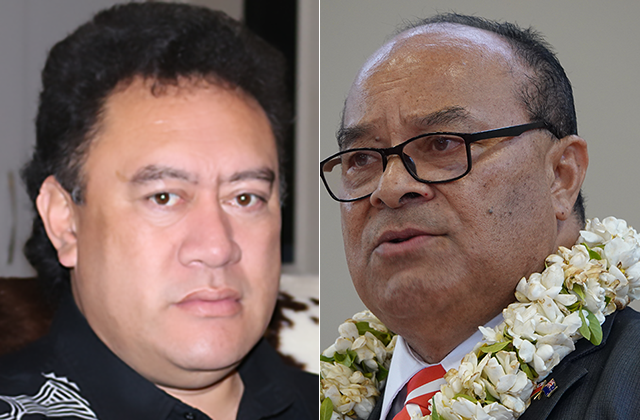
Tributes are pouring in after the death of Dr Netatua Prescott Taufatofua has been widely reported on Facebook this evening.
Dr Netatua Pelesikoti Taufatofua. Photo/Facebook
Dr Taufatofua’s family could not be reached for comment.
Her sister-in-law Elenoa Koloamatangi Prescott said on Facebook there was plan for Dr Taufatofua and her siblings to meet in Tonga when the border restrictions were lifted.
“‘Ikani (Dr Taufatofua’s brother) was crying and wishing he could kiss you goodbye,” ‘Elenoa wrote in Tongan.
A Tongan community leader in Australia, Uanivā Havea who goes by the name Touhuni Halapuopua on Social Media wrote on Facebook: “Netatua I can’t believe you’re gone. What a shock to learn just now of your passing, here on Facebook.”
“You only responded yesterday to the pictures I posted, suggesting that they’d be good for our Museum in Tonga. It’s as if you’ve now left me a chore to consider.
“Thank you for your leadership and for going the extra miles to ensure that there is a sense of purpose and that people would benefit in significant ways.
“ You’ve left Kolomotu’a, and Tonga for that matter, in a better place with people working together in one spirit of peace and harmony.
“My deepest condolences to the widow, Pita Tāufatofua, and your immediate family. Also to your siblings Lesieli, ‘Īkani, Kolopeaua, and the rest of your family. May God’s peace be with you all during this very difficult journey. Rest in God’s eternal peace dear Dr. Netatua. You’ve finished the race, now receive your crown from our Heavenly Father.”
Dr Taufatofua stood as candidate for Tongatapu One last year in the by-election for Late ‘Akilisi Pohiva, the former Tongatapu One constituency MP. She was defeated by MP Siaosi Pohiva.
She held a PhD Degree in Environmental Science, specialising in Sustainable Coastal Resource Monitoring and Assessment, coastal water quality, coral reefs and sea grass from the Environmental Science Department, University of Wollongong, Australia (2003).
As a scientist, Taufatofua was a Director of the Climate Change Division at the Secretariat of the Pacific Regional Environment Programme (SPREP).
Last year she became a new member of the World Meteorological Organisation (WMO) Scientific Advisory Panel, an elite group of 15 scientists worldwide who are experts on weather, climate and water.
Pasifika voters in the United States have been active in this year’s dramatic election.
Tongan American Sina Uipi from NGO organisation Empowering Pacific Islander Communities told the ABC’s Pacific Beat there had been an increase in political engagement from Pacific Islanders this election.
NZ MP Carmel Sepuloni, who is of Tonga and Samoan descent, with new US President Joe Biden. Photo/Carmel Sepuloni (Facebook)
“They’re participating, they’re voting, they’re paying attention, they’re watching the news and they are engaged,” Uipi said during the election.
More than 101 million early votes were cast in person and by mail before the polls even opened.
Empowering Pacific Islander Communities said the Asian American and Pacific Islander electorate had risen to more than 22.1 million voters.
In the past Asian and Pacific Island voters have supported Democrat presidential candidates.
In 2012 more than two-thirds of Asian Americans and Pacific Islanders voted for President Obama. Obama won every segment of the Asian American and Pacific Islander populations.
It is estimated that about 3.85 million Asian American and Pacific Islander votes were cast, with a about 2.67 million of them going to Obama.
President-elect Joe Biden was Obama’s Vice President. The Obama-Biden Administration re-established the White House Initiative on Asian Americans and Pacific Islanders to improve the lives of AAPIs
The Supreme Court has given a man a suspended sentence for possession of methamphetamine.
Tome Suasau appeared before Judge E.M.Langi on a charge of possession after pleading guilty at an earlier hearing.
The court was told that on January 25 this year, police raided the workplace of Kuliti Tongamoa at ‘Umusi. Tongamoa and ‘Epeli Taione were present at the time of the raid.
The police found a plastic dealer bag containing white powder on top of a small work table next to Tongamoa. The police arrested Suasau and the other two. During questioning he confessed to being in possession of Class A drugs weighing a total of 0.48 grams.
The court heard that Suasau told the probation officer that he was having a few beers with his friends at Tongamoa’s residence before the police raid.
He admitted to taking drugs for his own personal use, but said he did not know about the drugs inside the bag. He said he pleaded guilty because all three of them were inside the house.
The prosecution said that Class A drugs were a scourge on society, but in mitigation the accused had been co-operative and had no prior convictions.
Judge Langi sentenced Suasau to eight months in prison, but suspended the sentence completely because he had pleaded guilty and co-operated with the police.
The suspension is based on Suasau not committing any further offences punishable by imprisonment for a period of two years and completing the Salvation Army Drugs and Alcohol Awareness Program and Life Skills Course within the first year of his suspension.
He also has to undertake 70 hours of community work.
An Auckland-Tongan based resident who died while swimming at a Mt Maunganui beach has been named as Michael Finekifolau.
Michael Joseph Finekifolau. Photo/Facebook
His body was found about 15km east, on the beach near Karewa Parade at Pāpāmoa by a member of the public who notified Police at about 7am today November 9.
Tauranga Police can now confirm the deceased was aged 22, of Auckland, Western Bay of Plenty area response manager Senior Sergeant Shannon Clifford said.
Mr Finekifolau had not returned from a swim at Mt Maunganui on Saturday 7 November.
Mr Finekifolau’s death will be referred to the Coroner
“Our thoughts are with his whanau at this time and Police continue to provide them with support,” Senior Sergeant Shannon Clifford said.
“Police would also like to thank those involved in the search operation over the weekend including Surf Life Saving New Zealand members from the Mt Maunganui Lifeguard Service and Omanu and Papamoa Emergency Call-Out Squads.”
The resumption of the harvesting season in New Zealand and Australia may open up new opportunities for Pacific seasonal workers.
New Zealand growers want the government to allow workers from countries that are free of Covid-19, like Tonga, back in.
Growers say they are thousands of workers short, even with those who have been stranded by the pandemic.
In fact farmers are adamant that without overseas workers they won’t be able to function.
According to Tasmanian company Burlington Berrie, if the overseas worker’s programme stopped, so would Australia’s supply of berries.
Burlington hires hundreds of workers, many from Tonga. Many return year after year.
Tongan berry picker Lavenda Aiseke said she would sign on for as long as the company would employ her.
Like many workers, the 24 year-old is supporting parents and siblings. Workers like her get a minimum 30 hours a week and pay a flat 15% tax.
The Australian government has allowed a trial reopening of its seasonal workers’ programme, with 160 seasonal workers from Vanuatu sent to Darwin for the mango season.
The Northern Territory governmen and the industry covered the flights and quarantine costs.
Western Australia’s Agricultural Minister said farmers in that state would need thousands of workers to bring in the harvest.
Meanwhile, in New Zealand, growers hope the government will allow workers from virus free countries back into the country.
Pipifruit New Zealand’s Trade Policy and Strategy spokesman Gary Jones said his sector was 3-4000 workers short.
He said growers believed they should be able to bring in workers from Covid-29 free countries.
“I hope all players, including the Pacific Island governments, come together to get a good solution so we can support the Pacific Island economies and the New Zealand economies,” he said.
Cederman Brothers co-owner Peter Cederman said it appeared that New Zealanders were either unwilling or unable to take on the horticultural work.
“I could simply say without the RSE workers, and I think every orchardist would back me up, without them we would not have a business. We could not do the scale or the export we do without them,” he said.
Commentary: Prime Minister Pōhiva Tu’i’onetoa has told Kaniva News that he will not discuss the perception of conflict of interest surrounding the quarry debate any further.
That is a pity. The issue needs debating because it has happened before and is likely to happen again. So here are – for the moment – our final thoughts on the matter.
(L-R) Saia Moehau of City Engineering and Construction Limited, and a strong supporter of People’s Party; PM Pōhiva Tu’i’onetoa; Lord Nuku, used to be a Director for Island Dredging but his name was taken off the director’s list on July 31 last year. His son Faka’osifono Valevale is the current Director of Island Dredging; Etuate Lavulavu, Tongan People’s Party Deputy Chairman, was made a Director of Inter-Pacific Limited in February 2016 but was later replaced by ‘Inoke Finau Vala in May this year.
Tonga is a very small country and a majority of people are either related, went to the same school or attend the same church.
Some people become politicians and some become public servants and some become business people. And somewhere along the way they will inevitably intersect and decisions will be made that will raise questions about conflict of interest.
It has to be underlined that there is no suggestion that anybody has benefitted financially from the quarry deal.
The Prime Minister is absolutely correct in saying that the deal of TP$70 per truckload will save the government a lot of money and help it complete a road project that the public clearly wants.
Hon. Tu’i’onetoa is quite right in defending the government from any charges of criminal activity or financial benefit.
Unfortunately, that is not the point. There does not have to be illegality for questions of conflict of interest to arise. The mere fact of a business, family or personal relationship is enough for that to happen.
The point is that the government kept details of the contract from the public for several months, ignored obvious public disquiet when information leaked online and has tried to brush off the situation ever since.
Government is all about perception. That is a vital lesson that this government needs to learn. All of the guidance to MPs and public servants around the world that we have seen says that governments must be seen to be above reproach.
Being regarded as an honest and trustworthy government is not just about avoiding criminal activity or corruption or nepotism or fraud. It is about understanding the difference between corruption and conflict of interest and acknowledging that what is seen as the potential for wrongdoing is just as great a concern than actually committing a crime.
A leading Norwegian think tank says: “In reality, conflict of interest is properly understood as a situation, not an action, and it is clear that a public official may find him or herself in a conflict of interest situation without actually behaving corruptly.”
“The concept of conflict of interest does not refer to actual wrongdoing, but rather to the potential to engage in wrongdoing.”
The potential is what the public – the voters – see. That is what all governments have to be wary of.
In August this year the Canadian government was the centre of a financial scandal. Ethics experts told MPs that public office holders must be as careful to avoid the impression of conflict of interest as they were to avoid actual breaches of ethics law.
Robert Czerny, former president of the Ethics Practitioners’ Association of Canada, told MPs that even the appearance of a conflict of interest was capable of eroding public confidence in government.
“Avoiding the appearance of a conflict interest is no less important than avoiding its actual occurrence,” Czerny told MPs.
Another expert said that when a conflict of interest wasn’t dealt with properly, public trust could be lowered.
This is a trap into which the previous government fell. When the late Prime Minister ‘Akilisi Pohiva appointed his son as his PA in 2015, many Parliamentarians and members of the public were angry and bewildered.
Hon. Pohiva did not think he had done anything wrong. He obviously sincerely believed that it was appropriate to appoint his son because he understood him best and he would be paid out of the Prime Ministerial salary.
Unfortunately, to a lot of Tongans, the late Prime Minister was engaging in precisely the kind of nepotism and corruption that he had fought for so long.
Brushing aside public criticism and concern did not help Hon. Pohiva in the long run and helped to damage his reputation.
It was a lesson from which the current government should have learned.
The government could have avoided this problem by following simple procedures. The quarry tender process should have been carried out openly and at arms length by an independent body. If necessary it could have been handled through New Zealand or Australia, just so that the government was seen to be absolutely hands-off.
Then, if the same companies were awarded the tender purely on a financial basis, as Prime Minister Pohiva Tu’i’onetoa has said, nobody could complain.
The government should also have been very careful to consider that a number of the people involved in the quarry contracts have been the subject of serious allegations or adverse findings in the courts.
Nobody is suggesting for a moment that they have engaged in any way illegally or benefitted financially from the tender process.
However, this is once again a matter of public perception. We acknowledged that public perceptions are not always right, but a sensitive – and sensible – government would keep such matters in mind.
Some time ago we used a verse from the Old Testament in another political context and doubtless we may feel obliged to use it again. That verse, from Thessalonians 5:22, says “Abstain from all appearance of evil.”
It’s a simple idea. If you don’t give people any cause to think you are doing anything wrong, or aren’t being completely honest, then they will trust you and will turn to you. If you don’t, the people will turn away from you at the next election.
As we have said throughout this article, politics is all about perception. The late ‘Akilisi Pohiva forgot that on one or two occasions and it did him and the Democrats no good at all.
This story was originally appeared on TVNZ and is republished with permission.
New Zealand Prime Minister Jacinda Ardern has shared a message of congratulations for US President Elect Joe Biden on his victory over Donald Trump.
Source: Photo by Mark Tantrum
Biden was declared victorious after successfully flipping his hometown state of Pennsylvania this morning, giving him enough electoral seats to surpass the required 270.
Ardern says she looks forward to strengthening the ties between both nations in the coming years.
“There are many challenges in front of the international community right now, the message of unity from Joe Biden positions us well to take those challenges on.”
Noting Biden’s previous visits to New Zealand in 2016, Jacinda Ardern says the win would allow for the two countries to closely on prominent issues like Covid-19 and climate change.
“New Zealand will continue to work side-by-side with the United States on the issues that matter to both of us, including the prosperity, security, and sustainability in the Indo-Pacific and Pacific Island regions.”
Ardern also took a moment to share her thoughts on the departure of Trump, highlighting the work both nations have done together, particularly on issues regarding the Pacific.
(The New York Post) – The state’s 20 electoral votes vaulted Joe Biden past the 270-vote threshold needed to take the White House. He leads in Georgia, Arizona and Nevada. President Trump has vowed to file legal challenges.
Joseph R. Biden Jr. was elected president on his third try, after an extraordinary race in which he campaigned as an elder statesman seeking to restore civility to the nation. Credit…Erin Schaff/The New York Times
WILMINGTON, Del. — Joseph R. Biden Jr. was elected president of the United States on Saturday, defeating President Trump after campaigning on a promise to restore civility and stability to American politics and to expand the government’s role in guiding the country through the surging coronavirus pandemic.
Mr. Biden, 77, who will become the 46th president and the oldest man ever sworn into the office, secured the needed 270 votes from the Electoral College after Pennsylvania was called for him, though the race was far closer than many Democrats, Republicans and pollsters had expected.
The result also provided a history-making moment for President-elect Biden’s running mate, Senator Kamala Harris of California, who became the first woman, and first woman of color, on a winning presidential ticket.
With his third run for the White House — after unsuccessful bids in 1988 and 2008, and after spending eight years as President Barack Obama’s vice president — Mr. Biden finally attained a goal that he has dreamed of for decades, capping a career in national politics that began with a victory in a 1972 Senate race here in Delaware. He was swept into office this year with the support of a diverse coalition of younger voters, older voters, Black Americans, and white college-educated voters, particularly women.
Mr. Biden’s triumph concluded an extraordinary election that was expected to set modern records for turnout, despite being held amid a pandemic that has upended life across the United States. More than 100 million Americans voted before Election Day as states sought to make voting safer, putting the nation on track for the largest turnout in a century once the final vote is tallied.
Mr. Biden also won the popular vote by nearly three percentage points, and, with more than 74 million votes, broke the vote record set by Mr. Obama in 2012. Mr. Trump received more than 70 million votes — far more than the 63 million he received in 2016 when he beat Hillary Clinton while losing the popular vote.
Voters overcame their fears of the coronavirus, long lines at the polls and the vexing challenges of a transformed election system to render a verdict on Mr. Trump’s chaotic and norm-breaking presidency. Mr. Trump was the first incumbent president to lose a bid for re-election since George H.W. Bush lost to Bill Clinton in 1992.
Still, the race was not the landslide many Democrats had hoped for: Mr. Biden lost a number of important battleground states where he had invested time and resources, most notably Florida, amid signs of challenges with a number of Latino constituencies.
The Trump campaign and Republican lawyers have already begun a wide-ranging legal assault to challenge Democratic votes and victories in key swing states, part of a long-telegraphed effort to call the validity of the election into question.
Mr. Trump, who baselessly declared victory early Wednesday, before votes were tallied in multiple states, had regularly questioned the legitimacy of the election as polls showed him trailing, and it was not immediately clear how he would respond to the news of Mr. Biden’s victory.
Much of Mr. Biden’s agenda in office may rest on his ability to work with Congress. Democrats have maintained their hold on the House but had a much narrower path to reclaiming control of the Senate
Commentary: Prime Minister Pōhiva Tu’i’onetoa has accused Kaniva News of spin over the government’s quarry contract agreement.
Hon. Tu’i’onetoa did not deny the relationship between the government and the contractors we reported. He also spun his statement to make his readers think Kaniva had released misleading and incomplete information.
Editor of Kaniva Tonga News Kalino Lātū, Prime Minister Pōhiva Tu’i’onetoa.
“I wish to clarify the government’s decision was not based on blood relationship ground and closed working ties as what the news was trying to put a spin on “na’e hehema ki ai e fakamatala ko eni”,” the Prime Minister said in a press statement in Tongan.
“The government wishes to say it’s important to release news which is truthful and fair for the people of the country and to stop releasing news that was incomplete and misleading.”
The Prime Minister should think twice before completely rejecting criticisms from the public about what they see as a conflict of interest in the way his government offered the quarry contract agreements to companies which have strong family connections.
He should be aware that in New Zealand, Australia and the USA conflict of interest is a big issue when it comes to government or private company procurements.
This means conflict of interest is a matter of interest for Tongans who are now living in New Zealand, Australia and the United States where the Tongan population is bigger than in the kingdom.
These people have criticised Hon. Tu’i’onetoa’s road project on social media. They have the right to do so because these are the people who send millions of pa’anga in remittances to Tonga every year and upon which the country’s economy relies.
In these countries, conflict of interest is not treated lightly, unlike the situation in Tonga where a clear conflict of interest is being treated as if it is unimportant.
Whenever a contract for advertising to run on Kaniva News from the New Zealand government is being prepared, the government agency wants to know whether there is any conflict of interest. A maintenance supply form was sent to Kaniva News asking whether the supplier was aware of any conflict of interest that may exist between the supplier and the government agency in relation to existing or future transactions?
In his attempts to justify the family and government connection with the quarry contractors, the Prime Minister said no law had been breached.
He gave two examples to justify his actions. He said he was a Professional Auditor (Chartered Accountant) who worked as Auditor General for so many years. He said the code of ethics for Chartered Accountants allowed the accounting firm to perform the auditing work and provide the accounting services for the same business and that was conflict of interest in which in his own interpretation it was legal in Tonga.
In most countries high standards are expected of public servants, government ministers, MPs and professionals.
The New Zealand Public Service says: “The strength of any government system lies in the extent to which it earns and holds the respect of its citizens. That respect comes from the confidence which people have in the integrity of government and the services it provides.
“New Zealanders are entitled to the high expectations they have of the staff in government agencies. They expect that we are honest, fair, and loyal. These are absolute standards.
“New Zealanders expect departments to comply with both the letter and the spirit of the law. They expect official decisions to be made fairly and impartially. They expect that public money will be spent wisely and public assets will be used and cared for responsibly.
“Any abuse of trust, abuse of resources, abuse of information, or personal opportunism corrodes the entitlement of all New Zealanders.”
The Australian Public service says: “The public is entitled to have confidence in the integrity of their public officials, and to know that an employee’s personal interests do not conflict with his or her public duties.”
Government officials, whether elected or appointed, are held to very high standards in many countries. In South Australia, for instance, government ministers are expected to not only follow a ministerial code of conduct, but to ensure that they always appear to be doing so. In this way there can be no suspicion of ministers behaving improperly.
In some countries members of the government, whether elected or appointed, are expected to resign where conflicts of interest are serious enough. President Nixon was forced to resign in 1974 in the face of the Watergate investigation.
In July this year Tunisian Prime Minister Elyes Fakhfakh resigned amid suspicions of conflict of interest because of his stake in a waste processing company that won government contracts worth €15 million (NZ$26 million.)
Nobody is suggesting that Hon. Tu’i’onetoa should resign, but he should stop trying so hard to downplay people’s concerns. There is no doubt most Tongans want the road project and see it as a priority. However, they are deeply concerned about the background of the people who have strong links with government and these contractors.
There have also been concerns about the independence of the Procurement Committee because it was a government committee.