Two of Tonga’s most senior Nobles will return to court on December 3 for the next stage of a case for defamation brought against the Chairman of the Tonga Sports Council, ‘Ikani Taliai.
(L-R) Lord Sevele, Lord Tupou and ‘Ikani Taliai
Lord Tupou and Lord Sevele are suing Taliai in the Nuku’alofa Magistrate’s Court over allegations of that they misused TP$400 million in sports funding.
The first court hearing was held on Thursday, November 19.
Veteran Tongan journalist Kalafi Moala reported that the Nobles claimed they were defamed in an article Taliai wrote and posted on Facebook. The article has been widely copied.
The article centres on the controversy surrounding TASANOC and the decision to cancel the Pacific Games.
Lord Sevele and Lord Tupou had both been President and Vice President of TASANOC at various times.
The then Prime Minister, ‘Akilisi Pohiva, wanted TASANOC dissolved and replaced by the Tonga Sports Council.
A contract to host the 2019 Pacific Games was signed in October 2012 by the then Prime Minister, Lord Tu’ivakano, the Pacific Games Council and the Tonga Pacific Games Association.
Hon. Pohiva cancelled the games, claiming Tonga could not afford them. This contradicted previous government statements that constructing of Games venues and facilities would boost the economy.
The Pacific Games Council sued the Pohiva Government for breach of contract. TASANOC also launched legal proceedings for the recovery of money spent on preparing for the Games.
The legal action is based on a contention that that the government was contractually obliged to provide the Pacific Game Organizing Committee (PGOC) funding for organizing and holding the Games, which had been estimated at TP$400 million.
A further claim was made that the PGOC should have been incorporated as a company so that the putative TP$400 million would have been vested in the company rather than its membership.
However, by being incorporated as a charitable trust, the hypothetical TP$400 million in costs for funding the Pacific Games was vested in a Board.
The president of the Tokaikolo Church, the Reverend Liufau Vailea Saulala, has died in Auckland, New Zealand.
Rev Liufau Vailea Saulala
The Reverend Saulala’s death occurred at a hospital on Thursday 19, his son former MP Sangstar Saulala told Kaniva News.
He was 75.
Sangstar said one of the president’s favourite verses from the Holy Bible was Mathew 6:33 which says: “But seek first his kingdom and his righteousness, and all these things will be given to you as well.”
Ousted politician ‘Etuate Lavulavu has denied claims that documents purporting to give him permission to quarry land in Vava’u were false.
‘Etuate Lavulavu
As Kaniva News reported earlier this week, a landlord in Vava’u has denied writing and signing a letter which was submitted to the Ministry of Lands and Survey telling them he agreed to allow Lavulavu to quarry rocks on his land.
Sione Tunufa’i Tui said his lawyer had served legal documents on ‘Etuate and his wife Akosita, who is Minister of Infrastructure.
The lawsuit came after Tui learned further quarrying activities operated on his eight acre tax allotment in Ta’anea were based on a letter he said he did not know was submitted to the Ministry of Land and Survey three years ago.
He said they agreed to lease ‘Etuate only three acres of his land but Lavulavu allegedly forged a new written agreement in which he told the Ministry of Lands Tui agreed to lease him seven acres.
Writing on the Kaniva Facebook page, Lavulavu said: “Kaniva thanks for the information but you should wait because soon the people will find out the truth and right. I hugely respect the information given to you. But they were untrue. The best thing to do is to take it to court so that it can resolve the disputes. Thanks.”
One reader commented: “Take it to court but leave the news alone. It was important for them to let the people know about it.”
Courting controversy
‘Etuate Lavulavu is no stranger to courts, controversy or convictions.
In 2003 he was arrested by the FBI while trying to board a flight from Salt Lake City to Los Angeles. He was charged with falsifying immigration papers for Tongans to become American Citizens as part of a scam carried out with his brother. He pleaded guilty to two counts of illegal use of a birth certificate, but only had to pay costs.
In 2004 he began referring to himself as “professor” and said he had a doctorate from an American institution, which turned out to be a notorious “mail order” university which essentially sells degrees.
The Director of Education said at the time that the Ministry did not recognise his “professorship.”
In 2016 Tonga’s Supreme Court convicted him of bribery and spending over the legal limit on his 2014 election campaign.
The judge said Lavulavu was not a credible witness and that his evidence was implausible, evasive and untruthful.
As a result of his conviction he was kicked out of Parliament. His wife Akosita won the by-election in his electorate.
Last year, the Supreme Court ruled that ‘Etuate and Akosita must stand trial on three counts of obtaining money by false pretences and three counts of knowingly dealing with forged documents.
The charges arise from an investigation of the finances of the ‘Unuaki ‘O Tonga Royal Institute, a private education provider.
Akosita was the director and ‘Etuate was the president.
This story was originally appeared on TVNZ and is republished with permission
In a massive blow for New Zealand boxing fans, the highly anticipated match-up between Junior Fa and Joseph Parker has been put off until early next year.
Kiwi heavyweight boxers Joseph Parker and Junior Fa. Source: 1 NEWS
Originally scheduled for December 12, the fight is now expected to take place in either late February or early March after Fa was forced to withdraw due to medical reasons.
An abnormality in a blood test has ruled Fa out of the bout, with the 31-year-old heavyweight requiring surgery as a result of the news.
Lifting the ban on Tongan watermelon coming into New Zealand is in the hands of the Tongan officials, the head of New Zealand’s biosecurity service said today.
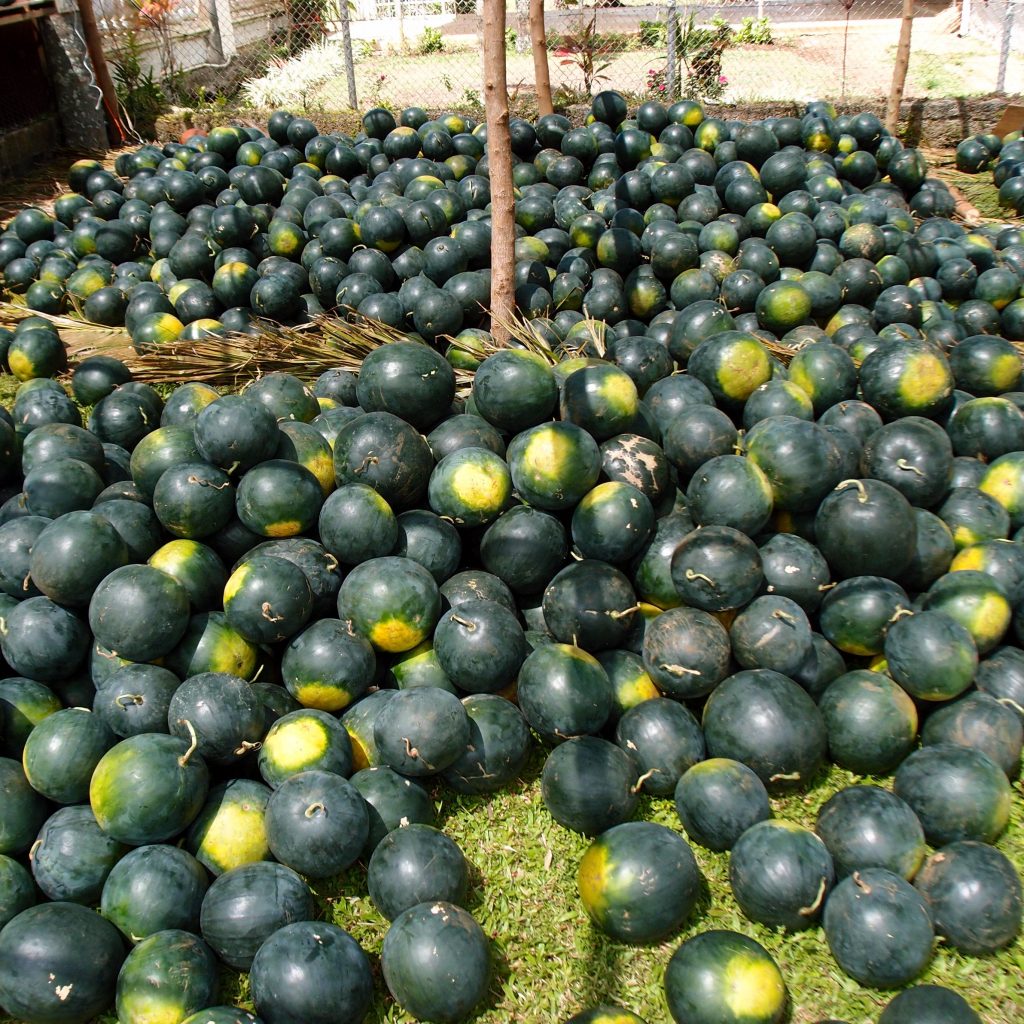
Watermelon in Tonga on sale after New Zealand ban. Photo/Supplied
“The length of the suspension will depend on how quickly Tongan authorities can investigate the situation and put measures in place to assure New Zealand that their treatment processes are working,” Biosecurity New Zealand’s Director of Animal and Plant Health, Peter Thomson, said.
Thomson told Kaniva News New Zealand authorities were working with their Tongan counterparts, but work was being done virtually because of Covid-19 related closures.
“That said, the work is progressing well,” Thomson said.
There were hopes in Tonga that the melon trade to New Zealand can be up and running again this month, but a source told us it could take a while before the ban would be lifted.
“I guess there is a huge non-compliance by Tonga in this case,” the source said.
Live fruit fly larvae were detected at the New Zealand border on a consignment of watermelons from Tonga on October 13.
A week later, Chairman of the Whole House Committee, Lord Tu’i’afitu called on the government to take action immediately, easing the burden on the nation’s watermelon growers.
Kaniva News has asked Tonga’s Minister of Agriculture whether the government had helped local watermelon growers financially. We are waiting for a response.
As we reported last month, watermelon growers in Tonga have called on the government to help pay for their crops. Some farmers have borrowed thousands of pa’anga to grow watermelons.
Growers told us they were paid 50 percent of the price for the melons in Tonga and were told the other 50 percent would be paid after the melons were cleared in New Zealand for the buyers.
Jerry Prendergast from United Fresh, which represents the New Zealand produce industry, said the suspension of imports would devastate Tongan growers. He estimated the value of the outstanding imports at about $1.6-2 million.
Tonga’s two main watermelon exporters are Nishi Trading and the Tonga Farmers’ Co-operative Ltd, each of which has its own growers.
Local media have reported that the domestic price of watermelon has dropped to TP$3-5 for export quality fruit being sold by the roadside by farmers anxious to sell their melons.
At the end of last month Minoru Nishi of Nishi Trading said 100 tonnes of watermelon meant for export had been offloaded onto the domestic market with another 400 tonnes likely to be put up for sale.
The Supreme Court has quashed a decision by Minister for Tourism Akosita Lavulavu to deny whale watching and swimming licenses to a group of companies.
Lord Chief Justice Whitten said the Minister’s decisions were infected by errors of law.
Hon ‘Akosita Lavulavu
The judge criticised Hon. Lavulavu’s behaviour and said citizens had legitimate expectations of natural justice and procedural fairness.
A total of six companies, Jones Business Services Ltd, Endangered Encounters Ltd, Shell Garden Ltd, Tongan Expeditions Ltd, Whales in the Wild Ltd and Diane Clarke trading as Vaka Vave all had their licenses effectively curtailed and appealed the Minister’s decision.
In February this year Hon. Lavulavu, declined each of the plaintiff’s applications for whale watching and whale swimming licences.
The whale watching industry is regulated by the Whale Watching and Swimming Act. The Act was amended in 2012, and in 2013, the Whale Watching and Swimming Regulations came into effect.
In May that year, the Ministry issued a press release saying that licences would be valid for a three years and could be renewed upon application.
Each of the plaintiffs applied for and were issued licences. The Ministry’s cover letter for each licence advised the licence holder to submit an a notice of continued activity to the Ministry “for the next three years” in order to maintain their licence.
In July 2015, all operators were advised that all applications for licences would be administered by the Ministry of Tourism. In 2016, the plaintiffs applied to the Ministry of Tourism, with payment of the relevant fees, and were granted, renewed licences.
Each of the plaintiffs applied for renewal of their licences, paid the relevant renewal fees and were issued with renewed licences, which they received between July and September 2019. Each bore a date of issue of July 1, 2019 and an “expiry date unless renewed” of November 30 the same year.
On receipt of their 2019 licences, the plaintiffs commenced preparations for that season. They also planned and received deposits for new and recurrent bookings for the 2020 season. On the basis of the earlier Ministry’s confirmation in 2013, and payment of their renewal fees in 2016 and 2019, the plaintiffs believed their 2019 licences were valid for a period of three years.
In February this year the Minister said the number of licences issued under the Whale Watching and Swimming Regulations 2020 would be limited to not more than seven for Tongatapu, 20 for Vava’u, 10 for Ha apai, and four for ‘Eua.
On February 27, 2020, Hon. Lavulavu wrote to each of the plaintiffs, telling them their applications had been declined.
The businesses lodged an appeal and in correspondence with the complainants the Minister cited what she said was scientific evidence showing that their activities would interfere with the whales, the Covid-19 pandemic and Cyclone Harold.
She promised a decision would be made no later than the end of June, but in May lawyers for the plaintiffs lodged a complaint with the Ombudsman’s office challenging the validity of the Minister’s decision to decline the plaintiffs’ applications.
On June 17 the plaintiffs were granted leave to apply for judicial review of the decisions.
After reviewing submissions and evidence in the case, Lord Chief Justice Whitten said Hon. Lavulavu did not give the plaintiffs any notice that she was considering effectively cancelling their licences, the grounds for doing so and, perhaps most importantly, why she had chosen theirs over others which were renewed.
She did not give the plaintiffs any opportunity to be heard before making her decision.
“The Minister is commended to carefully bear in mind and give effect to those legal obligations if and when any future action pursuant to the Act and the Regulations might be considered in relation to the suspension or cancellation of licences,” the judge said.
The judge said the expiry dates of November 30, 2019 inserted on each of the plaintiffs’ 2019 licences were invalid.
Each of the plaintiffs’ licences issued in 2019 would continue to be valid for a period of three years from the date of their issue.
“The Minister’s decisions purporting to decline each of the plaintiffs’ whale watching and swimming licences issued in 2019 are quashed and set aside,” the judge said.
The Minister was ordered to pay the plaintiffs’ costs.
A man who broke into a Houmakelikao house and sexually assaulted a woman as she slept next to her husband has been given a three year jail terms.
Tongamoa Kakau, 32, served only six months of his three-year sentence after Judge Langi suspended two years for three years after his release.
Because the prisoner has no relevant or recent criminal conviction since he was convicted in 2004 for the offence of assault, Judge Langi deducted six months, leaving a total sentence of two years and six months.
Kakau was found guilty of one count of serious indecent assault contrary to section 124 (1) and (3) of the Criminal Offences Act.
In sentencing Kakau, Judge Langi said: “I take the fact that the accused is not remorseful and maintains his innocence and putting the witness through the trauma of having to give evidence as serious aggravating factors.”
The complainant and her husband were inside their bedroom sleeping in September 2019.
Between the hours of 3 – 4.00am, the victim woke up when she felt someone kissing her on the mouth and touching her vagina.
“At first, she thought it was her husband but upon closer inspection she realized that it was someone else. She yelled out her husband’s name and the accused got up and ran out of the bedroom.”
The victim told a probation officer that she had been emotionally affected by the ordeal and that a few weeks following the offending, she was furious with the defendant.
“Over time her anger was replaced with the feeling of embarrassment and humiliation over what had happened to her.”
“Despite this, she told the report writer that she has moved on with her life and relocating to a different island has had a positive impact in putting everything behind her and moving on with her life.
“She stated that a few days after the offending the defendant’s mother and sister came to see her and apologized to her and gifted her with $400. The accused did not go with them because he was still remanded in custody.”
The prisoner had later approached her and asked her to have the charges withdrawn so that he would be able to go overseas on the Fruit Picking Scheme.
Judge Langi said the prisoner was a reliable and hardworking young man who is currently responsible for taking care of his parents and siblings and his adopted daughter.
“He has however, found himself in an unfortunate situation caused by his own decision to go on a drinking spree that resulted in him committing something he would not have done if he had been sober.”
A landlord in Vava’u has vehemently denied writing and signing a letter which was submitted to the Ministry of Lands and Survey telling them he agreed to allow ousted Cabinet Minister ‘Etuate Lavulavu to quarry rocks on his land.
Hon. ‘Akosita and her husband ‘Etuate Lavulavu
Sione Tunufa’i Tui said his lawyer had served legal documents on Minister of Infrastructure ‘Akosita Lavulavu and her husband ‘Etuate.
The lawsuit came after Tui learned further quarrying activities operated on seven acres of his eight acre tax allotment in Ta’anea were based on a letter he said he did not know was submitted to the Ministry of Lands and Survey three years ago.
Tui said they only agreed for ‘Etuate to lease only three acres of his land.
The letter was written on September 5, 2017 to the Ministry telling the authority Tui had agreed to alter the lease purpose from business to quarrying.
The letter, which was written in Tongan, also claimed the reason Tui agreed to the lease was to facilitate ‘Etuate’s agreement with the Ministry of Infrastructure to provide quarrying activities.
“Not only that but also I agree to allow ‘Etuate Lavulavu and his Inter Pacific company to operate the tax allotment for quarry purpose and to sell it for profit,” the letter read.
A copy of the letter, seen by Kaniva News, was purportedly showed Tui’s signature.
Tui denial
Tui told Kaniva News in an exclusive interview this afternoon he knew nothing about the letter.
He said the first time he knew about it was when he was handed a copy by a staff member at the Ministry of Lands and Survey after he made inquiries.
“I decided to use the law to resolve our problems and this was just the beginning,” Tui said.
He said he had also taken legal action against Hon. ‘Akosita because Etuate allegedly subleased the tax allotoment to her.
In another letter seen by Kaniva News, Tui wrote to the Minstry of Lands on January 27, 2020 and told its CEO he wanted to cancel the lease in question.
“The letter of September 5, 2017, which purported to show it was written by me was not mine. That was not my signature. And I haven’t seen any paper work like that before,” the letter read.
“We never talked about leasing and for a payemnt of $1500 per year. They were all made up by ‘Etuate Lavulavu,” Tui claimed.
Tui told the Ministry the signature he used to sign his letter of 27 January 2020 was his real signature which was totally different from the signature appeared on the letter apparently submitted to the Ministry dated on September 5, 2017.
‘Etuate’s response
‘Etuate, the People’s Party Deputy Chairman – the Party in which the Prime Minister was a founding member – told Kaniva News Tui signed the letter and there were people who could bear witness to it.
He claimed Tui’s signature varied whenever he signed.
He claimed he did not forge the letter or falsify any documents.
‘Etuate also alleged some opposition politicians were behind Tui and wanted to defame him.
As Kaniva News reported last week, ‘Etuate came under the spotlight after Prime Minister Tu’i’onetoa revealed Inter Pacific Ltd was one of the three contractors the government awarded with contracts to supply rocks for the government’s new multimillion road project.
‘Etuate was made a Director of Inter-Pacific Limited in February 2016, but was replaced by ‘Inoke Finau Vala in May this year.
In 2016 Tonga’s Supreme Court convicted ‘Etuate of bribery and spending over the legal limit on his 2014 election campaign.
The judge said Lavulavu was not a credible witness and that his evidence was implausible, evasive and untruthful.
Last year, the Supreme Court also ruled that ‘Etuate and Akosita must jointly stand trial on three counts of obtaining money by false pretences and three counts of knowingly dealing with forged documents.
The charges arise from an investigation of the finances of the ‘Unuaki ‘O Tonga Royal Institute, a private education provider.
Akosita was the director and ‘Etuate was the president.
A decision by the Tu’i’onetoa government to quarantine all international cargo which arrived in the kingdom has fuelled a debate among Tongans on social media.
The sudden restrictions came into effect yesterday November 16.
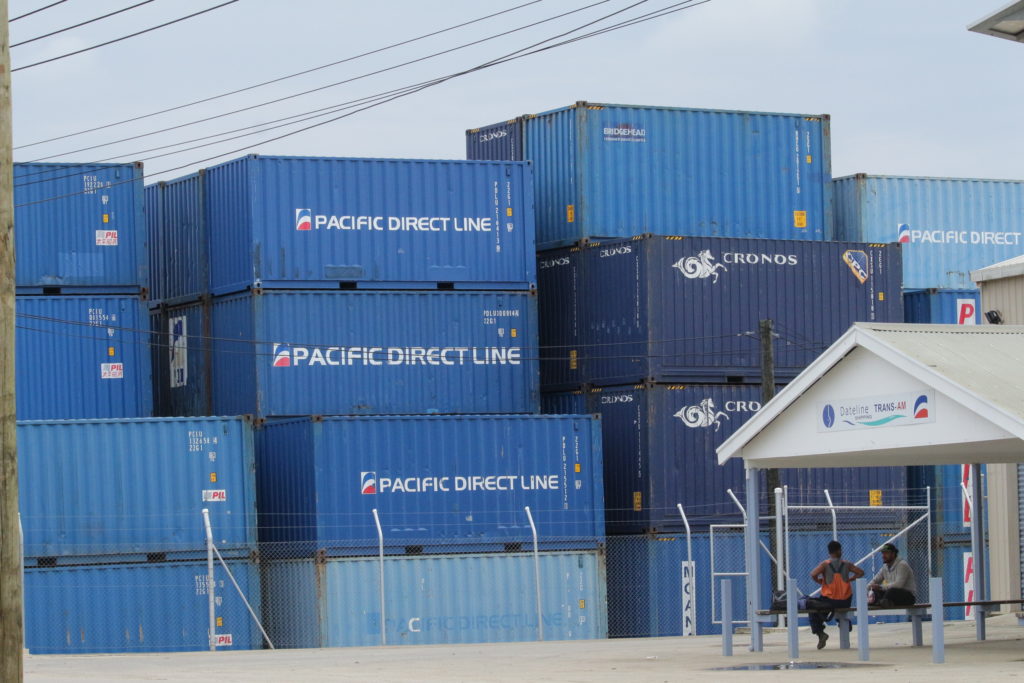
Shipping containers at Queen Sālote Wharf. Photo/Kalino Lātū
“3 Days Quarantine of International Cargo unloaded at Queen Salote International Wharf and Halaevalu international wharf,” a press release by the Minister of Infrastructure said.
It said all international cargo arriving in Tongatapu and Vava’u “must be quarantined for three days before releasing to agencies.”
Since there was no further information by the government to explain why the decision was made, online users took to Facebook to share their concerns.
“Don’t know why they do it. If there will be any virus coming with the cargo they will automatically be cleared while the ship was at sea,” a commenter said.
Critics of the decision said they were concerned about the safety and security of their goods sent to their family while they would be controlled at the wharf during this three-day quarantine.
“Why now?” another commenter said implying the government should have done it before and while New Zealand went into lockdown.
Some commenters believed the government made the decision after China has claimed yesterday it’s found Covid-19 on food products imported from New Zealand.
Prime Minister Jacinda Ardern has rejected the claim.
Experts said the virus can survive within refrigerated environments and can live for a time on surfaces outside the human body.
China has reported instances of the coronavirus being detected on the packaging of imported frozen seafood.
“In July China claimed that it had detected the virus in the outer packaging of frozen shrimp from Ecuador, as well as the container walls housing the seafood. However, subsequent tests cleared the food itself of carrying the virus.”
The man who hit her wife with a rock hammer wounding her forehead and back of her head has been sent to jail for three years.
Judge Laki Niu has suspended the last two years of his jail terms from the date of his release on the conditions that he committed no offence punishable with imprisonment for three years.
Toio Lauteau, 43, was found guilty of causing serious bodily harm to his wife on 7 May 2018 at their home at ‘Ohonua, of which he was convicted on 15 September 2020 after a two-day trial at Nuku’alofa Supreme Court.
Lauteau denied causing the injuries to his wife at all. His wife has also claimed that her husband did not cause the injuries that she sustained.
“You would maintain that she had fallen and cut her forehead on the corner of the table and had cut the back of her head on the corner of the walls of the hall way and the lounge,” Judge Niu said.
Mr Niu however did not buy it.
He said three things proved that Lauteau caused the injuries to his wife:
“When your wife arrived at the hospital at ‘Eua, she was covered in blood and she had facial swelling and back of the head swelling and two cuts – one “L” cut on the right side of the forehead and a lineal cut on the back of the head.
“She told the doctor that you had hit her with a rock hammer and caused those injuries. She also told the police officer, Viliami ‘Arnone, the same thing and he wrote her statement and she signed it as the truth.
“The doctor required that she see the rock hammer herself to decide whether or not to require your wife to be sent to Vaiola Hospital for Xray of her skull to ensure there was no cranial fracture or indentation or haemorrhage. She inspected the rock hammer, and she was positive that the two cuts to your wife’s forehead and back of the head were caused by the rock hammer. (c) The doctor herself observed that your wife looked scared and shocked.
“I am sure she was scared for her life and that is consistent with her description in her statement which Viliami ‘Arnone wrote down of what you had done to her, namely, hitting her on her forehead and on the back of her head with the rock hammer.”
Lauteau’s counsel Sione Taione said there was big change in his client’s life when he gave up drinking.
“You have now shown maturity and responsibility and respectability, and you have become a good member of the church, abstaining from tobacco, alcohol and drugs. He accordingly submits that it would be appropriate that the imprisonment sentence to be imposed on you be fully suspended.”