A Tongan scholar at the University of Auckland is undertaking research into the genetic factors linked to metabolic diseases, with the aim of improving health outcomes for Pacific communities.
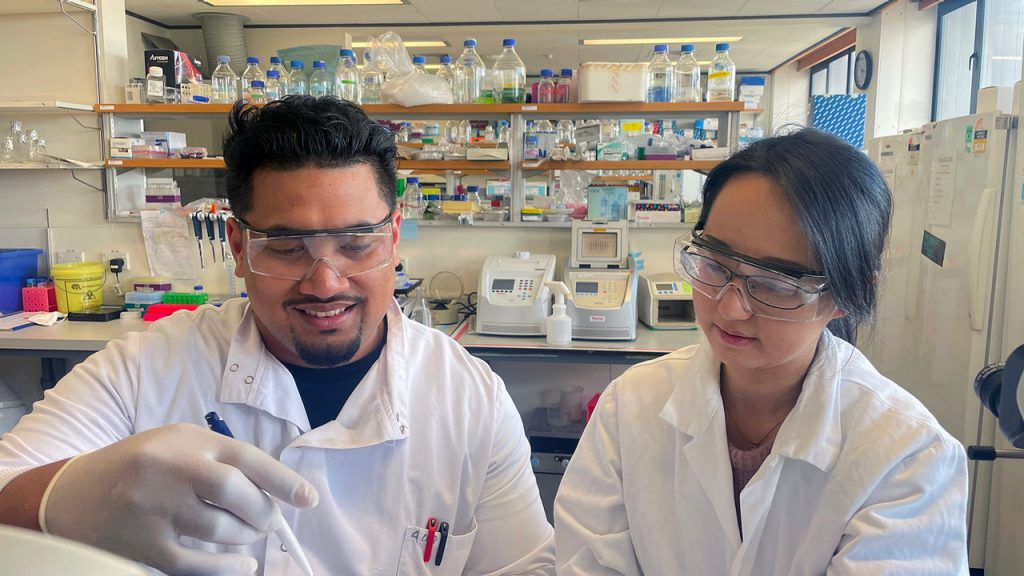
Dougie ‘Atiola, a biomedical science PhD candidate at the University of Auckland, says his path into research was shaped by a life-changing experience as a teenager in Tonga.
At the age of 14, ‘Atiola was hospitalised with meningitis, an experience that left a lasting impression and sparked an early awareness of the importance of quality healthcare.
“That experience shaped how I saw health and the need for better outcomes in our communities,” he said.
‘Atiola traces his whakapapa to Hofoa and Kolomotu‘a through his father, Alifeleti ‘Atiola, and to Kolonga and Vaini through his mother, ‘Aioema ‘Atiola. He is the second youngest of seven siblings and grew up in a household where education and church were central to daily life.
After completing his secondary education at Tupou College, Toloa in 2012, he moved to Aotearoa New Zealand to pursue further studies, beginning with a Certificate in Health Sciences before progressing to a Bachelor of Science in Biomedical Science at the University of Auckland.
It was during his undergraduate studies that ‘Atiola was introduced to research exploring how genetic variations among Polynesian populations are linked to metabolic conditions.
“That was a turning point,” he said. “I realised that becoming a doctor isn’t the only way to improve health outcomes for our people. Research is another powerful pathway.”
That realisation led him to pursue postgraduate studies, completing a Master’s degree with First Class Honours and later embarking on a doctoral programme in biomedical science.
For ‘Atiola, the pursuit of a PhD is about more than personal achievement. He sees it as part of a wider effort to increase Pacific representation in academia and break down barriers facing underrepresented communities.
“It’s about visibility, leadership, and smashing the brown ceiling,” he said.
Alongside his research, ‘Atiola is actively involved in mentoring Māori and Pacific students, sharing his experiences and encouraging others to consider careers in science and research.
He hopes his journey will inspire younger Pacific people — particularly those raised in Pacific Island nations — to see that higher education and academic careers are within reach.
Looking ahead, ‘Atiola aims to build a long-term career in academia, contributing to Pacific-led research that delivers tangible benefits for communities across the region.
“If my journey helps even one young Pacific person believe they belong in research,” he said, “then the work I’m doing is serving its purpose.”