Tropical Cyclone Urmil continues to affect Tonga despite weakening and moving further away from the southern island groups.
According to a 5pm advisory issued by the Tonga Meteorological Services, the cyclone, now a Category 1 system, is expected to move out of Tonga’s maritime boundary later tonight, but heavy rain, damaging winds and hazardous seas are still forecast to impact several areas.
At 3pm today, the system was positioned about 805 kilometres west southwest of Nuku’alofa and was moving southeast at a speed of 23 knots.
Meteorologists reported maximum sustained winds near the centre of about 50 knots, with momentary gusts reaching as high as 120 to 140 kilometres per hour.
The storm’s associated cloud bands continue to produce widespread heavy rain, poor visibility and high to very high seas reaching between seven and ten metres, while strong northwesterly swells of four to six metres are expected to remain dangerous for coastal communities.
The Meteorological Service has maintained several warnings for land and coastal areas, including a gale warning for Ha’apai, Tongatapu and ‘Eua, and heavy rain and flash flood advisories for Vava’u, Ha’apai, Tongatapu and ‘Eua.
Vava’u remains under a strong wind warning. Marine warnings also remain in place, with storm warnings and damaging swells affecting the Tele‑ki‑Tonga and Tele‑ki‑Tokelau waters, while gale and strong wind warnings apply to the coastal waters of Ha’apai, Tongatapu and ‘Eua. A small craft advisory continues across all island groups due to dangerous sea conditions.
As the system tracked southeastward today, regional forecast models continued to show Urmil drawing closer to the southern maritime zones. By midday, the cyclone was sitting about 880 kilometres west southwest of Nuku’alofa and moving east southeast at roughly 36 kilometres per hour.
While Tonga braces for the cyclone’s continuing influence, Fiji has been dealing with heavy flooding after the system passed about 520 kilometres southwest of Nadi earlier this morning. Several roads were inundated and emergency officials issued warnings urging motorists to avoid flooded areas.
Photos shared on social media show fallen trees lying across the road, with authorities later seen cutting and removing them this afternoon. The clean‑up followed reports of heavy rain across Tongatapu and a small earthquake that was felt by some residents.
A man has been taken to hospital after a shooting in the Auckland suburb of Papakura late this morning.
Police say officers were patrolling the Clevedon Road area at around 11.20am when they heard what sounded like gunshots. A short time later, they located a man suffering from a gunshot wound.
St John Ambulance confirmed they were alerted at 11.24am and responded with two ambulances, a rapid‑response unit and a manager.
Paramedics treated the injured man at the scene before transporting him to Middlemore Hospital, where he remains in moderate condition.
Police, supported by the Armed Offenders Squad, carried out inquiries at a property on Grove Road, though no arrests have been made at this stage.
Investigators believe the incident was targeted.
“We are following strong lines of enquiry in relation to the people allegedly involved in this incident. Initial indications are that the victim and the offenders are known to each other and there is no risk to the wider community,” a police spokesperson said.
Cordons that were put in place around Grove Road have since been lifted, and police thanked affected residents for their patience.
A continued police presence is expected in both the Clevedon Road and Grove Road areas throughout the evening as officers work to establish what happened. Witnesses reported the Police Eagle helicopter circling overhead earlier in the day as part of the response.
Police are urging anyone with information to come forward as the investigation continues.
Nuku‘alofa, Tonga – The National Tsunami Warning Centre has issued a Tsunami No Threat Advisory following a magnitude 6.1 earthquake that struck southwest of Tonga this evening.
It was recorded at Latitude 21.9° South and Longitude 179.3° West, at a depth of 590 kilometers, with the epicentre located approximately 430 kilometres southwest of Nuku‘alofa.
Officials stated that, based on current seismic data, “a result tsunami wave is unlikely to affect Tonga.”
The magnitude remains provisional and may be updated as further analysis is completed.
The National Tsunami Warning Centre emphasised that this is the final message for the event unless significant changes occur.
Social media platforms lit up this evening with reports from residents across Tonga who say they felt strong shaking after an earthquake struck near the island nation.
One of the earliest social media posts came from Kaufaki Monukaeafe, who wrote in Tongan: “Mālō pē hao” — a phrase expressing relief, translated as “Thanks, we are just saved.”
His post drew immediate engagement, including a commenter who asked, “Was it big or small?”
Monukaeafe has not yet responded to clarify the strength of the shaking.
Auckland, NZ — A major search operation is underway after a man was swept off the rocks while fishing south of Piha on Sunday morning.
Police say the man was fishing at Union Bay, Karekare, when a wave knocked him into the water at around 10.15am. Search teams from Police, Coastguard and Surf Lifesaving New Zealand were immediately deployed, but as of early afternoon there was still no sign of him.
Surf Lifesaving New Zealand confirmed the man was washed away near Farley Point, and that the alarm was raised by a witness who ran to the Karekare Surf Life Saving Club for help.
Lifeguards launched a wide search between Karekare Beach and Mercer Bay using four rescue watercraft and an inflatable rescue boat, supported by the Piha search and rescue squad.
By 1pm, lifeguards were stood down, though Police said the operation was continuing, with additional searches to be carried out at low tide later in the day.
Union Bay and the surrounding Karekare coastline are known for powerful surges and unpredictable swell, and authorities regularly warn rock fishers to take extreme care in the area.
Sunday’s incident comes just hours after the body of a missing kayaker was discovered in Waiwera, north of Auckland — the second serious water‑related emergency in the region the same day.
Police have not released further details about the missing fisherman, and the search remains active.
As Cyclone Urmil tracks southward, Tonga faces rising threat levels while Fiji battles heavy flooding left in the storm’s wake.
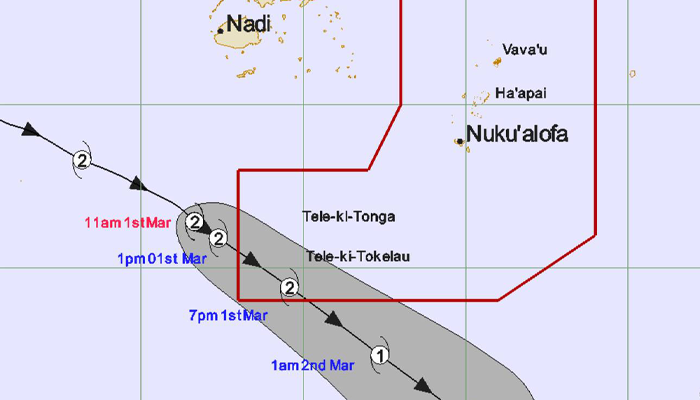
The forecast map shows Cyclone Urmil tracking southeast from west of Fiji, with projected positions marked from 11am 1st March to 1am 2nd March as the system moves toward the southern waters of Tonga, passing south of Nadi and approaching the Tele‑ki‑Tonga and Tele‑ki‑Tokelau zones.
Fiji Authorities said the cyclone was located about 520 kilometres southwest of Nadi at 6am, bringing intense rainbands and strong winds across multiple divisions.
Although the system is not expected to track directly over Fiji, the Fiji Meteorological Service said Urmil was moving southeast at about 30km/h and generating widespread downpours.
Officials warned motorists to avoid flooded roads and to remain alert to changing conditions.
Warnings Strengthen Across Tonga
In Tonga, the cyclone now poses a growing threat as it continues to track east‑southeast across the region.
The Fuaʻamotu Tropical Cyclone Warning Centre said at 1pm on Sunday that cyclone warnings remain in force for Tongatapu, ʻEua, Tele‑ki‑Tonga and Tele‑ki‑Tokelau.
At midday, Cyclone Urmil was positioned about 880 kilometres west‑southwest of Nukuʻalofa, moving east‑southeast at roughly 36km/h.
The system is carrying sustained winds of 100km/h, with gusts reaching up to 140km/h near its centre.
Gale warnings also remain active for Haʻapai, Tongatapu and ʻEua, while Vavaʻu is currently under a strong wind warning. Authorities say wind speeds are expected to increase gradually as the cyclone draws closer.
Heavy rain warnings and flash‑flood advisories remain in effect for Vavaʻu, Haʻapai, Tongatapu and ʻEua. The warnings have raised concerns about flooding in low‑lying and flood‑prone communities.
Marine conditions are also expected to become hazardous as the system progresses. Storm warnings and damaging swells are still in force for Tele‑ki‑Tonga and Tele‑ki‑Tokelau waters, with gale warnings in place for Haʻapai, Tongatapu and ʻEua coastal waters.
Rough Seas Expected
All coastal waters across Tonga remain under a small‑craft advisory, with authorities urging fishers and small boat operators to stay ashore. Large swells and rough seas could make navigation extremely dangerous.
Forecasters say associated heavy rain, strong winds and damaging gale‑ to storm‑force conditions will affect several island groups over the next 24 hours.
They are urging residents in exposed areas to secure property, monitor weather updates and follow official safety instructions.
Emergency authorities in Tonga warn that conditions may deteriorate quickly as the cyclone continues its approach. They advise communities to prepare for potential power outages, flash flooding and disruptions to inter‑island travel.
Explainer – As the world reels from reports that Iran’s Supreme Leader Ayatollah Ali Khamenei was killed in a US–Israel strike, Tonga’s own unusual connection to Iran — despite having no diplomatic relations — has come into sharp focus through the growth of a faith founded in Persia, the modern Iran.
In the wake of the massive US–Israel joint operation known as Operation Epic Fury, President Donald Trump has claimed that Khamenei was killed in the opening wave of strikes targeting senior regime figures.
According to other accounts, dozens of top Iranian security and military officials were also eliminated in the coordinated attack, with as many as ten high‑ranking leaders reportedly killed when Khamenei’s fortified compound came under direct fire.
Statements attributed to President Trump described the strike as an effort to give Iranians their “greatest chance” to reclaim their country, while Iranian state media alleged that several members of Khamenei’s family were also killed, though details remain unclear.
Israeli officials told Fox News that more than 40 senior regime operatives were taken out in the first hours of the operation, underscoring the unprecedented scale of the assault.
Shared Faith, No Diplomacy
Tonga and Iran occupy opposite ends of the geopolitical landscape: one a small Pacific kingdom, the other a major Middle Eastern state deeply involved in regional conflict.
Yet the two nations share a unique, indirect connection through the Bahá’í Faith, a religion founded in 19th‑century Persia that today has a meaningful presence in Tonga.
Despite this religious link, Tonga has no formal diplomatic relations with Iran, and the two countries have never exchanged ambassadors, embassies, or bilateral agreements.
A Religion With Iranian Origins
The Bahá’í Faith was founded in the mid‑19th century by Mírzá Ḥosayn ʿAlī Nūrí, known as Bahá’u’lláh, who was born in Tehran in 1817. Britannica confirms that the religion began as a reformist movement rooted in Persia before emerging as a global faith.
It grew out of the Bábí movement, also founded in Iran by the Báb (Mírzá ʿAlí Moḥammad of Shiraz) in 1844. Both central figures of the Bahá’í Faith were Iranian.
After enduring persecution in Iran, Bahá’í communities migrated and expanded worldwide, eventually establishing a significant footprint across the Pacific.
Tonga’s Significant Bahá’í Community
Tonga and its global diaspora are home to a significant Bahá’í community.
Detailed demographic studies of Tonga’s Bahá’í population show:
The World Religion Database (2015) estimated that Bahá’ís represented 3.5% of Tonga’s national population.
With Tonga’s population around 105,000, this equates to roughly 3,600 followers.
This makes the Bahá’í Faith one of Tonga’s larger minority religions, with deep roots in Tongan society since the mid‑20th century.
The Bahá’í Faith was introduced to Tonga in 1954 by pioneers following global expansion plans initiated by the Bahá’í leadership.
The first Local Spiritual Assembly was formed in 1958, and by the early 2000s, Tonga had dozens of local assemblies and its own Bahá’í school, the Ocean of Light International School.
Missile debris has fallen near the location of the Tongan Embassy in Abu Dhabi as Iran and the wider Gulf reeled from retaliatory strikes, while conflicting reports emerged over the fate of Iran’s Supreme Leader.
Israel’s prime minister says there are “growing signs” Ayatollah Ali Khamenei is “gone” following US–Israel attacks that heavily damaged his compound, according to BBC‑cited briefings, even as Iranian officials insist the leader remains “safe and sound” and deny reports of his death.
Meanwhile, multiple explosions were reported across Abu Dhabi’s Corniche district — the location of the Tongan Embassy at Etihad Towers on Corniche Road — as missile interceptions sent shockwaves through the area.
Witnesses told Reuters that several rapid explosions caused windows to shake in homes near the Corniche following the incoming strikes.
The UAE Ministry of Defence confirmed that missile debris fell across several parts of Abu Dhabi, reporting one civilian fatality caused by falling shrapnel in a residential area.
The attacks came as Iran targeted Gulf states hosting American military bases, including the Al Dhafra Air Base—located about 30 kilometres from the city centre—which was among Tehran’s stated objectives.
The Tongan Embassy has not yet updated the advisory it issued on Friday for Tongan residents and travellers in the region following the latest missile strikes.
Corniche Area Among Impact Zones
One witness interviewed by Reuters said she heard “five booms in rapid succession” that shook windows in a house near Abu Dhabi’s Corniche, confirming that the area around Etihad Towers experienced the shockwave from falling missile fragments or interception blasts.
The Corniche waterfront is a high‑density area home to foreign missions, luxury hotels and government buildings.
While there is no official confirmation that missile debris struck Etihad Towers directly, the confirmed proximity of explosions means the Tongan Embassy was within the affected impact zone.
Residents in both Abu Dhabi and neighbouring Dubai reported seeing missiles streaking across the sky, with air defence systems intercepting many of the threats.
Claims of Death
Reuters reported that Iran’s Supreme Leader — long seen as the architect of the nation’s anti‑US posture and regional military reach, while suppressing waves of domestic dissent — was killed in joint Israeli and US strikes, according to a senior Israeli official quoted by the news agency on Saturday.
Israeli Prime Minister Benjamin Netanyahu says there are “growing signs” that Iran’s Supreme Leader, Ayatollah Ali Khamenei, may have been killed in the US–Israel strikes, citing intelligence that his compound in Tehran suffered extensive damage, according to the BBC.
Satellite images earlier showed the Supreme Leader’s residence heavily hit, while Israel claims that “several senior figures” within the Iranian regime have already been eliminated during the operation.
Netanyahu concluded his remarks by urging Israelis to follow safety instructions from the Home Front Command, signalling that military operations against Iran are likely to continue “for as long as necessary.”
Regional Retaliation and Escalation
The Iranian missile launches followed massive US–Israel joint strikes on Iranian targets earlier in the day.
According to Emirati authorities, several waves of incoming Iranian missiles were intercepted over Abu Dhabi. Missile debris fell in areas including Saadiyat Island, Khalifa City, Bani Yas, Mohamed bin Zayed City and Al Falah, but the government also confirmed debris fell in other unspecified locations—one of which resulted in a fatality.
The UAE Defence Ministry described the Iranian attack as a “blatant violation of national sovereignty”, warning that the state reserves its full right to respond.
Authorities temporarily closed the UAE’s airspace, suspended flights at Dubai International Airport, and issued mobile alerts instructing residents to stay away from windows and move to safe areas.
What It Means for Tongans in the Region
As of publication, there are no reports of injuries involving Tongan citizens or embassy staff.
Given the proximity of the strikes to the Corniche district, Tongans living in Abu Dhabi—especially those near Etihad Towers—are urged to maintain extreme caution.
The Embassy has asked all Tongans in the UAE and across the Gulf to:
Register with the mission immediately
Avoid unnecessary travel
Monitor official safety alerts
Remain indoors during any further missile activity
Tonga has issued a public alert urging all Tongan nationals living in or travelling through the Middle East and North Africa (MENA) to exercise heightened caution, following the United States and Israel launching major, coordinated strikes across Iran on February 28 — a military operation described by President Donald Trump as “major combat operations,” targeting Iranian military and nuclear‑linked sites and prompting widespread regional retaliation.
President Donald Trump announced that the United States had initiated what he called “major combat operations” in Iran, urging the Iranian public to rise up against their clerical leadership once the military campaign concludes.
Israel’s Defence Minister, Israel Katz, said the Israeli military had launched a “pre‑emptive attack” intended to neutralise threats emanating from Iran.
Iran’s Foreign Minister, Abbas Araghchi, condemned the strikes as “wholly unprovoked, illegal, and illegitimate,” accusing both nations of violating international norms.
Tehran retaliated by firing missiles towards Israel and several Gulf states hosting American military bases — including Bahrain, Kuwait, Qatar and the United Arab Emirates — escalating fears of a broader regional conflict.
Explosions were heard in the city of Haifa and elsewhere in Israel, but it was not currently clear if these were impacts or interceptions.
The warning followed weeks of escalating threats from President Donald Trump, who had repeatedly signalled that the United States would take military action if Iran refused to agree to a new nuclear deal.
Early strikes by US and Israeli forces targeted the compound of Iran’s Supreme Leader Ayatollah Ali Khamenei — a long‑standing adversary of the West known for suppressing dissent and backing regional proxy groups.
A source indicated that Khamenei had been moved to a secure location outside Tehran before the attack, though his condition could not be independently confirmed. Satellite images, however, showed extensive damage to his headquarters in the capital.
Embassy Issues Alert
The Embassy of the Kingdom of Tonga in Abu Dhabi has issued a public alert urging all Tongan nationals living in or travelling through the Middle East and North Africa (MENA) to exercise heightened caution amid increasing regional tensions.
In a notice released on February 26, the Embassy warned that any escalation in the volatile geopolitical climate could disrupt travel and create unforeseen risks for Tongans currently in the region.
“Any escalation may result in travel disruptions and other unforeseen impacts for those currently in the region,” the notice stated.
The Embassy advised Tongan citizens to remain vigilant at all times, avoid unnecessary travel, and immediately register their name and contact details with the mission.
Registration will help the Embassy track and assist Tongans should the security situation deteriorate.
Tongans residing in the UAE or transiting through Middle Eastern countries were also encouraged to contact the Embassy directly for updates or urgent assistance.
The public advisory follows similar alerts issued by foreign missions in recent weeks as political and military tensions continue to rise across parts of the Middle East.
The Embassy provided official contact channels for all registrations and inquiries:
As more Tongans across the United States and the wider diaspora come forward with allegations about a recently collapsed Ponzi‑style scheme—alongside renewed concerns about an earlier, high‑profile case still awaiting trial—Kaniva News is sharing fresh FBI guidance urging anyone who believes they have been victimised to report the matter directly to its Internet Crime Complaint Center (IC3).
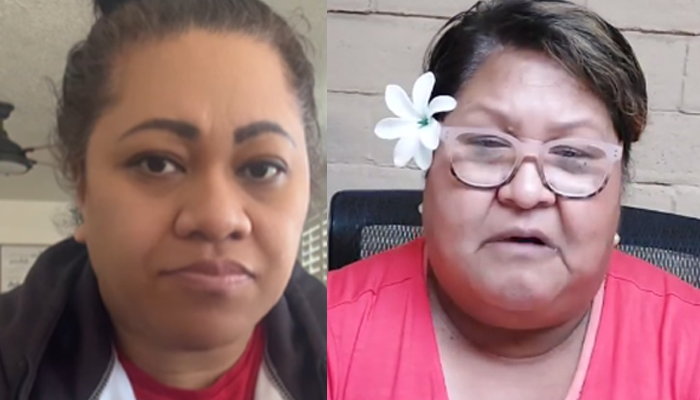
Victorine ‘Polygirl’ (left) and Tilila Walker appear in a composite image illustrating two separate alleged investment schemes affecting the Tongan diaspora, as the FBI urges potential victims to file reports through its Internet Crime Complaint Center (IC3).
Earlier this week, we reported that a Tongan woman in Salt Lake City, known on Facebook as Victorine Polygirl, had clashed publicly with investors on social media.
Many said they were misled into believing the scheme she aggressively promoted on social media would deliver rapid, high‑yield returns. Some labelled her a “liar” (“loi”) and “mata fefeka” (hard‑faced), expressing frustration over failed payouts and unanswered messages.
While full details of the investment remain unclear, reports and complaints on Facebook indicate that a significant number of people invested substantial sums, in some cases reaching hundreds of thousands of dollars.
Investor email reveals rising frustration
A copy of an email purportedly sent to Victorine by an investor — and obtained by Kaniva News — highlights the growing desperation among those who say they entrusted her with money, as well as the apparent lack of any formal contract or documentation supporting the investment.
“My name is Lavinia Fuapau, I zelle you $6000,” the sender wrote.
She continued:
“Back in April of 2025 for a ROI of $12,000 as you promised on advertising 2 yrs get 100% back.”
The email also raised concerns about missing paperwork:
“I have been asking you several times for my contract agreement forms but you never filled it out as you supposed to do.”
Appealing to Victorine’s sense of responsibility, she added:
“Let me remind you, what you have is blessed by the people.”
The message concluded with a blunt demand:
“I am out of patience, no patience anymore and I need you to send back… just my 12,000 that I entrusted with you.”
We have contacted Fuapau for comment.
This email reflects dozens of similar complaints across Facebook, where frustrated investors say their money has not been returned and promises of profits have not materialised.
Victorine’s social media responses
Victorine’s replies to criticism varied widely. At times, she claimed the funds were being invested in multiple business ventures in which participants would supposedly hold shares.
In other posts, she appeared frustrated—mocking investors with facial expressions—while elsewhere accusing her critics of “defaming her.”
On livestream, she showcased what she described as a soap‑making business and claimed the products were being sold in a shop. In another video, she walked through a building with an attached shop and unfinished carpentry work, saying it was a new restaurant.
These posts appeared intended to reassure investors that their money was being used to build legitimate businesses.
However, many viewers were unconvinced. Commenters argued that the sums Victorine collected were far too large for such small ventures to generate meaningful returns.
Several accused her of being “fake” and “pretending,” dismissing her demonstrations as insufficient to justify the funds taken.
Some also alleged she used investors’ money to build a luxurious home in Vavaʻu and purchase an expensive vehicle. Kaniva News was unable to verify these claims.
FBI advises victims to report immediately
In earlier communications with Kaniva News about Ponzi‑style operations affecting the Tongan community, the FBI emphasised that anyone who suspects they have been defrauded should act as quickly as possible.
The FBI advises victims to take the following steps:
Contact local, state, or national law enforcement to report what happened.
Submit a detailed complaint to the FBI’s Internet Crime Complaint Center (IC3) at www.IC3.gov, including names, dates, phone numbers, promises made, and all communication records.
The Bureau notes that even if a report does not immediately lead to enforcement action, victim submissions help investigators identify patterns, link related cases, and build evidence against suspected perpetrators.
The FBI also encourages victims to speak to someone they trust, noting that shame, embarrassment, or anger are common reactions — but reporting can turn those emotions into constructive action.
This guidance is particularly relevant now as Victorine’s alleged scheme draws comparisons with previous affinity‑based frauds targeting Tongans, including HyperFund, Validus, and Tongi Tupe — all of which left many families financially devastated.
FBI’s call for Tongi Tupe victims still open
Following our report earlier this month on Tongi Tupe and its founder Tilila Siola’a Walker Sumchai, who is set to stand trial in March 2027, several readers contacted Kaniva News saying they were victims and still hoped to recover their money.
The FBI’s appeal for potential victims remains open, nearly three years after the case began, as investigators continue to identify those affected by the Tongi Tupe investment programme.
The FBI is urging anyone who believes they were victimised to complete its official questionnaire to support the ongoing federal investigation.
Walker has been charged with wire fraud, mail fraud, securities fraud, and selling unregistered securities.
Court documents allege she defrauded more than 1,000 investors of over US$13 million, promising guaranteed returns before diverting the money to personal expenses — including gambling — and using new deposits to pay earlier investors.
Auckland, NZ – An elderly Tongan woman who says she lived in “constant fear” of her neighbours, including facing machete threats and an alleged attempt to run down her grandson, has been awarded $5000 after the Tenancy Tribunal found Kāinga Ora failed to protect her.
The woman, who has name suppression due to safety concerns, has lived at her Kāinga Ora home since 2019, the New Zealand Herald reported.
For years, she said, she endured escalating violence, harassment and intimidation from the family living next door at another Kāinga Ora property.
According to the Tribunal’s findings, the elderly woman and her family endured relentless intimidation from their neighbours, including racially‑charged abuse shouted over the fence and rubbish regularly thrown into their yard.
Loud music was blasted late into the night, rocks were hurled at the family, and they faced repeated threats of violence — several involving a machete.
Despite reporting the incidents numerous times, the woman said Kāinga Ora’s only advice was for her family to “keep to themselves” and avoid any engagement with the neighbours.
Machete threats and near‑miss with a vehicle
Police were called to three separate incidents involving the male partner of the neighbour, who lives at the property with the primary female tenant and their children.
In one incident in March 2024, the man stood at the elderly woman’s front gate holding a machete while shouting threats.
In the most serious situation, on 10 June 2024, the man allegedly threatened to kill the woman’s son while armed with both a shovel and a machete. He was later charged, though convicted of a lesser weapon‑related offence.
Another frightening moment occurred when the woman’s 14‑year‑old grandson was walking home from school. The neighbour allegedly chased the teenager with his car, driving onto the grass verge. The boy escaped only by hiding behind a parked boat.
The Tongan elder told the Tribunal the ongoing violence left her afraid to go outside. She suffered major health issues during this period, including a recent stroke.
At times, she was so fearful she stayed with her daughter instead of sleeping in her own home.
She initially hoped Kāinga Ora would remove the neighbours, but her declining health meant she eventually asked to leave the property altogether.
Kāinga Ora response criticised
Kāinga Ora acknowledged it had been notified about police call‑outs, noise problems and abuse.
However, it told the Tribunal the situation was “complex”, claiming there had been aggression “on both sides” after an altercation between the male neighbour and the Tongan woman’s son.
The agency also argued it could not terminate the neighbour’s tenancy because the man making the threats was not a listed tenant.
Tribunal adjudicator Melissa Allan was not satisfied with that explanation.
She ruled that Kāinga Ora should have applied to end the neighbours’ tenancy, saying the standard of proof required was civil, not criminal.
“The landlord only needed to prove that the tenant has been interfering with the reasonable peace, comfort and privacy of the neighbouring tenant,” she said. “The tenant has not felt free to move about her property and has been subjected to unreasonable levels of noise, rubbish being thrown, screaming, yelling and threats.”
By failing to act, Allan found, Kāinga Ora breached its responsibilities as a landlord.
The Tribunal ordered Kāinga Ora to pay the Tongan grandmother $5000 in compensation. The agency is now working to transfer her to a home that better matches her health and safety needs.
For the woman and her family, the ruling marks a long‑awaited acknowledgement of years of fear.