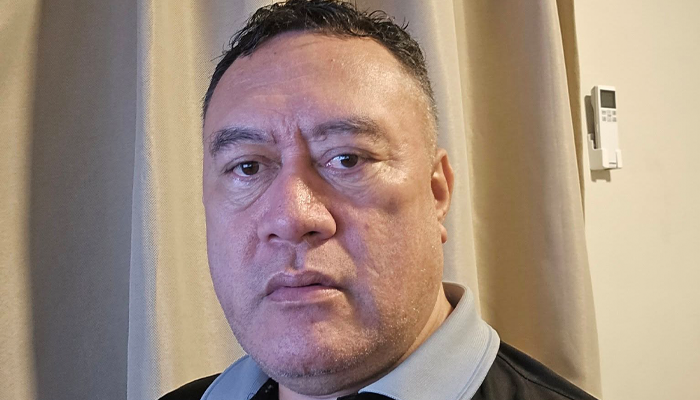
Vava Lapota, a Tongan town officer from Neiafu, Vavaʻu, who narrowly escaped Hawaiʻi’s deadly Lahaina wildfire in 2023, has returned to the devastated town two years after the tragedy that claimed 102 lives.
Vava Lapota and his brother at the site of the Lahaina wildfire—now partially redeveloped (inset). The larger image shows Tongan flags among others honouring those lost in the tragedy.
Among the victims was a Tongan family of four—Fa’aoso Tone, Malui’fonua Tone, Salote Tone, and Tony Takafua—who perished in their vehicle near their home.
Lapota, who described himself as the last Tongan to flee before authorities locked the gates to prevent more vehicles from entering the fire zone, arrived back in Lahaina this week after spending the last two years in Tonga.
“I was nervous at first, but growing up with hurricanes in Tonga—and with the fire raging in those strong winds—I managed to stay calm,” Lapota told Kaniva News.
Lapota, who is visiting his brother in Lahaina, said he was amazed by the rapid recovery of the fire-damaged area, noting how beautiful it looked.
He shared poignant images of flags lining the roadside, the Tongan banner among them, standing as a tribute to those lost in the August 8, 2023, disaster.
Lapota said: “This place holds so much pain, but also the memories of those we lost.”
His emotional return comes as the community continues to mourn the lives lost in one of the deadliest wildfires in U.S. history.
Authorities confirmed that all 102 victims have been identified, but two individuals remain unaccounted for as of February 2024.
Lapota’s survival and return serve as a poignant reminder of both the devastation and resilience of those affected.
The cause of the fire remains under investigation, while officials emphasise ongoing efforts to improve emergency response and wildfire prevention measures.
Tonga Police have apprehended a 49-year-old man and a 40-year-old woman, both residents of Halaleva, in connection with a housebreaking incident involving the theft of valuable Koloa Faka-Tonga—traditional Tongan cultural items—worth an estimated $20,300.
The arrests were made by the Crime Investigation Unit’s Property Squad after a 38-year-old woman filed a complaint.
Investigations uncovered that the stolen Koloa Faka-Tonga had been sold to a vendor at Talamahu Market, who acknowledged purchasing the items but stated they had already been resold.
Authorities also discovered that some of the stolen goods were allegedly shipped to New Zealand, with ties to a Tongan-operated money-lending business.
Police have since secured the items, which are now being processed for repatriation to Tonga.
The two suspects remain in custody and are expected to appear in court on 4 August 2025 to face charges related to the theft.
Tonga Police are urging the public to exercise caution when purchasing cultural or high-value items to avoid inadvertently acquiring stolen property.
Communities are encouraged to report any suspicious activities linked to housebreaking or the illegal trade of cultural artefacts.
Commentary – Kaniva News has been wrongly accused by Setita of Radio TV Tonga International of engaging in “fakamahamahalo” (suspicion – often carries negative connotations of distrust or bad faith) for using the term “allegation” in its reporting.
Kalino Latu, Editor and Publisher of Kaniva Tonga News
This unfounded criticism appears to stem from Setita’s personal dissatisfaction with a recent Kaniva News story—widely shared by reputable outlets, including The Pacific News Room Facebook group, with 70,000+ members and veteran journalists like Michael Field—about claims that three Tongan Cabinet Ministers allegedly pocketed $8 million in travel funds.
Rather than reaching out for clarification or engaging in constructive dialogue to uphold journalistic standards, Setita chose a public Facebook outburst, suggesting malice rather than a genuine concern for media ethics.
It appears her unwavering support for the former Hu‘akavameiliku government led to this unfounded criticism of Kaniva News.
It’s alarming that Setita chooses to act as an apologist for the accused rather than a watchdog for the public. This abandonment of journalistic responsibility undermines the very communities that rely on the media for protection.
The Misconception: ‘Allegation’ vs Fakamahamahalo
Setita inaccurately translated the journalistic term ‘allegation’ using the Tongan word ‘fakamahamahalo’, which carries a negative connotation, implying a tendency to lie or bad intention, such as the phrase mahalo kovi, literally meaning bad suspicion.
This is a fundamental misunderstanding.
In journalism, an allegation is a neutral term referring to an unproven claim of wrongdoing. Contrary to Setita’s assertion, it carries no inherent implication of falsehood or lying. Allegations play a crucial role in news reporting as they signal potential wrongdoing and highlight matters requiring public scrutiny and further investigation.
While allegations can drive significant outcomes—including key disclosures, public accountability, and potential legal consequences when verified—journalists must report them responsibly.
This requires maintaining strict standards of accuracy, providing proper context, and ensuring fairness to prevent the spread of misinformation.
Kaniva News adheres to global journalistic norms, where “allegation” is standard practice when reporting unproven claims.
Standard Journalistic Practice Worldwide
Setita, who also falsely accused Kaniva News of brainwashing people, argued that reports should refrain from publishing allegations (fakamahamahalo) and focus solely on facts.
This assertion contradicts fundamental journalistic practice.
While journalists must prioritise factual reporting and maintain objectivity, there are unavoidable circumstances where framing a report with allegations becomes necessary.
Setita of RTTI
Associate Professor Jason Bosland, Director of the Centre for Media and Communications Law at Melbourne Law School, explained the journalistic use of “alleged.”
Bosland clarified that terms like “allege,” “alleged,” or “alleging” are routinely used by media to indicate that someone is suspected of certain conduct, according to a report by Australia’s Special Broadcasting Service (SBS).
He emphasised that this practice isn’t limited to criminal behaviour or misconduct but applies broadly in responsible journalism.
Screenshot of Setita’s Facebook post criticizing Kaniva News in Tongan.
Contempt of Court
“[Contempt of court] is about protecting a person’s right to a fair trial and not prejudicing the trial,” Prof Bosland said.
“It’s up to the judge or the jury to determine the guilt or innocence.
“If the media are publishing that someone has committed an offence when they haven’t been tried for that offence might actually interfere with the reasoning process of the jury.”
Most journalism lecturers at New Zealand universities and institutes—including Dr Philip Cass, who often served as a media advisor to Kaniva News—advise that journalists may report only two types of occurrences as factual: court judgments issued by judges, and parliamentary debates and decisions, as members of the Legislative Assembly are protected by parliamentary immunity.
All other matters may be reported as allegations.
Anyone who follows news about wars, arrests, police busts, brawls, court hearings or disputes will notice reporters frequently use terms like alleged, allegedly, or allegation.
This is because we do not treat accusations as confirmed facts—unless they have been adjudicated in court or verified by authoritative sources.
If Setita seeks higher reporting standards, she should engage in professional discussion, not baseless public attacks.
Kaniva News stands by its reporting and urges critics to understand media terminology before launching accusations.
Three individuals have been sentenced in connection with a methamphetamine case involving more than 34 grams of the illicit drug.
Fukofuka and Neiufi
The prisoners are Mateni Neiufi of ‘Utulau with his partner Mavis Fusimālohi and Irvin Fukofuka from Fo’ui.
Neiufi faced two charges: possession of 20.92g of methamphetamine and unlawful possession of drug-related utensils, including a weighing scale, straw, and multiple empty packs.
Fusimalohi was charged with three counts of drug possession of 13.52g of methamphetamine and two counts of unlawful possession of utensils. Items seized include 0.19g of methamphetamine, a weighing scale, empty packs, and smoking pipes.
Fukofuka was also charged with possession of 20.92g of methamphetamine and unlawful possession of drug-related equipment.
Tip-Off Leads to Arrests
Police acting on a tip-off raided the area outside a Houma restaurant and discovered two vehicles, according to court documents.
Fukofuka and Fusimalohi were inside one vehicle, while Neiufi was either in or just outside the other. Along with the drugs and paraphernalia listed in the indictment, officers discovered at least $3,340 in the driver’s seat of Fukofuka’s car.
Neiufi and Fusimalohi’s early guilty pleas and demonstrated remorse were mitigating factors the court considered, resulting in partial suspension of their sentences. Chief Justice Bishop KC sentenced Neiufi to four years’ imprisonment, with the final 12 months suspended on conditions.
Mr Bishop sentenced Fusimalohi to two years’ imprisonment, with the final 12 months suspended on conditions.
Sentencing Fukofuka, who pleaded not guilty, Lord Chief Justice Bishop has handed down a prison sentence to Irvin Fukofuka, citing his repeated involvement in drug-related offences and breach of a previously suspended sentence.
The court heard that Fukofuka had prior convictions, including a 2020 drug offence and a suspended sentence imposed in February 2024 for unlawful possession of drug utensils. That suspended sentence was still active when he committed the current offences.
Justice Bishop noted that Fukofuka’s actions showed intent to supply methamphetamine, supported by the quantity of drugs and cash found in his possession. Despite acknowledging some positive character references, the judge said there were no grounds for mitigation.
Fukofuka was sentenced to four years’ imprisonment for drug possession, with an additional six months for possession of utensils, to be served concurrently. The court also activated the full four-month suspended sentence from 2024.
A high-stakes $10,000 wager between two former students, placed ahead of last Friday’s heated rugby clash between Tonga College and Tupou College, concluded with a stunning act of generosity.
The boys’ final rugby union match marked the end of Tonga’s intercollegiate rugby season. Tupou College won 34 – 31 against Tonga College.
Before Friday’s final, supporters of both teams took to social media to rally behind their sides.
Frontliners and social media cheerleaders engaged in spirited rivalries – exchanging chants, banter, and challenges while boosting their teams.
Two former students—one from Tupou College and the other from Tonga College—took the school rivalry to new heights by placing a $10,000 wager publicly on Facebook.
When Tupou College emerged victorious, the losing Tonga College graduate honoured the debt in full—only for the Tupou College winner to refuse all but $2,000 of the sum.
“This was never about money,” the Tupou College alumnus told a local broadcaster.
“Our schools share blood and history. $2,000 covers my bragging rights—the rest stays with my brother.”
The arrest of a child molestation suspect in the United States last week has reignited the Tongan case against three individuals who allegedly took part in a passport fraud scheme to help the accused flee Tonga.
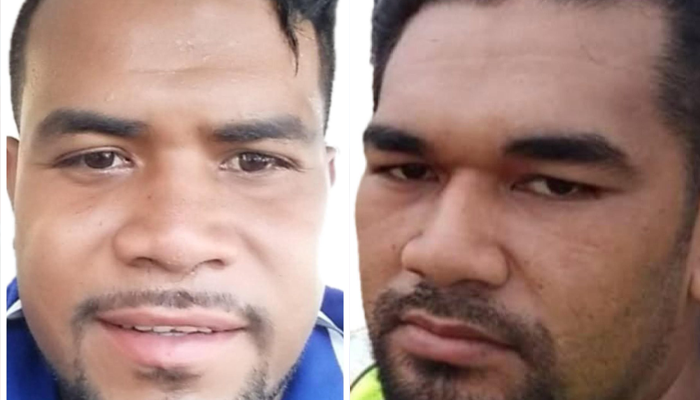
Malia Musie Halaifonua (L), Jim Folau, Joseph Dwyer Manu Tupou (Middle), and William James Purdy (R)
William James Purdy, 28, of West Valley, Utah – a former missionary accused of sexually abusing minors in Tonga – was arrested last week in Pittsburgh, Pennsylvania.
A federal grand jury indicted Purdy on July 16 on charges related to the exploitation of children outside U.S. territory.
He allegedly committed the crime in Tonga during his 2017 LDS mission and later as a teacher between 2019–2022.
Accused of grooming victims with gifts, electronics and money for sexual acts and secret recordings, he was arrested in 2022 after an eight-year-old’s disclosure.
Released but continuing abuse, Purdy fled to Utah before trial using a fake identity. Fourteen victims have been identified.
Trio Charged in Tonga
Malia Musie Halaifonua, 40, Jim Folau Joseph Dwyer Manu Tupou, 29, and Teau Faletau, 43, all charged in 2023 for allegedly facilitating Purdy’s escape through passport fraud.
Kaniva Tonga News understands that since the Tongan accused first appeared in court in 2023, the case has faced delays, including an appeal to the Supreme Court.
As this article goes to publication, we have been unable to locate any updated information regarding the current status of the case.
Passport System Failures Mount
As Kaniva News reported last week, the case reveals disturbing details about Purdy’s escape from justice in Tonga.
After allegedly obtaining a fraudulent passport, Purdy travelled to Fiji before disappearing en route to the United States.
The circumstances surrounding the processing of these travel documents have raised serious concerns about passport security and immigration controls in Tonga, especially given Purdy’s status as a wanted individual at the time of his departure.
Last week, social media users repeatedly asked: “Who helped Purdy flee Tonga before facing justice?”
This scrutiny comes at a critical time—Tonga’s passport system is under review by the U.S. government, with the Trump administration recently warning that travel restrictions may be imposed unless Tonga improves its passport security measures.
Tongan passport scandals have been widespread, involving a king, a former prime minister, and numerous government officials—many of whom ended up in court.
This Sunday, let’s pause and reflect on one of Mother Teresa’s most powerful yet simple truths: “If we have no peace, it is because we have forgotten that we belong to each other.”
Mother Teresa is a household name for her good works, but many people don’t knowmuch about her beyond “the nun who helped the poor.
In just 14 words, the Nobel Peace Prize winner captured a universal human need—connection.
At a time when headlines scream of wars, inequality, and isolation, her message feels more urgent than ever.
The Lost Art of Belonging
Somewhere between busy schedules and polarised debates, we’ve misplaced something fundamental: the understanding that the stranger in line at the store, the coworker with different views, and the family member who irritates us are all part of the same human story.
Mother Teresa didn’t just serve the poor—she saw and honoured the person behind every face.
Good News: It’s Contagious
The beautiful thing about this wisdom? It multiplies. When one person chooses:
To really see someone others ignore
To listen instead of argue
To respond with kindness instead of suspicion …it creates ripples. History shows us that real change often starts this quietly.
Your Sunday Challenge Today, try this experiment: With every person you meet—whether at home, online, or in the street—pause and silently remind yourself: “This person belongs, just like me.” Notice what shifts.
As the sun sets this Sunday, may we all remember—we’re not just neighbours sharing a planet. We’re a family sharing a home.
A significant weather event is set to impact large parts of New Zealand on Tuesday, 29 July, with MetService issuing severe weather warnings for heavy rain and strong winds.
A front, preceded by a strong and moist northeast flow, is expected to move eastward across the country, bringing potentially hazardous conditions to western and northern regions.
Authorities are urging residents in high-risk areas to prepare for possible flooding, slips, and disruptions.
The heaviest rainfall is predicted for the North Island, including Taranaki, the central high country, and areas north of the Bay of Plenty. Nelson/Tasman, northwest Marlborough, and Westland are also expected to experience significant downpours, with particular concern for Nelson/Tasman due to already saturated ground from recent rain.
Moderate-risk zones include Buller, Grey Districts, and the headwaters of Canterbury and Otago lakes and rivers, where rainfall may still reach warning levels.
In addition to heavy rain, severe northeast gales are forecast for exposed parts of Northland, Auckland, Great Barrier Island, the Coromandel Peninsula, eastern Waikato, Bay of Plenty, and inland areas of Whanganui and Taihape.
The Canterbury Alps may also experience strong northerly winds, though confidence in their intensity remains moderate.
Residents in affected regions are advised to secure loose outdoor items, monitor local flood risks, and avoid unnecessary travel during the worst of the weather.
Emergency services are on standby, and updates will be provided as the system develops.
This event highlights ongoing concerns about extreme weather patterns and their impact on New Zealand’s infrastructure. Stay tuned to official forecasts for further updates.
Commentary – Tonga’s newly introduced Fraud Policy has set a bold precedent in the kingdom’s fight against corruption — but the real test will be whether it can rein in the abuse of power, including allegations that Cabinet Ministers have pocketed excessive taxpayer-funded travel allowances.
As the government takes a firm stance against fraud, public scepticism remains high: will this legislation deliver accountability, or will it be another toothless decree in a nation still ranked among the world’s most corrupt?
The answer could determine not only Tonga’s democratic integrity but also its standing on the global stage.
The announcement of Tonga’s new Fraud Policy Law by the government last week marks a significant milestone in the kingdom’s 14-year democratic journey.
Deputy Prime Minister Taniela Fusimalohi’s emphasis on comprehensive legislation to prevent, detect, and prosecute fraudulent activities signals a firm commitment to governance reform.
This law is particularly crucial as it seeks to protect consumers from deceptive practices, reinforcing public trust in financial and commercial systems.
However, the urgency behind this move cannot be ignored.
Adding to the urgency, Fusimalohi’s recent acknowledgement that Tonga remains ranked 95th out of 183 countries in global corruption indices underscores the persistent challenges the kingdom faces.
US Widespread Fraud Warning
The revelation comes amid serious concerns raised by Prime Minister ‘Aisake Eke over a stern warning from the U.S. administration, which had previously flagged Tonga as one of 36 countries at risk of a travel ban due to alleged “widespread fraud.
While the specifics of the U.S. allegations remain unclear, the implication is troubling—Tonga’s international reputation is at stake.
Allegations of fraud within the government have been widespread, with many cases landing in court.
Tonga’s Persistent Corruption Crisis
These include the unlawful transfer of $90 million in Chinese grants to Princess Pilolevu – a transaction later declared illegal by the Supreme Court. Furthermore, the ongoing sale of national passports to Asian nationals, allegedly conducted without proper oversight, continues to raise serious concerns.
Additionally, one of the most serious allegations involves the misuse of the $120 million loan from China intended for the reconstruction of Nuku’alofa following the 2006 riots.
A Parliamentary select committee reported that only about 40 per cent of the loan was used for its intended purpose, while millions reportedly remain unaccounted for.
While the new Fraud Policy Law is a step in the right direction, its effectiveness will depend on rigorous enforcement, transparency, and public awareness.
For Tonga’s young democracy, this law is more than just policy—it is a test of the government’s proactive ability to combat corruption, safeguard economic integrity, and meet international standards.
The coming months will reveal whether this legislative effort translates into tangible progress or if further reforms are needed to restore confidence both at home and abroad.
There is currently a linguistic shift occurring in Tongan communities, particularly in the context of funerals, where the word ‘aofia is increasingly being used to refer to the funeral wake.
However, this usage is incorrect and diverges from the traditional and accurate term: ‘āfia.
According to Churchward’s Tonga Dictionary, the word ‘āfia is defined as: “To keep watching over (a corpse) during the night.”
This term has long been used in Tongan culture to describe the vigil held over a deceased person, a practice deeply rooted in respect, mourning, and communal support.
Other synonymous expressions include ‘āfaki and ‘ā pō, both of which also refer to night vigils or funeral wakes.
The word ‘āfia is derived from ‘ā, which means to open one’s eyes, to awaken, or to be awake.
The Confusion with ‘Aofia
The word ‘aofia, although phonetically similar, carries a completely different meaning. It derives from the root ‘aofi, which means:
To defend, protect, especially to place oneself between danger and the person endangered.
This word is used in contexts of covering, shielding, or protection, not mourning or vigil. For example:
‘Oku ‘aofia ‘a e la’aa’ ‘e he konga ‘ao. “The sun is covered with a cloud.”
This sentence illustrates the protective or covering nature of ‘aofia, which has no semantic connection to funeral practices.
This etymology highlights that using ‘aofia instead detaches the word from its true meaning, as ‘ao in ‘aofia does not convey the sense of being awake.
The misuse of ‘aofia to refer to funerals is now widespread, especially as funeral wakes are increasingly being held during the daytime—unlike in the past, when they were traditionally conducted at night.
Despite this shift in timing, the correct term ‘āfia still applies.
The only change is in the accompanying time reference: from ‘ā pō, meaning “wake at night,” to ‘ā ‘aho, meaning “wake during the day.
Why Accuracy Matters
Language is a vessel of culture and identity. Misusing words—especially in sacred contexts like funerals—can dilute cultural meaning and lead to confusion.
Preserving the correct usage of ‘āfia ensures that Tongan traditions remain linguistically and culturally intact.
The use of ‘aofia to refer to a funeral wake is a linguistic error. The correct term is ‘āfia, as documented in authoritative sources and supported by traditional usage.
We especially urge the media to preserve and use the correct word ‘āfia accurately, rather than the incorrect ‘aofia.