A four-year-old boy has allegedly shot dead his seven-year-old brother at their Ha’ateiho home.
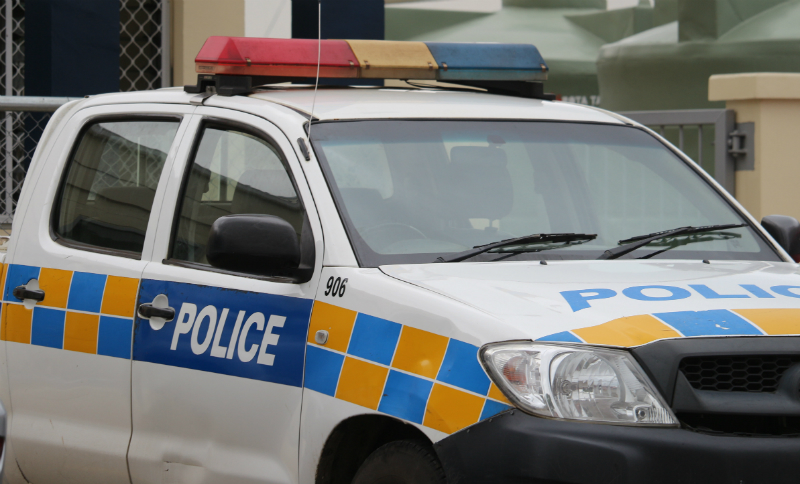
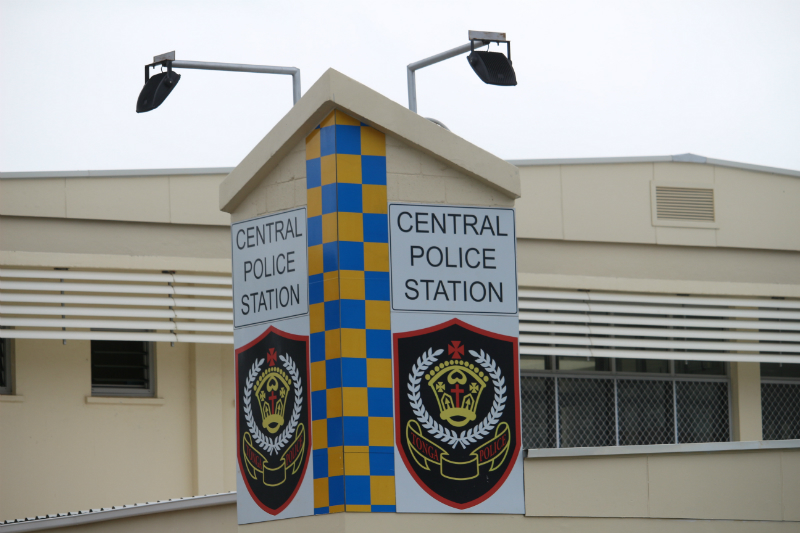
Tonga Central Police station. Photo/Kalino Lātū
Police seized a .22 rifle and arrested their 40-year-old father for possession of unlicensed ammunition and firearms.
Tonga Police responded to the shooting incident at the residence at around 6.20pm on Friday, September 2, 2022.
The seven-year-old boy was playing with his four-year-old brother in their family vehicle where they had found the .22 rifle.
When the four-year-old got hold of the gun, he allegedly fired four shots at his seven-year-old brother, which tragically caused his death.
The father had been charged with possession of unlicensed ammunition and other firearm related charges.
“We are reminding firearms licence holders to take their responsibility with safe storage of their firearms seriously. It was only in April last year that an 18-year-old male died from an accidental shooting, and now we have lost another young life in a similar situation that could have been avoided,” the Tongatapu Districts Commander, Chief Superintendent Filipe Fifita said.
Tonga Police is urging the public to help Tonga Police in keeping our communities safe and feel safe by notifying us and or surrendering any unlicensed firearm in their possession.
The death of Fr. Dr. Mikaele Niusenia ‘Oto’Ota Pāunga SM is a great loss to Tonga and the Pacific as a whole.
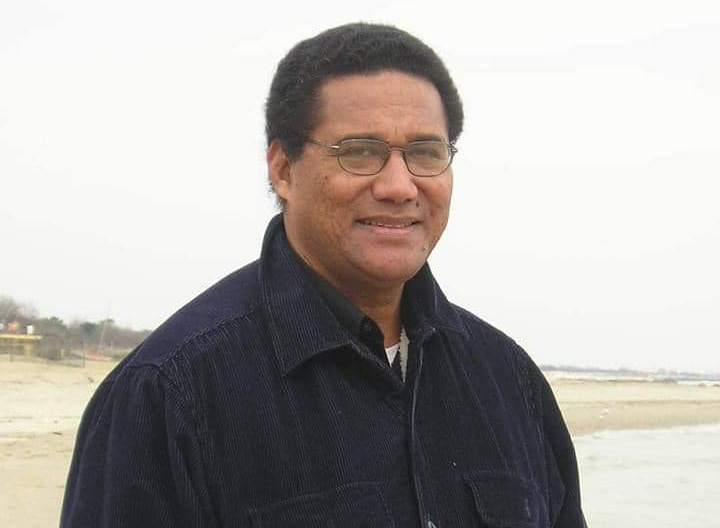
Professor Fr Mikaele Pāunga
Fr. Pāunga died in the Colonial War Memorial hospital in Suva, Fiji, yesterday morning (September 3).
He was 68.
A graduate of the Pontifical Gregorian University in Rome, where he gained a doctorate in theology, Fr Pāunga had taught at the Pacific Regional Seminary in Suva for 22 years.
In a post on its Facebook page, the seminary said Fr Pāunga would never be forgotten.
“Prayers and fond memories are what we have to remember our dearly departed. May the love of family and friends comfort you all during these difficult days, our most heartfelt condolences,” the post said.
Born in Vaipoa, Niuatoputapu, Tonga, Fr Pāunga was the youngest brother of Marist Fr Nisifolo ‘Oto’ota.
He was educated by the SMSM sisters in Vaipoa before entering ‘Apifo’ou College in Nuku’alofa, where he was taught by the Marist fathers.
He finished his secondary education in New South Wales where he attended Belambi High School.
He entered the Novitiate in Tutu, Taveuni and was professed in the Society of Mary at the beginning of 1980.
He studied for a Licentiate in Sacred Theology at the Gregorian, graduating in 1985. This was the start of a lifetime of lecturing, beginning with the Holy Spirit seminary in Bomana in Port Moresby in Papua New Guinea.
He was parish priest of St Anthony of Padua Basilica in Nuku’alofa from 1991-1992.
He then returned to the Gregorian, graduating with a doctorate in Sacred Theology in 1999.
The following year he joined the Pacific Regional Seminary where he taught Dogmatic, Systematic and Contextual Theology, Anthropology, world Religions and Modern Social Issues.
He was also Dean of Studies for five years.
Dr. Pāunga was a regular contributor to academic journals and collections, covering a range of topics including globalisation, culture, justice and development, human rights and the social mission of the church.
Campaigners for the Niuafo’ouan language want it to be part of the Tongan curriculum.
The jetty on Niuafo’ou, which is regarded as one of the most isolated islands in the world. Photo/Maxim Chervyakov
They are accusing the Ministry of Education of destroying the language because of its failure to teach it in schools.
They are also accusing modern Niuafo’ouans of being embarrassed to speak the language.
The promoters have called on the Prime Minister Hu’akavameiliku Siaosi Sovaleni to allow the language in the curriculum.
They were optimistic about their chances, saying Hu’akavameiliku was Niuafo’ouan through his mother’s side.
The language of Niuafo’ou, which is regarded as one of the most isolated islands in the world, is dying out, with fewer than a thousand speakers.
Tongan Prime Minister Hu’akavameiliku Siaosi Sovaleni.
Located in the north of the kingdom, it is the furthest island from the mainland, Tongatapu.
Hawai’ian anthropologist Thomas S. Dye, who visited the island in 1970s to research the language, said it could only be understood by Tongans if spoken slowly.
Dye said there was pressure from the Tongan government at that time to teach the Niuafo’ouan children to speak Tongan at school and disregard their own mother tongue.
Speaking of the language is identified with the Tongan words kote or kotekote or kote faka-Niua.
It was described as being the same as speaking a foreign language in a way that was fast with an exotic vocal variation which most Tongan speakers found out of the ordinary. The situation led to the language being stigmatised as a laughing stock.
Dr Akihisa Tsukamoto, who was in Niuafo’ou in the 1980s and researched the language, wrote some Niuafo’ouan sentences in his dissertation and translated them into English as follows:
Niuafo’ouan: Kuo te tamai ‘ia Sione
Tongan: Ko e tamai ‘a Sione
English: Sione is a father.
Niuafo’ouan: Kua tamai ‘ia Sione he kua fā’ele tono mali
Tongan: Ko e tamai ‘a Sione he kuo fā’ele hono mali’
English: Sione is a father because his wife has had a baby.
Tsukamoto said the Niuafo’ouan language closely resembled ‘Uvean and Tongan.
He said they had a very similar grammar and shared much vocabulary.
“There are mutually intelligible with one another to a considerable extent unless spoken very fast,” he said.
Mākisi Fīnau, a former senior government officer in Tonga told PMN Tonga that he assisted and accompanied Tsukamoto while he did his research in Niuafo’ou.
He said Tsukamoto did a great job to preserve the language.
Mākisi said the Niuafo’ou language was “beautiful,” but it was “hugely destroyed by the Ministry of Education”.
He said he once raised it in Parliament while working there, with the Late Hu’akavameiliku Senior, the father of Prime Minister Hu’akavameiliku, who was the Minister of Education at the time.
“I told Hu’akavameiliku his Ministry of Education badly damaged the Niuafo’ouan language,” Mākisi said.
He said he told Hu’akavameiliku Snr that his teachers taught spelling to the children in Tongans while the children responded in the Niuafo’ouan language.
Mākisi gave an example:
The teacher asked the children to spell the pronoun kimoua in Tongan, but the children responded with the Niuafo’ouan equivalent of the word, which is kolua.
Mākisi implied that the children in this way were forced by the teachers to learn Tongan, according to the syllabus and disregard the Niuafo’ouan language.
Mākisi said Niuafo’ouans these days were ashamed to speak the language and this had contributed largely to the shrinking number of speakers
Makisi’s co-guest on PMN Tonga, Feletiliki Fīnau, agreed and said it was about time for the government to include the Niuafo’ouan language in the curriculum.
“I wish the Prime Minister could hear us. His mother was a Niuafo’ouan”, Feletiliki said.
He said if the language could not be included in the syllabus there was no way that it could be preserved.
He also said they were campaigning in New Zealand to preserve the language and have their radio programme broadcast in Niuafo’ouan.
There have been academic moves to teach the language. In 2019 the University of the South Pacific’s (USP) Tonga Campus and Institute of Education launched a Bachelor of Arts programme in Pacific Vernacular language in Tongan and Niuafo’ouan.
Geologists in Tonga are monitoring the Fonualei volcano closely for signs of a major eruption.
Fonualei Volcano emits sulphuric gases. Photo/ Ministry of Natural Resources
They said there was evidence of an ongoing volcanic eruptions at Fonualei since 1791.
They said the eruptions spewed ash and rocks 3km into the air.
Evidence showed the eruptions in the past were not sufficient to cause widespread damages, they said.
While the authority has issued no tsunami or volcanic alert, they said a possible tsunami and ashes from Fonualei could reach Vava’u’s other islands.
They said people should stay vigilant.
In Tongan it said: “Ka ‘oku mahu’inga pe ke mateuteu ‘e malava pe ke a’u mai ‘a e efu mo’unga afi, mo ha peaukula ki he ‘otumotu ‘o Vava’u”.
The warning came after a marine biologist and a team who were researching and mapping the marine life and reefs in the north of Vava’u, took photos of Fonualei last week.
One of the photos showed the water surrounding the island appeared to have changed its colour into brownish yellow.
The authority described the photo as being taken from the northwest of Fonualei and it showed sulphuric gases being emitted from the volcano.
Stone was reported by the authority as saying there was a rotten egg smell in the area, a smell which normally associated with sulphur deposits.
Fonualei volcano
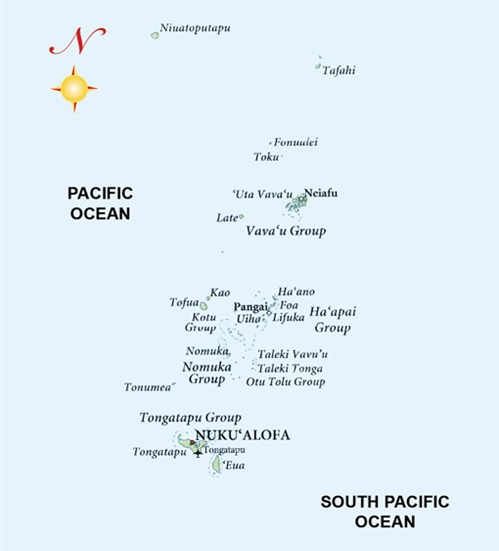
Fonualei is the peak of an active volcano which rises 1000m from the seafloor. It is about 350km from Nuku’alofa and 78km from Vava’u’s capital Neiafu
It has a diameter of two kilometres and a maximum height of 188m.
Fonualei is the northernmost island of Vava’u
The coast is surrounded by cliffs, with only two beaches suitable for a landing.
The western, southern, and north-eastern sides have narrow fringing reefs.
Hunga Tonga-Hunga Ha’apai
The Fonualei activities came after the devastating eruption of Hunga Tonga-Hunga Ha’apai 304km away on 15 January.
It triggered a tidal wave which caused devastation in Tonga and killed people as far away as South America. The atmospheric shockwave caused by the eruption was felt as far away as the UK.
It produced Earth’s biggest atmospheric explosion in over a century.
The caldera of Hunga-Tonga Hunga-Ha’apai is now 4km (2.5 miles) wide and drops to a base 850m below sea level.
Before the catastrophic eruption, the base was at a depth of about 150m.
It drives home the scale of the volume of material ejected by the volcano – at least 6.5 cubic km of ash and rock.
“If all of Tongatapu, the main island of Tonga, was scraped to sea level, it would fill only two-thirds of the caldera,” Prof Shane Cronin from the University of Auckland, New Zealand, said.
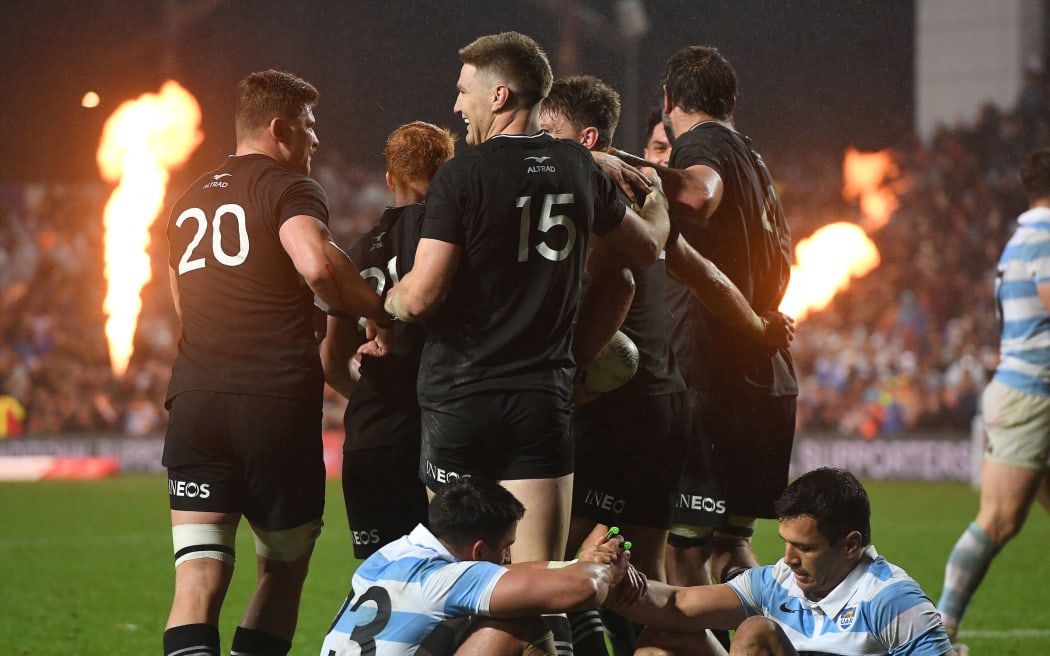
The All Blacks have bounced back from last week’s loss to comprehensively beat the Pumas 53-3 in a rainy Hamilton tonight.
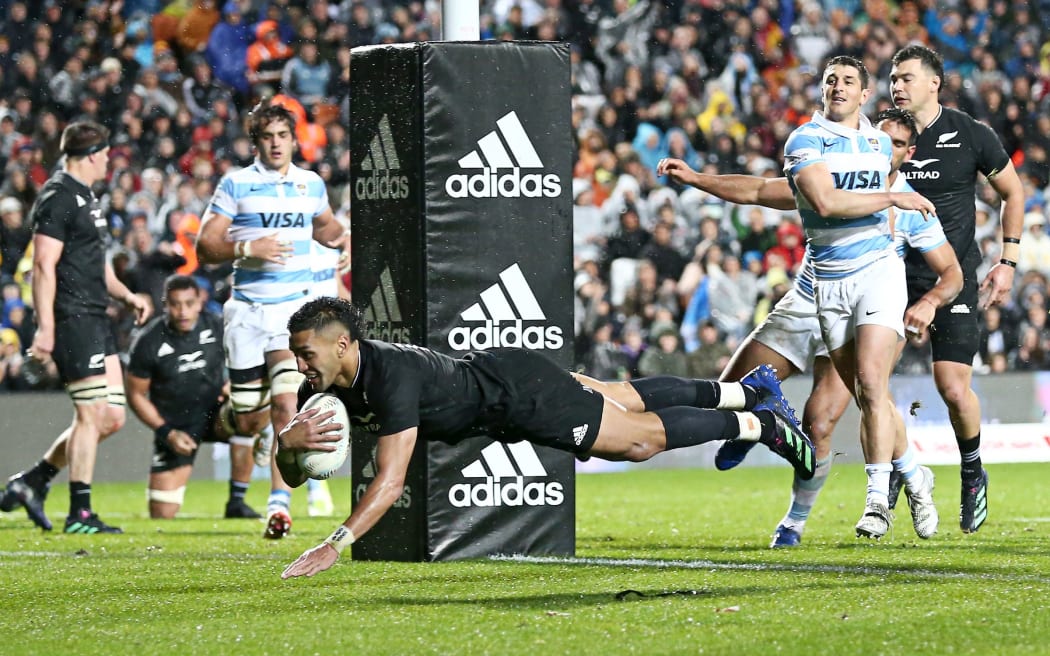
Jordie Barrett of the All Blacks scores against Argentina in the Rugby Championship match at FMG Waikato Stadium in Hamilton. Photo: Jeremy Ward / PhotoSport
New Zealand scored seven tries in the game, with one each to Ethan de Groot, Caleb Clarke, Rieko Ioane, Jordie Barrett, Ardie Savea, Brodie Retallick and Beuden Barrett.
The All Blacks dominated from start to finish, leading 24-3 at half-time.
The win ends a run of three consecutive losses at home and keeps the All Blacks’ Rugby Championship hopes alive ahead of their matches against the Wallabies.
After suffering their first ever home defeat to Argentina in Christchurch a week ago, the All Blacks brought the same starting 15 but a ruthless mindset as they tore the visitors to shreds.
De Groot, Clarke and Ioane crossed early, before Barrett, Savea, Retallick and Barrett added tries after the break to complete the rout.
All Blacks captain Sam Cane, under huge pressure after struggling in recent tests, came off to a warm ovation from the rain-soaked crowd after helping set up Jordie Barrett’s 61st minute try.
“This week we were in the game right from the start and were able to turn that into points so it was a pretty enjoyable night,” said Cane.
“I thought our defence was outstanding. We were able to force them into a heck of a lot of errors but on top of that our discipline was really good so we were able to capitalise on that and counter-attack.”
It was a dirty night for Michael Cheika’s Pumas, who racked up handling errors, lost Santiago Carreras to an apparent thigh injury and had lock Tomas Lavanini yellow-carded all in the opening half.
They were scoreless until Emiliano Boffelli knocked over a penalty in the 33rd minute and then shut out after that.
Lavanini dropped a pass deep in defence in the opening minute, paving the way for an early Mo’unga penalty, before prop De Groot thundered over the line from five metres out in the 10th minute.
The All Blacks celebrate after Beauden Barrett’s try during the Rugby Championship game against Argentina at FMG Waikato Stadium in Hamilton. Photo: Jeremy Ward / PhotoSport
Ioane sliced through the midfield nine minutes later, dishing off to Clarke who crossed at the left corner to put the home side 17-0 up.
A Samisoni Taukei’aho try was cancelled on review due to a knock-on in the buildup but the All Blacks had their third five-pointer to Ioane two minutes before the break.
With Lavanini yellow-carded for foul play, Cane opted for a five-metre scrum and Ioane burst through under the posts after quick hands from fellow centre David Havili.
Argentina battled to hold back the tide of black jerseys after the break until Barrett and Savea slammed the door shut with a two-try burst from the hour-mark.
Retallick celebrated his comeback from a broken cheek bone by barging over six minutes from the final whistle before Beauden Barrett completed the statement win with their seventh try a few minutes after the siren.
The Ministry of Health says only seven babies had been recorded dead in Tonga in the months of July and August.
Photo/Kaniva Tonga
The Ministry was responding after Facebook fake news posts alleged that there was a spike in newborn babies death since July which some have linked to COVID-19 vaccines. The allegations did not provide any exact numbers and they amplified their claims by using exaggerated Tongan words such as “mate tavale” (died randomly) or “tuva e mate” (died indiscriminately).
But the Ministry said, in July, only three of the recorded deaths were babies.
One was an eight-month-old baby who died from Pneumococcal Meningitis. Another was a two-year-old who died from Sepsis and a third died after he was diagnosed with West Syndrome with Severe Sepsis.
In the month of August, the Ministry said it recorded four deaths as babies.
One was a newborn with a severe respiratory distress from meconium aspiration. Another was a two-year-old with severe multiple injuries from a car accident. A third death was a four-year-old with brain tumour and the fourth died from a left intrathoracic tumor.
The last two deaths were babies referred to Vaiola from Vava’u.
“It is important to note that all the above causes of death are life-threatening conditions with very high fatality rate”, the Ministry said.
“Also the disclosure of information about the causes of death is confidential and only be shared with the parents or guardian”.
“None of the deceased had a positive covid test which are routine for all hospital admissions”.
The update from the Ministry came after its chief executive Dr Siale ‘Akau’ola said last week, that there was no evidence to show there was excess deaths among children.
He said the Ministry records showed there was a decline in this year’s death records in the first six month compared to the same time recorded during previous years.
He said he was aware of allegations made on Facebook regarding a surge in death but at the same time he did not receive any complaint from the public.
HONOLULU (KHON2) — Hawaiian Airlines operated their very first flight with a mother and daughter pilot on Wednesday, Aug. 31.
Mother, Captain Kamelia Zarka and her daughter, First Officer Maria Zarka took flight over the Pacific.
Hawaiian Airlines first mother daughter pilots (Courtesy: Bryan Shirota – Hawaiian Airlines)Read More »
Hawaiian Airlines first mother daughter pilots (Courtesy: Bryan Shirota – Hawaiian Airlines)
Hawaiian Airlines first mother daughter pilots (Courtesy:Bryan Shirota – Hawaiian Airlines)
Hawaiian Airlines first mother daughter pilots (Courtesy: Bryan Shirota – Hawaiian Airlines)
Hawaiian Airlines first mother daughter pilots (Courtesy: Bryan Shirota – Hawaiian Airlines)
Both pilots flew from neighboring islands in the Boeing 717 aircraft.
According to Hawaiian Airlines, the daughter was hired as a Boeing 717 first officer earlier this year and the mother, a Boeing 717 captain, was the first Tongan woman to captain a commercial airline.
“It was a dream come true. I’ve been so lucky on my aviation career so far but being able to fly right seat with my mom was an unbelievable lifetime experience. Everybody always comes up to me and tells me how amazing my mom is to fly with and today I got to experience that firsthand,” said First Officer Maria Zarka.
The mother and daughter pilot duo is encouraging other young girls to follow their dreams.
A woman was killed following a crash on Halaleva’s ‘Alaivahamama’o By-Pass Road this morning Thursday 1.
Tonga Police. Photo/Kalino Lātū
The 20-year-old woman from Pahu, was driving alone in a silver Toyota Rav-4 heading east when the incident happened at 2.42am, Police said.
The car swerved to the side of the road and crashed onto a block fence before hitting an electric pole.
“ Speed and driving under the influence contributed to this fatal incident”, Police said.
Tongatapu District Commander, Chief Superintendent Filipe Fifita warned drivers that “there is only one life”.
“You should always take responsibility for your safety first and foremost. Make sure you do not drink and drive. Arrange for a sober driver or catch a taxi home if you decide to consume alcohol.”
Tonga Police is also reminding the public to comply with the Restrictions Directions especially with the night-time curfew, which has now been reduced to 4 hours from 1:00am– 5:00am.
“Please, let us work together to keep the law and maintain safety on our roads,” Chief Superintendent Fifita urges the public.
This incident has tallied up the total number of road fatalities to eight so far this year.
The process of repatriating significant artefacts and cultural items taken from Tonga as long ago as three centuries has begun, a Tongan scholar says.
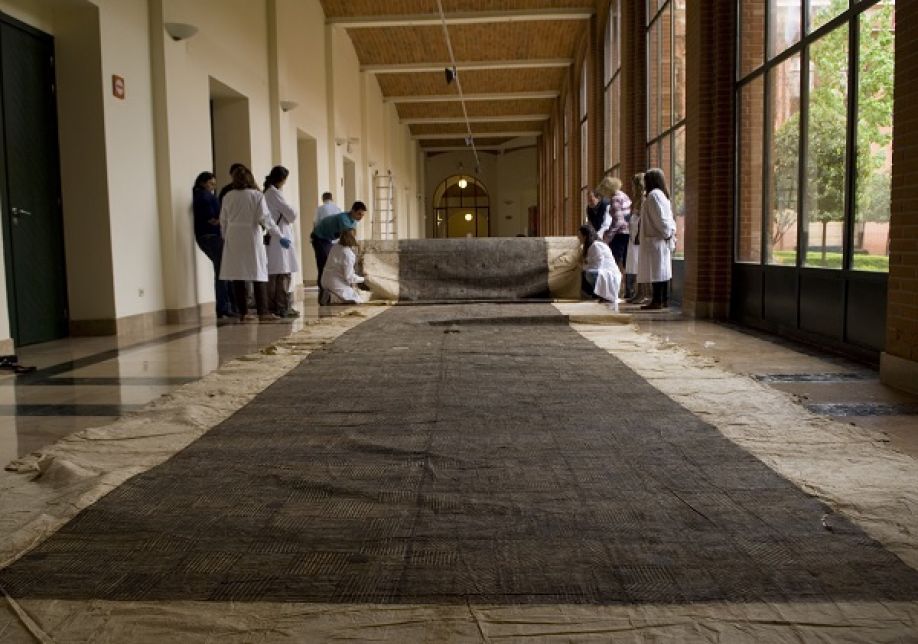
A 229 years old ngatutā’uli lau nima in the Museo de America museum in Madrid, taken from Vava’u by the Spanish explorer Aljandro Malaspina. Caption/Photo/Prof ’Ōkusitino Māhina.
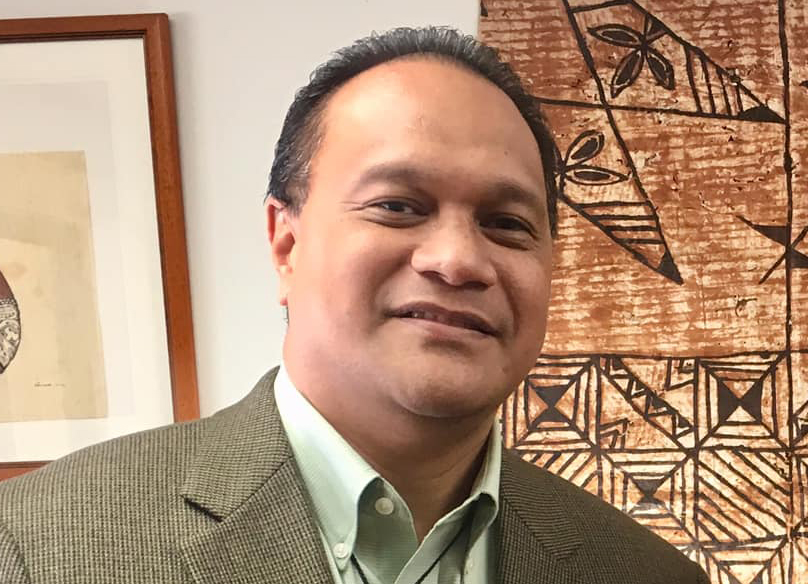
Anthropologist Professor Tēvita Ka’ili has asked academics who have carried out research in Tonga to return any items they might have taken.
“They can either physically return the objects or share digitised photos of the items on the internet”, he says.
Ka’ili said he made the move in the wake of a United States law known as the Native American Graves Protection and Repatriation Act (NAGPRA). It provides for the ownership or control of Native American cultural items such as human remains and objects excavated or discovered on Federal or tribal lands.
Ka’ili believes the US law could be applied to Tonga, describing it as a “nga’unu fo’ou” or new development.
He says people had the right to see and keep cultural properties in their local museum.
Items that could be returned included items dating to the 17 th and 18th centuries when European explorers arrived in Tonga.
Among the items were clubs, baskets, ngatu and fine mats at the national museums in Australia, New Zealand and the UK as well as the royal Palātavake (comb) which was said to have been preserved at the Museo de America museum in Madrid, Spain.
It is understood some international museums were reluctant to release some items.
In 2020, the government of the Netherlands created new guidelines to determine requests for the return of colonial-era artefacts from its former colonies.
The Dutch believed “most of these artefacts are right now the property of a museum”.
“If we value the respect of common principles of our democracies, such as property, we have to have a process to say whether the artefact should be returned or loaned and what the provenance is, because that’s the rule of law.”
Anthropologist Professor Tēvita Ka’ili has asked academics who have carried out research in Tonga to return any items they might have taken.
Ka’ili said he wrote to Professor Richard Michael Moyle of Auckland University, who researched several aspects of Tongan music and cultures in 1970s, and shared his views about the repatriation law.
“I told him he should make a digital repatriation of all the photos he took in Tonga,” Ka’ili said.
“Professor Moyle was really happy to do it.”
The photos shared by Moyle on Facebook were mostly people he interviewed or who posed for photos during events or meetings while he was in Tonga doing his research.
The sharing drew strong compliments from the Tongan online community.
Relatives and close family members of those in the picture shared those photos on their Facebook accounts. Moyle also shared some audio files of Tongan composers talking about how they composed their songs.





 Hawaiian Airlines first mother daughter pilots (Courtesy: Bryan Shirota – Hawaiian Airlines)Read More »
 Hawaiian Airlines first mother daughter pilots (Courtesy: Bryan Shirota – Hawaiian Airlines)
 Hawaiian Airlines first mother daughter pilots (Courtesy:Bryan Shirota – Hawaiian Airlines)
 Hawaiian Airlines first mother daughter pilots (Courtesy: Bryan Shirota – Hawaiian Airlines)