There have now been 1420 cases in the current community outbreak.
All of the 18 cases in Waikato are linked to known cases.
Speaking at today’s media briefing, Director of Public Health Dr Caroline McElnay said there are two cases in recent returnees in MIQ
There was also one new case in a border worker and authorities are investigating to determine whether it is linked to the border or to a community cluster.
There are 12 active clusters and Dr McElnay said it was estimated there could be an additional 36 cases in coming days in household contacts.
There are 32 people in hospital with Covid-19, seven of whom are in ICU.
There were almost 25,000 swabs processed nationwide yesterday. There are 22 community testing centres open in Auckland today.
Waikato DHB said a patient visited its ED last Friday night and has now tested positive for Covid-19. They were asymptomatic at the time and correctly screened, but some ED staff have been stood down. Public health staff are investigating.
There continued to be exposure events, but that was expected, Dr McElnay said.
Strict infection control measures are in place, she said.
In light of the increased risk from Delta, the Ministry of Health is advising people consider a shorter gap between vaccine doses than the currently recommended six weeks.
The gap between doses was extended from three to six weeks in August.
At the time, he told his followers he wanted them to hear directly from him that he was accused of possessing and importing the drug in 2019.
“I’ll be fighting my innocence for these charges,” he said.
“I know there’ll be a lot of questions that will be wanting answers but I’ve been advised by my legal team that’s all I can talk about. So hopefully you can all respect that, and also can you please respect the privacy of my family while I go through this battle.”
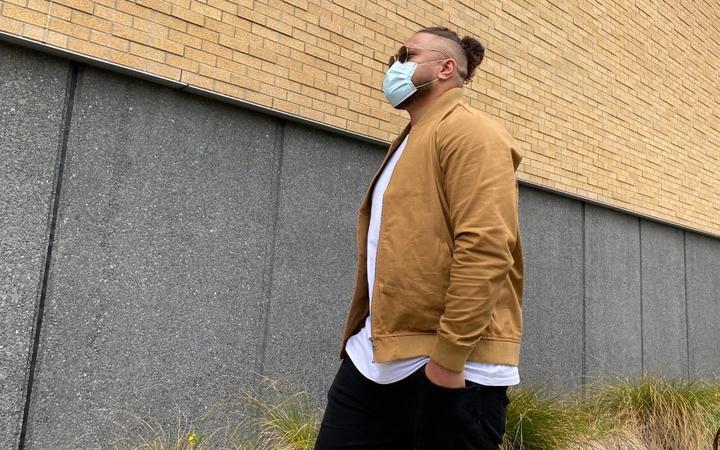
Vatuvei outside court in March 2021 Photo: RNZ / Simon Rogers
Between 2004 and 2017, Vatuvei played 14 seasons for the Warriors and scored 152 tries over 226 games.
He was nicknamed “the Beast” and became the first player in NRL history to complete the feat of scoring 10 tries or more in 10 consecutive seasons in 2015.
In 2019 he had success in Dancing with the Stars, winning the series with dance partner Loryn Reynolds.
The ruling was welcomed by Te Paati Māori co-leader Debbie Ngarewa-Packer of Ngāti Ruanui iwi in South Taranaki, who led legal challenges against the bid.
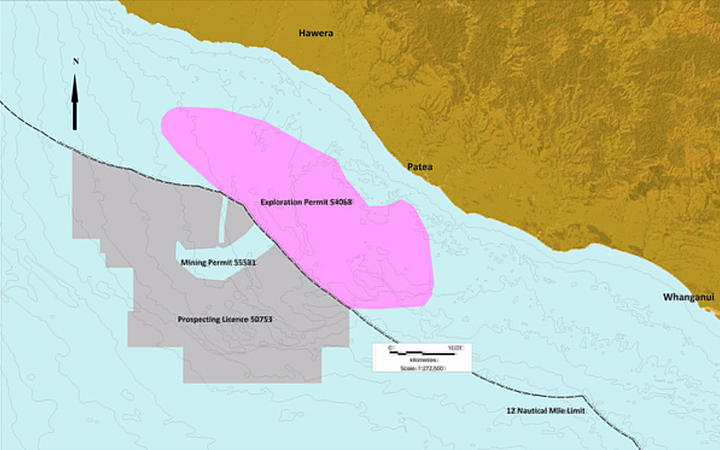
A map showing the area covered by the South Taranaki Bight Project. Photo: Trans-Tasman Resources
Ngarewa-Packer is wary about seabed mining companies courting Pacific islands governments with promises of money and claims that seabed minerals will help the fight against climate change.
“This isn’t about the planet and this isn’t about people, and I think if there’s anything that a pandemic environment has warned us it’s that money is not the ‘be all and end all’ I think,” she said.
Photo: RNZ / Samuel Rillstone
“Seabed mining wasn’t able to guarantee any assurance off environmental protection at all, it’s purely desecration.”
Given the growing interest in the Pacific Ocean seabed by mining advocates, Ngarewa-Packer said it’s incumbent on New Zealand to lead the way.
“The pressure now has to be calling on the prime minister to follow through and ban seabed mining. And if we follow through then the other Pasifika nations will get the confidenceto follow throught. There’s better ways to grow an economy.”
Ngarewa-Packer said New Zealand must now ban seabed mining in its waters.
She said economic growth should not come at the cost of the environment and future generations.
A trial date has been set for the South African mother of three charged with killing her daughters.
Photo: RNZ / Richard Tindiller
Lauren Dickason, 40, who is a medical practitioner, was excused from appearing in the High Court in Christchurch via video link for her second hearing.
She is accused of murdering twins Maya and Karla, 2, and their older sister Liane, 6.
The three were found dead at their home soon after the family arrived in Timaru from South Africa for a new life.
Today a trial date of March 2022 was set by Justice Dunningham, however, a plea has yet to be entered.
The accused was remanded back to Hillmorton Hospital for a further psychiatric assessment.
Her next hearing is set down for 15 October.
Last week Graham Dickason, the father of the three children thanked all of those donating money to the family on a Givealittle page.
The fundraising was started by other South Africans in Aoteaoa to help pay for funeral expenses, and accommodate relatives who have travelled to be with Graham Dickason.
It has so far raised $31,755.
He said the messages left along with the donations had been heartfelt and comforting.
It was gratifying to remark the headline of Kaniva’s recent coverage of the ‘Atenisi Institute’s recent court case (AC9/2021) because it balances the denial of funding with the finding of liability, thereby capturing the two-fold aspect of the judgment. However, there are some factual errors.
In Oct. 2019, the recruitment bans of 2018 and 2019 were declared ultra vires by Lord Chief Justice Whitten, not Lord Chief Justice Paulsen who had denied injunction against the initial ban in February 2019. The ‘Atenisi Institute did not challenge Lord Chief Justice Whitten’s vital judgment of ultra vires but rather on appeal obtained reassuring clarification regarding two obiter dicta, as well as further encouragement to litigate for damages.
Justice Hansen’s opinions regarding quantum are restricted to judgement at ¶56-59. He endorsed endorse the reasoning of the Lower Court in denying quantum, but it is unfair to conflate the Lower Court’s opinions with his. He never, for example, opined that prospective candidates could sufficiently assess the ‘Atenisi environment via a “smart phone”; he cited the Lower Court’s opinion in that regard. And he certainly never described ‘Atenisi’s appeal for funding as “opportunistic”, again citing the Lower Court’s opinion in that regard, as is common practice in appellate judgment;
Moreover, it’s odd that Kaniva is in such detail covering the appellate denial of additional funding without ever having informed its readers that in February the Lower Court awarded ‘Atenisi damages for lost tuition caused by the recruitment bans. Had it done so, its readers would have appreciated that since litigating damages in May 2020 ‘Atenisi has twice established discrete liability for the recruitment bans.
Dr Michael Horowitz
University Dean
‘Atenisi Institute
We regret that some errors of attribution occurred during the editing process – Kaniva News.
The government has announced a three-step plan for easing Auckland’s alert level 3 restrictions. Here’s what you can do at each of the steps.
Photo: RNZ / John Edens
The government’s three-step plan for Auckland will allow – over time – for outdoor socialising as well as stores, pre-schools and schools to re-open.
The intention is to to allow whānau to reconnect with each other and more businesses to operate as well as educational facilities to resume having children on site.
Under the roadmap Auckland will remain at alert level 3 for the foreseeable future as the restrictions are eased. The rest of the country stays at alert level 2.
However, as Prime Minister Jacinda Ardern made clear during the announcement of the easing of some restrictions today: “In total, this phasing amounts to a careful and methodical transition plan for Auckland.”
So, how will it operate?
With the Auckland region still at level 3, masks must be worn in most indoor settings and social distancing of 2 metres still applies.
The air and road boundaries between the city and the rest of the New Zealand, including the alert level 3 area in Waikato, will remain in place.
It’s intended schools will reopen on 18 October 2021, although this will be confirmed the week beforehand.
“In the meantime, if your child is aged 12 and older and is not yet vaccinated we strongly urge you to use these two weeks to get them vaccinated,” Ardern said.
There are no dates for moving to each step – it will depend on advice from health officials.
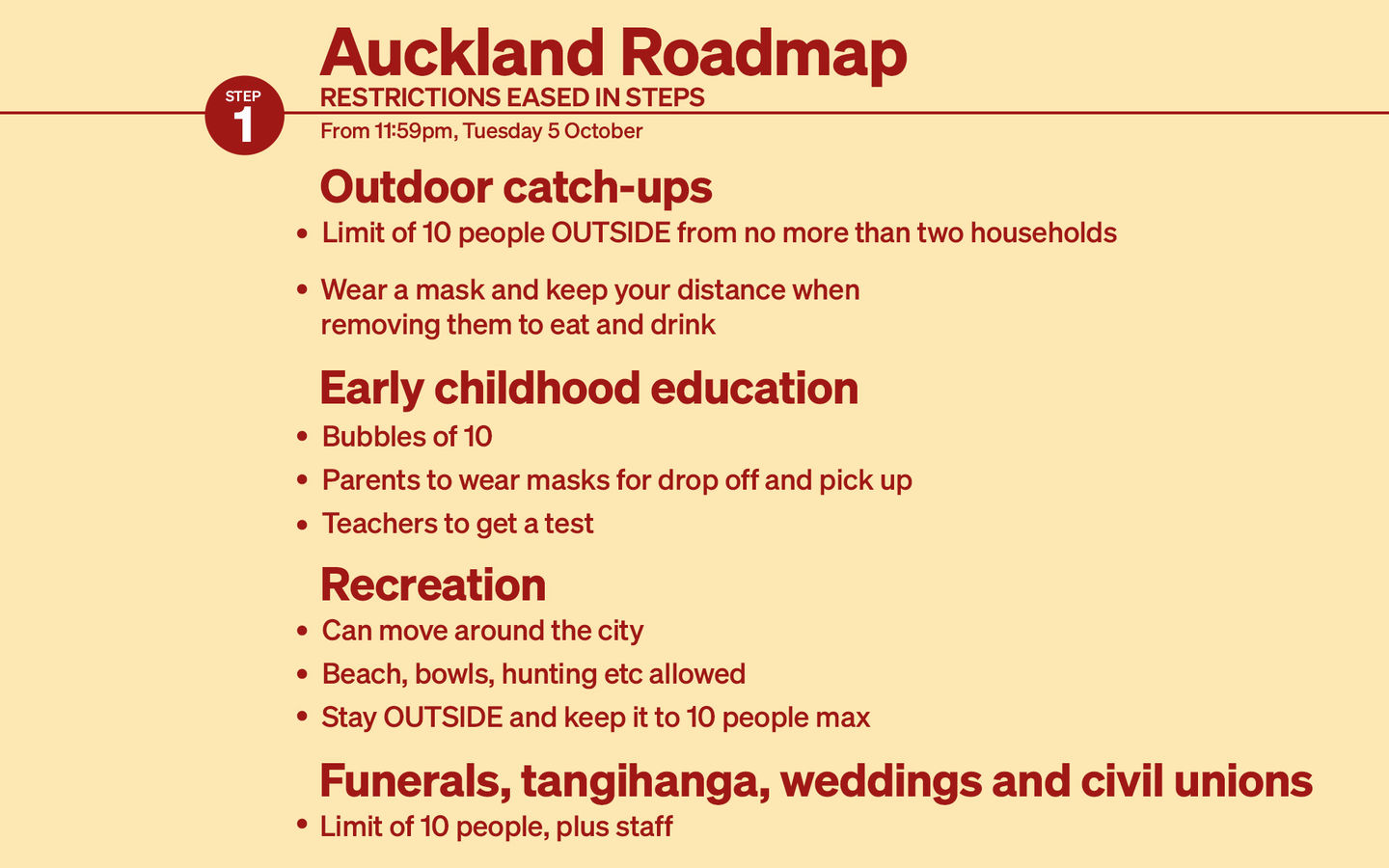
Step 1
Outdoor gatherings between two households can go ahead, with a maximum of 10 people attending
Travel is allowed anywhere in the Auckland region for exercise, sports or recreation outdoors
Early learning centres can reopen to all children, with a maximum of 10 children in each bubble
The prime minister said the ‘outdoor’ part may not sound relevant but it is in fact the most relevant part of all.
“Keep it outside,’ she said.
“The science tells us Covid finds it hard to spread outdoors … children can have a play date in a park, friends can meet outside for a walk, a picnic or a beer.”
Ardern said the public health team believe that with the right precautions in place, the risk posed by reopening early childhood centres is low. This includes limits of 10 within a bubble in ECE and strict infection control.
“To ensure this is done as safely as possible though we’re encouraging early learning teachers to get tested alongside other Aucklanders who will return to work and we’ll look at options for more regular but less invasive surveillance testing.
“This is an added precaution and an acknowledgement that children at that age cannot be vaccinated.”
Photo: RNZ/Vinay Ranchhod
Step 2
Retail can operate, with customers able to enter premises, wearing face coverings and keeping 2 metres apart
Public facilities like pools, libraries and museums can reopen, with face coverings and 2-metre social distancing required
Outdoor gatherings of up to 25 people can go ahead
Photo: RNZ/Vinay Ranchhod
Step 3
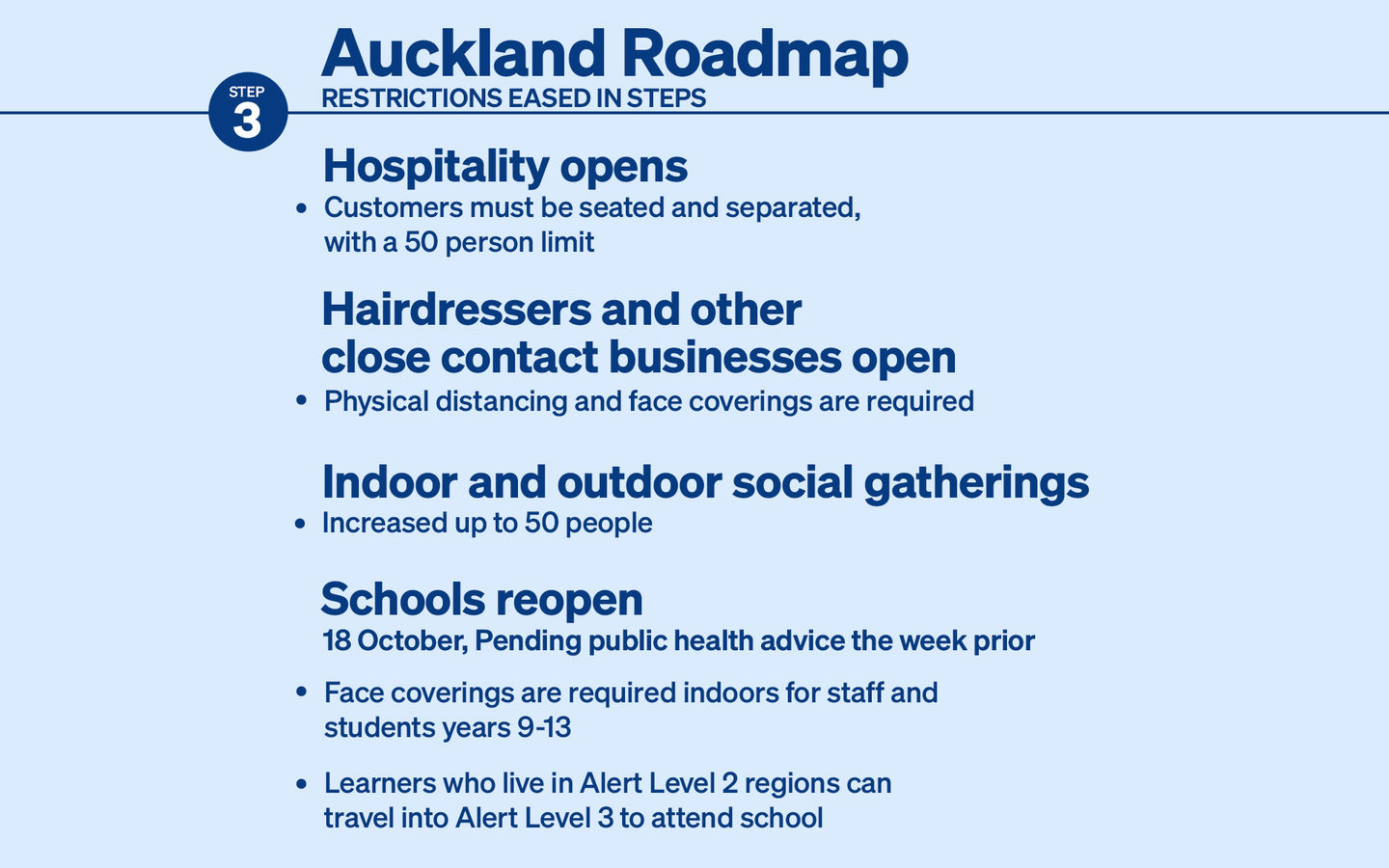
Hospitality venues, like cafes, bars, and restaurants, can reopen with a limit of 50 people
Event facilities likes cinemas, casinos, and theatres can open with a limit of 50 people in a defined space, wearing face coverings and 2-metre physical distancing
Close contact businesses, like hairdressers, barbers and beauty salons, can reopen, with workers wearing face coverings
Social gatherings, indoors and outdoors, can take place with a limit of 50 people in a defined space.
Photo: RNZ/Vinay Ranchhod
“At the end of these steps, we will then move to a national framework that reflects a more highly vaccinated population, allowing us the ability to deal with riskier settings such as large-scale events with the use of vaccine certificates,” Ardern said.
Today the country hit the milestone of 2 million New Zealanders vaccinated.
Policing was only part of the solution to combating illegal drugs, according to Acting Deputy Commissioner Halatoa Tāufa.
Nuku’alofa Central Police Station. Photo/Kalino Lātū
Tāufa, who heads the country’s drug enforcement taskforce, was speaking ahead of a national symposium on illicit drugs, which will be held in Tonga next week.
He said it would be a chance for people to share their views and work together on the issue.
The symposium will be held at the Tāufa’āhau Tupou IV wharf on October 6-7.
His Majesty will open the event.
The King has described drugs as the greatest challenge facing the kingdom and has criticised Parliament and the government for not doing enough.
Acting Police Commissioner Lord Fielakepa said illicit drugs remained a challenge to Tonga and the region.
“We must step up our collective efforts locally and regionally to combat this grave issue,” he said.
Speakers will talk about the kingdom’s three policies of supply reduction, demand reduction and harm reduction.
Registration for the conference can be made through the police on nsid@police.gob.to or by phoning the police on 7761809.
Prime Minister Jacinda Ardern and Director-General of Health Dr Ashley Bloomfield are speaking to media after Cabinet decisions about alert levels in Auckland.
Watch live from about 4pm:
Prime Minister Jacinda Ardern said the government will take a careful, methodical approach to the changes.
From midnight tomorrow, Tāmaki Makaurau will remain in alert level 3 but Aucklanders will be able to connect with people outside their bubble outdoors, with no more than two households and ten people mingling at a time.
Early childhood education will return as normal and people can move around Auckland for recreation, like visiting the beach or hunting.
At the second stage, retail shops can open with face masks and social distancing, public facilities such as pools and zoos will open and number of people who can meet outdoors will increase to 25.
Hospitality venues will open at the third stage, seating people at a distance with a maximum capacity of 50 people.
Public health advice at this stage also indicates schools will be able to return after the school holidays on the 18 October – with a final decision to be made closer to the time.
Cabinet has agreed the rest of New Zealand will remain at alert level 2 – with the only change being the 100 person limit in hospitality venues removed.
She describes step 3 as higher risk. Hospitality will open – seated, separated and with a limit of 50; close contact businesses like hairdressers will also open with mask use and physical distancing; and gatherings will also then extend to 50.
“Cabinet will review each step weekly to ensure it’s safe to move before confirming the next step. The wage subsidy will continue to be available.
“In total, this phasing amounts to a careful and methodical transition plan for Auckland. At the end of these steps, we will then move to a national framework that reflects a more highly vaccinated population, allowing us the ability to deal with riskier settings such as large-scale events with the use of vaccine certificates.”
“Today we hit the milestone of 2 million New Zealanders vaccinated. It follows the doubling of Auckland vaccination rates over the past 7 weeks, with 84 percent of Aucklanders having had one dose, and 52 percent now fully vaccinated. But there is more work to do.
“Vaccines were always going to change the way we manage Covid-19 into the future, but our strategy has worked and will remain – we want to control the virus, avoid cases and hospitalisations, enjoy our freedoms, and reconnect with the world,” Ardern said.
The High Court in Auckland has ordered that the former Governor of Vava’u, Lord Fulivai and his wife repay a New Zealand businessman $253,370.60.
Lord Fulivai
Mr Justice Venning entered judgement against the couple following an application for summary judgement against the Fulivais by company director Christopher Barrett.
The Honourable Justice Venning ruled that the Fulivais must repay the money paid to them by Barrett to make land available to him, together with interest dating to January 1, 2018; repayment of loans with interests and costs for the entire proceedings.
In his affidavit Barrett said that the king’s noble told him he had considerable influence in being able to facilitate the granting of leases of land in Vava’u and made various other promises.
“In particular, he gave me assurances for the granting of a 99-year lease of land on an island called Pangaimotu in Vava’u for which I was to pay $170,000,” Barrett said.
“Part of these monies were to be used to pay off persons who were presently occupying that land.”
Barrett said he did not receive any lease and the defendants were therefore in breach of the agreement.
Lee Latu, an Australian woman who ran a restaurant on the block of land Barrett was interested in, said she was told by Lord Fulivai to vacate the land. In an affidavit she said she was given three months to leave the land, but never received any money.
Barrett said Lord Fulivai made various attempts to grant leases of other pieces of land in Vava’u.
“Looking back on the matter now, I can see that I was duped,” Barrett said.
“Having given me these assurances of the granting of various leases in land, I received a series of requests from both defendants seeking loans from me over the following years. Unfortunately, I naively trusted them and made loans to them as requested from time to time.
“In general, the loans were agreed to be repaid shortly after they were made although there was no particular time for that to happen. They were certainly repayable on demand.”
Barret said he paid money into Lady Fulivai’s bank account in Otahuhu, Auckland in April 2015. Police investigations showed the money was promptly withdrawn. Other payments were transferred to accounts owned by Lady Fulivai.
New Zealand Police had investigated claims against the Fulivais and charged them with obtaining money by deception.
A statement lodged with the court by Barrett’s legal representative said Lord Fulivai had admitted responsibility to repay the $170,000 and $21,500 in loans. The Fulivais had agreed to take no further action in the proceedings.
FAKAMATALA FAKATONGA
Kākaa’i ‘e Looti Fulivai mo hono uaifi’ ha tangata pisinisi Nu’u Sila ‘i he pa’anga laui kilu pea kuo tu’utu’uni ‘a e Fakamaau’anga High Court ‘a ‘Okalani’, ke na totongi fakafoki ‘a e tola ‘e ua kilu tupu ($253,370.60) kia Christopher Barrett. Pehē ‘e Barett ne kākaa’i ia ‘e he nōpele’ ni mo hono mali’ tokua te ne tokoni ange ke lisi hano kelekele ‘i Pangaimotu, Vava’u ‘osi ange hala ke ma’u ha kelekele. Ne fakapapau ange ‘a Fulivai ‘e ‘oange ‘a e kelekele ‘eka ‘e 99 fe’unga mo e $170,000 pea ko e konga ai ke totongi’i ‘aki ‘a e tokotaha ne ne ‘osi lolotonga lisi ‘e ia ‘a e kelekele’ kae mavahe mei ai ka e foaki ia kia Barrett. Pehē ‘e he tokotaha ne ne ‘osi lisi e konga’ ko ‘eni’ ko e fefine ko Lee Latu ne fekau ange mei a Fulivai ke mavahe ka ne ‘ikai ‘oange ha silini ia. Ne tuku ia kae toutou fakapapau’i ange pe ‘e Fulivai ‘e toe ‘i ai pe ngaahi kelekele kehe ‘e lisi ange ma’ana. ‘I he taimi tatau hū ai pe ‘ena toutou kole pa’anga kia Barett ka ne ‘ikai pe ma’u ha kelekele ia. ‘Oku lolotonga ‘i Nu’u Sila’ ni foki ‘a e ongo Fulivai’ pea ‘i he fakatotolo ‘a e kau polisi Nu’u Sila’ ne ma’u ai ‘a hono fakahū ‘o e pa’anga’ ki ha ‘akauni ‘a e uaifi’ Heleni, ‘i ha’ane pangikē ‘i ‘Otāhuhu. Na’e faka’ilo ai kinaua pea fakahā ‘e Looti Fulivai kuo’ ne mo’ua ke totongi fakafoki ‘a e pa’anga’ ni.
The Court of Appeal has dismissed an appeal by the ‘Atenisi Institute for costs associated with the recruitment of a replacement dean.
‘Atenisi Institute
The appeal was the latest step in a long running dispute between the Institute and the Tonga National Qualifications and Accreditation Board.
Judge Hansen, presiding, said insufficient evidence had been produced to prove the Institute would suffer any actual or prospective loss associated with the need to replace Dr Lorenz Gonschor following his resignation.
The judge said the figure demanded by the Institute to cover the cost of recruiting a substitute dean – TP$50,000 – was more than the amount received for tuition in 2017.
His Honour described the appeal for funds as opportunistic
The ‘Atenisi Institute has been in dispute with the Board over requirements under the Tonga National Qualifications and Accreditation Act for more than a decade. This has resulted in litigation in relation to the Board’s approach under the Act to several issues: registration of ‘Atenisi as a university; accreditation of its educational courses and the validity of compliance notices issued by the Board purporting to ban ‘Atenisi from enrolling students for unaccredited courses.
Arguments over accreditation have been long and bitter and culminated in the Board ordering ’Atenisi to stop recruiting students in February 2018. The Supreme Court lifted the ban in 2019.
Shortly afterwards ‘Atenisi issued legal proceedings against the Board. Lord Chief Justice Paulsen declared that the compliance notices were ultra vires and of no effect. Following an unsuccessful appeal against Mr Justice Paulsen’s finding, the ‘Atenisi Institute then lodged a new appeal for the Board to pay TP$50,000 for the costs of recruiting a replacement for Dr Lorenz Gonschor who resigned from his position as senior lecturer in liberal arts and Dean of Faculty in November 2019.
Dr Gonschor was employed by ‘Atenisi as Dean of Faculty between July 2017 and November 2019. He is now employed by the University of French Polynesia in Tahiti.
Part of the basis of the appeal was that the ban on student recruitment and the need to keep up a prolonged struggle against the Board had prevented Dr Gonschor from fulfilling his duties as a teacher or researcher.
The figure of TP$50,000 was derived from the following costs:
$2000 for international recruitment advertising
$30,000 for international airfares for prospective candidates
$7000 local per diem for prospective candidates
$4000 for local settling-in of the appointed administrator
$7000 for eight months on-site training of the appointed administrator concurrent with said administrator’s first year of service.
Judge Hansen said the TP$50,000 was more than the total amount of tuition revenue for 2017. The judge said the method proposed for recruiting was unreasonable.
He said the expense of advertising and flying interviewees to Tonga “simply could not be supported by the normal revenue streams enjoyed by ‘Atenisi.”
“That, in turn, smacks of opportunism which is not to be condoned by the Court in an exercise such as the present.”
The judge said the expenditure and proposed method of recruitment had not been ratified by the Board of the Institute.
“That is a matter of significance because without that ratification, it follows that the Board has no idea about the expense expected to be incurred if it were to undertake that process,” he said.
”It will be recalled that Mr Velt, the current President of the Plaintiffs Board, frankly stated that if the Plaintiff cannot afford to conduct the recruitment process in the manner claimed, it will have to do something else.”
The judge said there was no need to bring interviewees to Tonga.
“In modern times, and particularly with the border closures and quarantine requirements imposed by the current pandemic, the availability of audio-visual communications for the purposes of conducting meetings or to actually show any prospective candidates what the campus looks like, require, at a minimum, nothing more sophisticated than a smart phone,” the judge said.
“There was no satisfactory evidence to establish any actual or prospective loss associated with the need to replace Dr Gonschor following his resignation.
“Entitlement to an award of damages was not satisfactorily established.”
Dr Horowitz
Speaking after the judge’s summary of the case was issued, the ‘Atenisi Institute’s University Dean, Dr Michael Horowitz, said the Institute had partly prevailed in its attempts to put forward its view of the situation.
Dr Horowitz said the Institute had asked that the Appeals Court above declare that the recruitment bans contributed to Dr Gonschor’s resignation and that the court order the Qualifications Board to contribute to the costs of replacing the Dean.
He said the Appeals Court had ruled that a previous finding on the impact of the bans on Dr Gonschor’s decision to leave was wrong.
Dr Horowitz quoted Judge Hansen as saying: “To conclude that the bans were no longer an operative factor is to underestimate their impact on ‘Atenisi’s viability and their ongoing potency in Dr Gonschor’s ultimate decision to resign.”
“The testimony of ‘Atenisi’s former Dean of Faculty has been upheld, once again demonstrating the veracity of our staff.”
He said the appeal hearing had confirmed the extent of TNQAB’s assault on the Institute’s spirit.