Auckland, NZ – Footage of a church minister apparently reprimanding two camera operators for not wearing taʻovala during a Tongan wedding ceremony in Auckland has sparked debate on social media, with viewers questioning why the minister and several other men appeared not to be wearing taʻovala themselves.
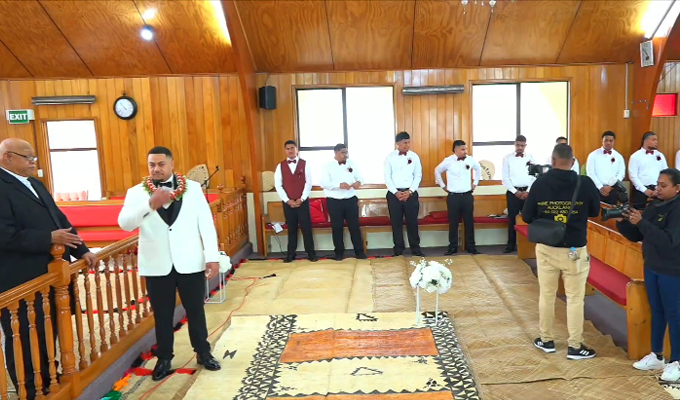
The incident occurred during the Mr & Mrs Fakapalea Wedding Ceremony in Auckland on Saturday, September 12. The wedding ceremony was livestreamed and shared on the Mai Niu Productions Facebook page.
In the footage, the cameraman and camerawoman, who appeared to be of Indian descent, seemed unaware that the minister was addressing them or apparently instructing them to leave or move from where they were filming.
Both were dressed in neat casual attire, including long trousers, but were not wearing taʻovala.
However, viewers quickly focused on what they regarded as an apparent contradiction.
The minister himself appeared not to be wearing a taʻovala at the time, while several men standing around him in a circular formation as part of the ceremony also appeared to be without the traditional Tongan waist mat.
The apparent contradiction became a point of discussion as footage from the livestream circulated on Facebook, dividing commenters over the incident.
Others debated whether different cultural or ceremonial rules may have applied to the minister and the men participating in the wedding ceremony, compared with a cameraman working inside the church.
The incident has prompted wider discussion about the application of Tongan dress and cultural protocols at church ceremonies, particularly whether such expectations should apply consistently to everyone present.
Critics argued that churches should focus on people’s spiritual wellbeing rather than material or cultural requirements such as taʻovala.
Others said that if wearing taʻovala was a requirement inside the church, there should have been a clear policy, with church members informing hired photographers and videographers beforehand about the expected dress code and where they were permitted to stand, walk or film inside the building.