New Zealand’s official general election results have left National, ACT and New Zealand First one seat short of a parliamentary majority, placing the Opportunity Party at the centre of negotiations to form the country’s next government.
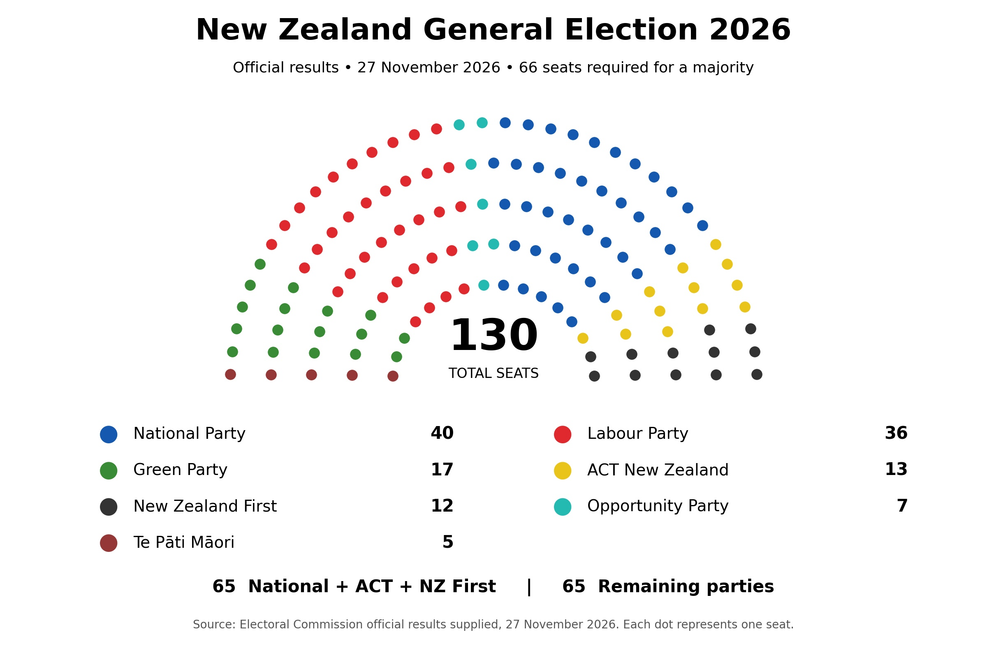
The Electoral Commission confirmed this afternoon that National had lost two seats since election night, while the Green Party gained one, reducing the size of Parliament to 130 seats.
National now holds 40 seats, Labour 36, the Greens 17, ACT 13, New Zealand First 12, the Opportunity Party seven and Te Pāti Māori five.
The three governing coalition parties collectively hold 65 seats, one short of the 66 required for an outright majority.
While Opportunity’s support would give the National-led coalition a majority of 72 seats, joining Labour, the Greens and Te Pāti Māori would result in a 65–65 parliamentary deadlock.
The outcome also raises the prospect of New Zealanders returning to the polls should negotiations fail to produce a workable governing arrangement.
Despite Labour securing the largest share of the party vote at 29.88 percent, ahead of National’s 28.35 percent, National remains the largest parliamentary party after winning 40 electorate seats.
The Electoral Commission confirmed an overhang of 10 seats because National and Te Pāti Māori won six and four more electorate seats, respectively, than their party vote entitlements.
Three electorate results overturned
The official count overturned three election-night electorate results.
Labour’s Georgie Dansey won Hamilton East by 173 votes over National’s Ryan Hamilton, while fellow Labour candidate Kieran McAnulty secured Wairarapa by just 81 votes over National’s Mike Butterick.
Green Party candidate Julie Anne Genter won Wellington Bays by 1,610 votes over Labour’s Craig Renney.
All other electorate candidates leading on election night were confirmed as winners.
Voter turnout declines
A total of 2,931,604 votes were cast, including 484,865 special votes, of which 99,118 were overseas votes.
Overall voter turnout declined to 77.2 percent, compared with 78.2 percent in 2023 and 82.2 percent in 2020.
In contrast, turnout in Māori electorates rose to 72.9 percent, up from 68 percent in 2023 and 69.1 percent in 2020.
The official results remain subject to judicial recounts, with applications required to be filed by Wednesday, December 2.
If no applications are received, the Electoral Commission will return the writ to the Clerk of the House of Representatives and declare the election of list MPs on Thursday, December 3.