The Sandringham man was last seen on CCTV leaving New World Mount Roskill on 27 April. Earlier that day, Okeke attempted to call his wife, who is based overseas. The call went unanswered.
He was then reported missing on 3 May.
Ronny Okeke was last seen on CCTV leaving New World Mount Roskill on 27 April. Photo: Supplied / Police
Detective Inspector Glenn Baldwin said police were continuing to try and piece together Okeke’s disappearance and were keeping an open mind about the circumstances surrounding the case.
“This is still a missing person’s inquiry, but naturally we have serious concerns for Ronny given the length of time since he was last heard from,” Baldwin said.
In a fresh appeal, police were asking for dashcam footage captured between the Kaimai Ranges and Ramarama in south Auckland between 10pm on 27 April and 7pm on 28 April.
Police specifically wanted footage from people travelling between the Kaimai Summit Loop Track and Ramarama during those times.
“We would also ask anyone who stopped at a lay-by between these locations with footage to contact us,” Baldwin said.
“We understand that this is a broad request, but we are appealing to anyone with footage to make contact with us, so that we can establish whether it may be relevant to the inquiry.”
Police could be contacted by calling 105 or going on its website, quoting file number 240501/3879.
Information could also be given anonymously through Crime Stoppers on 0800 555 111.
Prime Minister Christopher Luxon has announced nearly $27 million for projects in Fiji and removing the need for transit visas for Fijians entering New Zealand.
It follows a leader-to-leader meeting between Luxon and his Fijian counterpart Sitiveni Rabuka in Fiji, as part of the New Zealand prime minister’s first trip to the Pacific.
The two countries have also set a goal of boosting two-way trade — currently about $1.4b a year — to $2b a year by 2030.
The projects announced today are funded from New Zealand’s International Development Cooperation programme, and include:
A further $3.6m to Fiji’s Climate Relocation of Communities Trust Fund
$572,000 for an upgrade to the High Temperature Forced Air (HTFA) Facility at Nadi International Airport alongside Australia, to help Fijian horticultural exporters meet New Zealand’s strict biosecurity requirements
$15.3m for a New Zealand Plant and Food Research-led programme to support farmers in five Pacific countries including Fiji adapt to the impacts of climate change on production
$7.5m for the Fiji government’s economic reform programme, which is focused on improving fiscal management, sustainability and economic resilience.
Luxon and Rabuka, who has been Fiji’s Prime Minister since 2022, also released a joint statement recognising the “deep and broad historical, cultural, and people-to-people connections” between the two countries and committing to refresh their Duavata Partnership next year, when it is set to reach maturity.
He said the change to allow Fijian nationals to enter New Zealand without the need for a transit visa was also a “tangible demonstration” of New Zealand’s commitment to Fiji.
“Many Fijian nationals travel through New Zealand to reach other destinations in the Pacific and around the world — we expect this will have a positive economic impact for the region.
“This change will mean that Fijian nationals will be able to transit New Zealand with a New Zealand Electronic Travel Authority (NZeTA), similar to many other Pacific countries,” he said.
Luxon arrived in Fiji from Niue last night and presented a gift of a harmonica ahead of their meeting.
It appeared to be received well by Rabuka, who proceeded to play a few notes. Luxon said he had been told Rabuka was a prodigious harmonicist and hoped Rabuka would enjoy the gift in times he needed to relax.
The harmonica was one of three of its kind in New Zealand, Luxon said.
Rabuka’s gift was slightly humourous in nature, a playing shirt of the Fijian Drua Super Rugby team.
In the last round of Super Rugby before the playoffs, Luxon’s beloved Crusaders were relying on the Drua losing to make the top eight and qualify for the finals.
The Drua instead won, knocking the Crusaders out of the top eight and finishing a dismal season for the Canterbury team.
Luxon, who had repeatedly guaranteed the Crusaders would reach the playoffs, accepted the shirt in good but somewhat resigned spirits.
However, he said the result was for the best as Rabuka would’ve been “very grumpy” if the Drua hadn’t made the playoffs and therefore the Crusaders missing out meant potentially avoiding a “diplomatic incident”.
Māngere Bridge resident Kimela Kolo Piukana, 24, entered the guilty plea today from the dock in the High Court at Auckland, two and a half years after he was arrested at the conclusion of a lengthy undercover police and Customs investigation dubbed Operation Selena.
Piukana was alleged to be part of a group of airport workers who on several occasions in 2021 were tasked with secretly removing illicit drug shipments stowed aboard Malaysian Airlines flights from Kuala Lumpur and Air New Zealand flights from Los Angeles.
“The drugs were subsequently driven off airport grounds and on-supplied to other members of the syndicate,” court documents state.
The scheme diverted the drugs from being screened by Customs.
Piukana initially faced multiple drug importation-related charges upon his arrest in November 2021. He pleaded guilty today to a charge of participating in an organised criminal group that carries a punishment of up to 10 years’ imprisonment.
As part of the guilty plea, Piukana also conceded he “contributed to the activities of the syndicate by passing important messages between key members”.
Authorities outlined several examples in court documents, including a series of messages in January 2021, in which there was discussion of a “test bag” being used to try out the scheme.
“Tell him duffel bag with a photo of it and make sure the bag has a fake tag on it and to message once the plane takes off with it,” Piukana was instructed to tell the alleged syndicate leader.
Authorities intercepted a message months later in which Piukana told another alleged syndicate member that a shipment had been delayed and would be coming a different day.
The agreed summary of facts for Piukana’s guilty plea does not list specific amounts of methamphetamine that were smuggled into New Zealand, other than to state they were “commercial quantities”.
Police alleged at the time of Piukana’s arrest that the group had either successfully smuggled or tried to smuggle roughly 500kg of methamphetamine. While the cost of methamphetamine can fluctuate wildly, that amount has been described by police in prior drug import cases as having a value of between $50 million and $90 million in New Zealand — considered one of the most profitable meth markets in the world.
“This type of offending is highly concerning not only because of the harm drugs are doing to the community, but the ability to place unchecked items into aircraft … threatens the integrity and security of air travel,” Detective Inspector Paul Newman said at the time of the arrests, estimating that an influx of 500kg of the drug on to the underground market would have caused “around $550 million in community harm … particularly in vulnerable communities”.
Customs intelligence manager Bruce Berry commented at the time of the arrests that the scheme showed a disturbing trend: “Organised crime in New Zealand is becoming more sophisticated … in subverting systems at the border”.
During today’s brief High Court hearing, Justice Mathew Downs set a sentencing date for August. He allowed Piukana to remain on bail until then — a matter that was not opposed by Crown prosecutor Matthew Nathan. The judge also approved a request by defence lawyer Benjamin Mugisho to not immediately enter a conviction for Piukana, who intends to seek a discharge without conviction at sentencing.
Craig Kapitan is an Auckland-based journalist covering courts and justice. He joined the Herald in 2021 and has reported on courts since 2002 in three newsrooms in the US and New Zealand.
Police Minister Mark Mitchell admits there is a “big problem” in central Auckland, but he said improvements had already been seen.
Police Minister Mark Mitchell addressed frustrated residents and business owners in Auckland’s CBD. Photo: Melanie Earley/RNZ
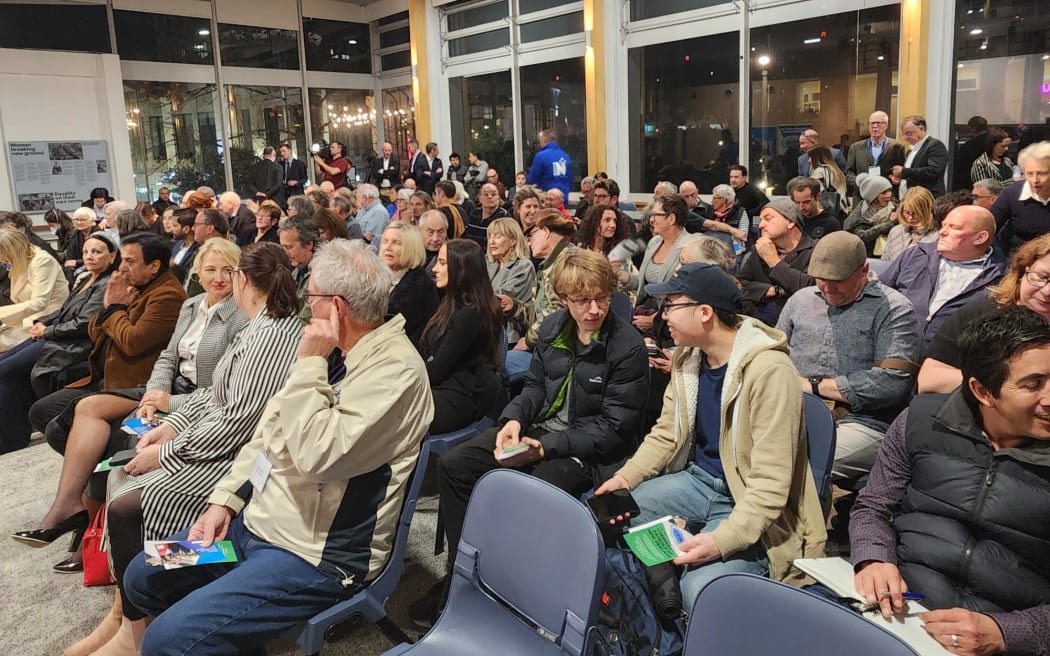
More than 100 frustrated residents and business owners attended a public meeting with Mitchell at Ellen Melville Centre on Tuesday night, telling him they don’t feel safe and want to see more police officers on the street.
Mitchell told Morning Report there had been a 60 percent increase in the number of officers doing foot patrols in Auckland’s central business district since the new government indicated it wanted to see more cops on the beat. However, he said he didn’t know what the number of officers was.
“The reality is… we know that we have got a big problem in our Auckland CBD.”
Mitchell blamed that on the previous Labour government.
Statistics showed things had improved in the last six months, he said.
“I’m certainly not saying that we are on top of the problem but we’re making moves in the right direction.
“Crime is trending down in the CBD, we’ve got a lot more work to do and I acknowledge that.”
It wasn’t simply a matter for police, the council and local business association were also involved, Mitchell said.
“We’re going to get there; we’re definitely going to make our CBD much safer than what it is presently.”
Many at the meeting spoke of wanting to see a police station return to the central city, and raised concerns about the slow response from police as well as the rise in antisocial behaviour on Queen Street.
Mitchell told the crowd there had been a 58 percent increase in foot patrols around the city in the last six months. But one resident stood up and claimed that was “bollocks”.
“I can count on one hand the number of police I’ve seen on the beat in the last three years in the central city,” the man said and was met with a round of applause from the crowd.
He said last week he had to hold someone down who had stolen alcohol from an inner city supermarket until police arrived and that same day he said he dislocated his shoulder trying to chase a person who had stolen items from another store he was in.
“It’s not safe and I want to see cops rotating up and down the streets all day,” the man said.
Queens Arcade property manager Ian Wright told Mitchell he had dealt with “hundreds” of incidents in the CBD including attacks and intimidation.
“Today there was a teenager who came in and she attacked some shoppers who she didn’t even know. Last week we had a sex offender lock himself in one of the stores with some girls.
“I’ve been assaulted, abused and intimidated, it’s a daily occurrence here.”
The crowd at a public meeting with Police Minister Mark Mitchell on Tuesday night. Photo: Melanie Earley/RNZ
The central city needed to be a welcoming place for visitors, Westmere resident Gael Baldock said. She said as a woman she felt unsafe taking public transport.
“I don’t feel as safe as I used to – I had a friend who was attacked recently on Wellesley St by a man she didn’t know who hit her in the face.”
Baldock did note she had seen more police officers on the street in Point Chevalier and on Karangahape Rd recently, but less so on Queen St.
“I’ve seen the community patrol out there but not that many police, more would be good and I think taking away the central station was a major problem.”
Community Patrols NZ chair Chris Lawson said it was tough out there for officers and residents.
He lived and did regular patrols in the CBD and had spent 20 years working as a police officer.
“I’ve seen people peeing and pooing in the streets, fighting, stealing and I am concerned about crime. There’s a fair amount of it happening lately and people are concerned for their safety which is why so many people are here.”
Lawson said the Community Patrol was looking for more volunteers.
“It was a tough decision to start a patrol in the CBD because we’re a risk averse group, but we’re getting out there and doing what we can.
Patrol members were trained not to be involved in conflict, Lawson said.
Mitchell couldn’t tell residents if or when a new police station would be built in the city, but said until that time increased foot patrols would continue.
“I think a physical presence of officers on the beat is more important.”
Tongan tenor Manase Latu has been selected as a semi-finalist in Aotearoa’s premier opera singing competition, the 2024 Lexus Song Quest.
Of these 10 semi-finalists, one is Auckland based Tongan tenor Manase Latu who has recently completed the Lindemann Young Artist Development Program at the Metropolitan Opera. 2018 Finalist in Lexus Song Quest. Photo/Supplied
Latu is a graduate of Auckland University and won a scholarship to the Royal College of Music in London. He was supported as an Emerging Artist with New Zealand Opera as well as the Kiri Te Kanawa Foundation.
He has just completed the Lindemann Young Artist Development Programme at the Metropolitan Opera in New York.
He was the first singer of Tongan heritage – and one of just two from New Zealand – to join the programme.
During the summer of 2022, Latu was selected as a Renee Fleming Artist for The Aspen Music Festival and School where he performed Don Ottavio in Don Giovanni under the baton of Dame Jane Glover.
Latu was selected as one of 10 semi-finalists from a pool of 29 applicants by preliminary judges Andrea Creighton and Peter Lockwood.
He was a finalist in the 2018 Lexus Song Quest.
Latu and the other semi-finalists will perform for head judge, Grammy Award-winning South Korean lyric coloratura soprano Sumi Jo on July 27-28 at St Andrew’s on The Terrace, Wellington.
She will select the five finalists who will perform with the New Zealand Symphony Orchestra at the Grand Final Gala at the Michael Fowler Centre in Wellington on August 3.
Latu was born in New Zealand, but spent his early childhood in Tonga surrounded by church music and traditional Tongan music. After returning to Auckland he was educated at St Kentigern’s. He joined the high school choir in 2011.
He said his passion or music was driven by his love for music and the opportunity to represent his family, his country and his motherland on the international platform.
TVNZ is warning of a large underlying loss amid a worsening advertising downturn.
The state-owned broadcaster said it now expected an underlying loss of between $28 million and $33m in the 2024 financial year.
It said on top of the underlying loss, TVNZ’s full-year result would include a significant non-cash write-down as the value of its assets would be affected by future earnings forecasts.
It said traditional television advertising was down nearly 16 percent from last year, and only partially offset by digital revenue, despite revenue growth on its TVNZ+ streaming platform.
Jodi O’Donnell Photo: Supplied / TVNZ
“We have made significant strides in our path to being a digital-first broadcaster over the past six months, however, as a fully commercially funded organisation, we are exposed to the ad market,” chief executive Jodi O’Donnell said.
“Since we announced our interim position, the advertising downturn driven by recessionary conditions and structural market change has deepened. TVNZ’s revenue position as a result has deteriorated, despite a continued focus on cost saving initiatives,” O’Donnell said.
Following the results, TVNZ announced 68 jobs would be cut, including its Sunday and Fair Go programmes.
However, the Employment Court ruled it had failed to consult with staff before cancelling the programmes and cutting jobs.
O’Donnell said despite the tougher results, it was not looking for a government handout.
“While we strongly support regulatory and legislative change to encourage a fairer playing field and fit-for-purpose operating environment, we are not seeking financial support from the Crown,” O’Donnell said.
She said TVNZ’s balance sheet was “robust”.
In response to the tougher television advertising market, TVNZ said it would be accelerating its digital changes.
“We will continue to invest aggressively in a digital future to build online audience and revenue scale, and to secure a profitable and sustainable future for the business,” O’Donnell said.
Seini Fale’aka Taumoepeau passed away ‘very suddenly’ aged 48 last week, according to her family.
The Tongan-Australian, who also performed under the stage name SistaNative, hosted Pacific Mornings on ABC Radio Australia.
A social media post by ABC Pacific said Ms Taumoepeau ‘paved the way for this team of Pacific people to be represented in ABC media programs’.
‘Seini will remembered and celebrated as a dedicated artist, orator, song woman and storyteller who spent over 30 years advocating for Pasifika communities and their representation in the Australian media landscape,’ the post read.
‘Seini’s first appearance on ABC Radio Australia was as a 13-year-old on programs produced by her mother, going on to become the inaugural host of Pacific Mornings in 2018.’
‘Colleagues recall her last sign off, “I hope that ABC Radio Australia will consider replacing me with 2-5-10 more people of Pacific heritage and understanding and in doing so evolve the Australian lens of the Pacific with the great and valuable resource that is our region, inclusive of its people”.’
Ms Taumoepeau was born in Australia but spent her early childhood living with her grandparents in Tonga.
After completing her university degree, she taught at schools in the Northern Territory and later co-founded the Pacific Wave Festival, which helped showcase the best artists from the Pacific region.
Ms Taumoepeau later landed a role as presenter for BCs PAcific Beat where she helped amplify voices from the region for an Australian audience.
A prayer vigil will be held at Croydon Park Uniting Church in Sydney’s west on Monday at 6pm and her funeral will be the following day at Newington College Chapel in the city’s inner-west at 6.30pm.
Tongans in Auckland have rallied round in an effort to counter the increasing struggles experienced by Māngalo patients in the community.
Dr ‘Etuini Ma’u and Dr Sione Vaka (R). Photo/Kalino Lātū
Māngalo is the Tongan translation for dementia.
Experts estimated that 500 patients in the Pacific community including Tongans are currently being diagnosed with Māngalo.
Participants were grouped and given various questions to answer about their experiences with Māngalo during a four-hour workshop in Ōtāhuhu last week. It was followed by each group leader presenting the answers from the front to the whole gathering.
There were calls for more health professionals on Māngalo and for the Tongan language to be compulsorily used when providing advice, and educating people about the disease, starting from homes.
The workshop was told there were also needs for a government funded separate service to specifically address Māngalo for the community.
One of the group leaders told the meeting that providing dementia patients with identification cards could be a good idea to help if they encountered difficulties.
As an example, the leader said the cards could be shown to Police or wardens if people with dementia were found to have breached traffic rules.
He said he was once fined for not buckling up and the police officer ignored his plea that he had dementia because he could not provide any proof that he in fact had the disease.
“I am suggesting this because I was ticketed after getting into my car and immediately drove off forgetting to wear my seatbelt and a police car pulled me over”, he said in Tongan.
Another woman said she often forgot her destination while driving as a result of her Māngalo.
Dr Sione Vaka, an Associate Professor and clinician for Pacific Dementia, told the attendants although there was no cure for Māngalo, having a good diet and keeping a healthy lifestyle could help ease the effects of the disease.
“A 15-minute workout each day really help”, Makoni Havea, a Nurse Practitioner in the Child and Adolescent Mental Health Service, told the meeting.
She said patients should pay particular attention to their heart health as heart contributed to Māngalo if it was not well looked after.
The workshop was organised by the ‘Ākiheuho, a Tongan health provider in Auckland and assisted by other Tongan clinicians including Dr Etuini Ma’u, Dr Staverton Kautoke, Dr Alo Fokiaki, project manager Tevita Vungamoeahi and practitioner Makoni Havea.
‘Ākiheuho Chief Executive Makahokovalu Pailate previously said that early intervention was the key. “Our research shows that in many Pacific families, people with dementia are often formally diagnosed when there’s very little we can do to slow the disease.
“If people are diagnosed in the early stages, they’re still aware of what’s happening and can take part in exercises that help slow the progression of dementia—which is a much better outcome for our families.”
‘Ākiheuho Communication Officer Kitekei’aho Tu’akalau said the gathering was the first of four government-funded workshops planned for this year. The workshops would run for four years.
Māngalo or Dementia
Māngalo is a complex condition that can be both heartbreaking and bewildering. It is not one specific disease, but an umbrella term that is used to describe approximately 100 different illnesses.
This debilitating condition affects a person’s ability to think, reason, and remember. It is a progressive condition that slowly and steadily worsens over time and can have a profound impact on a person’s daily life, as well as the lives of their family.
According to the ‘Ākiheuho website there are about 70,000 dementia patients in New Zealand from the Pākeha community. The number of people affected by the disease could triple by 2050.
The political fallout from Fijian parliamentarians giving themselves a pay rise last week is spiralling out of control after the main opposition FijiFirst – the largest single political party in Parliament – sacked 17 out of 26 of its MPs.
FijiFirst Headquarters Photo: RNZI / Sally Round
Sixteen out of the 17, who voted for an increase to MPs salary and benefits, include the opposition leader Inia Seruiratu, who told Parliament that MPs had “wants” and “needs” and “church commitments” to justify the salary bump.
One MP, Alvick Maharaj, who was part of the special parliamentary committee that recommended the raise, and had abstained, was also handed the termination letter.
The FijiFirst party has written to the Speaker of Parliament, Ratu Naiqama Lalabalavu, informing him that the MPs have been expelled for not following a party directive on 24 May to vote against or abstain on the motion for the pay increase.
The letter, signed by the FijiFirst leader and convicted former prime minister Frank Bainimarama (who is serving a one-year jail sentence) and the party’s acting secretary-general-secretary Fiayaz Koya, was reportedly handed to the Speaker on Thursday afternoon.
“Given the immediate vacancy of these seats, we have copied the Electoral Commission in this letter so it can, as per sections 64 of the Fijian Constitution, award the 17 vacant seats to the remaining FijiFirst candidates…to fill the vacant seats at the earliest,” the letter stated.
“We are disputing the legality of the termination letter and as far as we are concerned we are still Members of Parliament,” he said, adding they will “await the full process of the law to take its course.”
According to the 2013 Fiji Constitution, section 63(1)(h) states: “The seat of a member of Parliament becomes vacant if the member; votes or abstains from voting in Parliament contrary to any direction issued by the political party for which he or she was a candidate at the time he or she was elected to Parliament, without obtaining the prior permission of the political party”.
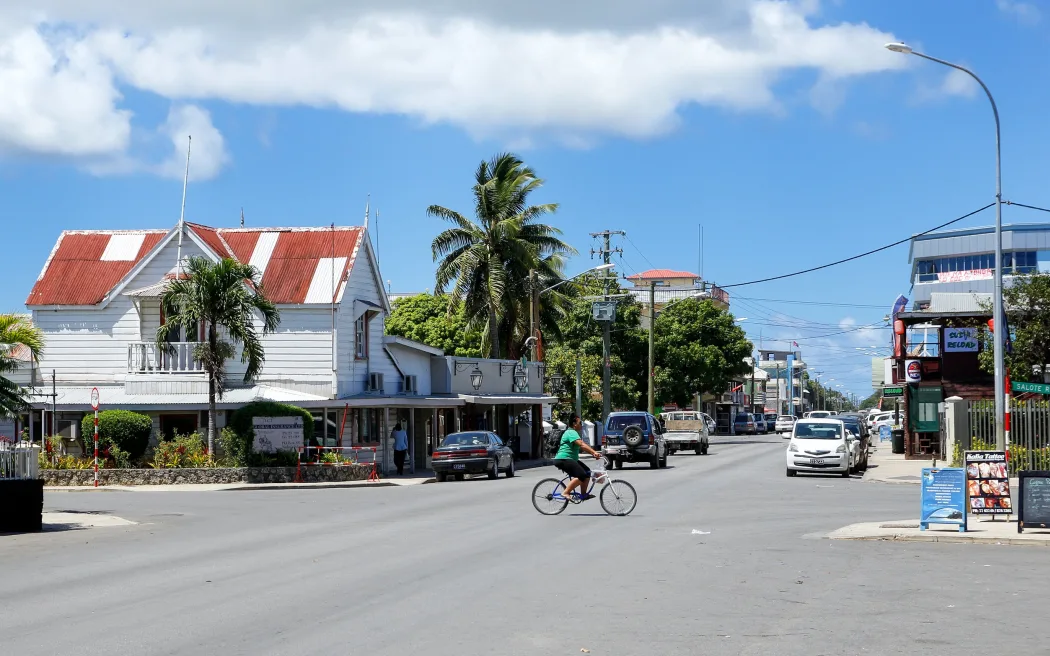
There are concerns in Tonga whether a housing development planned to provide accommodation for people attending the 53rd Pacific Islands Forum Leaders Forum in August will be completed in time.
Work to clear the land at Popua, which is adjacent to the historic Sia Heu Lupe site, has been underway through May.
The government hopes to erect 100 prefabricated houses at the site to provide additional accommodation for those attending the summit.
They will be allocated to the elderly after the event.
“The site preparation, now into its third week, will continue until the end of May, before construction begins in June,” according to a report by Matangi Tonga last week.
RNZ Pacific’s correspondent in Tonga, Kalafi Moala, said the Forum meeting will put a lot of pressure on Tonga’s accommodation facilities.
“All the hotels have been booked and so they have to build the houses, new houses,” he said.
“So again officially the word has come out that they have got a location where they are going to build 100 pre-fab houses. I think that’s great but you have to order those houses to be pre-fabricated overseas.”
Work is also underway on another site near the heart of Nuku’alofa, where more housing is being built.
But Moala said the issues facing the government also include finding a site to hold the forum meetings.
The Tongan government has appealed to China to hurry the construction of an indoor stadium in Nuku’alofa so it can be used for the meeting.
Moala said the government is also eyeing the new indoor stadium being built near Tonga High School, asking if it could be finished and ready in time for the summit.
“It was supposed to be finished by December so they are going to finish by August.
“I talked to the Chinese officials here they say, ‘Yes they can finish it for the Forum but it means that it’s going to cost more money, it means they are going to have to bring in more labour from China’.”