Please subscribe to unlock this content. Enter your email to get access.
Outrage boils in Tongatapu after a 16-year-old teenage boy dies. Photo/Sypply
Some members of a community in Tongatapu have called for urgent changes to make their village safer from youth violence after a 16-year-old boy reportedly died last night.
Victoria Langilangi said on Facebook her little brother Toni Jr Langilangi was allegedly attacked by some youth before he died at hospital.
She claimed the attackers were from the village of Ha’ateiho.
“We will get justice for you Toni”, she said.
The details of the incident were still unknown.
Some media commentators criticised what they perceived as a lack of action by authorities. They said complaints had been lodged after youth gang often disturbed peace in the community.
“Victoria Langilangi may you little brothers soul RIP”, a commenter wrote.
“Hope this is not a school feud. So sad Christy. No one deserves this especially a young boy with a whole future ahead of him…he’s younger than BJ Sincere condolences to your family, Christy; hoping fair justice will be served for your brother”, one commenter write.
“Love and prayers for the victim Toni Langilangi Jr (RIP) family. Rip to your dear brother hope you guy will get justice for him.
“This is just soooo sad I pray justice will be served”
A shot was fired inside an Auckland bar during one of three aggravated robberies across the city that police believe may be connected.
Two men seen in CCTV footage are being sought over the aggravated robberies of three Auckland bars. Photo: NZ Police
Three bars in the city have been hit in the early hours of the morning by multiple offenders armed with hammers and a firearm over the past three nights.
In the most recent incident, police were called to the Wapiti Sports Bar in the suburb of Point Chevalier at about 2am this morning.
Detective Senior Sergeant Martin Friend said a number of staff were locking up for the night when the masked offenders entered and threatened them with a firearm.
The robbers took cash and left in two vehicles, one of which was found abandoned near the scene and will be forensically tested today.
A day earlier, multiple offenders – again armed with hammers and a firearm – entered the The Harlequin Sports Bar on Great North Road in Point Chevalier shortly before 1am.
Friend said there were several staff and patrons inside the premises at the time.
“One person has fired a shot inside the premises, which has struck a wall behind the bar and the offenders have taken money from the tills and gaming machines before fleeing,” he said.
Police believe the same group of offenders are responsible for an aggravated robbery at the Mount Albert Sports Bar on New North Road at about 2.20am on Thursday.
“Four offenders armed with hammers have entered the building which at the time had a staff member and four customers inside,” said Friend.
Police are seeking any sightings of this car. Photo: NZ Police
Police are now hunting for a silver Toyota Mark X with the registration HTU397, and two men who were captured on CCTV footage attached.
Friend said this type of violent behaviour was “totally unacceptable”.
“We believe these three incidents are linked and we’re following positive lines of enquiry but need the public’s assistance to find these offenders before they injure someone.”
All of the victims of the robberies have been offered Victim Support.
“We are now working hard to identify and locate those involved so we can hold them accountable and are currently seeking any witnesses to come forward if they haven’t yet,” said Friend.
A visa for graduates from the world’s top 100 universities and another for those with specialist tech skills are part of National’s plan to help rebuild the economy.
The policy has been announced in Auckland by party leader Christopher Luxon, National’s Immigration spokesperson Erica Stanford and Science Innovation and Technology spokesperson Judith Collins.
Luxon started the briefing by saying the election campaign is “all about the economy” working in some criticism of Labour’s economic performance revealed by the books being opened earlier this week.
“We will clean up this mess Labour has left behind.”
The party has released a plan to boost growth in the tech sector today.
Features include:
Offer an international graduates visa – a three-year open work visa for people who have graduated with a Bachelor’s degree or higher within the last five years from one of the top 100 universities in the world. This visa will initially be capped at 500 successful applicants in the first year.
A new global growth tech visa – a residence visa for people with highly specialised skills who have worked at a top global tech company earning at least $NZ400,000 per annum. This visa will initially be capped at 250 successful applicants in the first year.
A digital nomad visa – a 12-month visa to attract skilled mobile people to come to New Zealand while working remotely for an overseas-based company, with the option to apply for a work or residence visa later if they choose to stay. This visa will initially be capped at 250 successful applicants in the first year.
Supporting startups – investigate changes to the tax treatment of options issued by startups to their staff to make it easier to attract and retain talent in their early years
Appoint a Minister of Technology – to work with the tech sector to create the right policy and regulatory environment to support more innovation and faster growth
Luxon says some of the ideas being announced today have come from input from representatives of the tech sector.
Responding to journalists questions, he says he expects “significant demand” for the visas and there is already a vibrant tech sector here and it just needed a global input of skills to help New Zealand companies be more successful on the world stage.
He disagreed the policy was in any way elitist. “We want the world’s best talent to be able to come here to New Zealand and partner with New Zealand’s best talent and create the opportunity for ourselves.”
The country needs a more productive economy and by lifting tech, salaries would also be lifted.
Luxon says the country needs faster growth from the tech sector which has unlimited potential. The government could assist by creating the environment for tech businesses to flourish, he says.
Most importantly, there would need to be improvements to the immigration system.
To be eligible for a new global growth tech visa applications must have worked at a top global company and be earning at least $400,000 a year.
“Lack of access to skills and expertise is often raised by tech firms as one of the main barriers to growing New Zealand’s technology and innovation sector,” Collins says.
For a new international graduates visa people would need to have graduated with “highly specialised skills” from one of the world’s top 100 universities within the last five years, the party says.
National's Immigration spokesperson Erica Stanford. Photo: RNZ / Samuel Rillstone
Stanford says New Zealand needs a smarter approach to immigration that focuses on attracting highly talented people with the skills, knowledge and expertise Kiwi firms need to grow.
She says the country’s immigration system is too rigid and not very innovative, and we’re not getting the skills we need “to power up”. Under the green visa only 51 tech people have come into the country in the last year. “We can do better and we can aim higher.
Under the international graduates visa the candidates would not need a job offer. “We’re after young talented highly educated mobile people who have transferable skills… We want New Zealand to be a top destination for young highly educated young people.”
Stanford says she’s most excited by the global growth tech via, which she says is aimed at the world’s top talent and is very attractive. She describes it as “a red carpet visa” and those who came would have “a multiplier effect” and “incredible impact” on assisting tech companies expand.
On the digital nomad visa she says the hope is that while the successful applicants will get a visa for 12 months that they might fall in love with the country and decide to stay.
Collins says tech is the country’s second biggest export earner – generating $11.49 billion or 14 percent of export revenue last year.
It comprised 20,000 small businesses employing over 114,000 people and needing another 4000 – 5000 people annually.
“So we are something of a startup nation in New Zealand and we need to be a scaled up nation.”
The sector had wanted a voice at the Cabinet table for some time, Collins says, and a new minister would be part of a Luxon government.
“One priority would be a rethink of treatment of employee share option plans – changes introduced in 2018 have worked against employees being able to exercise their share options and retain skilled staff. So National would start work with IRD post-election to reverse these changes,” Collins says.
“This will bring us into line with Australia and also the US and work will begin immediately after the election.”
Stanford says for those on the proposed visas it will be important to collect data on how long they stay, whether they decide to take up residency and what impact they have. She says the Immigration Ministry has not done this work in the last six years and that will have to change if National wins power.
Labour leader Chris Hipkins is accusing National of producing clickbait policy which looks good on the surface, but lacks substance.
He compares one of the visas to the millionaire investor visa category National advocated years ago which only attracted “one or two people”.
Chris Hipkins says he doesn’t want to see Kiwis missing out on tech sector jobs.
Fiji’s Parliament has passed a motion for the coalition government to establish a Truth and Reconciliation commission “to facilitate open and free engagement in truth telling” to resolve racial differences and concerns in the country.
On Wednesday, 28 MPs voted for the motion, 23 voted against while four did not vote.
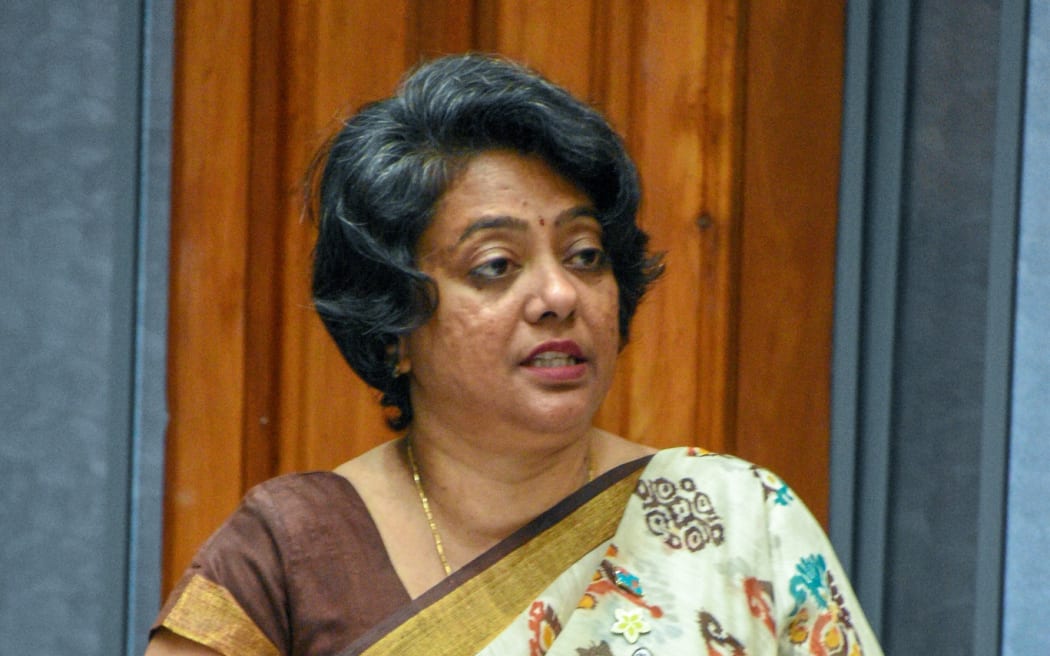
While tabling the motion in the Parliament, Fiji’s assistant minister for women Sashi Kiran said people were still hurting from “political upheavals” and “many unresolved issues” from the past.
Kiran said the commission will offer “closure and healing” to individuals who are still affected by the Fiji’s turbulent history.
Assistant women's minister Sashi Kiran said Fiji has been plagued by political turmoil for more than three decades with four coups. Photo: Facebook.com / Parliament of the Republic of Fiji
In May this year, the Methodist Church of Fiji initiated a national prayer and reconciliation program during the Girmit Day celebrations. Kiran said the participation of leaders and various faith groups at the event signalled that Fijians were ready for the healing process.
“Some may ask whether this is the time for it. Some may say we should focus on cost of living and on better public services and I understand [that],” she said.
“I know from many long years of personal engagement with our people lot of people are hurting. There are many unresolved issues that need closure. Can we be a prosperous society if we live in fear and insecurity, if we do not trust our neighbours and carry wounded hearts.
She said Fiji has been plagued by political turmoil for more than three decades with four coups.
“We are not looking deep inside ourselves to learn the lessons of the past. It is easier to look away from the painful events and perhaps pretend that they did not happen. But constant echoes of divide, narratives of the past remind us that there are deep rooted wounds in may hearts unable to heal.”
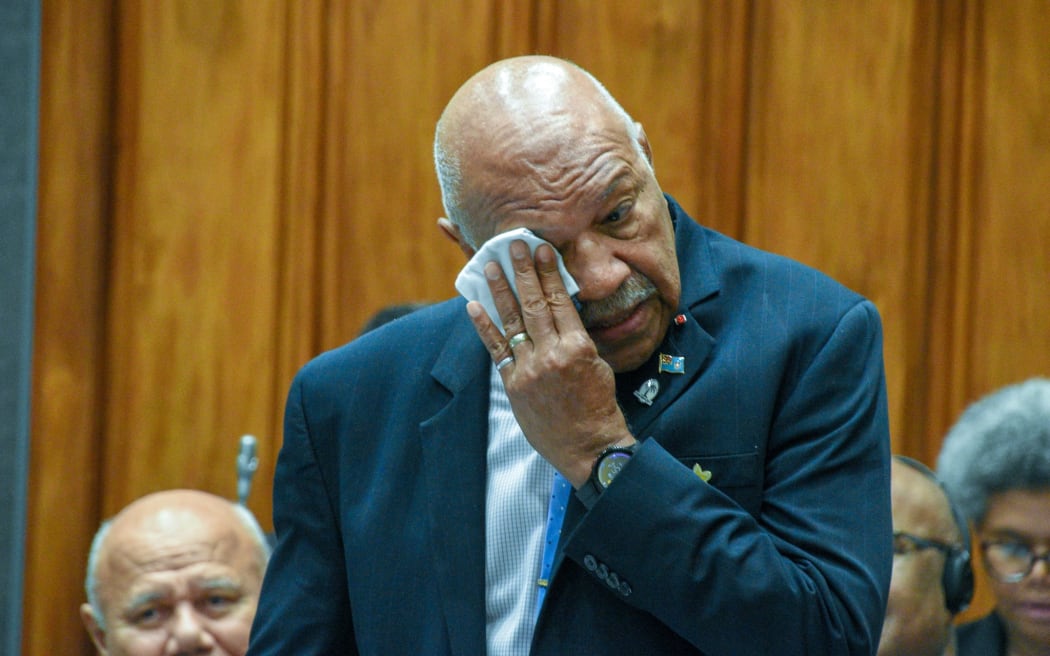
An emotional Rabuka said the commission will “remove the division between the two main communities that have co-existed since well before independence” in 1970.
He said the opposition did not have any reason to oppose the motion.
“I have but I am opening it up. I would probably want to hide a long of things I know [but] none of you [MPs] has anything to hide so we should cooperate and work for this,” Rabuka said.
However, opposition MPs did not back the motion, saying a Truth and Reconciliation Commission would do more harm than good.
Prime Minister Sitiveni Rabuka said opposition should back the government. Photo: Facebook.com / Parliament of the Republic of Fiji
Tackle ‘deep-rooted problems’ – Naupoto
FijiFirst MP and former military commander Viliame Naupoto, in a teary intervention, said “the problem we have is the divide in our society”.
“The divide along racial lines, now there’s even a bigger divide along political lines. I think the big task we have is try and narrow the divide as much as we can and keep working on it,” Naupoto said.
“When we have the truth and reconciliation commission you are opening wounds of the past. If needs to be opened, it needs to be treated so that it can heal.
Naupoto cautioned that political leaders needed to ensure they were not creating new wounds by opening wounds of the past.
“Equality that we strive for can be dealt with policies that unite us,” he said.
“When we see that most of the things that were put in place by the government of the past it means also that the 200,000 voters that voted for us are feeling bad…and so our divide widens now.
“I plead that if you want and work on that utopian dream of this country that is prosperous and peaceful and stable, we have to be tough and face the deep-rooted problems that we have.”
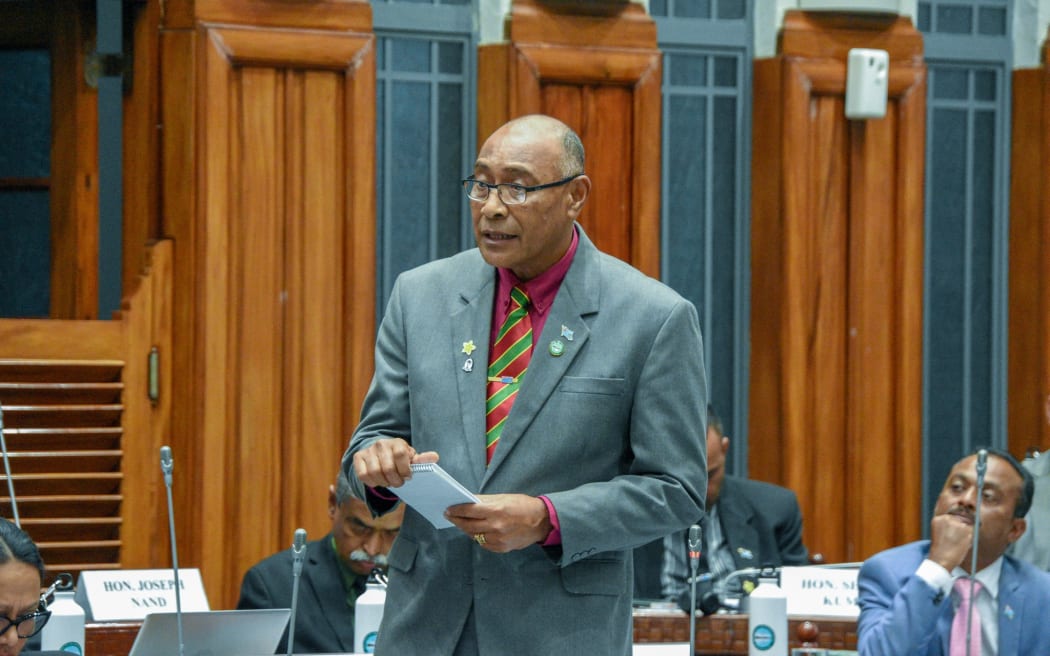
FijiFirst MP Viliame Naupoto said equality can be achieved through policies. Photo: Facebook.com / Parliament of the Republic of Fiji
Tonga has named their strongest match-day 23 to face world No.1 Ireland in Nantes in their first Rugby World Cup pool match on Sunday morning (New Zealand time).
French-based prop forward Ben Tameifuna will lead the side against the Irish in a tactical move that sees captain Sonatane Takulua starting off the bench.
Manu Samoa, who arrived in Bordeaux on Thursday afternoon, have also announced a strong team that will battle World Cup debutants Chile at the Stade de Bordeaux, also early Sunday morning.
Head coach Seilala Mapusua has named his experienced flyhalves Christian Leali’ifano and Lima Sopoaga in the match-day 23.
Meanwhile, Fiji is expected to make changes for the crucial game against Australia.
Tonga focused
‘Ikale Tahi head coach Toutai Kefu said they are focused on Ireland, which began the World Cup with an 82-8 thrashing of Romania last weekend.
“This is a very exciting Tonga team who I think will prove to be very competitive against the best in the world,” he told media in Paris before the team left for Nantes.
“The players are looking forward to playing the best and testing themselves against a confident, capable Ireland team. We’ve been watching them for 12 months now and they definitely deserve the number one team in the world tag.
“The boys are excited to get out there and play. There will be no lack of motivation to do their country and their families proud.”
Kefu has retained the front-row trio of Tameifuna, Siegfried Fisi’ihoi and hooker Paula Ngauamo.
He has also gone for height and speed in the loosies and locks selections.
Vice-captain Halaleva Fifita and Samiuela Lousi start at locks while Tanginoa Halaifonua, Sione Havili and Vaea Fifita complete the loose trio.
In a major move Kefu has opted to give Augustine Pulu the nod ahead of Takulua.
Takulua, Tonga’s most capped player, has been the first-choice halfback for the last six years.
Kefu’s backline choice sees William Havili at fly half while Pita Akhi pairs former All Blacks Malakai Fekitoa in midfield.
Former Mate Ma’a Tonga and Auckland Warriors winger Solomone Kata pairs Afusipa Taumoepeau on the wings, with former All Black Salesi Piutau manning the fullback berth.
Manu Samoa coach Seilala Mapusua said they respect the South Americans and have named a strong team to face them.
“The whole lead-up to the Rugby World Cup has been about Chile, our first game.
“And we are giving them the respect they deserve and making sure we not only do our own people proud but also make sure we are taking steps towards our own goal as Manu Samoa,” Mapusua told media in Bordeaux on Thursday.
Mapusua said they do not underestimate Chile and believed their opponents had played well against Japan in their opening pool game last weekend.
“We need to start well. This is our first game at the Rugby World Cup,” he said.
“We have to nail the opportunities we get.”
Photo: Samoa Rugby Union
He has named both his co-captains Michael Ala’alatoa and Chris Vui in the starting team.
With two experienced flyhalves in former Wallaby Christian Leali’ifano and former All Black Lima Sopoaga both available to him, Mapusua has gone for Leali’ifano to start.
He said he is lucky to have such talented flyhalves and both can play as well as the other.
“They are very similar in their roles with us. I expect them to control the game and really manage the team over the full 80 minutes.
“We are blessed to have them.”
Former All Black Steven Luatua gets to run in at No.8.
Manu Samoa lineup: 1. James Lay, 2. Seilala Lam, 3. Michael Alalatoa, 4. Chris Vui, 5. Theo MacFarland, 6. Taleni Seu, 7. Fritz Lee, 8. Steven Luatua, 9. Johnathan Taumateine, 10, Christian Leialiifano, 11. Nigel Ah-Wong, 12. Tumua Manu, 13. Ulupani Junior Seuteni, 14. Danny Toala, 15. Duncan Paia’aua; Reserves – 16. Sama Malolo, 17. Jordan Lay, 18. Paul Alo-Emile, 19. Sam Slade, 20. Sa Jordan Taufua, 21. Ereatara Enari, 22. Lima Sopoaga, 23. Ed Fidow.
Fiji to ring the changes
Meanwhile, the Flying Fijians are expected to make some changes to their team that lost 32-26 to Wales last Sunday in Bordeaux.
The Fijians meet the Wallabies on Monday morning (Fiji time) in a must-win game for them.
Josua Tuisova is expected to start at No.12, pushing Semi Radradra out to the wing, with Levani Botia also expected to start, at No.7.
Coach Simon Raiwalui will name his team on Friday local time.
Raiwalui said their focus this week has been on the Wallabies.
“We have very good spirit, the boys were laughing again and they were training well,” Raiwalui said.
Fiji sits on two points behind both Australia and Wales and needs to win against the Wallabies to keep their hopes of a quarter-final spot alive.
Semi Radradra of Fiji is tackled by Sam Costelow of Wales during the Rugby World Cup France 2023 match between Wales and Fiji at Nouveau Stade de Bordeaux on September 10, 2023 in Bordeaux, France. Photo: Adam Pretty – World Rugby/World Rugby via Getty Images
Please subscribe to unlock this content. Enter your email to get access.
Opposition MP Māteni Tapueluelu said he was saddened by what appeared to be Speaker Lord Fakafanua’s disregard for some important advice from the former Chief Justice that he should have followed while he conducted last week’s vote of no confidence motion.
Mateni Tapueluelu
Hon. Tapueluelu was referring to a Supreme Court decision in which he was recently granted leave to sue the Parliament in relation to an alleged illegal pay rise.
He said the former Chief Justice Whitten found that the Parliament had failed to make its decision for the pay rise according to the Rules of Procedure of the Legislative Assembly number 79 which said that reports by the Standing Committees regarding the pay rise must refer to Parliament for “debate and vote”.
Instead, the Parliament’s resolutions in response to the reports were communicated to the Members in the form of circulars delivered to their homes for them to tick and sign their names to express agreement. The circulars were neither a motion nor a resolution, the judge said.
Hon. Tapueluelu said he strongly believe the Speaker Lord Fakafanua had made the same mistake last week when he did not allow the House to debate the 46 motions and their corresponding responses read out as part of the vote of no confidence in the Prime Minister.
He said the Assembly’s rule 62 (2) said that “A motion shall be put forth with without debate – (a) if the Speaker or the Chairman is of the opinion that a question has been sufficiently debated.”
Motions vs circulars
Hon. Tapueluelu argued that the 46 motions and their corresponding responses from the Prime Minister which were read out in the House could not be regarded as debates. They were just like questions and answers.
He said this meant that after the reading the Speaker should have used rule 62 (2) (a) which pointed out that the 46 accusations and the corresponding answers from the Prime Minister must be “sufficiently debated” until the Speaker was satisfied the issues had well been clarified before he put it into a ballot.
“What really concerns me is that although we and the court could interpret the rules and constitution differently, it is the court which normally has the final say. The court has already made its decision on the same rules 62 (2) about a motion in Parliament”, Hon Tapueluelu told Kaniva News.
He said the court has already made its recommendation on rule 62 and reminded the Parliament that a “motion must be debated”.
“If we look at Justice Whitten’s decision, the problem with the circulars is that no MP can debate or speak and express his opinions on what message provided in the circulars before the Speaker could make his conclusion.
“In my view, it is the same scenario which applies to the vote of no confidence motion. Last week, no one was allowed to speak and express his opinion in the House regarding the 46 motions and answers. It was just the clerks who spoke and read out the motions and they were not MPs,” Hon Tapueluelu said.
He also said that rule 48 provides the right of MPs to reply.
Rule 48 (1) says “A member who has made a substantive motion shall have a right of reply”.
Tapueluelu said: “All 10 of us MPs who submitted the motion of no confidence were not allowed to reply”.
Ten-minute promise
He said the Speaker told the House the day before the no confidence motion was balloted that he would allow MPs to debate the accusations and the corresponding answers for 10 minutes each.
“That’s rule 38 (1) (a) under which a member may speak for no more than 10 minutes during a debate”, Tapueluelu said.
This meant a Member could speak more than one time, but for no longer that 10 minutes.
That 10 minutes promise for a chance to debate on the motions and answers was not given before the MPs voted on the no confidence motion.
After the reading of the motions, and while the Opposition members were expecting a debate, the Prime Minister moved for the Speaker to let the House ballot on his vote of no confidence.
While the Opposition opposed the Prime Minister’s ballot move some of them began raising some issues they claimed were inaccuracies in the Prime Minister’s 46 response, but they were immediately warned by the Speaker that they were not allowed to debate those issues. He said they were only allowed to show their opinion on the Prime Minister’s motion for a ballot.
“So where is the chance for us to debate then?” Hon. Tapueluelu asked.
Secret meeting not representative
He said the “secret meeting” between the Speaker, the Prime Minister and Hon. Eke before the House returned to finalise the vote of no confidence session on Wednesday appeared to be a move by Lord Fakafanua to justify his second decision to withdraw his promise for the House to debate the 46 responses from the Prime Ministers.
As we reported earlier this week, most of the 10 Opposition MPs, who submitted the vote of no confidence motion were unaware of that special meeting.
The Chief Clerk told us yesterday that the controversial meeting between the Speaker, the Prime Minister and Tongatapu 5 MP Eke on Wednesday was a normal way of meeting used when an MP had something to raise with the Speaker.
She said the details of such meeting would not be released during Parliamentary sessions in order to allow MPs to feel confident in raising any issues with the Speaker.
Hon. Tapueluelu weighed in and said MPs could meet with the Speaker at any time. However, he said he wanted to make it clear that the Speaker’s meeting with Hon. Hu’akavameiliku and Hon. Eke was part of an important issue which was currently being debated in the House and it should have been declared by the Speaker right at the beginning when the House returned from lunch.
“The other thing is that that meeting was not representative as there were 10 of us altogether who signed the motion,” Hon. Tapueluelu told Kaniva News.
Hon. Eke submitted the motion because according to the law only one MP could lodge the submission, but the 10 MPs all contributed to the content of the motions, he said.
By Lydia Lewis, of RNZ.co.nz and is republished with permission
A former intelligence and defence policy analyst Paul Buchanan says some Pacific Island nations are “acting to stay in line with China” over Japan’s Fukushima treated nuclear wastewater release.
Buchanan told RNZ Pacific this is “[to] keep that pipeline open to them when it comes to developmental assistance”.
As China continues to ban all seafood from Japan, the Fukushima issue has “become more of a geopolitical and diplomatic problem than a scientific one”, he said.
The release started on 24 August and is expected to last decades.
The nuclear wastewater is treated to remove harmful radionuclides, then diluted before being released off the coast of Japan in an effort to decommission the defunct Fukushima Daiichi nuclear power station.
Buchanan, who is the director of 36th Parallel Assessments (NZ), put much of the opposition from the region down to “ignorance” or acting to “stay in line with China”.
“The MSG, as well as the Pacific Island Forum, have one eye on China and the other eye on Japan,” he said.
In a speech in June, PIF secretary general Henry Puna acknowledged the elevation of security-driven partnerships and development co-operation with the region.
An emphasis on regionalism and strengthening strategic leverage as a Pacific collective has been drummed home at most PIF events.
On the Fukushima issue, Puna said Pacific leaders are committed to holding Japan “fully accountable” should anything go wrong.
This week’s Forum Foreign Ministers meeting is set to be an opportunity for members to discuss a collective position, a Pacific Island’s Forum Secretariat spokesperson said.
But the region is very much still divided on the matter.
Vanuatu’s deputy prime minister Matai Seremaiah, left, and MSG director general Leonard Louma at the opening of the 22nd MSG Leaders’s Summit Foreign Ministers’ Meeting in Port Vila. 21 August 2023 Photo: RNZ Pacific / Kelvin Anthony
‘No cause for concern’
The Melanesian Spearhead Group (MSG) – made up of Fiji, the FLNKS of New Caledonia, Papua New Guinea, Solomon Islands and Vanuatu – opposed Japan’s release into the Pacific Ocean, though not all leaders of the sub-regional grouping have the same view on the issue.
Fiji’s leader Sitiveni Rabuka continues to maintain his position, saying the science stacks up.
The Pacific and its people “have been victims of false assurances”, MSG Secretariat director-general Leonard Louma said recently.
“The scourge of the health effects, of once-touted negligible effects of nuclear activities, continue to beset us to this day,” Louma said.
The International Atomic Energy Agency’s comprehensive report on Japan’s plan said it would have a negligible radiological impact on people and the environment.
Japan maintains the release is safe.
The Tokyo Electric Power Company said results from daily testing show radionuclide levels are below limits set by Japan’s Nuclear Regulation Authority.
Buchanan agrees there is a “very reasonable” anti-nuclear sentiment.
“That goes back to the French testing days, the American testing days and the destruction that they wrought on small island states,” he said.
“That all is true and it is reasonable. But here’s where they run afoul of science. The science simply points out … there is no cause for concern in the South Pacific.”
Dr Paul Buchanan, director of 36th Parallel Assessments which is a non-partisan, non-governmental geopolitical risk and strategic assessment consultancy, from a South Pacific perspective. Photo: Supplied/ 36th Parallel Assessments
Buchanan said no issues of sovereignty are going to accrue, as Japan is discharging the water into its own coastal waters.
He said in doing that Japan was not breaching any international treaties either.
“It’s easy to sit in the South Pacific and criticise Japan because there will be no harm accrued because of that,” Buchanan said.
Condemning Japan’s plan is an easy way out for the MSG, “to appear to be on the side of China”, he said.
‘Generalised anti-nuclear sentiment’
It could take around ten years for the tritiated water to reach any Pacific Island, if at all, according to ocean current projections.
But even then, the tritium levels will be so low it will not be able to be measured, TEPCO told RNZ.
Buchanan said activists and governments right across the Pacific seem to be allowing “generalised anti-nuclear sentiment” to take control over their rational selves.
He said this simply is not an abuse of nuclear privilege and there is no cause for concern in the South Pacific.
“Unfortunately, I would say that this is born more of ignorance, than of rational concerns about the spillover effects of this treated water, and may actually hang on to lingering historical distress of the Japanese,” Buchanan said.
“The Japanese have not ingratiated themselves to people with their whaling activities.
“And so you have a combination of anti-Japan sentiment with anti-nuclear sentiment, all against the backdrop of Japan’s behaviour in World War II, up to the present day when it comes to issues like whaling.”
Hypocrites
UK, China, South Korea, France and Canada all release tritium into the sea, nuclear experts in the UK told media on the UK Science Media Centre panel.
“This happens all over the world and has been happening all over the world for decades,” Portsmouth University environmental science professor Jim Smith said.
“I would say it would be hypocritical of them to oppose this release.”
Smith has studied radiation at Fukushima and Chernobyl. In theory, you could drink the water from the pipeline at Fukushima, he said.
He said the Sellafield site in the UK releases about seven times more H-3 (tritium) than Fukushima will each year.
“In 2019 alone, the UK emitted about the same amount of tritium as in all the tanks at Fukushima,” he said.
Smith said Canada would have “certainly” emitted more than in all the tanks at Fukushima, which is to be emitted over 30 years.
The Kori plant in South Korea is listed as emitting 91 TBq which is about four times higher than the Fukushima release, but not as high as the Bruce plant in Canada.
“And France emits more than ten times the tritium, in one year, as in all the tanks at Fukushima,” Smith said.
He said the same was likely to be true of China and the US.
“If the ALPS-treated water is safe, why is it being stored?,” he asked, adding “All nuclear reactors emit tritium”.
Smith said there has been no evidence of harm to people or the environment following these operations.
Japan on ‘horns of a dilemma’
With arguments for and against strewn across the backdrop of a chequered colonial and warring past, Buchanan wants people to put their faith in the experts at the IAEA, UN and the Japan Nuclear Regulation Authority.
“That might help encourage non-experts in the world to be aware of their bias and ignorance.”
He said Japan has science on its side, but “for a variety of reasons, environmental and then strictly strategic if you will”, there are significant numbers of people that oppose the release.
“No amount of science is going to convince them otherwise,” he said.
A Tongan medical health specialist with links to anti-vaccination protests and a group founded by Destiny Church leader Brian Tamaki has attacked Prime Minister Chris Hipkins, saying many lives may have been saved if his government told the public ”the truth” about the side effects of Covid-19 vaccines.
Reactions from listeners were mixed. Some commenters were suspicious and asked why she made the allegation during the run-up to the election.
Dr Moala claimed the Labour government and the Medical Council of New Zealand had forced doctors to lie to the public that the vaccines had no side effects.
Moala was referring to a recent statement by Hipkins saying that Covid-19 vaccines were not “compulsory” and the people were given the freedom to choose whether they vaccinated or not.
Moala described Hipkins’ statement in Tongan as: “‘A ia ko e fu’u loi ‘aupito pe foki ‘eni”.
In English this translates as: “This was of course an absolute blatant lie”.
She said political leaders had lied too much.
“We grew up and used to expecting our leaders to tell the truth, but now they used to tell lies”.
“When I think about their lies. It may have been okay if not many people had died from Covid vaccines.”
The registered doctor alleged Covid-19 vaccines had caused human hearts to swell, a symptom of a disease she said was known as “myocarditis” and it had killed young children and athletes.
Moala said the Prime Minister never considered the people who had lost their jobs because they did not want to be vaccinated of their own volition.
She said: “Nurses and doctors who lost their jobs because they were unvaccinated have yet to retain their jobs. Pharmacists, health workers, they are still unable to return despite Labour lying the mandate is over. That’s not true”.
The criticisms came as health experts this afternoon were warning the new COVID-19 variant might already be in New Zealand, but say it’s a variant of interest and not of concern yet.
Moala claimed that at one stage the government through the Ministry of Health and the Medical Council of New Zealand wrote and prohibited (“tapu”) all doctors from advising the public about the side effects of the vaccines.
She alleged the doctors were told to advise the public that the Covid-19 vaccines were safe and they would work just like Panadol tablets.
Moala has links to anti-mandate groups the Freedom and Rights Coalition and New Zealand Doctors Speaking Out with Science (NZDSOS).
She previously protested in the Freedom & Rights Coalition’s anti-government marches against Covid-19 lockdowns.
She was a candidate for Wellington City Council, and in her candidate statement, according to Stuff, she described herself as a public health expert, who “loathe(s) poor decision-making that violates people’s health, rights, and freedom”.
On Facebook, Moala sometimes tags Destiny Church leaders Brian and Hannah Tamaki in her Facebook posts about the Freedom & Rights Coalition. The self-styled Bishop Tamaki founded the Freedom and Rights Coalition.
The Broadcasting Standards Authority dismissed claims by Doctors Speaking Out with Science that a television broadcast in 2021 about the then new Pfizer vaccine was inaccurate.
In 2021 Stuff reported that 6500 doctors had signed an open letter supporting vaccination while Doctors speaking Out had 64 members.
Moala told RTTI that all vaccines had good and bad effects.
“But we weigh up the balance of good and bad effects of the vaccines”, she said.
“We all know that there are side effects of vaccines as we had been immunised previously for polio, rubella and meningitis. They all have side effects.
“But we doctors here in New Zealand were prevented from telling that to people”.
Moala claimed that on December 23 the Ministry of Health changed its stance on vaccine side effects and “urgently alerted family doctors to start telling the public that there were side effects of the vaccines, and it caused the heart to swell, which was the Myocarditis.”
“We are talking about the agenda and the leaders’ lying like Prime Minister’s Hipkin’s lying, saying the people were not forced. After all, people who did not immunise lost their jobs and businesses were closed”.
She claimed the Labour Party had been lying for a long time and their interest in people was their votes only.
“When the Leaders are lying and never tell the people the truth there were consequences. As I have just explained there were children and athletes who were healthy, but they suddenly collapsed and that because they had heart swelling or myocarditis,” Moala claimed.
She warned listeners to be wary of the coming election in October and such lying that comes from the leaders.
“This is a religious war as Satan was trying to take away many lives,” she claimed.
She then invited her co-hosts Dr Ana Mesui to share her experience with those who could not understand about Covid vaccines.
Mesui , an Associate Clinical Director for Pacific at ProCare Health, said most of her patients at the time did not want to be vaccinated.
“But it’s their own decision”, she said.
“But the narrative from the government at the time, just like what Ate has said, it (the vaccines) was 100 percent” safe, Mesui said.
She said no vaccines in the world were 100 percent safe.
“There is always a risk for everything”.
“So what I saw with some of my patients some of them have a rash, pains, drowsiness and heart diseases – rapid heartbeat.
She said the only response from the doctors in New Zealand were that the vaccines were 100 percent safe.
“So we are in an environment we are seeing people dying unexpectedly we turned to the government as we are relying on them and they said we did not force you”.
“But we know a lot of Tongan kāinga they did not want to vaccinate, but they had financial obligations for their families,” implying that prize draws , shopping vouchers and cash giveaways offered to people, schools and charities were an incentive to get vaccinated.
The RTTI programme showpresenter Setita Tu’i’onetoa, who said she chose not to get vaccinated, credited the doctors for what she described as “revealing the truth to the people”.
The one-sided show racked up 882 comments, 52 shares and 260 reactions.
One asked Moala whether she favoured a particular political party.
She mentioned Freedom New Zealand, Brian Tamaki, Vision New Zealand and Alfred Ngaro.
Kaniva News has contacted the Prime Minster’s Office and the Medical Council of New Zealand for comments.
Please subscribe to unlock this content. Enter your email to get access.
The Parliament’s Chief Clerk said a controversial meeting between the Speaker, the Prime Minister and Tongatapu 5 MP Dr ‘Aisake Eke on Wednesday was a normal way of meeting used when an MP had something to raise with the Speaker.
She said during the Parliament’s session for the vote of no confidence last week the Speaker met with several MPs on various occasions.
She said the details of such meeting would not be released during Parliamentary sessions in order to allow MPs to feel confident in raising any issues with the Speaker.
Chief Clerk Gloria Pōle’o was responding after Kaniva News asked the Speaker, Lord Fakafanua, for comment on what we described as a “secret meeting” between him, the Prime Minister and Tongatapu 5 MP Dr ‘Aisake Eke on the day the House was about to ballot the Prime Minister Hu’akavameiliku’s vote of no confidence motion.
Pōle’o denied the accusation raised by the public against the Speaker.
She said Lord Fakafanua was neutral and his responsibility was to direct the Parliament’s operation according to his interpretation of the Constitution and the Assembly’s rules.
“However, not all MPs, media organisations, the people and the Lord Speaker could agree on the same interpretation at all times”, Pōle’o said in Tongan.
Pōle’o confirmed the meeting in question had occurred. She said she attended it. However, she refused to answer any of our queries which were sent to the Speaker.
As we reported yesterday, we asked the Speaker whether the meeting in question was on the agenda. We also asked him who organised and called his meeting with the Prime Minister and Hon. Eke.
We asked him why he did not declare the special meeting when the House returned after their lunch break since the vote of no confidence motion was livestreamed.
We told the Speaker that the Prime Minister’s surprise revelation of that meeting during the House session without giving any details had sparked suspicion and speculation among the public that he was taking sides with the Prime Minister.
Some Democratic (PTOA) supporters interpreted the meeting differently and accused Dr Eke of betraying the Opposition.
Dr Eke was called to the meeting after he submitted the vote of no confidence in the Prime Minister.
Not all MPs, especially the Opposition, were informed about the meeting.
As we reported yesterday, the Speaker was made aware in that meeting that the Prime Minister would move in the House to have his vote of no confidence balloted without a debate.
Since Dr Eke had joined the meeting in question the Prime Minister used it as an excuse in the House to silence the Opposition from arguing that they should be given an opportunity to respond to his answers to the motion of no confidence.
MP Piveni Piukala told the Prime Minister he could not use a meeting held outside Parliament as a defence.
The Opposition argued that the Prime Minister was trying to prevent them from clarifying his responses – which they deemed misleading – for fear that the public might find out more about the truth of his responses.
The Speaker eventually allowed the Prime Minister’s motion for a vote which was carried by 17 – 10.
Pōle’o also confirmed that Parliament was postponed yesterday until further notice to allow the Opposition to file their legal action against the Speaker over his decision not to allow them to debate the Prime Minister’s responses.