Another 11 people have died from Covid-19, and 6242 more community cases have been detected, health authorities say.
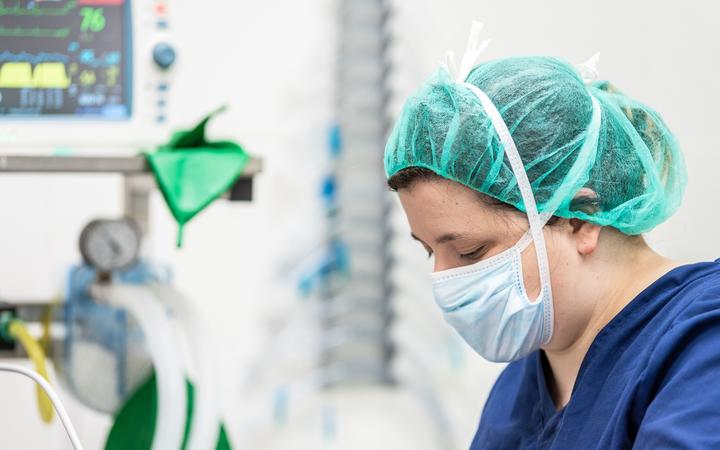
A nurse working in an intensive care ward. (File photo). Photo: 123RF
The Ministry of Health said the seven-day rolling average of case numbers was on the decline, with today’s seven-day rolling average at 7986 – last Monday it was 10,169.
There are 553 people are currently in hospital with the virus, including 23 in intensive care.
Yesterday, there were ten new deaths reported, and 5933 new community cases reported.
Air New Zealand said it has been flooded with calls from people interested in travelling as the borders open.
Many people want to check safety precautions and what documentation and other preparations they need to make for travelling under Orange restrictions, and the airline said it had brought in extra staff to cope with the demand.
The Hu’akavameiliku government has dumped the former government’s controversial multi -million pa’anga roading project, Kaniva News has learned.
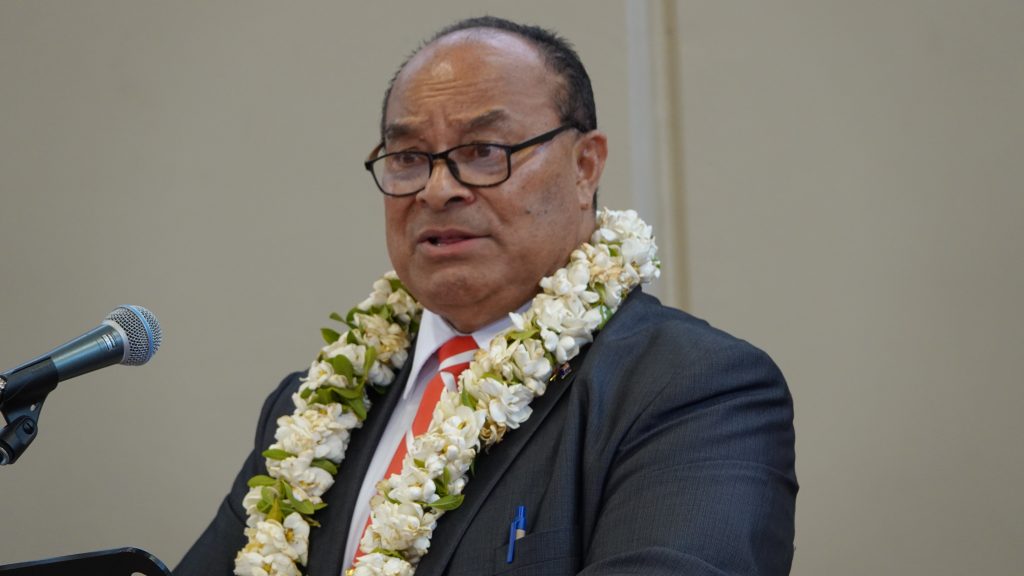
Prime Minister Hu’akavameiliku
Reliable sources told Kaniva the Hu’akavameiliku government has also scrapped the Pohiva Tu’i’onetoa government’s housing project, which included weaving, tapa making and evacuation community centres.
The projects attracted a lot of criticism from the public. Many people blasted the former government for what appeared to be favouritism and nepotism involved in the way the projects were distributed. The roading project was a three-year plan set to run from 2020 until 2023. The Tu’i’onetoa government was ousted in last year’s premiership election.
The Hu’akavameiliku government has initiated new rebuilding projects including the Hunga-Tonga-Hunga-Ha’apai volcano and tsunami rebuilding program.
Questions are now being asked about the millions of pa’anga spent by the former government on the project. Roads in Tongatapu and Vava’u which had been repaired, renewed and constructed under the project have been badly damaged. Critics said the damage was the result of unprofessional work, lack of upkeep and lack of serious purpose.
Photos taken in Vava’u today seen by Kaniva News showed roads with large potholes and vehicles queuing on damaged roads with some having to cross to their opposite lanes in an attempt to avoid falling into the holes. Some of these roads were not constructed under the former government’s roading projects.
Neiafu Town Officer Vava Lapota previously told Kaniva News that the main roads from the capital Neiafu to Taoa and Mataika were badly damaged.
Concerns about the merit of the project have recently emerged on social media with people, including foreign expatriates in Tonga, asking what happened to the millions of pa’anga spent in the project.
“I was horrified how massive potholes are in Vavau right now. What happened to roading project money that ran into the millions?” a businesswoman asked on an Expats and Locals Facebook group.
Prime Minister Pōhiva Tu’i’onetoa. Photo/Kalino Lātū (Kaniva Tonga)
Former Opposition Leader Sēmisi Sika accused the Tu’ionetoa government of creating the roading project to benefit his friends and those who helped him win the Prime Ministership, including former Cabinet Minister ‘Etuate Lavulavu who is serving a jail term for fraud. Tu’i’onetoa had argued that the project was a public priority.
In 2020 Hon. Sika accused the Tu’i’onetoa government of designing the tendering process for its roading project so that contracts were given to three of its friends.
He made the accusation in Parliament after the Minister for Finance said the government would guarantee loans from the Tonga Development Bank to three private companies which won the bid of outsourcing road work from the government.
Prime Minister Tu’i’onetoa eventually conceded that contracts for the roading project had gone to companies with strong links to the government.
The contractors were Island Dredging Limited, City Engineering and Construction Limited and Inter-Pacific Limited.
The then Minister of Police, Lord Nuku, was a former Director of Island Dredging.
Lord Nuku’s son, Faka’osifono Valevale, was the Director of Island Dredging when the contracts were issued.
Tongan People’s Party Deputy Chairman Etuate Lavulavu was made a Director of Inter-Pacific Limited in February 2016, but was later replaced by ‘Inoke Finau Vala.
Opposition MPs claimed that other contractors involved in the bid for the contract were cheaper than the government’s favoured contractors.
Kaniva News reported in April 2020 that the government claimed it could not afford to pay the market price of between TOP$190 and TOP$220 for rocks for the project and so had lawfully cancelled the procurement process.
Hon. Tu’i’onetoa then said the government had set the price at TOP$70 for each truck load.
There have been changes around the interim board table for the Tonga Rugby League including a new chairman.
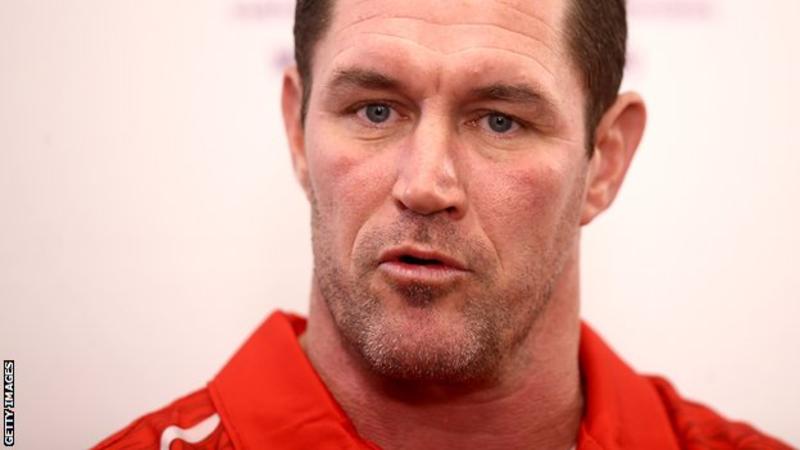
Kristian Woolf continued as Head Coach of Tonga’s National Rugby League team ahead of the June test match against New Zealand.
Kristian Woolf led Tonga to the last four of the 2017 World Cup, where they were beaten by England
Prime Minister Hu’akavameiliku was appointed as the new chairman of the board, taking the place of former Prime Minister Pōhiva Tu’i’onetoa.
Two other Cabinet Ministers appointed were Sports Minister Sangstar Saulala and Trade Minister Dr Viliami Lātū, a government spokesperson told Kaniva News.
The interim board, previously known as Interim Management Group (IMG), was installed in June 2021, combining Tonga government officials, working together with administrators from the Asia Pacific Rugby League (APRL).
It was announced last year, that according to the constitution of the Tonga Rugby League, the IMG’s other posts include:
The Working Group Secretaries – Edgar Cocker (Tonga) and Jeremy Edwards (APRL)
Working Group members – The Hon.Tatafu Moeaki, Sports CEO Fotu Fisi’iahi, Mr. Scott Clark, and Mr. Gareth Holmes.
It is understood the IMG is now operated under a new banner “Tonga Rugby League”.
The government was currently working on a new Memorandum of Understanding (MOU) before it is expected to announce a permanent rugby league body to oversee the sports in Tonga after the upcoming World Cup tournament.
Tonga’s Prime Minister has told the Our Ocean Conference in Palau that island communities encounter several multifaceted ocean challenges.
Hu’akavameiliku Siaosi Sovaleni told 500 delegates from more that 80 nations “that we are small island communities with small economies and capacities and managing our ocean alone.”
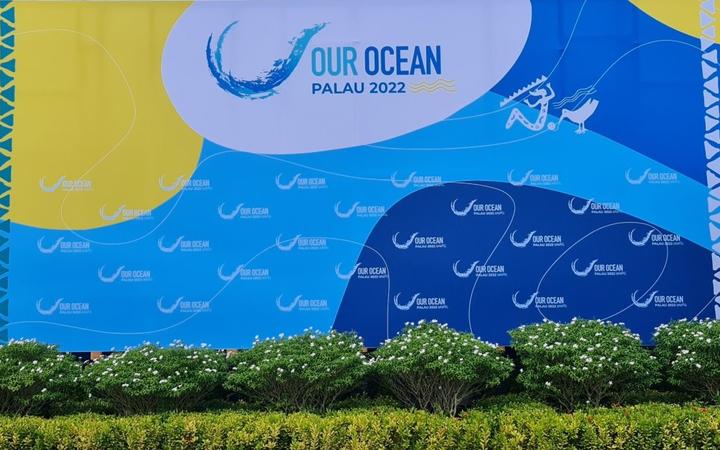
Our Ocean conference Photo: RNZ Pacific
The prime minister quoted renowned Pacific academic and ocean champion, the late Epeli Hauʻofa:
‘Oceania is vast, Oceania is expanding, Oceania is hospitable and generous, Oceania is humanity rising from the depths of brine and regions of fire deeper still, Oceania is us.’
“We are the Pacific ocean, it is the largest and deepest ocean base on earth. So for small island and large ocean states, it is critical to understand the inter-connectivity between land and oceans for sustainable development.
From the highlands to the high seas where the connection between people, planet, and profit systems underpin security and livelihoods. And therefore sustainable development requires a paradigm shift from sectorial to eco-system based systems,” Sovaleni said.
“As island communities we encounter several ocean challenges which are multi-faced. We are small island communities with small economies and capacities to manage our ocean alone.
We are vulnerable to natural hazards and disasters such as extreme weather events, climate change, volcanic eruptions, and tsunami which was experienced in Tonga on January 15, this year,” he said.
He said can not control transboundary impacts of marine bio-diversity… beyond our jurisdictions, these include pollution, illegal unregulated unreported fishing, and other climate change impacts.
“The multifaced nature of these challenges encountered by our island communities is one that we cannot address alone and what we need is the support of the region and the world
This conference is one of the many solutions to our multifaceted ocean challenges, like the all encompassing sustainable development goals, the proposed areas of actions [conference] are interlinked in their common intent, yet different to their approaches,” he said.
The prime minister said we welcome these areas of action as they highlight the nexus between ocean and climate, critical ocean base climate solutions and the important issue of security which are commonalities we all.
RNZ Pacific’s manager Moera Tuilaepa-Taylor is covering the conference in Palau. Her trip was made possible by the US State Department.
By Jordan Bond of RNZ.co.nz and is republished with permission.
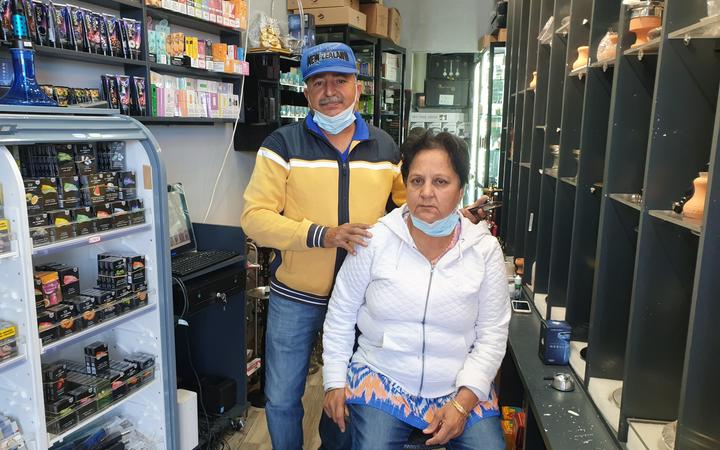
A shop owner in a central Auckland suburb had a knife pulled on him and his wife in broad daylight yesterday by two teenage girls.
Subhash Batra and his wife. Photo: RNZ / Jordan Bond
The assailants told him they would kill him over a hundred dollars worth of shisha products, which look similar to cigarette packets.
Within a 200 metre stretch of Sandringham Road, three different stores are boarded up, having been broken into or ram-raided in the last fortnight.
Stolen cars and weapons are being used to steal tobacco, vapes and alcohol. Police say the vast majority of ram raids are committed by teenagers.
Subhash Batra owns a vape shop on Auckland’s Sandringham Road. The two young girls walked in wearing hoodies and masks yesterday at 2:30pm.
“I was standing here and one of the girls pointed a knife onto me and said ‘get back or I’m going to stab you’,” Batra said.
“So I talked to the girl like she was my own daughter. I said ‘what the hell are you doing, you’re a school-going girl, why are you trying to ruin your life? For God’s sake, don’t do this,’ but she was not bothered.”
The other girl started putting shisha products, which look like packets of cigarettes, into her bag.
“My wife pushed her and stopped her from doing that. The other girl with the knife pointed it [at] my wife and said ‘I’ll hit you, I’ll kill you’.”
They had a scuffle, neighbouring shop owners arrived, and the girls got away. Subhash and his wife were not injured.
It was all caught in CCTV footage.
“It is scary, but I’m sorry to say, when we came to New Zealand we were told it was a crime-free country. We opened the store in October 2021, and so far five times [we’ve been robbed],” Batra said.
Police say in the 12 months to October last year there were 283 ram raids around the country, more than five a week.
Eighty-eight percent of those were by teenagers or even younger kids.
Just 42 percent of the offenders were found – the majority got away.
That was not a surprise to Kshitij Vatsa, whose dairy a couple of hundred metres away from Batra’s shop was ramraided a week ago by teenagers.
They crashed through a bollard with a stolen car and smashed through the front door.
“The damage I am thinking would not be less than $20,000 or $30,000,” Vatsa said.
As well as the damage, a few thousand dollars worth of cigarettes were taken.
Vatsa no longer had his children hanging out in the back of the shop due to safety concerns.
“I’ve heard it’s only teenagers [doing the ramraids]. I think there were nine kids in my shop when it happened, I think two or three girls and six boys. What I know from the police is that it was an 11-year-old girl driving. It’s pretty sad, 11-year-olds or 12-year-olds doing robberies like this.”
Police managed to apprehend all nine occupants after being tracked by the police helicopter. Two of the offenders were to appear in Youth Court. The other seven offenders were referred to Youth Aid.
Back up the road, a boarded-up liquor shop was ram raided two weeks ago, store owner Anna said.
“We are worried. We work so hard, we pay taxes. But now I think that New Zealand is not secure anymore. Even if the police catch them, what [would] they do?”
Batra said the children and teenagers involved in the attacks did not have any fear of the police. In fact, they boasted about it online and essentially taunt police, he said.
He mentioned a robbery of his shop earlier this year.
“Young guys, they recorded the entire proceedings amazingly with their own phone. [They] made a video, went home, displayed the [stolen goods] and posted it on social media, on TikTok. Amazing! They are throwing a challenge to the police – ‘look, we have done it. You can’t do anything to us’.”
Sandringham is a vibrant, multi-cultural part of town. There are a lot of immigrants and second generation New Zealanders living in the suburb and there is a large Indian influence.
These shop owners say their feeling of security has dwindled recently, and they were questioning whether to shut up shop.
The Ministry of Health has also reported the highest number of new confirmed positive COVID-19 community cases in a 48 hour period with 701 new cases, through to 2pm Thursday.
There have now been 4,730 cases of Covid in Samoa with another 63 detected at points of entry since November 2020.
17 cases are in managed isolation and 2 critical cases are in the intensive care unit of the Tupua Tamasese Meaole hospital.
In a statement the Ministry has asked the public to remain vigilant, follow the health precautions, stay home and isolate if feeling unwell, mask up and ensure good personal hygiene.
It has also reiterated that vaccination remains the best defence against the pandemic.
The nationwide RAT and vaccination roll out continues daily but no new data was released except that more than 36,000 RAT tests have been conducted since testing started last month.
Fiji police are investigating the arrival of a luxury vessel owned by a Russian oligarch, questioning its captain about how he brought the boat to the Pacific island nation without customs clearance.
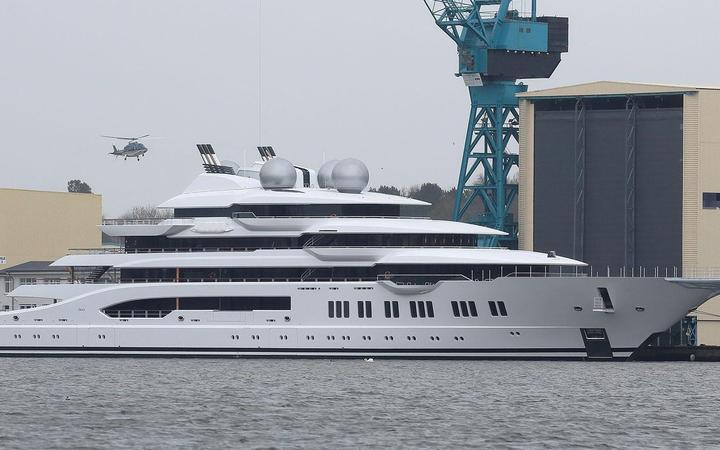
Fiji newspapers reported that police had seized the superyacht Amadea, owned by a Russian billionaire, Suleiman Kerimov, who has been sanctioned by the United States, Britain and the European Union over Russia’s invasion of Ukraine, and detained its crew.
The ‘Amadea’ Photo: Boat International
An official at the National Police Command and Control Centre confirmed to Reuters the captain of the vessel, which arrived on Tuesday, was being questioned about how it came to Fiji without customs clearance.
Russian President Vladimir Putin, lawmakers and businessmen have faced wide-reaching sanctions in the wake of the invasion, which Moscow calls a special military operation, while European countries have seized property including villas and boats.
The US embassy said it was aware the Amadea had docked in Fiji’s Lautoka port and the embassy was cooperating with Fijian authorities on the matter.
“The United States is committed to finding and seizing the assets of the oligarchs who have supported the Russian Federation’s brutal, unprovoked war of choice against Ukraine,” the embassy said in a statement.
“We and several of our EU partners have already frozen or seized many assets of these oligarchs. We are working closely with governments and private sector partners in Europe, and the entire world, including Fiji, on this issue.”
Commissioner of Police, Brigadier General Sitivini Qiliho, told the Fiji Sun newspaper the Attorney General’s office had been contacted by a foreign government requesting assistance in a criminal matter, and Fiji had agreements with other countries to enforce sanctions on Russian oligarchs.
The European Union delegations in Fiji had also requested cooperation, the Fiji Times reported.
Fiji had been alerted to the approach of the Amadea before it moored at Lautoka Wharf, the media reported.
An official in Attorney General Aiyaz Sayed-Khaiyum’s office declined to comment saying it was an internal matter for the Fiji government.
The Marine Traffic website showed Amadea left Mexico 18 days ago.
Police busts in Tongatapu have led to the seizure of meth, cash, drug utensils and the arrests of 11 people.
Police photo supplied
Six men and a woman, aged 22 to 63 years old were arrested from a residence at ‘Utulau after a police drug raid on Friday April 8. The Police Drugs Enforcement Taskforce seized from the residence 0.13g methamphetamine, more than $4,000 cash in Tongan and American currencies, and drug utensils.
All seven appeared in court on Monday. April 11 where Magistrate Salesi Mafi released them on bail except for a 32-year-old male who remains in custody until 15th April.
Another two people, a 21-year-old man and a 27-year-old woman, were arrested on the same day from a bush allotment at ‘Utulau for possession of drug utensils. Both have been released on bail.
Further arrests were made on Sunday. April 10. Police arrested two 20-year-old men, one at Lapaha and the other at Ngele’ia for breaching curfew. Each had a pack of cannabis in their possession for which they have been criminally charged.
“We are concerned that while our people and communities are amid tough times with the impact of the COVID-19 pandemic, selfish individuals are adding to that burden through non-compliance with curfew restrictions and the continuing supply of drugs to our youth,” says Detective Acting Deputy Commissioner Halatoa Taufa.
He added that the Drugs Enforcement Taskforce will continue to bring before the courts those who are illegally involved in drugs.
Anyone with information on drug related activities to contact Police on 740-1660 or 922.
The teenager who was fatally stabbed during a brawl at the Easter Show was about to become a father.
Uati Falelotu (R), The post was flooded with messages of congratulations, with some calling it a ‘miracle’ that she’s been left with ‘a little piece of her love
Taylor Piliae, 18, announced through her younger sister that she was expecting a baby with her late 17-year-old boyfriend Uati ‘Pele‘ Faletolu.
Faletolu was allegedly fatally stabbed in the chest during a brawl while he was working at the Easter Show on Monday night.
There are fears a postcode gang war between rival western Sydney gangs, the 67 and the 27, may have sparked the melee.
Ms Piliae wrote ‘can’t wait to meet you mini Pele’ alongside her ultrasound video.
The announcement confirms speculation after Faletolu’s untimely death that he was due to be a father.
‘The rumours are true,’ Ms Piliae’s sister Bree said. ‘My beautiful sister has been blessed with his baby. Congratulations big sis with you every step of the way.’
The post was flooded with messages of congratulations, with some calling it a ‘miracle’ that she’s been left with ‘a little piece of her love’.
‘That was his biggest goal, to become a dad,’ another said.
Friends of the 17-year-old victim warned his death could further escalate tensions between the rival western Sydney gangs.
Members of the two groups, 67 from Doonside and 27 from Mount Druitt, reportedly had an altercation near the adult section of the show about 8pm before it descended into an all-out brawl.
Police are yet to formally identify a suspect and believe the attacker may still be on the run.
The victim’s 15-year-old brother has been charged with affray and carrying a knife. He has not been charged relating to his death and will face Parramatta Children’s Court on Tuesday afternoon.
The boy was allegedly seen on viral footage sitting on the ground in handcuffs after the melee.
Distressed friends and relatives of Faletolu and the 15-year-old have spoken out to clear up false rumours that the teenager has been charged over his brother’s death.
Instead, the charges relate to the alleged brawl.
‘Now a mum has to find out she lost a son. For what? An area you don’t own,’ one critic said online.
Superintendent Danielle Emerton, from the Auburn Police Area Command, would not rule out the possibility the attack was motivated by postcode wars.
Instead, she suggested it could have been a ‘planned confrontation’ between the groups.
‘We’re trying to piece it together. It’s a tragic, senseless act. This is a family event and the fact that someone has bought a knife into the show is upsetting,’ she said.
‘There were two groups involved in the affray incident where there was a knife involved. So we are looking at additional people that were involved in last night’s attack.
‘Someone knows who has done this.’
Faletolu was rushed to Westmead Hospital in a critical condition but later died. He’d been stabbed in the chest while working at the show.
Paramedics were called to a busy strip inside the Sydney Royal Easter Show about 8pm Monday night amid reports of a brawl between two groups of young men.
At least two teenagers were stabbed; the victim and a 16-year-old boy who remains in hospital in a stable condition with wounds to his leg.
Police confirmed in a press conference on Tuesday morning at least one suspect remains on the run. A strike force has been established to identify any other people involved in the brawl.
Daily Mail Australia revealed on Tuesday Faletolu was an employee of the carnival and had been for at least two years.
He was on his break midway through his shift when he reportedly went to meet some friends, including his younger brother, who were attending the show.
Just a day before his death, the victim shared a video at work pouting at the camera with the caption: ‘When you wish ur gf worked at the Easter Show again with u’.
He was working the Break Dance ride inside the adult section of the carnival. The ride is near a thoroughfare which is often congested and brimming with people.
Friends and colleagues have described him as a ‘great guy’ who always made shifts fun.
‘Was a blessing working with you at the show,’ one friend said.
‘He had his whole life ahead of him… This never should have happened.’
While campaigning in western Sydney on Tuesday, Prime Minister Scott Morrison said he was ‘distressed’ to learn of the teen’s death.
‘I would say to the family of those who have lost their son, my heart goes out to you. Your hearts must be shattered and broken,’ he said.
‘I would be asking all parents, obviously, to be taking care and making sure their kids are doing the right thing and making sure they’re staying safe and being very aware of their surroundings.’
Footage circulated to social media showed two men brawling in the middle of the carnival.
The taller of the pair tried to send his knee into the other’s head as he was driven backwards before landing a series of punches in his abdomen.
The smaller man retaliated by driving him backwards into a set of garbage bins before the taller man was joined by another who also began to swing his fists.
NSW Ambulance Inspector Mark Whittaker said by the time paramedics arrived the victim was already suffering a cardiac arrest as a direct result of the chest wound.
‘Paramedics performed CPR and a number of other critical interventions at the scene before loading the patient for transport to Westmead Hospital, unfortunately despite best efforts he couldn’t be resuscitated,’ he said.
Showgoers were moved out of the carnival area as officers established a crime scene.
Will New Zealand move out of the red traffic light setting today? Minister Chris Hipkins has more…
Covid-19 Response Minister Chris Hipkins
Covid-19 Response Minister Chris Hipkins has confirmed the entire country will drop from red to the orange traffic light setting from 11.59pm tonight, saying the “overall picture is a very positive one.”
Hipkins said the change in alert levels was justified for several reasons, including an ongoing decline in cases.
He said it had been three weeks since the most recent simplification to the traffic light system, and despite the “significant relaxation of the settings, we’ve continued to see positive improvements in the overall trajectory”.
He said case numbers now sit below 10,000 new cases per day for the first time since 24 February, and that hospitalisations in Auckland were lower, with all three DHBs each reporting fewer than 100 patients for the first time since late February.
Planned care delivery is also increasing day by day, and deaths were also decreasing, from a seven-day rolling average of 20 a week ago, to 13 now.
“The overall picture is a very positive one.”
The change ot the orange traffic light setting means there are no indoor or outdoor capacity limits and no seated and separated rules.
Face masks remain an important protection and are encouraged, but are largely no longer required.
They are still required at some gatherings and events, close-proximity businesses like hairdressers and food-and-drink businesses.
Masks are also no longer required in schools, though they are again still encouraged. The ministry is providing further advice to schools about increasing ventilation.
Hipkins said mask requirements in schools will no longer be justified in all cases, some will have high rates of vaccination or immunity through having had Covid-19, and others might not be experiencing outbreaks at all, so it “does move to a more localised response from schools”.
He said masks are still required on public transport and flights.
He says Cabinet “absolutely” considered the possibility of requirements for mask use in schools.
“Ultimately looking at a school by school basis, in some schools there is still a very strong justification for masks – but not all.
“It is very challenging for schools, it has proven to be one of the most challenging Covid-19 requirements.”
He said schools have been provided with guidance, and they have access to public health guidance so they can consider the advice for themselves.
Hipkins urged the roughly 1 million New Zealanders who have not yet got booster shots to do so, saying New Zealand fared much better than many other countries because of high levels of vaccination.
He said the only question in considering settings was over whether the move to orange would be tonight or tomorrow, and ultimately the evidence was very in favour of moving to orange.
The next review of the traffic light settings will be in mid-May.