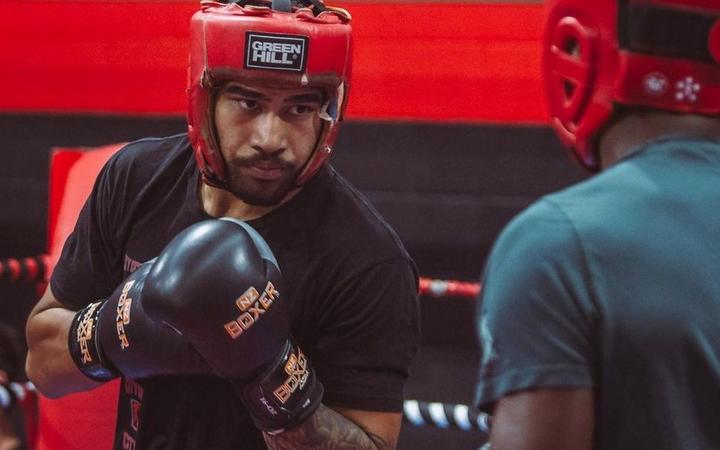
A man has pleaded guilty to the manslaughter of Fau Vake, a rising MMA fighter who was punched in a late night attack in Auckland last year.
Liufau Vake known as Fau died in hospital nine days after the attack. Photo: Instagram / Fau Vake
Liufau Vake, 25, known as Fau, died in hospital nine days after being hit late at night outside a bar on Symonds St. He was in critical care and underwent surgery to try relieve pressure on his brain.
Today in the Auckland High Court, Daniel Havili pleaded guilty to the manslaughter of Fau Vake, and to assaulting Fau’s brother Ika Vake, who survived. Havili’s name suppression lapsed today and he can be named for the first time.
Another man, Siofilisi Paongo, pleaded guilty to assaulting Ika Vake.
Both men initially pleaded not guilty and were set to be tried in court later this year. They will now be sentenced on April 12 this year.
A total of four men were charged. Three have now pleaded guilty, and one denies his charges and will go to trial this year.
In August last year Ofa He Mooni Folau, 29, was sentenced after he pleaded guilty to two charges of assaulting with intent to injure.
“That’s not good enough for being part of an attack that took a man’s life,” Dan Hooker said outside court in August 2021.
“Six months, stay at home? That’s Covid restrictions,” Hooker said, who’s also an MMA fighter. “100 percent the laws have to change.”
Neither the Crown nor the defence contended that Folau was responsible for Fau’s death, but the judge said Folau had punched Fau Vake three times in the head with a closed fist. Vake was subsequently assaulted by others and was rendered unconscious. He was taken to hospital and required surgery to relieve pressure on his brain, and died nine days later.
The judge in Folau’s sentencing said Vake and his brother were trying to get away from the men, and were not aggressors in the situation.
Tonga has gone into lockdown after five fresh cases of Covid were recorded in Nuku’alofa.
They included three new covid-19 cases which have been confirmed this afternoon bringing the total number of patients to five.
The latest transmission involved a woman and her 3 and 4 years old children.
The additional cases come after two port workers tested positive and their results were confirmed in a press conference last night.
The Ministry of Health is expected to update the situation every two days during the lockdown which began today at 6pm.
It is expected that more cases could be detected in the community after places of interest had been revealed.
As we reported this morning, a kindergarten in Fangaloto in eastern Nuku’alofa and a church in western Tongatapu have become close-contact locations of interest for Covid-19.
The Ministry of Health has asked anyone who was at the Matahau Free Wesleyan Church last Sunday at 10am and at 5.30pm on Monday 31 or at ‘Ela’s preschool at 11-12pm on Monday or the whole day on Tuesday to self-isolate and get tested immediately or contact the Ministry on phone 080019 or 0800935.
There are also four other close-contact venues in Tongatapu listed today, including a food outlet, liquor shop and a convenience store.
They are:
Saturday 29 January
12 – 1pm
Rodney Liquor in Fanga ‘O Pilolevu
1-2pm
Solomone Ikahihifo convenience store in Kolomotu’a
Sunday 30 January 2022
10am
Matahau Free Wesleyan Church prayer services
Monday 31 January
10-11am
MBF Bank
11am – 12pm
‘Ela’s kindergarten in Fangaloto
12-2pm
Chinese Shop KFC, Vuna Road opposite Taufa’āhau Domestic Wharf
5.30pm
Evening prayer service at Matahau Free Wesleyan Church
A kindergarten in eastern Nuku’alofa and a church in western Tongatapu have become close-contact locations of interest for Covid-19 as Tonga braces for a nationwide lockdown this evening at 6pm.
The Ministry of Health has asked anyone who was at the Matahau Free Wesleyan Church last Sunday at 10am and at 5.30pm on Monday 31 or at ‘Ela’s preschool at 11-12pm on Monday or the whole day on Tuesday to self-isolate and get tested immediately or contact the Ministry on phone 080019 or 0800935.
There are also four other close-contact venues in Tongatapu listed today, including a food outlet, liquor shop and a convenience store.
They are:
Saturday 29 January
12 – 1pm
Rodney Liquor in Fanga ‘O Pilolevu
1-2pm
Solomone Ikahihifo convenience store in Kolomotu’a
Sunday 30 January 2022
10am
Matahau Free Wesleyan Church prayer services
Monday 31 January
10-11am
MBF Bank
11am – 12pm
‘Ela’s kindergarten in Fangaloto
12-2pm
Chinese Shop KFC, Vuna Road opposite Taufa’āhau Domestic Wharf
5.30pm
Evening prayer service at Matahau Free Wesleyan Church
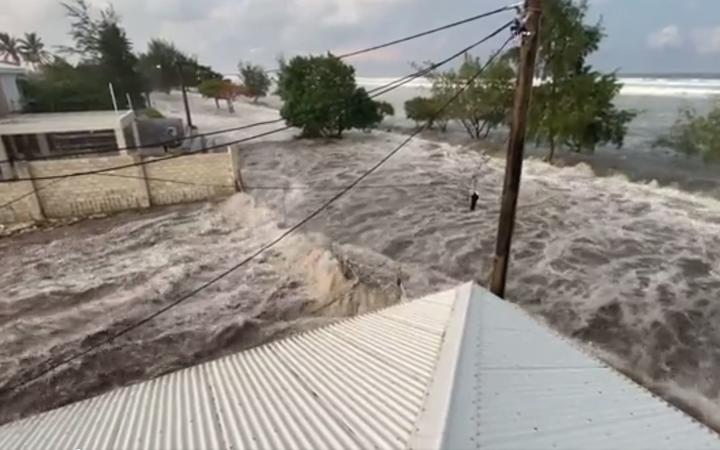
A tsunami expert says forecasting models and warning systems designed to assess earthquake-triggered waves did not account for the boosting effects of the shockwave from the recent Tonga volcanic eruption.
Photo: Twitter / Dr Faka’iloatonga Taumoefolau
Hermann Fritz at Georgia Tech University in the United States said that was a critical flaw in the systems which left many scientists unable to predict exactly when the waves would hit land.
The civil engineer, who studies tsunamis, said the Hunga Tonga eruption on 15 January had unleashed an atmospheric shockwave that radiated out at close to the speed of sound.
The shockwave pushed large waves across the Pacific to the shores of Japan and Peru, thousands of kilometres away, Fritz said.
“The trans-Pacific and global waves arrived earlier than forecast, which (was) terrible for distant shorelines,” he said.
The Hunga Tonga-Hunga Ha’apai volcano eruption triggered a tsunami that destroyed villages and resorts and knocked out communications for the South Pacific nation of about 105,000 people.
Three people died as a result of the disaster.
However, Tongans were well equipped to deal with the tsunami.
The small Pacific island nation is considered among the most prepared for natural disasters, with years of tsunami drills under its belt, and many people knew to evacuate to higher ground.
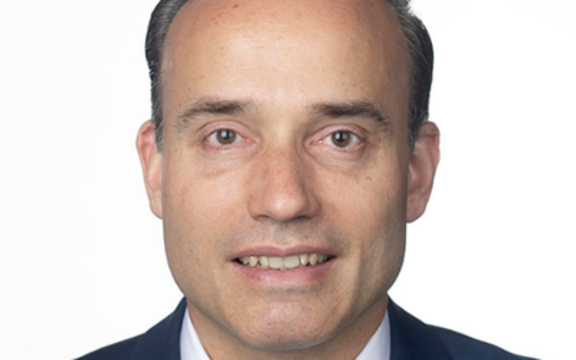
Hermann Fritz. Photo: Twitter / Hermann Fritz
But for faraway Peru, for example, the lack of accurate information may have contributed to the death of two people who drowned in unusually high waves, as well as the catastrophic oil spill from a ship near La Pampilla refinery.
“We need to re-evaluate tsunami hazards for other volcanoes around the world,” Fritz said.
For example, the underwater volcano known as Kick’em Jenny is thought to pose only a regional tsunami risk to the neighbouring Caribbean island of Grenada.
But in fact “it may very well excite the entire Caribbean and Gulf of Mexico, and possibly even the Atlantic and global oceans, if a Tonga-type event were to happen”, Fritz said.
Volcano-triggered tsunamis have been rare in modern history, and the shockwave from Tonga’s volcano was among the largest ever recorded, similar to the one produced by the 1883 eruption of Krakatoa.
Prior to the 2018 tsunami that followed the eruption of Anak Krakatau, a tsunami set off by a volcano had not happened in the ocean in more than a century.
Rather, 90 percent of tsunamis are triggered by earthquakes.
As such, tsunami warning systems are programmed to prioritize seismic events, with scientists gauging risk by whether an earthquake magnitude is high enough – above 7.5 on the Richter scale – to cause a destructive tsunami.
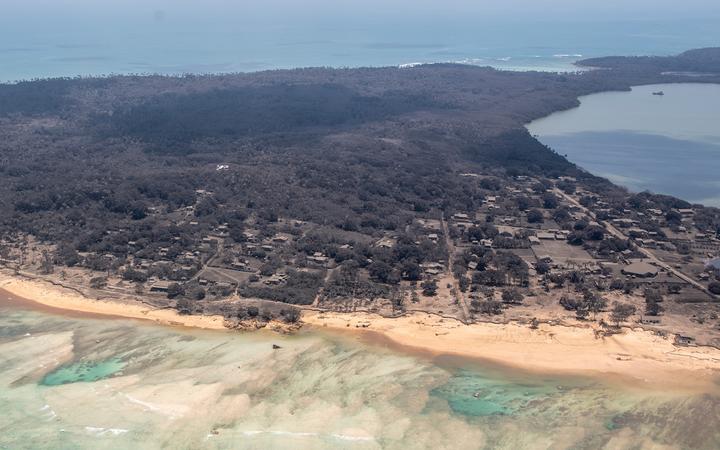
A view over an area of Tonga that shows the heavy ash fall from the recent volcanic eruption within the Tongan Islands. Photo: Supplied / NZ Defence Force
Seafloor instruments also monitor for irregular changes in wave height, sending information by surface buoy and then satellite to a warning centre for assessment.
The Pacific Tsunami Warning Centre in Hawaii had initially warned of dangerous waves within 1000km of the Tonga eruption.
However, their bulletin noted that “due to the volcano source we cannot predict tsunami amplitudes nor how far the tsunami hazard may extend”.
Roughly 10 hours later, the warning was updated to include a possible threat to Peru – a surprising development given that the tsunami near Tonga was relatively small.
Tsunami waves, driven by gravity, travel at around 200 metres per second – roughly the speed of a jetliner.
But the shockwave from the Tongan volcano had moved at more than 300 metres per second and was so powerful, scientists said, that it caused the atmosphere to ring like a bell.
Through the transfer of this energy from the atmosphere to the ocean, the shockwave amplified ocean waves around the world, pushing them farther afield and accelerating their travel time – something tsunami warning centres weren’t equipped to handle.
The possibility of atmospheric pressure waves needs to “be added to tsunami warning centres’ suite of modelling and forecasting tools”, Fritz said.
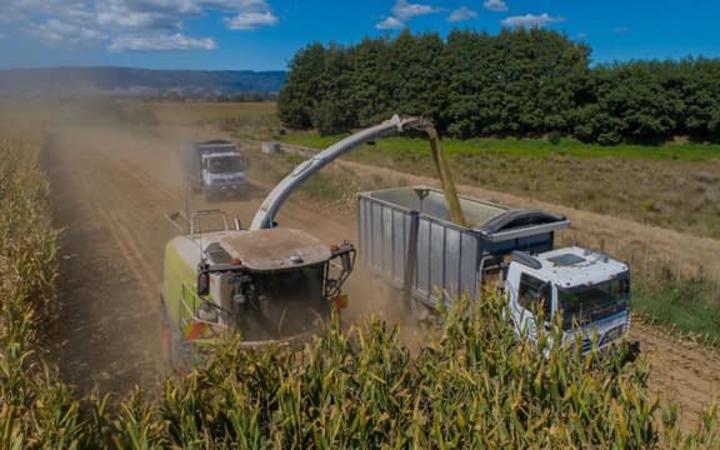
A rural contractor says the government has two weeks to follow through with its December promise to allow 200 skilled machinery operators into the country to help with the busy autumn harvest.
It comes as the government announces it has got a voucher for pregnant journalist Charlotte Bellis in MIQ – and has urged her to travel from Afghanistan to take it.
Brook Nettleton from BlueGrass Contracting in Waikato says if workers don’t arrive in the country within the next fortnight crops will deteriorate to a point farmers will not be able to milk their cows.
Nettleton told Checkpoint he was hoping to get five to 10 workers from Scotland, Ireland, England or anywhere else they were willing to come from.
They had been pressing the issue since last August and in the early days his business was told the workers were not critical enough, he said.
A few contractors in the area got together and then Rural Contractors and Federated Farmers went to the government and it was announced in December that 200 foreign workers would be allowed MIQ places.
“We haven’t got any – not a single worker.”
They were two weeks away from one of the biggest harvests of the year, the maize silage, and if it did not get harvested it would put huge pressure on the rural and farming sectors in Waikato, he said.
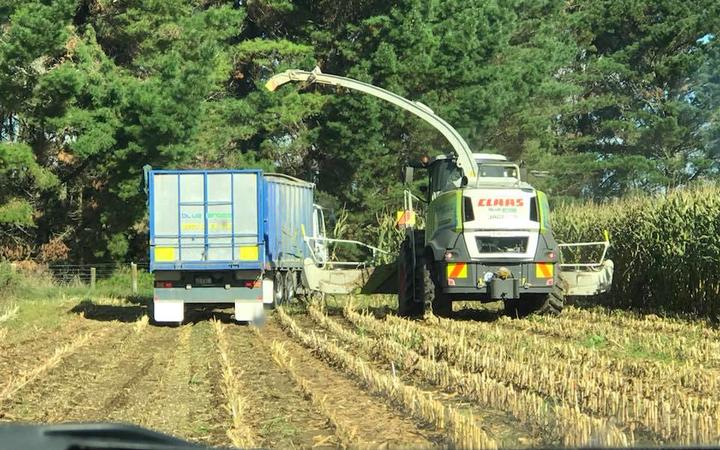
Maize silage needed to be harvested in a seven to 14 days window, otherwise it would deteriorate.
If there was a drop in quality, it would have to be used as winter feed or conditioner instead of much needed milk solids.
“It’s real serious.”
Photo: Supplied / BlueGrass Contracting
Each foreign worker would cost his business $8000 to $9000, which covers flights, an MIQ spot and wages while in managed isolation.
Foreign workers had been secured last October and they were willing to come but now most have moved on to other work in their home countries.
“They’ve been hanging on the end of a string wanting to come to New Zealand.”
Some had worked for him in the last three to four years driving harvesters. “But they’re gone.”
He has an empty nine-bedroom house on the property and the workers could have self-isolated there.
It was difficult to get New Zealanders to do the work because it can be seven days a week with long hours, he said.
His message to Prime Minister Jacinda Ardern, who is due to make an announcement on MIQ on Thursday, is: “They [foreign workers] need to be on a plane within a week to 10 days ….we really need them here by the end of February at the latest.”
The deputy prime minister and the agriculture minister declined Checkpoint‘s invitation to be interviewed on the issue.
The Prime Minister Hu’akavameiliku has ordered a nationwide lockdown starting tomorrow Wednesday 2 at 6pm in response to the Kingdom’s latest reports of Covid-19 cases.
Prime Minister-Designate Siaosi Sovaleni. Photo/Fale Alea ‘O Tonga
The Minister of Health has confirmed during an urgent press conference this evening in Nuku’alofa that two cases of Covid patients tested positive and had been isolated at Taliai MIQ.
The patients’ families had been home isolated and provided medical assistance.
The two cases were people who had been working at the Queen Sālote Wharf.
The two asymptomatic patients were fully vaccinated with their respective two doses of vaccines, the Minister said.
Hon Piukala said staff working at the Ministry of Health’s Covid-19 surveillance to monitor front liners tested the patients and found they had been infected.
He said it is believed they were infected last week, but did not give an exact date.
The Minister said the viruses have yet to be identified whether they were Omicron or not.
Tonga did not have sequencing technology available to identify whether the viruses were Omicron or Delta.
The Minister said that type of test can only be done in New Zealand or Australia.
The lockdown had been announced for the whole of Tonga since some closed contacts were believed to have been travelling to outer islands.
All domestic flights had been cancelled.
The press conference was livestreamed and broadcast this evening on FM 87.5 online.
Tonga reported its first positive Covid case last year after an Air New Zealand flight arrived from Christchurch, New Zealand. The kingdom went into lockdown but was shortly lifted after the patient recovered at the MIQ.
The shipment was discovered by officials on Thursday at a port in Bolívar, Colombia in a container bound for Genoa, Italy. Anti-narcotics personnel found 19,780 coconuts inside 504 canvas bags, a press release issued Thursday stated.
“Upon inspection, it was established that the water in the tropical fruit had been exchanged for liquid cocaine,” the Office of the Attorney General of Colombia said in a statement. “In this sense, the coconuts were transferred to a specialized laboratory to establish the exact amount of drug.”
Liquid cocaine is powder cocaine that has been dissolved in various solvents that allow it to become liquid and later converted back into a powder, Vice reported. Liquid cocaine is more difficult to detect than powder cocaine and is commonly ingested.
The investigation was carried out in collaboration with the Attorney General’s Office’s Specialized Directorate against Drug Trafficking and the National Police‘s Anti-Narcotics Directorate.
Officials are investigating the party responsible for loading the nearly 20,000 coconuts. Investigators said they have contacted the Italian authorities and are working to establish who was set to receive the shipment.
The amount of cocaine inside the coconuts has not been released but the coconuts have been sent off to a lab for further analysis.
Fiji has been through the worst phase of its third wave of the coronavirus, health authorities say, amid soaring deaths and infections across the country.
Permanent Secretary for Health Dr James Fong said the medical data confirmed this.
.. Photo: Facebook/Fiji govt
Dr Fong said Fiji was seeing a sustained decrease in the number of Covid-related admissions in hospitals.
He said various employers could also vouch for this decreasing trend “as there is less Covid-related absenteeism from work.”
But he stressed the Covid-safe measures must continue in the immediate and medium-term to protect the most vulnerable in the communities.
“We have seen relatively low rates of hospitalisation and death in this wave, due to our high rate of vaccination. And we did not have to create extra space in our treatment facilities of mortuaries.”
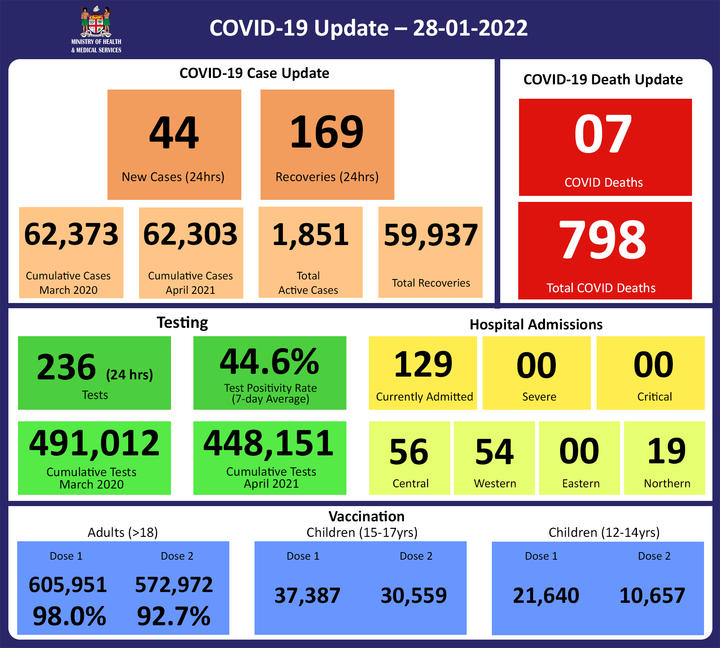
Dr Fong said 798 people had died from Covid-19 since the pandemic hit Fiji in March 2020.
He said majority were unvaccinated, had severe comorbidities and died while at home or on their way to the hospital.
Dr Fong said this trend showed the next stage of the government’s response would need to involve a more holistic view of the medical realties Fiji faced.
.. Photo: Fiji Health Ministry
Seven more deaths, 146 new cases
In its latest update on the Covid-19 situation last weekend, Fiji’s Health Ministry reported that seven people had died from the virus.
This brings the death toll to 798 – 796 since April 2021.
There were 146 new cases confirmed in the community.
Dr Fong said people who were eligible to get vaccinated against Covid-19 must do so.
He said this included Fijians who were yet to receive their booster shot.
Fiji has 1851 Covid cases in isolation with 129 of them in hospital in critical condition.
The ministry also said 92 percent of Fiji’s adult population had been fully vaccinated against Covid-19, while 98 percent were yet to receive their second dose of the vaccine.
There are 41,216 children aged 12 to 17 fully vaccinated, the ministry stated, with 59,027 having received their first dose.
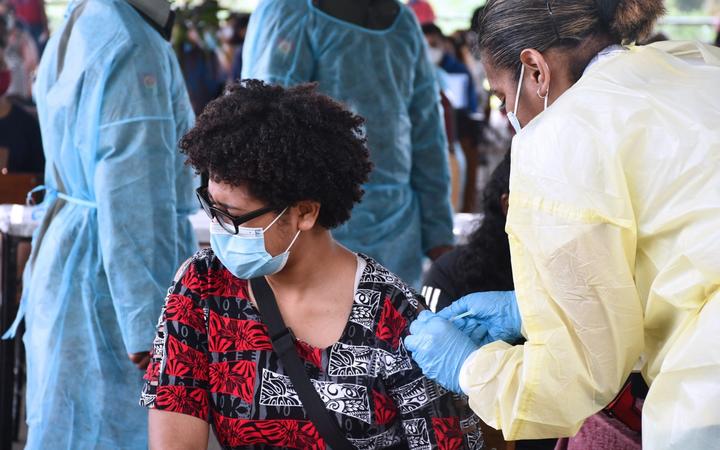
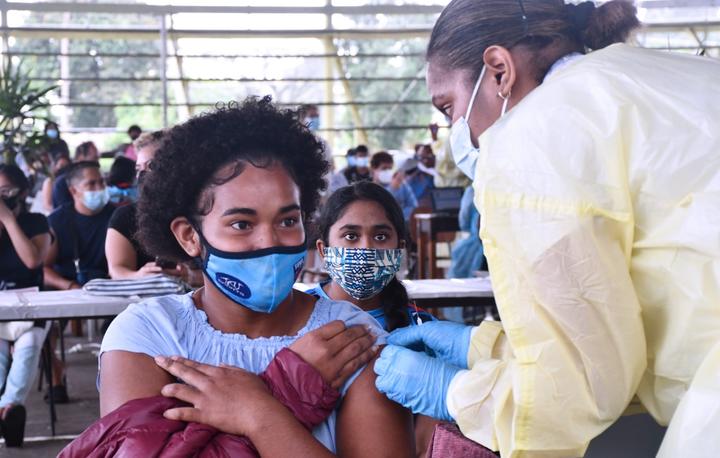
Children and teens being vaccinated in Fiji. Photo: Supplied/ Fijian government
One booster shot is needed – MOH
The ministry was aware of the need for only one Covid-19 booster dose, said Dr Fong.
Dr Fong said Fijians would not need have a booster every six months.
“So far, the only recommendation we are aware of is one booster with Moderna or Pfizer.”
Dr Fong said vulnerable groups in the communities were at an increased risk of being infected and suffering from severe disease.
“We know that severe disease is rare in children, but this risk increases should they have significant underlying health conditions.
“By vaccinating and maintaining our Covid-safe measures, we protect the vulnerable among us.”
Dr Fong also reiterated the need for the public to be aware of the symptoms of severe Covid-19 disease, and early presentation to a health facility when severe symptoms were present, were critical protection measures that every individual should know and act upon.
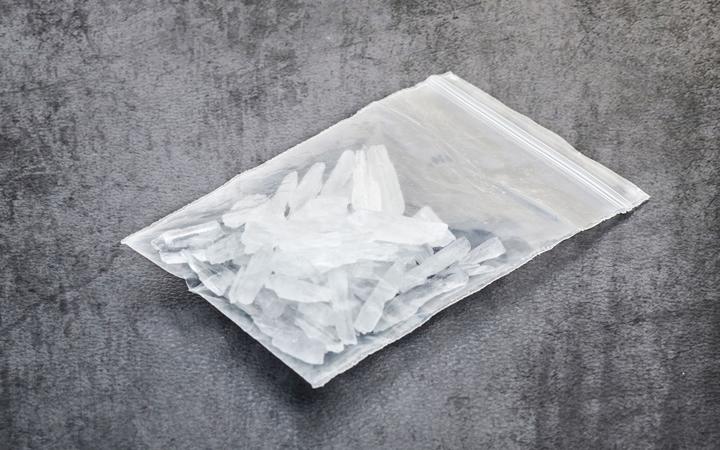
The public prosecutor in French Polynesia says there are at least 10,000 consumers of methamphetamine in a territory with fewer than 280,000 inhabitants.
Photo: 123RF
Thomas Pison said such high use of the illegal drug is not only a crime issue but has become a public health problem.
After initially being used by the elite, methamphetamine has spread to all levels of society, including to schools.
Figures for last year show crime has dropped due to prolonged periods with curfews but that the number of methamphetamine consumers reportedly remained unchanged.
Mr Pison says the drug is highly addictive and cuts people off from society.
The drug is smuggled in from the United States and sells for up to $US8,000 a gram.
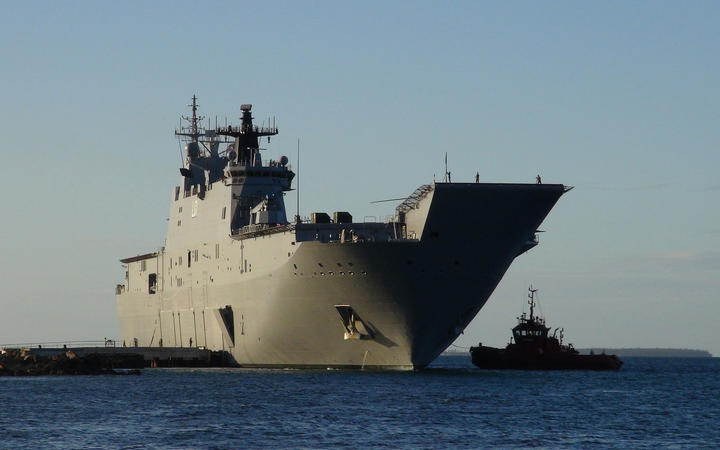
A massive electrical power failure has crippled the Australian Navy’s largest warship as it completes its humanitarian mission to Tonga following the 14 January volcanic eruption and tsunami.
Australian Navy HMAS Adelaide docked at Vuna Wharf in Tonga’s capital Nuku’alofa on 26 January, 2022. Photo: AFP
The ABC can reveal that despite days of emergency work, HMAS Adelaide, known as a landing helicopter dock (LHD), is still experiencing problems, having earlier been “stranded”.
An email sent by HMAS Adelaide‘s commander states: “Marine Technical Department have worked throughout the past few days to restore power and get us operational again.”
In the message, obtained by the ABC, Captain Stuart Watters said: “We are still experiencing issues with external communications and wanted to let you know that everyone onboard is safe.
“We want to thank the technical team for their hard work in hot and difficult conditions which is enabling us to complete our task and restore services and communications.”
Sources on board HMAS Adelaide told the ABC the ship was “stranded” for a period of time because of a “total power failure”, including the backup power.
According to several members of the crew, most of the ship’s company were now sleeping “above deck” because of the power problems.
Last week, HMAS Adelaide was allowed to dock in Tonga to deliver humanitarian supplies, despite a Covid-19 outbreak that occurred on board shortly after it had departed Australia.
The ship’s commander insisted “Covid protocols are in place and effected personnel are being provided with medical care and being supported”.
“A number of people who were originally identified as infectious have been cleared to return to duty after completing quarantine,” Captain Watters wrote.
The Australian Defence Department is yet to respond to the ABC’s request for comment.
– This story by ABC.net.au appeared on RNZ.co.nz. RNZ collaborated with Kaniva News

 The latest transmission involved a woman and her 3 and 4 years old children.