Iranian war games held in the Persian Gulf this week were meant as a warning to Israel, Iran’s top military commanders say, amid concerns Israeli could have plans to target Iranian nuclear sites.
This photo from Iran’s Revolutionary Guard Corps website shows the Islamic Revolutionary Guard Corps taking part in five-days military exercises this week. Photo: AFP Photo / Iran Revolutionary Guard via SEPAH News
The Revolutionary Guards’ war games included firing ballistic and cruise missiles, and ended on Friday.
“These exercises had a very clear message: A serious, real … warning to threats by the Zionist regime’s authorities to beware of their mistakes,” Guards chief General Hossein Salami said on state TV.
“We will cut off their hands if they make a wrong move… The distance between actual operations and military exercises is only a change in the angles of launching the missiles,” Salami added.
Armed Forces chief of staff Major General Mohammad Bagheri said 16 ballistic missiles of different classes had been fired simultaneously and had destroyed predetermined targets.
Britain condemned the launch of ballistic missiles during the war games.
“These actions are a threat to regional and international security, and we call on Iran to immediately cease its activities,” the Foreign Office said in a statement.
Iran says its ballistic missiles have a range of 2000km and are capable of reaching arch-foe Israel and US bases in the region.
Israeli defence minister Benny Gantz called on world powers not to allow Iran to play for time at the nuclear negotiations, in recess at Iran’s request and scheduled to resume next Monday.
Israel is widely believed to be the only Middle Eastern country with a nuclear arsenal.
By Tom Kitchin, RNZ.co.nz and is republished with permission.
Many RSE workers around the motu are stuck here for Christmas and New Years. So what do they do? Our Hawke’s Bay reporter Tom Kitchin spoke to some.
RSE workers So’o Fala (left) from Samoa and Joel Bruno Lee from the Solomon Islands, are celebrating Christmas by the apple orchards of Hawke’s Bay this year. Photo: RNZ / Tom Kitchin
The glaring Hawke’s Bay sun stares down on the hundreds, if not thousands of apple trees on the outskirts of Napier.
The mercury’s reaching the late 20s, but this might be a bit colder than what Joel Bruno Lee from the Solomon Islands and So’o Fala from Samoa are used to.
They’re long haulers at T&G Global, one of the biggest apple producers in New Zealand.
Lee has been back and forth from New Zealand to his home in the Solomon Islands for 14 years.
For Fala, it’s seven seasons.
Neither have returned home in two years, since before the pandemic began.
They each have a daughter that they have not seen face-to-face in that time.
For Christmas, it’s all about the food and sport, even if Covid-19 restrictions and bubble requirements have quietened it down.
“We were planning to have a big sport day with some of our brothers here – putting on volleyball tournament, think we cancelled that and carry on in our own bubbles,” Fala says.
The bubbles are strict and workers have only been able to keep to them since the pandemic began.
“We’re only keeping to our teams – for myself we have 10 under my leadership, ” Fala says – they are both team leaders.
“For Samoan and our culture it’s mainly food, as long as we have a lot of food on Christmas.
“As long as we have a pig, we’ll be good. We usually roast a whole pig, if not we can just we can just cut it in pieces and roast it.
“We’re going to play some sports and make some funny games to keep our minds away from families and that.”
Even if they miss their wives, daughters and extended families back home.
“Hard not being with families but yeah it’s all right – as long as we put that smile on their face by sending them some money, yeah we should be good,” Fala says.
“We’re just going to have Christmas calling them on the phone, and chat with them, do video calls, stuff like that,” Bruno says.
Shelly Beckett, who looks after pastoral care for RSEs at T&G says a Christmas meal will be provided.
“We’re going to provide them with a lot of fresh vegetables and hams so they can more of a traditional Kiwi kind of Christmas, and maybe some pavlovas for their desserts.”
The work won’t stop either – they’re thinning apples and will just get the statutory days as a bonus rest.
Fala and Lee are only a small share of the RSE workers staying in New Zealand.
At T&G alone, 261 RSE workers are currently in Hawke’s Bay.
For Lee, he says coming back for nearly a decade and a half has meant he has been able to help his family for a long time.
“I’m able to build my own home from the money I’ve earned from New Zealand – it’s really helpful … now I’m in the process to build another home. All the efforts that are put in here, I’m sending back home.”
It’s the same for Fala.
“I’ve been able to build a nice home for my family and even buy them a car, and looking to helping my siblings go to school, paying for all their school fees and that. Coming here has really placed my family financially.”
Even if it means not seeing their young daughters face-to-face as they grow up, a video call is never far away.
It is only a matter of time until there is community transmission of Covid-19’s new Omicron variant in South Auckland, says a Pacific public health expert.
Auckland University associate professor of public health Collin Tukuitonga says more people in South Auckland are likely to live in big households where the threat of transmission is greater. Photo: supplied by University of Auckland
There has been a surge in case numbers around the world since the variant was first detected last month, including in South Africa, the United States, the United Kingdom and Australia.
Data from South Africa suggests the numbers of people hospitalised, or dying from the new variant are lower than Delta, but the new strain of the virus is far more contagious.
Auckland University associate professor of public health Collin Tukuitonga said the potential impact of the new strain of the virus in South Auckland was a growing concern.
“There’s a lot we don’t know about Omicron, but one of the things we do already know is that it is highly transmissible.”
He said as a result areas like South Auckland were likely to be hit hard in an outbreak, because more people were likely to live in overcrowded and multi-generational households where the threat of transmission was greater.
“Omicron is likely to have a significant impact on those communities. I would say it’s a no-brainer that that’s what’s going to happen,” Dr Tukuitonga said. “And with this variant it’s a matter of when, not if, we get it.”
A Counties Manukau District Health Board spokesperson said it was still too early to carry out accurate modelling to say what might happen if, or when, Omicron finally emerged.
They said the data was not yet available to make an educated prediction on possible numbers.
“We expect this to become clearer later in January 2022.”
The spokesperson said there were many variables that could influence the impact of Omicron in South Auckland, including the rate of transmission, the severity of infections, the impact on hospital and ICU-level care and how responsive it was to treatment.
Covid-19 testing in Ōtara, South Auckland last year. Photo: RNZ
University of Auckland epidemiologist Rod Jackson said while we did not yet have any community transmission of Omicron in New Zealand, it appeared to be more infectious and therefore the chance of it escaping from managed isolation and quarantine facilities was quite high.
Epidemiologist Rod Jackson Photo: RNZ / Nick Monro
He said if New Zealand got the high case numbers modellers were predicting in other countries like Australia, the threat of it spreading would be that much greater.
“And we know Omicron is a lot more contagious,” Prof Jackson said. “So even if the vaccine is preventing 95 percent of deaths, some cases will get through.”
He said it was purely a numbers game.
“The good news for us is we were late to the party in terms of the national vaccine roll out and we’ve vaccinated virtually everyone,” Prof Jackson said. “And at the moment that is stopping a lot of cases.”
But he agreed with the Counties Manukau DHB that it was too early to make concrete predictions on Omicron.
“At the moment, we just don’t know,” Prof Jackson said.
He said the fact the new variant was first identified in late November meant it was still relatively new.
Prof Jackson said while there were plenty of reports coming out on Omicron in South Africa, there were major demographic differences between countries that needed to be taken into account.
“People are doing their best to make sense of it. But you can’t tell until it has worked its way through a complete demographic of a population.”
Local Democracy Reporting is a public interest news service supported by RNZ, the News Publishers’ Association and NZ On Air.
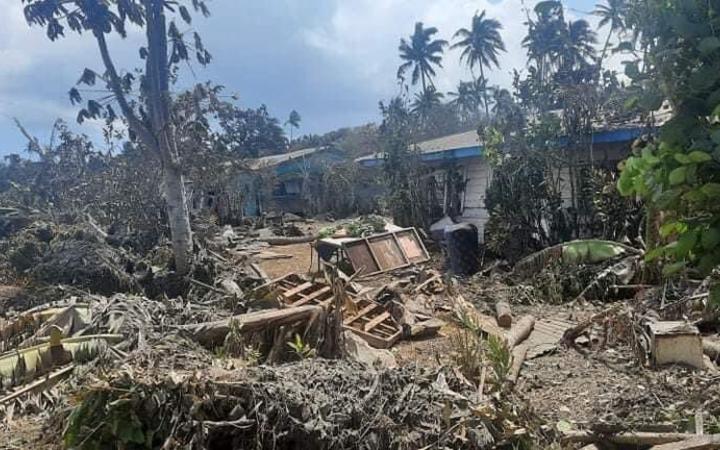
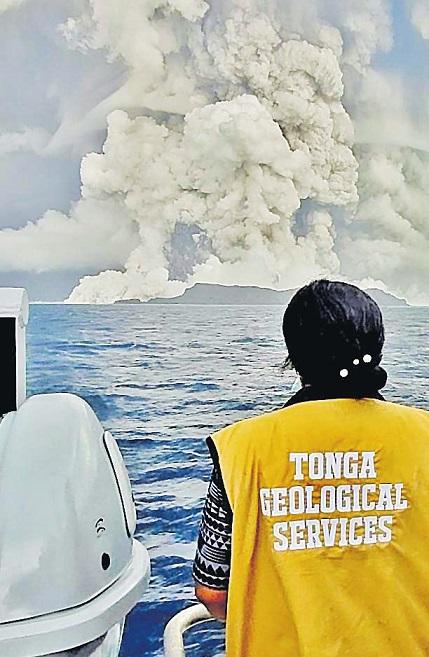
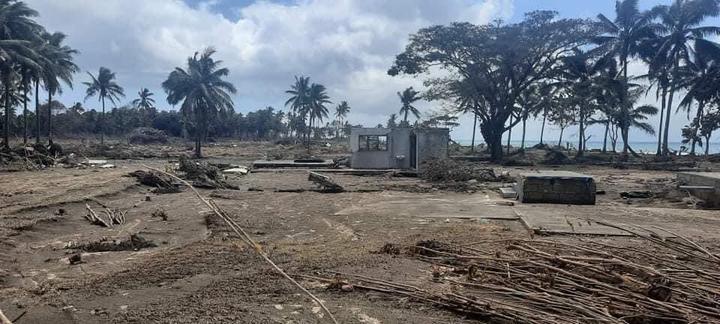
Satellite imagery shows the island of Hunga Tonga Hunga Ha’apai has grown in size while the underwater volcano erupts into its sixth day.
File image. Photo: Mary Lyn Fonua / AFP
Tonga’s head geologist Taniela Kula has been monitoring the eruption all week, which erupted again this morning.
While observations have had to be kept to a distance, new satellite imagery shows the island’s land mass has grown since Monday.
“The island has grown 300-600metres to the eastern side. So it has widened up a bit. [The debris] has been building up the island, building up the rim of the vents,” Kula said.
Today’s ash clouds had fallen back into the ocean in a 10km radius, he said.
The volcano has an active history, last erupting in 2014/15 and before that in 2009.
There have been 62 new community cases of Covid-19 and one further death reported in New Zealand today.
In a statement, the Ministry said a patient in in their 50s who was admitted to hospital on 11 December has passed away.
“Our thoughts are with their whānau and friends at this sad time.”
There are now 45 people in hospital with the coronavirus – including two in Waikato and two in Tauranga – with eight in intensive care.
Today’s new cases were in Auckland (37), Waikato (5), Bay of Plenty (14) and Rotorua (5).
There was also one new case reported in Christchurch today and public health officials are investigating recent travel to Auckland as the source of their infection.
The case travelled from Auckland to Christchurch on Monday 20 December on Air NZ Flight NZ543.
“All passengers on the flight are being treated as close contacts and are required to get tested. Contact tracing is underway to contact all passengers.”
All of the Waikato cases are in Te Kūiti, while seven of the 14 new cases in the Western Bay of Plenty today have been linked to existing cases.
There were also 10 cases reported at the border, with travellers from the UK, USA, Greece, UAE, Australia, Germany, Kenya and India testing positive.
There have now been 10,493 cases in the current outbreak and a total of 13,349 in New Zealand since the pandemic began.
There were 21,338 vaccine doses administered yesterday, including 1413 first doses and 7135 second doses. Hawkes Bay DHB has just 415 doses to go to reach 90 percent fully vaccinated, while Waikato has just 1436 second doses to go.
Police says they hold serious concerns for the safety and well-being of an Auckland man who was last seen in New Lynn on 16 November.
Auckland man Atonio Finau, 65, who was last seen in mid November. Photo: Supplied / NZ Police
Atonio Finau, 65, who lives in Otahuhu, drove to Laingholm on Monday, 15 November, where he left his car – a black coloured Nissan Murano SUV/wagon.
The following day, he caught a bus from Laingholm to the New Lynn bus depot, arriving shortly before 3pm.
Police say that despite extensive enquiries, they have not been able to determine Finau’s movements after that bus journey, and his whereabouts remain unknown.
They have now released CCTV footage of his last-known sighting in the hope someone remembers speaking with him or recalls seeing him in the New Lynn or surrounding areas on 16 November or afterwards.
The footage shows the clothing and hat that Finau was last known to be wearing.
Detective Sergeant Rob Kerr said Finau has a son who lives overseas, who is understandably very distressed at his father’s disappearance.
“We are doing everything we can to work out what has happened to Atonio Finau to give his family answers.
“There is nothing to indicate that foul play is involved, however given that there has been no confirmed sightings of Atonio after he was at the New Lynn bus depot, he could have travelled anywhere and we aren’t able to focus on one particular area.”
Kerr said the investigation had been made challenging by the length of time Finau had already been missing before the matter was reported to police in early December.
Anyone with information is asked to contact police on 105, quoting file number 211203/4366.
A homicide investigation is underway after two armed offenders entered a house in the Auckland suburb of Mt Roskill and a man was shot and killed.
Police received a report of an incident at an address on Glass Rd on Thursday evening. Photo: RNZ / Katie Todd
Police received a report of an incident at an address on Glass Rd about 9.30pm last night.
Auckland City CIB Detective Inspector Scott Beard said the two offenders entered the house and an altercation took place with the people inside.
One of those inside the house, a man in his 20s, was shot and died at the scene.
“Two other people at the address have received non-life threatening injuries and were transported to hospital,” Beard said.
The offenders fled the scene and are still on the run, he said.
Photo: RNZ / Katie Todd
“A scene guard has been in place overnight and police will remain present at the address today carrying out a scene examination.”
A Mt Roskill resident said he was shaken and concerned following the fatal shooting in his neighbourhood.
Wei Wang said he lived nearby and walked down Glass Road every night.
He said it felt like a safe, family area, but there had now been two shootings in a matter of weeks.
“It shouldn’t happen,” he told RNZ, adding that he hoped to see more of a police presence in the area.
Another resident said new tenants had just moved into the property where the shooting took place.
Mount Roskill’s MP Michael Wood said the homicide was distressing and upsetting.
Wood lives around the corner from the scene and said he heard police helicopters last night.
He asked people to support each other and the police.
“It’s really important that we do give the police the space and support that they need to help to keep us safe, to find the people who are involved and to take it from there.”
Wood also urged people not to get their information from rumours on social media.
Police are asking anyone with information relating to the incident or who saw suspicious activity in the area to contact them on 105, quoting file number 211224/4140 or call Crime Stoppers anonymously on 0800 555 111.
The body of the Tongan father who was killed in a motor vehicle accident in the United States will be returned to Tonga for funeral and burial services.
Latu Moli
The family said on Facebook this was the deceased’s wish that his body be buried at his parents’ burial place.
The 45-year-old Latu Moli of Carmel Valley, Monterey County was killed after a crash on Southview Lane on his way to work on December 6.
According to reports, Moli’s vehicle veered off the road, past the guardrail, and down a steep hill for unknown reasons.
CHP responded and tragically pronounced Moli dead at the scene. Moli was an employee at Public Works Monterey Road District for 14 years.
Officials were conducting an investigation to determine the cause of the crash.
“Latu was a God fearing and God loving Man and he never wavered in his trust in God”, the family said.
“He has taught us to be strong and trust is God in all that we do! Following thru with this plan is challenging but with God and prayers all things are possible”.
A failotu service began yesterday and his wake was expected for today at Hiltop UMC, 1340 Hilby Avenue before his body will be prepared to be returned to Tonga.
Meanwhile, the friends and family of Moli made a GoFundMe page to help with costs during this devastating time.
Moli is survived by his wife and three daughters, the GoFundMe page said.
Acid rain from a large volcanic eruption in Tonga continues to threaten water tanks, as huge plumes of dust are thrust into the air.
Hunga Tonga and Hunga Ha’apai are two close volcanic islands in Tonga. Photo: NASA
Tonga’s head geologist Taaniela Kula told RNZ Pacific the “huge” eruption began on Monday morning, and by the afternoon ash had smothered the whole of Tonga.
He said ash clouds had since drifted north creating a spectacular sight, and leading to warnings.
“This morning it’s still continuing to emit gas and vapour into the atmosphere. This morning you can still see the white clouds, it is probably about 16km high.”
Matangi Tonga reported the eruption was at Hunga Ha’apai island, but a bright white gas cloud could be seen from Tonga’s capital Nuku’alofa, 65km north, and bursts of lightening played through the cloud on Tuesday evening.
People in Tonga were last night told to protect water tanks from possible acidic rainfall, until the eruption ends.
Tonga Geological Services said residents should remove guttering systems from rainwater tank storage until the eruption finishes. These should not be reinstalled until after the next rainfall, to reduce the risk of contamination.
Symptoms of exposure to acid rain are itchiness and skin irritation, and blurry discoloured vision. If skin or eyes are exposed to acid rain people should see a doctor.
Air New Zealand cancelled a flight from Auckland to Tonga that was due to fly yesterday, because of concerns about the ash cloud.
The flight included the funeral cortege for Tonga’s Deputy Prime Minister, the late Lord Ma’afu. Matangi Tonga said the funeral programme was postponed as a result.
In 2015, Tongan government officials said eruptions at Hunga Ha’apai had formed a new island more than a kilometre long, joined to the existing island. It has reportedly become a home for plants and birds.
The frequent discovery of dead bodies and the increase in the number of missing people in Fiji is a concern, says a human rights advocate.
Photo: VNP / Daniela Maoate-Cox
Police reported a dozen people missing in the past month and several bodies have been found.
Shamima Ali, of the Fiji Women’s Crisis Centre, said she was also concerned that the majority of these cases were young women and children.
Ali said often in restrictive environments where human rights and democracy and the rule of law spaces were shrinking, there was often an increase in violence within communities, murders and anti-social behaviours.
Ali said in an already patriarchal society, authoritarian leadership encourages the lack of debate, consultations and violence and bullying were the only answers to settling arguments and disputes.
“Our communities are impoverished and many people are struggling for their own and their family’s survival,” she said.
“This also gives use to mental health issues and many are again struggling for lack of a robust system that caters to their needs.”
Ali said many were resorting to alcohol and or self-harm, and the social fibre of our communities seemed to be disintegrating and had worsened by the Covid-19 and poverty crises.
The majority of victims are the most vulnerable, she added. “The poor and the disfranchised.”
.. Photo: RNZ Pacific/ Koroi Hawkins
Ali said it’s important for people to act responsibility to avoid such tragedies.
“We often do not know the outcomes of these reports – has the missing person been found, the circumstances of the bodies found- murder’s accidental or suicide.
“There have been a couple cases where there have been allegations against police and corrections officers.”
We need answers to these, Ali said, adding that Fiji did not have a robust national human rights institution that’s proactive and acts on its own violations.
“The police need to update and the media needs to follow up. Civil society also needs to raise concern and not just let it be the topic of conversation.
“Families and friends will also know what to look out for – troubled teens, family members behaving oddly and seeming troubled.”
Ali said alcohol use was an issue in the country and would get worse during this festive season.
“Let us all take responsibility and look out for each other, especially families and friends.”
.. Photo: Facebook/Fiji govt
Ali is urging Fijians to ‘make this Christmas a caring one for each other’.
Fiji police said they had ruled out foul play in some of the discoveries they made following the post-mortem examinations.
Police said some cases of people found dead were linked to alcohol.
And as Fiji enters into the festive season, Police are calling on the need for people to enjoy responsibly.
Police said based on past trends cases of assault and other serious offences increased during this period.
“As we are well into the festive season a few of the cases were linked to alcohol which is why at the beginning we had stressed the importance of enjoying responsibly as cases of assault and other serious offences based on past trends increased during the festive season due to the excessive consumption of alcohol,” police said in a statement.
Police also said other cases had been dealt with and those responsible were charged and produced in court.