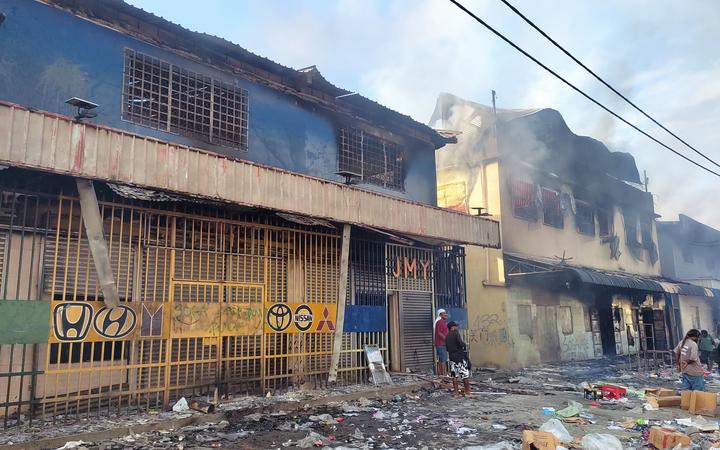
A group representing Chinese people in Solomon Islands says many Chinese families have lost everything and been left homeless following the widespread looting and torching of shops and properties.
A protest last Wednesday calling for Prime Minister Manasseh Sogavare to step down lapsed into major unrest and three days of rioting.
The Solomon Islands Chinese Association (SICA) has condemned the events which it says has endangered innocent lives.
Chinatown in Honiara, where buildings were torched Photo: Georgina Kekea
SICA is encouraging all Chinese owned and operated businesses to continue operating in an ethical and fair manner; respecting and abiding by the laws of the country.
It said the Chinese community remains confident in a brighter Solomon Islands despite the violence, which it blamed on a small minority.
The Mayor of Honiara Eddie Siapu has appealled for help to clean up the city with Chinatown and eastern Honiara in particularly bad shape.
“I would like to make a call, an appeal, to my good people of Honiara City to come forward and assist the City Council with a majoro voluntary cleanup in the city. Following the riot and looting in the capital I appeal to the business houses, NGOs, stakeholders, commnity leaders, church leaders and other groups for assistance,” he said.
External help vital in regaining control
Papua New Guinea’s police chief said the deployment of its forces to Solomon Islands helped quell the unrest.
PNG’s deployment of 37 police and correctional services personnel to Honiara followed Australia’s move to deploy over a hundred military and police forces last week.
Police commissioner David Manning says his force was glad to help their Solomons counterparts.
“And our support was not only timely but very much critical to their ability to contain the situation in Honiara. It is very much Papua New Guinea’s intent to ensure not only that we enjoy domestic security but also regional security as well.”
Rioting has ceased in Honiara but security forces remain on high alert as parliament reconvenes.
Manning said PNG security forces could stay longer if needed.
He said the deployment of 37 police and correctional services personnel was critical to their local counterparts being able to contain the situation.
“The deployment marks the beginning of a three to four week deployment for this contingent. There is a coimmitment to support further, depending on the situation in Honiara.”
Australia has also deployed over 100 military and police forces to Honiara.
Meanwhile, the European Union is monitoring the situation.
The EU’s Ambassador for the Pacific Sujiro Seam said they are greatly concerned by what has taken place in Honiara.
“We call on all parties involved to enable a return to peace, calm, stability and security after days of riots, looting and fire,” he said.
COMMENTARY The lack of information and statement to update the public on what the newly elected 26 MPs are doing in the lead up to Tonga’s premiership election is unacceptable.
St George Palace at Pangai Si’i. Photo/Kaniva Tonga (Kalino Lātū)
This is the country’s most important election and news of what is happening is being kept secret from the public. The situation does not help promote the mechanisms of transparency, good governance and accountability laid out in Tongan law.
An interim Cabinet minister told Kaniva News this morning that all MPs, including the Nobles were meeting to decide on the best option for them to elect the best Prime Minister and his new Cabinet.
Some media have produced well informed speculation about what might happen, but there is too much danger of unfounded rumours spreading online.
After the election on November 18 the only information that came out from a few of the newly elected MPs were votes of thanks for being elected to Parliament and they were only posted to Facebook.
The political system for electing the Prime Minister is undemocratic because of the involvement of the nobility MPs who were only voted into parliament by their 33 members. In New Zealand, although its voters would not elect their prime minister like the US presidential election, its party system election allows voters to vote for the prime minister’s political party making their election democratic.
Concerns about new PM
At the moment there is strong concern about who will be the new Prime Minister. There is a possibility Pōhiva Tu’i’onetoa will be elected PM again because of what appear to be binding documents between him and his former Cabinet ministers and the nobles under his PAK Party agreements. But there are also rumours that the new MPs want a new PM, not Hon. Tu’i’onetoa.
The local news media has been heavily criticised for its failure to update the public. They were also criticised for their failure to announce the provisional results of the elections on November 18 from the polling booths as soon as they became available. The results were finally announced about 11.30pm, eight hours after the polling booths closed.
By that time the public was already well aware of the results in the afternoon because they had been announced at the polling booths. While there were complaints on social media for the time it took for the results to be officially announced, FM 87.5 announcer kept on saying they already had the provisional results, but they had to wait for the election supervisor.
Former Manager of the Tonga Broadcasting Commission, ‘Ahongalu Fusimālohi, reportedly said he felt the local media, especially FM87.5 and the TBC were told by the government to only release the official results. Fusimālohi said this was unacceptable.
Fusimālohi criticised the media’s actions and said it was the norm in the past that TBC had to release the unofficial results once the polling booths announced their results. It did not have to wait for the election supervisor to announce the official results.
He said the problem was that when the media did not announce the preliminary results as soon as they become available the public would be skeptical about the outcome.
Nobility MPs
Veteran journalist and publisher Kalafi Moala reportedly said the situation about the newly elected MPs came about because the general election results were being recounted on Friday after complaints were lodged with the election supervisor. This meant nothing would be released until the recount was finished.
Moala said he had received unconfirmed reports that the MPs representing the nobility had decided they would not accept any offer of Cabinet posts from the people’s MPs. He said the Nobles wanted to leave the running of the government to the people’s MPs alone. Moala said this meant a new Cabinet would be people’s elected MPs only and there were rumours the new cabinet would not appoint any new minister from outside the MPs.
Tongatapu firefighters responded to a house fire alert and had to break locked gates down so they could reach the fire scene.
Black smoke was pouring while the house going up in flames at Tufumāhina royal residence, a video clip taken near the scene shows.
The clip, which was shared to Facebook last night, also appeared to show two fire engines remained park in idle mode outside the high fence property while the firefighters were trying to break down the gates.
It was unclear whether or not the fire was brought under control. The video camera man followed the fire engines to the scene after the gates were opened but he was told to leave.
The cause of the fire remains unknown. No reports of injuries.
The property was owned by the king and it was normally guarded by members of His Majesty’s Armed Forces.
There have been 144 new community cases of Covid-19 reported in New Zealand today, with one further death also reported.
In a statement, the Health Ministry said 82 people are in hospital, including nine in intensive care.
Today’s death was a Covid-19 patient at North Shore Hospital in their 80s who passed away yesterday evening.
“Our thoughts are with the patient’s whânau and friends at this deeply sad time.”
The Ministry said 88 of today’s new cases are yet to be linked.
Today’s new cases included 127 in Auckland, two in Northland, nine in Waikato, four in the Bay of Plenty and the one in Hawke’s Bay reported earlier today which was picked up after a routine hospital swab.
The nine new cases in Waikato include five in Hamilton, two in Te Kūiti, one in Cambridge and one in Kawhia.
In the Bay of Plenty, the four new cases include one based in the Whakatāne district and three in the Tauranga area.
The Whakatāne district case and one of the Tauranga cases are linked to previously reported cases. The remaining two Tauranga area cases are household contacts, with their links to previously reported cases still being investigated. All are self-isolating at home.
The two new cases in Northland were announced yesterday and are being formally included in today’s figure, but the Ministry said there were also another two cases in Kaitaia and in Whangārei that will be added to tomorrow’s numbers.
The Kaitaia case is a close contact of a known case and links between the Whangārei cases and known cases are still being investigated. Both are self-isolating at home.
There were also four cases reported in managed isolation today, which include one new case in Canterbury.
The ministry said the case – who is a child and has been isolating at home with family – travelled from Auckland to Christchurch on Thursday 25 November on Air NZ Flight NZ8475 arriving in Christchurch at 10.50am. Anyone who is considered a contact of this case will be contacted directly.
This case travelled from London to Doha on 16 November and Doha to Auckland on 18 November. They left managed isolation last week and tested positive on their Day 9 test while in home quarantine.
There were also four cases reported in managed isolation today.
There have been 8118 cases in the current community outbreak and 10,891 since the outbreak began.
Omicron advice
Last night Covid-19 Response Minister Chris Hipkins announced that New Zealand will ban travel from nine southern African countries from 11.59pm tonight in an effort to curb the potential spread of the new Omicron coronavirus variant. From then only New Zealand citizens will be allowed to travel here and they will also be required to stay in managed isolation for a full 14 day period and undergo testing.
The Health Ministry said today that knowledge about this emerging variant “is in its infancy and we are closely watching and monitoring evidence and countries’ responses”.
It said there was no need to rush to get the booster.
“The science shows fully vaccinated people remain really well protected from infection, and from being seriously ill if they do get Covid-19. There is plenty of existing stock of the Pfizer vaccine in New Zealand now and on order for everyone who needs a booster shot over coming months.
“We will advise on any potential impacts for New Zealand, noting that we remain in a good position to minimise the impact of any new variants with isolation and routine testing of international arrivals.”
There were 20,873 vaccine doses given yesterday, including 6378 first doses and 14,495 second doses. The ministry said 92 percent of eligible people in New Zealand have had their first dose and 85 percent are fully vaccinated.
It said it had now issued more than 2.26 million My Vaccine Passes.
Ninety percent of Pacific people in New Zealand have had their first Covid-19 vaccine, while 11 district health boards (DHBs) have reached 80 percent first doses for Māori, Ministry of Health says.
Nurses in the Far North Vaccinating during the lockdown Photo: RNZ / Angus Dreaver
There were a total of 17,899 doses administered yesterday, including 5679 first doses and 12,222 second doses.
To date, 92 percent of eligible people in New Zealand have had their first dose and 85 percent are fully vaccinated.
The ministry said the country’s Pacific communities had reached “some key vaccination milestones”, with 90 percent having officially received their first dose, and 80 percent fully vaccinated.
Eleven of the 21 DHBs had reached 80 percent first doses for Māori, it said in a statement.
The ministry also highlighted how Capital & Coast DHB is just 1131 doses shy of reaching the 90 percent fully vaccinated milestone.
More than 2.1 million My Vaccine Passes have been issued.
Events held in Auckland to encourage vaccine uptake
This weekend is the last chance New Zealanders have to be fully vaccinated with both injections in time for Christmas.
More than 20 vaccination events are being held in Tāmaki Makaurau this weekend, ahead of the Auckland border restrictions easing on 15 December.
Tāmaki Makaurau vaccination programme director Matt Hannant said there will be live music, free food and spot prizes on offer at events across the city.
People can also now pre-book to get the AstraZeneca vaccine, which is available from Monday, he said.
Scientists are working quickly to establish whether the “concerning” new Omicron variant of Covid-19 is already in Sydney after two arrivals from southern Africa tested positive to the virus.
Sydney Kingsford Smith airport. (Source: istock.com)
Urgent genomic sequencing was under way, NSW Health confirmed early on Sunday.
Fourteen passengers who’d been in the nine southern African countries subject to elevated restrictions arrived on a flight from Doha to Sydney on Saturday evening.
Two of them tested positive on arrival.
Scientists are looking into whether they’ve been infected by the new Omicron B.1.1.529 variant of concern.
All 14 travellers were transferred to special health accommodation for 14 days of quarantine, under new federal government rules.
Passengers who hadn’t been in southern Africa may be considered close contacts and be forced to isolate for 14 days.
Under rules announced by federal Health Minister Greg Hunt on Saturday to address the risk posed by Omicron, all travellers who have recently been in South Africa, Lesotho, Botswana, Zimbabwe, Mozambique, Namibia, Eswatini, Malawi, and the Seychelles must quarantine for two weeks.
NSW has imposed extra measures, with all overseas arrivals ordered to quarantine at home for 72 hours.
Flight crews who have been overseas must isolate for two weeks.
Anyone already in NSW who has been in the nine southern African countries within the previous 14 days must immediately be tested, isolate for 14 days and contact NSW Health.
Premier Dominic Perrottet said precautionary steps were needed to protect against the Omicron variant while experts investigate the risk.
Omicron looked as if it could be even more transmissible than the Delta variant, Health Minister Brad Hazzard said on Saturday.
He said it was concerning for public health officials, though experts were still trying to understand the variant.
Perrottet and Hazzard will address the media on Sunday about the new variant.
Meanwhile, the state added 235 new infections to its caseload on Saturday, and no further deaths.
NSW’s hospitals continue to treat 174 patients, 26 of them in intensive care units and 10 requiring ventilation
Testers processed more than 62,000 results in the 24 hours to 8pm (10pm NZT) on Friday.
NSW is 94.5 per cent single-dosed for everyone 16 and over, while 92.3 per cent are fully vaccinated.
Of 12- to 15-year-olds, 81.2 per cent have received one jab and 76.2 per cent both.
Should NSW reach its goal of 95 per cent full coverage by December 15 an early easing of restrictions will trigger, according to the state’s roadmap out of lockdown.
People who cannot get their vaccine pass online, can now visit a pharmacy to have a hard copy printed out.
It is one of the new channels offered by the Ministry of Health to help people access their Covid-19 vaccine passes.
More than 300 pharmacies are listed on Healthpoint as offering vaccinations and many of those will also print out or email vaccine passes to people.
Some are yet to implement the service so people are being advised to call ahead to check.
Liv from Unichem Wellington Central Pharmacy said since it began printing passes yesterday, around 50 people had come in and used the service.
“We’ve had quite a few people come in, not so much that we can’t keep up and we can still stay on top of our other pharmacy practices but it’s been a pretty constant flow in the last few days.”
Many of those people were having trouble with using technology to download their own pass or had international forms of ID that could not be used to access their My Health account online, she said.
In Auckland, Unichem Broadway Pharmacy also began offering the My Vaccine Pass service yesterday and had a busy Saturday morning issuing passes.
Further south, Life Pharmacy Papakura was yet to implement the service but said it would be offering it from the end of next week.
People need their National Health Index (NHI) number in order to get the vaccine pass, which the pharmacy can then print out or email.
Alongside the My COVID Record website, people can also call 0800 222 478 to request a physical copy of their pass.
Ministry of Health national digital services group manager Michael Dreyer said call centres had faced “unprecedented demand” with more than 70,000 calls to the 0800 number on Thursday alone.
There are now three call centres operating with extended hours to help people wanting to set up their My Covid Record, check their NHI number, or generate their My Vaccine Pass – which can be saved digitally or posted or emailed out to them.
The Ministry of Health has issued more than 2 million passes to more than 50 percent of fully vaccinated people in New Zealand.
My Vaccine Pass, which is an official record of a person’s Covid-19 vaccination status, will help people access places within New Zealand that require proof of vaccination under the new Covid Protection Framework which will be implemented at 11.59 on 2 December.
By Russell Gould, NCA NewsWire, www.perthnow.com.au
Former Wallabies and NRL star Israel Folau is set to resume his international career with Tonga after a rule change opened the door for a comeback and coach Toutai Kefu he will “come straight in”.
World Rugby has made a change to eligibility rules that means from January 2022, a player will now be able to represent another country after a stand-down period of three years.
A player can move to a nation of their birth, or that of their parents’ or grandparents’ but can only switch allegiance once.
Folau, who played the last of his 73 Tests for the Wallabies against England at Twickenham in 2018, has Tongan heritage and Wallabies great Toutai Kefu, the Tongan coach, confirmed the 32-year-old would be part of his team in 2022.
“We’ve been talking to a lot of players over the lats 12-18 months … Israel Folau is ready to jump on board, he’ll come straight in to the team or in the squad next year,” Kefu told the ABC.
“I’m sure there will be some controversy but we’ll cross that bridge when it comes.
“That’s always been our goal is to get those players playing for us.
“The biggest change we can make in terms of getting wins it to change the class of player we have and changing this rule does that straight away.”
Folau has struggled to find a foothold anywhere after being sacked by Rugby Australia for a series of homophobic tweets.
He joined French rugby league side Catalans Dragons in the UK Super League but left them in acrimonious circumstances.
After a brief stint with Gold Coast rugby league club the Southport Tigers earlier this year, Folau will return to rugby in 2022 with Japanese side Shining Arcs.
World Rugby said the amendment to its eligibility regulations passed by its ruling council would “benefit players and the global competitiveness of rugby”.
“We have listened to our membership and players and sought to update the regulation recognising the modern professional rugby environment without compromising the integrity of the international game,” said World Rugby chairman Bill Beaumont, a former England captain.
The move has also been backed by the global players’ union.
“Many players across the world will now benefit from the chance to represent the country of their or their ancestors’ birth, serving as a real boost to the competitiveness of emerging nations, which, in turn, will benefit the game as a whole,” International Players’ Union chief executive Omar Hassanein said.
Folau could be among a number of beneficiaries from the rule change, which could be a game changer for the Pacific Islands with the amendment meaning that the likes of New Zealand stars like Charles Piutau, who has 17 All Blacks caps, George Moala and Vaea Fifita could play for Samoa.
New Zealand, Australia and other nations in the Pacific need to do more to combat rampant vaccine misinformation in Pacific Island countries, which poses a threat to the whole region, a researcher says.
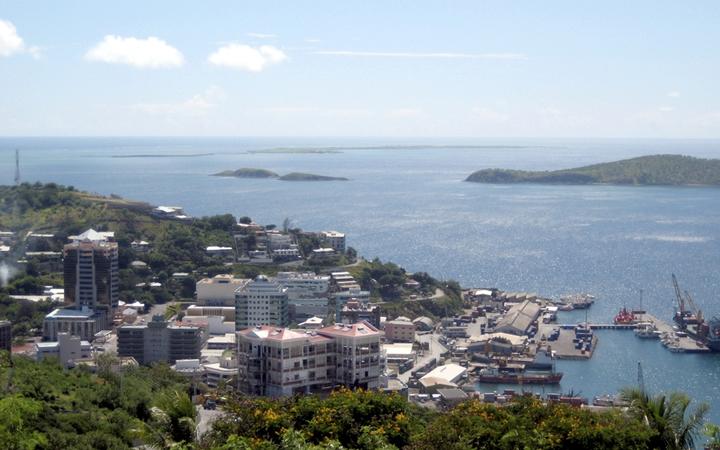
Papua New Guinea’s capital Port Moresby. Photo: Supplied/ MSchlauch – public domain
The Sydney-based Lowy Institute think tank has released projections for when Pacific countries are likely to have vaccinated most of their populations against Covid-19.
Lowy researcher Alexandre Dayant said while some Pacific countries have been world-leading in vaccine coverage, others are coming last, and parts of the region now face a humanitarian crisis.
Smaller countries like the Cook Islands, Palau, Nauru and Niue have already achieved majority vaccination thresholds, but other countries lag far behind.
The forecasting shows that even by the start of 2023 there will likely still be a vast chunk of the population unvaccinated in Papua New Guinea, Vanuatu and the Solomon Islands.
Samoa is not expected to have vaccinated everyone 12 years and older until June next year, and Micronesia, the Marshall Islands and Kiribati are not expected to achieve full vaccination for those over 18 years old until part-way through 2022.
In Papua New Guinea, only 1.7 percent of the eligible population have been vaccinated so far, and the Lowy report said it could take until 2026 for just one third to be vaccinated.
Dayant said one of the main issues in PNG and elsewhere in the Pacific is misinformation.
He said that as well as continuing to support the health system in Pacific countries, New Zealand and the international community should help counter the rampant misinformation about vaccines.
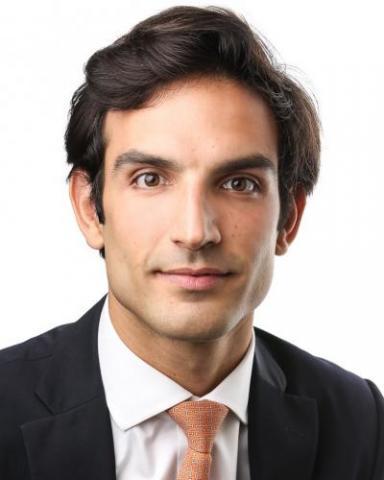
Alexandre Dayant, development economics project director for Asia Pacific at Australian think tank, the Lowy Institute. Photo: Supplied/ Lowy Institute
“New Zealand and Australia could help in some ways – dealing with Facebook, seeing what can be done to better control the spread of misinformation on Facebook. I think this is an issue that Facebook has had to deal with for many years.
“Development partners must continue to partner with local government on their targeted counter-misinformation campaigns and develop a media messaging plan to ensure consistency of messaging about vaccines.”
The report said vaccine supply to Pacific nations was also still an issue, but lack of healthcare workers and difficulties getting to those who need to be vaccinated has created bigger logistical challenges, with many remote and diverse areas.
“How well vaccines are distributed and administered will have significant health, social and economic ramifications in the Pacific,” it said.
The New Zealand Council for International Development’s humanitarian network chair Quenelda Clegg told RNZ that in PNG vaccine hesitancy has become vaccine phobia.
“The situation is dire, people are genuinely afraid of this vaccine … and a critical reason why people are afraid of the vaccine is because of misinformation.
“Misinformation is being spread around the country, and it really is preventing people from going and getting help, and going to the health centres and getting that very crucial vaccine.”
Clegg said before the arrival of Covid-19 previous campaigns to reduce vaccine hesitancy have been successful in the Pacific, and she’s hopeful the same can be done again.
Quenelda Clegg, of ChildFund NZ, and chair of the New Zealand Council for International Development’s humanitarian network. Photo: Supplied/ ChildFund.org.nz
“We’ve seen it done in Samoa, which went from a very low vaccine rate with the measles, and now today there’s around 100 percent vaccine take-up in the country – so that’s really positive.
“We also know from a recent study done by the World Bank that when people are receiving accurate messages, and are receiving up-to-date information about the safety of vaccines
that actually the general intention to get vaccines goes up by around 50 percent.”
Access to the vaccine in geographically isolated areas, and cultural, economic and educational factors were all contributing to many people missing out in PNG, Clegg said.
New Zealand recently sent a health team to PNG, but if more is not done to help the country, Clegg said “we could see the death rate spiral, the country’s health systems collapse, and even the spread of Covid-19 beyond PNG.”
The Council for International Development said New Zealand should donate its spare vaccines to PNG, help provide reliable cell phone coverage so health workers and community leaders there can pass on vaccine information, and fund mobile clinics to provide vaccinations in remote areas.
By Leilani Momoisea of RNZ.co.nz. Republished with permission
A church that has been considered anti-vax is hosting a vaccination event to encourage remaining unvaccinated members to get their first dose – and reframe anti-vax perceptions of the church.
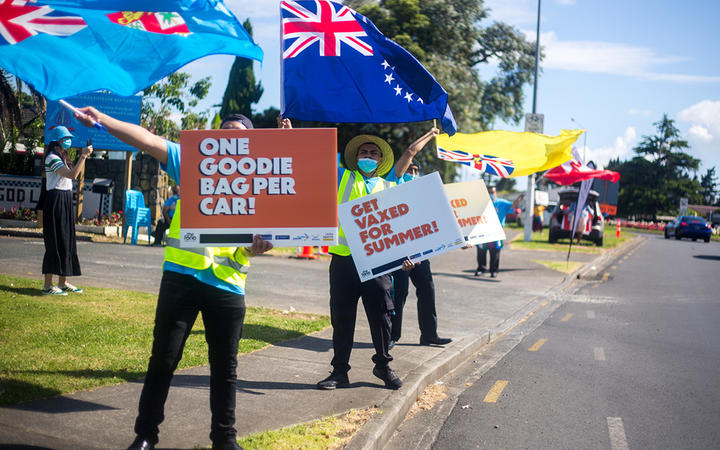
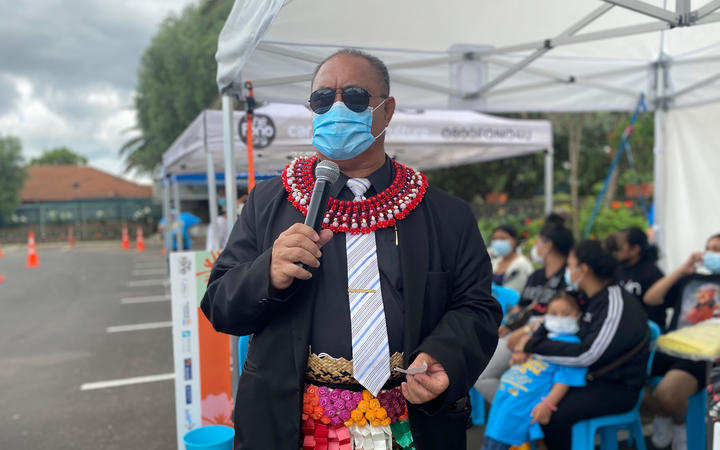
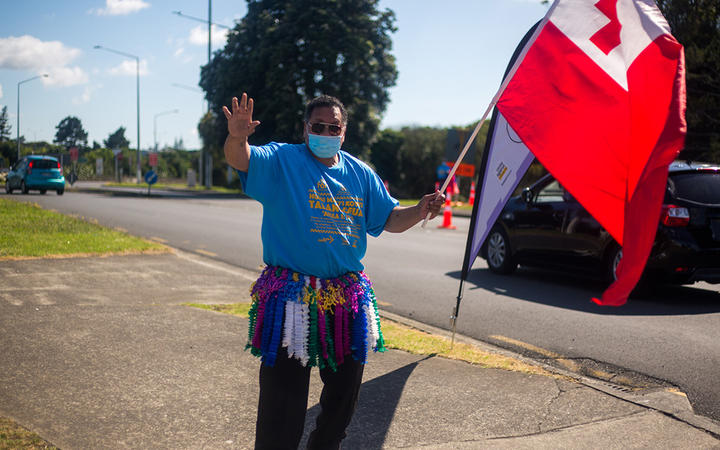
Church leaders and members of the Tokaikolo ‘Ia Kalaisi church in Māngere Bridge line the entrance way to the church, waving the Tongan flag as cars beep and people wave while driving past.
A speaker is set up on the front lawn of a house nearby, blasting music out to the neighbourhood.
The Niuean, Fiji and Cook Islands flags are being waved too.
“I’m not even Cook Island,” laughs the flag bearer as more cars beep, and others drive in to wait in line for their vaccination.
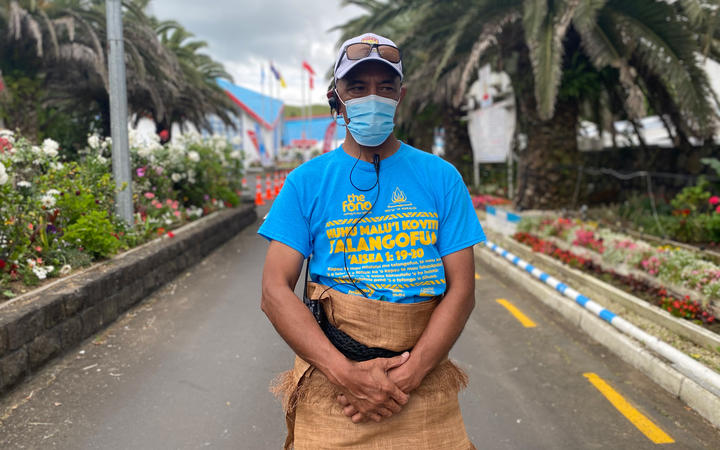
Frank Koloi the marketing and communications manager for The Fono. Photo: PeninaJoy
The large majority of church members have already been vaccinated, says Frank Koloi, marketing and communications manager for The Fono.
“This church has been perceived in mainstream New Zealand as well as the Tongan community as not supportive, or anti-vaxxers.
“That’s one of the things the church leadership wanted to take place today – is to dismiss some of that belief.
“Like many other churches there are members in different churches that are vocal against vaccination, but the bulk, and the large majority of this church’s members have already been vaccinated.”
Fiji, Cook Islands, Niue and Tongan flags waved to passersby Photo: PeninaJoy
The Fono was approached by the church to be the clinical lead for the event today after the Auckland congregation surveyed its 700-1000 members to find out who had yet to be vaccinated.
Most of the 200 members who had not yet received their first dose said they would like to be vaccinated.
“When it was suggested if they would come to a vaccination event here at the church grounds, they all were excited to join in.”
The survey took place a month ago and Koloi, who is also a member of the church, says today is the culmination of a lot of work from the church leadership. Just a few minutes past 9am, when the event began, cars steadily streamed through behind him.
It is an emotional and humbling moment for Koloi.
“I’m not just a member of the church, my father was the founder of this church 40 years ago. The work that we do at The Fono in vaccinating everybody else and every other church, I’ve always had it in my heart that I would hope one day, we’ll be here.”
Cars queue up at the vaccination event at the Tokaikolo ‘Ia Kalaisi church in Māngere Bridge. Photo: PeninaJoy
Senior church minister Viliami Mapapalangi is on MC duties for the day, his voice booming through the mic and over the sound system, thanking church members as they wave and drive past once their observation period is over.
There are tears as he speaks of the support shown today, and pride when speaking of a senior member of the church who got their first vaccine dose.
“How I’m feeling, I know God is here. It’s a great blessing, it’s a great privilege for all of us to be here to be support.
“It’s very emotional for us, I’m really happy seeing how the Tongan people come to support what the government needs for everyone here. It’s a blessing for us.”
Senior church minister Viliami Mapapalangi Photo: PeninaJoy
Just this afternoon, the Ministry of Health reported that 90 percent of Pacific people have had their first dose and 80 percent are fully vaccinated.
Fisiinaua Taufa is parked up after getting his second shot. It was not a difficult decision to get vaccinated, he said: “I think it’s cool.”
Mele Mavae waits in her car after getting her second shot. She said she did it to protect herself and her family.
It was a difficult decision, she said, but she prayed and the church leaders’ example helped.
A young Marcellin College student plays rugby league for Māngere East, and says he got vaccinated so he can compete in the U16 Shaun Johnson Shield.
The chief executive of The Fono, Tevita Funaki, said seeing the turn-out is heart-warming.
“These are the real hard to reach … and to get such an opportunity is actually quite significant. It sends a strong signal, that it’s actually safe, and you get vaccinated to keep you safe, and your family, but also our village as well.”
Koloi said there are many factors which have helped those hesitant to get vaccines come forward, including seeing the effects of the virus first-hand, as well as seeing a lot of people they know get vaccinated safely.
But first and foremost he said, it’s the church leadership driving this.
“The president himself came out and said that he’s been vaccinated and all members should be vaccinated.”
Early on, he said some members of the church had been very vocal particularly in using the scripture to dismiss and discredit the work of the vaccinations.
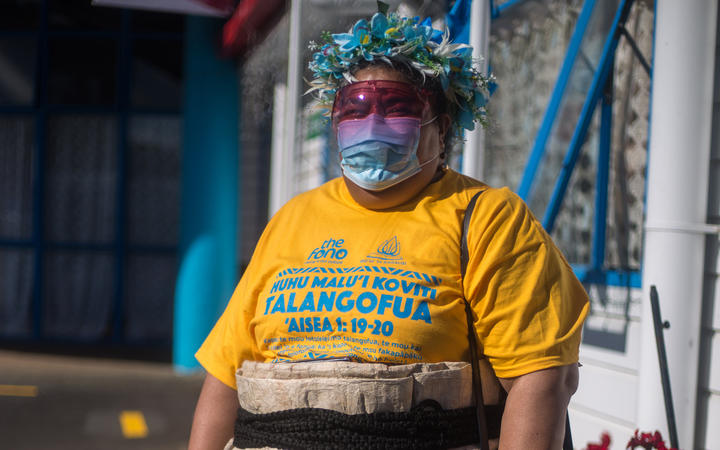
Today, leaders and church members wear shirts with the scripture ‘Aisea 1: 19-20’ and the word ‘Talangofua’ printed in bold.
“When the church leadership decided on a name for the programme, they came up with the name ‘Talangofua’ which literally means obedience. The verse … talks about being obedient to your leadership.”
The Tongan flag is waved out the front of the Tokaikolo ‘Ia Kalaisi church in Māngere Bridge. Photo: PeninaJoy
In the prayer this morning, they emphasised that again.
“We’re here in NZ as a society, and this society needs us all to be vaccinated and we should be obedient as members of this society.”
He said they made it clear that those that will be waving their flags out in the front will be church ministers.
“To make it clear to everybody that we are obedient to the law but first and foremost it’s still within our belief and value and within the scripture that we follow.”


 Black smoke was pouring while the house going up in flames at Tufumāhina royal residence, a video clip taken near the scene shows.
:quality(70):focal(-5x-5:5x5)/cloudfront-ap-southeast-2.images.arcpublishing.com/tvnz/XQUZN45VRNG5LCRVNJAR4PWFK4.jpg)
 World Rugby has made a change to eligibility rules that means from January 2022, a player will now be able to represent another country after a stand-down period of three years.