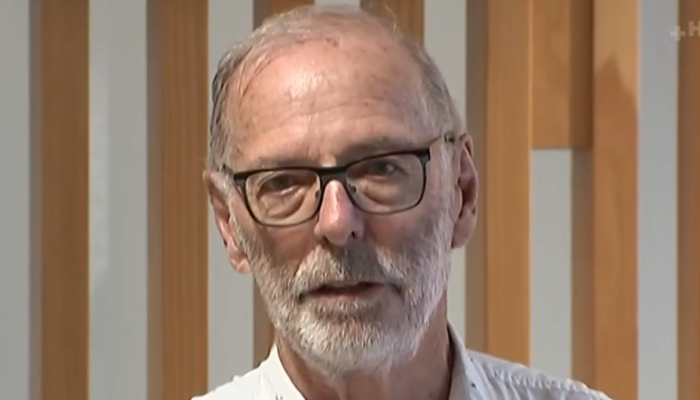
Aucklanders have re-elected Wayne Brown as mayor in the 2025 local elections, giving him a second and final term to complete the work he began three years ago.
Auckland Mayor Wayne Brown
Brown, who campaigned on fixing Auckland’s transport system, said he was “relieved and humbled” by the strong support from voters.
Speaking to media at Karanga Plaza Harbour Pool — which he affectionately calls “Brownie’s Pool” — shortly after preliminary results were released on Saturday afternoon, Brown admitted the campaign had been tough.
“It’s been like being in the dentist’s chair for six weeks,” he said. “I didn’t enjoy it, I don’t enjoy campaigning.”
Voting closed at midday Saturday, with more than 1 million votes counted across 78 city, district, and regional councils nationwide. Local Government NZ reported a voter turnout of 31.61%. Final results for close races are expected next week.
Brown confirmed this would be his last term as mayor, saying his focus now is on finishing what he started.
“They’ve seen what I do, and it won’t be much different — just finishing the job that I started,” he said.
Asked why he believed he won by a large margin, Brown said it was because he had been “quite plain about what I’m doing.”
“I haven’t quite finished everything I’ve set out to fix,” he added. “Even today in the paper, somebody said I hadn’t really done the things on the streets with transport that I said I’d do, but I haven’t actually got my hands on AT [Auckland Transport] yet — but it’s coming shortly.”
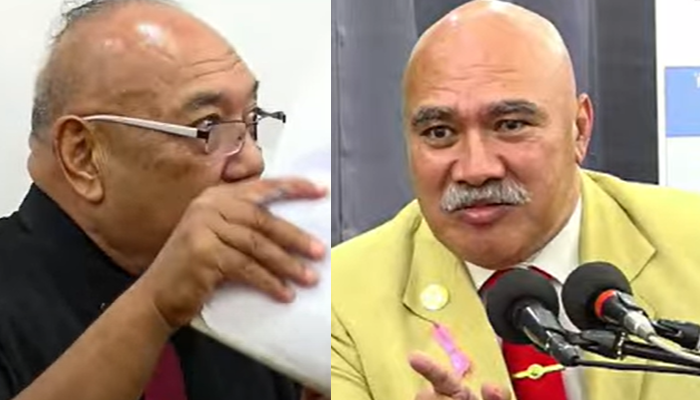
An angry outburst from Minister of Police Piveni Piukala nearly escalated into a physical confrontation with former Cabinet Minister ‘Etuate Lavulavu during a press briefing yesterday—forcing Deputy Prime Minister Dr Taniela Fusimālohi to step in.
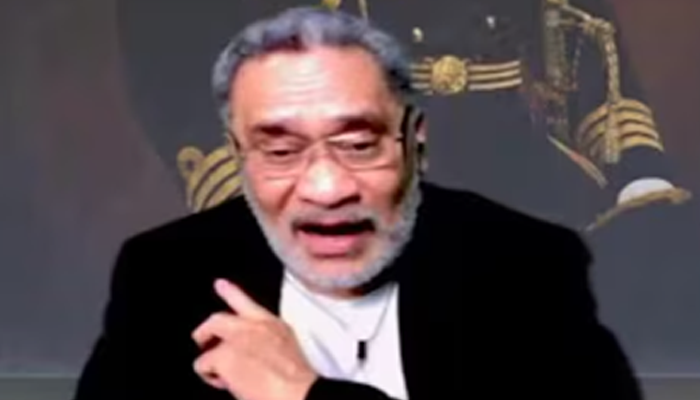
Former MP and Cabinet Minister ‘Etuate Lavulavu and Minister of Police Piveni Piukala
Voices grew louder as speakers interrupted one another, exchanging sharp words during the livestreamed press conference.
This latest incident comes more than two months after Piukala was involved in a physical altercation in Parliament with Lord Tuʻilakepa, Chair of the Whole House Committee.
Prime Minister Dr ʻAisake Eke later confirmed he had issued a formal warning to Piukala and given him a final chance to remain in Cabinet.
Lavulavu maintained that the solution to the ongoing issues with Lulutai Airlines was not to continue injecting funds into it, but to shut it down entirely.
“To be honest, that’s not the answer—just declare it bankrupt and start another one,” he said in Tongan.
Addressing Cabinet Ministers at the press conference, Lavulavu argued that the government could not revive the airline unless, as he implied, domestic services were operated by a private company from overseas.
He claimed that Lulutai’s survival depended solely on its services to Vavaʻu, not to other outer islands.
“You have to listen to us from Vavaʻu,” he said.
“You can’t make decisions here in Tongatapu that could cause us to suffer.”
Airline Decisions Under Fire
He was then cut off by Piukala, who, visibly angered, abruptly returned to the podium after having just left it, and challenged Lavulavu over his comments.
Piukala blamed the airline’s problems on a former administration, in which Lavulavu served as a minister. Lavulavu denied any involvement, but Piukala insisted otherwise.
The Minister of Police responded, saying the Deputy Prime Minister—who chaired the press conference—had clarified that the airline’s problems stemmed from poor decisions made in the past.
Directing his remarks at Lavulavu, Piukala said that if he were in Lavulavu’s position, he would be embarrassed to speak on the issue.
“You are the ones, when you were in government, who initiated what we are now facing as problems,” Piukala said.
Lavulavu responded and told Piukala it was the former government before them but Piukala insisted it was them.
“You have been in a state of disarray in this company,” Piukala told Lavulavu.
Lavulavu responded and offered an apology, but Piukala raised his voice and said, “You initiated the airline, yet you never knew anything about how to operate it.”
Lavulavu replied in a similarly firm tone, telling Piukala he was wrong and should refrain from twisting the truth.
Piukala then accused Lavulavu of using the livestreamed press conference as a platform to campaign for the upcoming general election, in which he is a candidate.
“You made the wrong decision,” Lavulavu fired back, referring to Piukala’s role as Minister of Public Enterprises in making decisions about Lulutai Airlines.
Auckland, NZ — Auckland businessman Chris Barrett has offered a substantial financial reward to anyone who can help locate Lord Fulivai and Lady Helen Fulivai, who fled New Zealand for Tonga following a High Court ruling against them.
Lord Fuliva (L), Helen Fulivai (R). Photos (Supplied) taken at the time of service of Certificate of Registration of Judgment, Ex parte Application for Registration of a Foreign Judgment in the Supreme Court of Tonga filed 4 March 2022, Affidavit in support of Application for Registration of New Zealand Judgment in Tonga sworn on 20 December 2021 & Ruling of the
Court dated 8 March 2022.
As Kaniva News reported previously, the Honourable Justice Venning ruled in 2021 that the Fulivais must repay Barrett the full amount of NZ$253,370.60, including interest dating back to January 1, 2018, and legal costs.
The judgment is legally enforceable in Tonga under the Reciprocal Enforcement Act—an agreement between Tonga and New Zealand that allows court decisions from one country to be recognised and enforced in the other.
The case against the Fulivais was formally registered with Tonga’s Supreme Court in March 2022.
The judgment, obtained by Kaniva News, followed years of financial dealings in which Barrett claims he was misled by the former Governor of Vava’u.
“In particular, he gave me assurances for the granting of a 99-year lease of land on an island called Pangaimotu in Vava’u for which I was to pay $170,000,” Barrett said in court documents.
“I was duped,” he previously said.
Kaniva News has seen legal documents indicating that Lord Fulivai appeared to acknowledge his obligation to repay Barrett.
However, the couple reportedly disappeared either shortly before or soon after the High Court of New Zealand ordered them to repay the funds, making enforcement of the judgment difficult.
Reward Offered for Recovery
Barrett is now calling on legitimate Tongan debt collection agencies to recover the debts.
He said that if any agency can recover the funds, they are entitled to an additional NZ$50,000 in collection fees from the Fulivais, as awarded by the High Court of New Zealand.
“My lawyer will distribute it once the money is collected.”
In a gesture of goodwill, Barrett has also pledged NZ$20,000 from the recovered funds to support community development in Pangaimotu island, near the land he was defrauded over.
He expressed hope that the King would consider revoking Lord Fulivai’s noble title and taking steps to compensate an international investor who has demonstrated a commitment to prioritising the welfare of the people.
Barrett said the King has the authority to correct the actions of his representative and send a clear message to the public that those who abuse their position—whom he described as “thieves”—will no longer be allowed to represent the people.
“This should make his actions easier if there is an uproar by locals seeing investors who can aid the average Tongan scared off by deceit and personal greed by a Noble and his wife, both jointly and severally liable in our High Court action and award,” he said.
“If the King removes the noble titles from Lord and Lady Fulivai and collects the funds, he may retain the NZ$50,000 collection fee for the Kingdom,” Barrett added.
“I will still donate NZ$20,000 for the village’s benefit.”
Barrett accused the Fulivais of hoarding rental income from properties in Hunga and Vava’u, while withholding the money owed since 2015.
He said their actions have discouraged genuine investors and betrayed the trust of the Tongan people.
“My intention was always to support Tonga’s development,” Barrett said.
He said the Fulivais’ greed and deceit robbed the Kingdom of real investment.
Judgment Registered, Enforcement Stalled
Barrett says his claim against Lord and Lady Fulivai is legally enforceable in Tonga under the Reciprocal Enforcement Act, an agreement between Tonga and New Zealand that allows court judgments from one country to be recognised and enforced in the other.
The case, in which the High Court of New Zealand ordered the Fulivais to repay the NZ$253,370, was formally registered with the Supreme Court of Tonga under a ruling issued by former Lord Chief Justice Michael Whitten in March 2022.
Chris Barrett, Director of Steel Worx Group. Photo/Chris Barrett
Barrett said the enforcement of the court judgment has stalled because he and his legal team have been unable to serve or hold Lord and Lady Fulivai accountable for breaching the court orders.
He told Kaniva News that he is raising the issue publicly to alert Tongan debt collectors that they may have a legitimate opportunity to pursue the Fulivais, who are believed to be hiding in Tonga.
He said his family was so disheartened that they redirected their investments—over NZ$15 million—into beachfront and ocean-view properties in Bali.
The businessman’s offer remains open until Christmas 2025, with hopes that the Kingdom of Tonga will take decisive action to protect its reputation and encourage future investment.
“This could bring real Christmas joy to villagers,” Barrett said.
He said his intention was always to support Tonga’s development. He accuses Lord and Lady Fulivai of greed and selfishness, claiming their actions drove away genuine investors.
Police Response: No Border Alert Issued
When asked why the Fulivais were not flagged at the border, Detective Sergeant Shane Page of Waitematā Police explained that the threshold for a border alert was not met.
“Police can only stop individuals at the border if there is sufficient evidence to arrest them for a criminal matter,” Detective Page said in an email to Barrett, which Kaniva News was copied into after raising the issue.
“Unfortunately, in this case, the criteria were not met.”
Page expressed sympathy for Barrett’s situation, acknowledging the emotional and financial toll.
“I hope you continue to keep both eyes on them and hold them accountable,” he said.
More than half a tonne of cannabis was seized by police in Auckland yesterday, following a series of raids across the city’s inner west.
Some of the cannabis seized by police. (Source: Supplied)
A man was also arrested on a raft of charges.
Detective Senior Sergeant Anthony Darvill said the searches were part of a police effort to crack down on criminals profiting from the sale of drugs.
“During the searches of the properties, significant commercial cannabis grow set-ups were located,” Darvill said.
More than 500kg of cannabis was seized, as well as a “significant amount” of cash, MDMA, and ketamine.
Some of the cannabis seized by police. (Source: Supplied)
“Cultivation of cannabis at this level is organised crime, and the action taken by police will impact those facilitating this activity and lessen the residual harm being caused,” Darvill said.
“We’re particularly pleased to remove the MDMA and ketamine from circulation, given the significant risk that it creates in the community”.
A 26-year-old man was due to appear in the Auckland District Court on October 15, facing cultivation of cannabis charges. Darvill said further charges were likely.
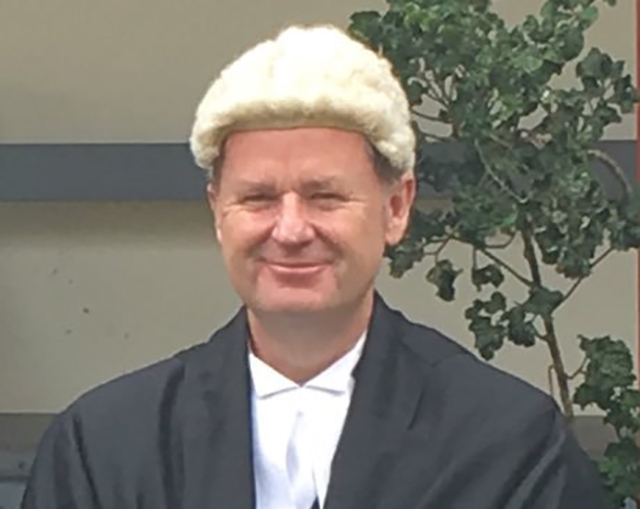
Wellington, NZ — Justice Owen Paulsen, who served as Lord Chief Justice of the Kingdom of Tonga from 2015 to 2019, has been appointed as a High Court Judge in New Zealand, effective 15 November 2025.
Former Lord Chief Justice of the Kingdom of Tonga, Owen Paulsen
He will sit in Christchurch, continuing a distinguished legal career that spans more than three decades across the Pacific.
Justice Paulsen’s tenure in Tonga marked a significant chapter in his judicial service.
As Lord Chief Justice, he was the professional head of the Tongan judiciary, President of both the Court of Appeal and the Land Court, and a Privy Council advisor to His Majesty King Tupou VI on land matters.
His contributions to the Tongan legal system were formally recognised when he was awarded membership in The Most Devoted Royal Household Order of Tonga, an honour bestowed by the King.
During his time in Tonga, Justice Paulsen was known for strengthening judicial independence, modernising court procedures, and upholding the rule of law in a complex constitutional environment.
His leadership was instrumental in navigating high-profile cases and reinforcing public confidence in the judiciary.
Justice Paulsen began his legal career after graduating with a Bachelor of Laws from the University of Canterbury, later becoming a partner at Harman & Co from 1991 to 1998.
He served as an adjudicator and mediator for the Employment Tribunal from 2000 to 2001, while also practising as a litigation lawyer.
From 2001 to 2014, he was a partner at Cavell Leitch Law, and in 2011, he earned a Master of Laws (Commercial Law) with First Class Honours from the University of Auckland.
Following his return from Tonga, Justice Paulsen was appointed an Associate Judge of the High Court of New Zealand in 2019, where he has presided over complex commercial and civil matters.
His elevation to High Court Judge reflects his deep legal expertise, commitment to justice, and broad experience across both New Zealand and the Pacific.
The 2025 general election in Tonga has officially begun with Fotofili confirmed as the Noble Representative for the Ongo Niua constituency—after standing as the sole candidate.
Some of the people’s representative candidates (L-R): Former Minister and current MP for Tt9 Sevenitiini Toumo’ua, returning candidate and former DPM Sēmisi Sika of Tt2, new candidate for Tt10 Faka’osi Maama; current Minister of Customs and MP for Tt4 Māteni Tapueluelu and returning candidate for Tt6 Fane Fituafe. Photo/Faka’osi Maama
His unopposed election signals the start of the national voting process, with residents set to head to the polls on November 20.
The final count of registered candidates has now surpassed 90, following the close of the nomination period today, October 9.
Tongatapu 7 and Tongatapu 8 have attracted the highest number of candidates for the people’s representative seats, with seven each.
They are followed by Tongatapu 6 and Tongatapu 12, which have six candidates each.
The high number of contenders reflects strong public interest in this year’s election, which will shape the next term of Tonga’s Legislative Assembly.
Nobility Candidates:
Tongatapu:
1. Lasike
2. Ma’afu
3. Nuku
4. Tuívakano
5. Vaea
6. Veéhala
Vava’u:
1. Fulivai
2. Luani
3. Tuíáfitu
4. Tuílakepa
Ha’apai:
1. Fakafanua
2. Tu’iha’angana
3. Tu’iha’ateiho
Éua:
1. Lasike
2. Nuku
3. Tuívakano
4. Veéhala
Ongo Niua:
1. Fotofili
Peoples Representative Candidates
Tongtapu 1:
1. Tevita Fatafehi Pukola, Ísileli
2. Siaosi Vailahi Pohiva, Halaóvave
3. Éliesa Fifita, Tufuenga
Tongatapu 2:
1. Úhilamoelangi Fasi, Kolofoóu
2. Semisi Kioa Lafu Sika, Haveluloto
Tongatapu 3:
1. Siaosi Ófa ki Vahafolau Sovaleni, Ngeleía
2. Gabriella Renee Blake Ílolahia, Fasi-mo e-afi- á Tungi
Tongatapu 4:
1. ‘Isileli Pulu , Fangaloto
2. Mateni Tapueluelu, Houmakelikao
3. Viliami Á. Takau, Maúfanga
4. Vili Fonolahi Pese a.k.a. Sione Laulaupeaálu, Úmusi
Lo‘au University has refunded a student’s tuition fees following complaints and growing scepticism about the quality and credibility of its academic offerings.
Dr Siosiua Lafitani
This development followed action taken by former Australian student Toki’ukamea Liutai, also known as Marshall Cameron, who engaged Auckland-based Tongan lawyer Nalesoni Tupou in an effort to reclaim his payment from the Australian-based Lo’au University Founder Dr Siosiua Lafitani.
Liutai said he requested a copy of the university handbook from Lafitani to choose a course but was told that access to the syllabus and course details would only be granted after paying the full tuition fee of $3,500 for the BA programme.
Liutai claimed that after paying $2,200, teaching began without any clarification about which course he was enrolled in.
Following his withdrawal and communication with Lafitani, Liutai took to Facebook to express his concerns, referring to the university as a “fraudulent academic organisation.”
He maintained that his short time as a student revealed a disconnect between the course delivery and what he had expected from Lo‘au University.
He questioned the upfront payment policy, citing the absence of detailed course information and the apparent use of Lafitani’s personal bank account for tuition transactions.
Speaking to Kaniva News, Liutai said he became suspicious after Lafitani cancelled their first scheduled face-to-face meeting.
His concerns deepened when he was assigned a five-page essay on a topic he found unusual and difficult to justify.
Liutai said he enrolled at Lo‘au University under the illusion that it was “a leading Tongan college” and a school that was grounded in “Moanan thought.”
Course Content Sparks Doubts
However, he claimed the course he was provided focused on “Rational Thinking”, which he felt did not reflect Moanan or Tongan Indigenous perspectives.
He said that his first assignment was a five-page essay on how modern Tongan professors associated with Lo‘au University differed from Greco-Western scholars.
“I was stumped as to how these Tongan men, educated at Western universities in the 1980s, could be edifying themselves alongside Socrates, Plato, Zoroaster, Thoth-Hermes, and Rumi,” Liutai told Kaniva News.
He said their first video call session lasted approximately 90 minutes, during which Lafitani allegedly read from his notes and dictated content that appeared to come from one of his own books, “which he requested that I purchase, and I did, for a cost of $80AUD.”
He claimed that the notes provided by Lafitani were neither “particularly special nor helpful” and appeared to have been “copied and pasted from Google or random websites.”
“In particular – although I am a firm believer that there are great philosophical and spiritual truths in Moana/Tonga, I am sceptical of his claims and assertions that modern philosophers are the equivalent or even greater than those Grecian scholars three thousand years ago.”
Liutai also shared with us course notes and message screenshots that appeared to show the university delivered its materials to students by uploading them via Facebook Messenger.
University Claims Under Scrutiny
Amid growing doubts, and following the conclusion of the first session, Liutai went online and began investigating the university’s credentials — including who approved them, the origin of the course outlines, and the authority responsible for issuing the Bachelor’s, Master’s, and Doctorate degrees it claimed to offer.
“The investigation found no active company, no valid credentials, and no governing body to approve the certification. Even the website, email, and phone number had been disconnected,” Liutai said of Lo’au University.
Toki’ukamea Liutai also known as Cameron Marshall. Photo/Provided
“I Facebook messaged him and proceeded to request my money returned whilst delivering the reasons why.”
In a letter to Lafitani, which he shared with us, Liutai says:
“I wanted to thank you for the time you have spent so far and your kind invitation to do some study with Lo’au University. I was excited to be able to engage with Tongan Higher Learning both to further my families knowledge but also to support the Tongan education system in my own way”, the letter read.
Liutai told Lafitani that his extensive experience in business administration and leadership in Australia’s RTO sector, regulated by ASQA, gives him a solid understanding of how universities should operate.
He said that, given his expertise, he checked with TEQSA in Canberra and TNQAB in Tonga—both responsible for regulating and assuring the quality of higher education.
“Lo’au University is not registered as a ABN, registered as a University/RTO or approved to offer the course range of Bachelor’s/Master’s or PHD courses in the Australian Capital Territory”, Liutai claimed.
“Lo’au University is not registered as a Tongan Company, registered as a University or approved to offer the course range of Bachelor’s/Masters or PHD courses in the Kingdom of Tonga by TNQAB.
“Lo’au University does not provide any official email, website, policies or procedures or code of conduct.
“My financial transactions, thus far have not yet received a formal written receipt from Lo’au; and where transferred directly to your personal bank not a company/organisation account which is contrary to the Tongan Code of Conduct for Academia.
With this being the case, I demand a full refund of the $$$ by no later then COB 12/09/2025. I will place the bank account to transfer to below this post so you can comply.”
School Fees Refunded
In an effort to recover his money, Liutai contacted Auckland-based lawyer Nalesoni Tupou for legal advice.
Tupou previously confirmed this communication with Liutai to Kaniva News and stated that he had reached out to the University’s Chancellor, Inoke Hu’akau, who acknowledged that the money had been refunded.
Tupou also took to Facebook to thank the Lo’au for repaying Liutai’s money.
In another post by Tupou on his Facebook, Hu’akau responded and confirmed their earlier conversation about Liutai’s school fees and said it has been paid.
He accused Liutai, writing in Tongan, of having what he described as personal issues.
Responding to Liutai’s Facebook post about the matter, Lafitani claimed that Liutai had defamed him and made false accusations.
In a Facebook post dated September 14, Lafitani stated that he and Liutai had agreed to a tuition payment plan in instalments.
He said Liutai had enrolled in the university’s Bachelor of Arts programme, and that Lo‘au University had supported him in fulfilling the course requirements.
“In the end, he withdrew and allegedly made threats and behaved inappropriately towards us,” Dr Lafitani claimed.
Institution Description Under Scrutiny
A Google search for the term “Lo‘au University” produced an AI-generated overview stating that the institution is a non-profit organisation dedicated to Oceanic and Tongan knowledge and scholarship, with a focus on cultural preservation and blending Tongan wisdom with global learning.
“The university offers degrees from bridging courses to PhDs across various schools, including Social Philosophy, Technology, and Health. It operates on an alternative framework to national accreditation, emphasizing transparency, academic integrity, and a commitment to student well-being.”
As Kaniva News previously reported, Lo‘au University no longer appears to be operating its two websites, known previously as Nuama and Lo‘au ‘University. It appears the University is now being operated through Facebook and has some videos on Youtube.
The university was launched by Minister for Education Dr. ‘Ana Maui Taufe’ulungaki on January 7, 2014. It was described by the media at the time as “Tonga’s first online virtual university.”
The Prime Minister of Tonga, Dr ʻAisake Valu Eke, has ordered all national flags across the Kingdom to be flown at half-mast on Wednesday, 8 October 2025.
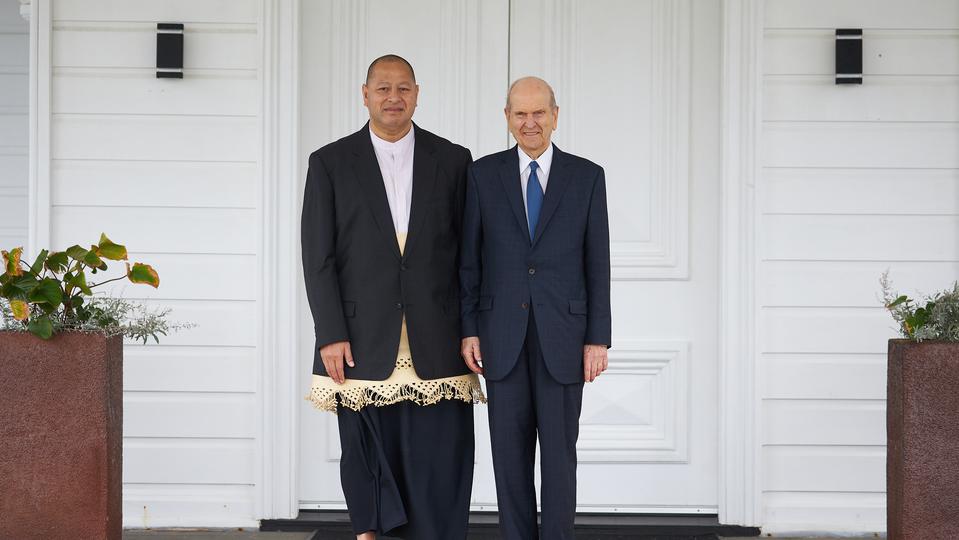
King of Tonga and President Russel Nelson. Photo/churchofjesuschrist.org
This is to honour the late Russell M. Nelson, President of The Church of Jesus Christ of Latter-day Saints (LDS), who passed away on 29 September in Salt Lake City, Utah, at the age of 101.
Dr Nelson, revered globally as a prophet and spiritual leader, was the oldest serving head of the LDS Church and credited with leading transformative policy changes during the final decade of his life.
His passing marks the end of an era for the church, which has seen significant growth in Tonga and among the Tongan diaspora.
Tonga: The World’s Most Mormon Country
Tonga holds the distinction of being the world’s most Mormon country per capita.
According to the Tonga Department of Statistics, the 2011 census recorded 18,554 Mormons (18%), surpassing 15,441 Catholics (15%), making Mormonism the second-largest Christian denomination in the Kingdom after Methodism.
This marks a notable shift from the 1996 census, where Catholics outnumbered Mormons.
The island of Vavaʻu has the highest concentration of Mormons at 18.5%, while Niuafoʻou and Niuatoputapu have the lowest, with only 4% identifying as LDS.
The village of Matahau in Tongatapu stands out, with 400 of its 628 residents identifying as Mormon.
The LDS Church also maintains a strong presence among Tongans living abroad, particularly in the United States.
A Legacy Remembered
Dallin H. Oaks, widely expected to succeed Dr Nelson as the next president of the LDS Church, described him as a man of “extraordinary modesty for someone with such great accomplishments.”
The Prime Minister’s decree reflects the deep cultural and spiritual ties between Tonga and the LDS Church, and acknowledges the profound impact Dr Nelson had on the lives of many Tongans.
The government has shortlisted two companies from the pool of bidders seeking to operate Lulutai Airlines.
Dr Aisake Eke
Prime Minister Dr ‘Aisake Eke confirmed this to Kaniva News this morning, following the government’s call for private ownership bids approximately three months ago.
It is understood that Fly Niu is among the companies shortlisted to operate Lulutai Airlines.
It is also understood that a key factor in the negotiation process is the Retirement Fund loan, which amounts to about $6 million.
The loan was originally used to purchase the airline’s Twin Otter aircraft, and the government is now working to ensure that this debt is addressed as part of the privatisation deal, a source told Kaniva News.
The loan is being treated as a central issue in discussions with potential bidders.
The move to privatise Lulutai Airlines comes amid ongoing financial challenges, including the need for a $7 million subsidy earlier this year to keep the airline operational.
The government is also reviewing the airline’s legal status and transparency, with concerns raised over missing share certificates and the lack of annual financial reports.
The former Hu‘akavameiliku government borrowed approximately $6 million from the Retirement Fund, but faced strong criticism from the Opposition for failing to address the loan transparently and in a timely manner in Parliament.
Concerns were raised by civil servants, with Public Service Association Secretary Mele ‘Amanaki previously taking to Facebook to question what would happen to the loan if Lulutai Airlines ceased operations.
PM Eke previously told Kaniva News that the loan is guaranteed by the government and therefore secured. However, he acknowledged that the challenge lies in finding funding to cover the cost of the loan.
Former Prime Minister Hu‘akavameiliku previously informed the media that Lulutai Airlines had commenced repaying its debt to the Retirement Fund Board, which owns 27.19 per cent of the airline’s shares.
He stated that the airline had repaid approximately TOP $800,000 of its TOP 6 million loan.
At the time, he said the remaining balance—including principal and interest—stood at around TOP 5.7 million.
The Tongan government has rejected as false reports circulating on social media that its delegation walked out during Israeli Prime Minister Benjamin Netanyahu’s speech at the United Nations two weeks ago.
Trade Minister Kapeli Lanumata
The claims sparked backlash online, particularly among Tonga’s Christian community, many of whom are vocal supporters of Israel due to biblical and religious beliefs.
The revelation comes after Israeli Prime Minister Benjamin Netanyahu condemned the recognition of a Palestinian state by several Western nations during a combative speech at the United Nations General Assembly.
Netanyahu described the recognition efforts as a “mark of shame,” claiming they send the message that “murdering Jews pays off.”
His remarks prompted dozens of officials and diplomats to stage a walk-out as he took the podium, leaving large sections of the conference hall visibly empty. Outside the UN headquarters, protesters gathered in Times Square to demonstrate against Israel’s ongoing war in Gaza.
Tonga’s Trade Minister, Kapelieli Lanumata, who was part of the country’s delegation to the UN, clarified the situation in response to the rumours.
“We did not walk out because we were not there in the first place,” Lanumata told a press conference last week.
He explained that at the time of Netanyahu’s address, Pacific Islands Forum leaders were attending a separate meeting with the UN Secretary-General.
The misinformation prompted strong reactions from Tongan social media users, who condemned the reports and reaffirmed their support for Israel.
As Kaniva News reported earlier today, Tonga recently voted in favour of Israel by rejecting the New York Declaration supporting a two-state solution between Israel and Palestine.
However, the move has drawn criticism from Tongan scholars abroad, who argue that Prime Minister Eke’s position overlooks serious humanitarian concerns, including allegations of genocide, starvation, and displacement in Gaza, as reported by the United Nations.
The controversy highlights growing divisions within the Tongan diaspora over the government’s stance on the Israel-Palestine conflict.