Home Blog Page 161

All Blacks banish Wellington hoodoo with win over Wallabies

By rnz.co.nz and is republished with permission

The All Blacks have beaten the Wallabies 33-13 in the second Bledisloe Cup test in Wellington, their final home game of the year.

Caleb Clarke of New Zealand celebrates his try with Sevu Reece of New Zealand and /Beauden Barrett of New Zealand.
New Zealand All Blacks v Australia Wallabies, Bledisloe Cup and Rugby Championship rugby union test match at Sky Stadium, Wellington, New Zealand on Saturday 28 September 2024. © Photo: Harry Cornaga / Photosport

Caleb Clarke celebrates his try with Sevu Reece and Beauden Barrett. Photo: Harry Cornaga / Photosport Ltd 2024 www.photosport.nz

The victory ends the hosts’ six-year winless run in the city and means the All Blacks finish the Rugby Championship with three wins and three defeats.

Skipper Scott Barrett told Sky Sport it was a relief to finally get a win in Wellington.

“Really pleased to reverse the curse, we didn’t start too well but I am really pleased with how we finished, some grit on defence and we held out the Aussies.”

Having gone scoreless in the final quarter throughout the Rugby Championship, the All Blacks also broke that unwanted streak with second-half tries to Tamaiti Williams and another for Clarke.

“We just talked about owning our effort really and it showed there on our line, pleasing to not let them in. Pleased to finish on a high at home.”

Anton Lienert-Brown of New Zealand and Sam Cane of New Zealand.
New Zealand All Blacks v Australia Wallabies, Bledisloe Cup and Rugby Championship rugby union test match at Sky Stadium, Wellington, New Zealand on Saturday 28 September 2024. © Photo: Andrew Cornaga / Photosport

Anton Lienert-Brown and Sam Cane, who has become the 13th All Black centurion. Photo: Andrew Cornaga/www.photosport.nz

Former captain Sam Cane became the 13th All Black to play 100 tests.

“Just feel really lucky to be able to have this moment at home in New Zealand, I feel like this is best I have seen Wellington to be honest,” Cane said.

Cane lauded the performance of the younger loose forwards throughout the Rugby Championship.

“They are pretty special athletes, a bit quicker and explosive, the guys coming though are just getting better and better.”

The test marked the final outing in black for both Cane and TJ Perenara.

Barrett said they left special legacies.

“Both have given a lot to the jersey, TJ at home here, and Sammy, 100 test matches – every time he has come out here he has put his body on the line.”

Wallabies captain Harry Wilson said while the team had their moments throughout, it had been a disappointing campaign.

“It’s not the result we wanted, we had a few chances at the end to get some points on the board but didn’t.”

It was a fast start from the Joe Schmidt-coached Wallabies with visitors running a blindside move from a scrum before putting in a chip and chase that almost resulted in the first try of the game.

Sevu Reece of New Zealand celebrates a try 1`before the Bledisloe Cup - New Zealand All Blacks v Australia Wallabies at Sky Stadium, Wellington, New Zealand on Saturday 28 September 2024.
Copyright photo: Masanori Udagawa /  www.photosport.nz

Sevu Reece celebrates a try. Photo: Masanori Udagawa

The Wallabies would continue to apply early pressure and would soon score, with flanker Fraser McReight burrowing over from a ruck on the tryline in the eighth minute.

The try was converted giving the visitors a 7-0 lead and they broke the All Blacks again from the resulting kickoff with the hosts having to scramble.

The Wallabies dominated early possession, but the All Blacks were the next to score, with wing Sevu Reece scoring in the right corner following a break from blindside flanker Wallace Sititi.

First-five Beauden Barrett missed the conversion and the chance to draw level leaving the score 7-5 to the Wallabies, who then kicked a penalty through first-five Noah Lolesio to go ahead 10 points to 5 after 20 minutes.

That lead didn’t last long, with fullback Will Jordan slicing through several Wallabies defenders to score the All Blacks second try of the night in Te Whanganui-a-Tara.

This time Barrett didn’t miss the conversion attempt and the All Blacks took their first lead of the night, up 12-10.

Caleb Clarke of New Zealand.
New Zealand All Blacks v Australia Wallabies, Bledisloe Cup and Rugby Championship rugby union test match at Sky Stadium, Wellington, New Zealand on Saturday 28 September 2024. © Photo: Andrew Cornaga / Photosport

Caleb Clarke in possession. Photo: Andrew Cornaga/www.photosport.nz

The Wallabies then looked to have scored a near identical try to their first in the 35th minute with flanker McReight barging over in the left corner after a series of rucks, only to be help up over the line.

It didn’t matter though, with a penalty kick to Lolesio moments later giving the visitors a 13-12 lead not long before halftime.

The All Blacks turned down a kickable penalty of their own on the stroke of halftime and the gamble paid off, with wing Caleb Clarke bursting over for a try near the posts after taking a short ball from Beauden Barrett, who duly converted to put the hosts ahead 19-13 at halftime.

The All Blacks began to get on top in the second half but some unforced errors again blighted their performance, highlighted by halfback TJ Perenara knocking the ball on after taking a quick tap from a penalty.

The hosts continued to put pressure on the Wallabies and were awarded a penalty close to the visitors tryline.

The Wallabies defended the All Blacks lineout drive but a few phases later the hosts would score with prop Tamaiti Williams crashing over from the base of a ruck, the converted try extending their lead to 26-13 with 56 minutes gone.

Sevu Reece of New Zealand and Beauden Barrett of New Zealand.
New Zealand All Blacks v Australia Wallabies, Bledisloe Cup and Rugby Championship rugby union test match at Sky Stadium, Wellington, New Zealand on Saturday 28 September 2024. © Photo: Andrew Cornaga / Photosport

Sevu Reece and Beauden Barrett. Photo: Andrew Cornaga/www.photosport.nz

The hosts looked to have scored again through lock Tupou Vai’i, but the try was disallowed due to a knock on in the leadup.

The All Blacks though had begun to assert their dominance and Clarke went over for his second try in impressive fashion, taking the ball on the left wing before cutting inside the Wallabies defence and carrying a tackler or two with him across the line.

Veteran Barrett, who had a strong game at first-five in place of Damian McKenzie, again converted to put the hosts ahead 33-13 with 14 minutes remaining before centurion Cane was subbed off to a standing ovation from the sold-out Wellington crowd.

The Wallabies did find some spirit and peppered the All Blacks tryline forcing the hosts to give away a penalty. However New Zealand’s defence held strong and they cleared their 22 well, something they have struggled to do at times this year.

The test would finish on a sour note for Clarke after a strong two-try performance, with the All Blacks wing yellow carded for offside in the final few minutes.

The one-man advantage though didn’t come to much for the Wallabies who were unable to score any more points, with the game ending 33-13 to the All Blacks, who finish their Rugby Championship campaign with one of their better performances.

Israeli military says it has killed Hezbollah chief Nasrallah

The Israeli military said on Saturday it had killed Hezbollah leader Sayyed Hassan Nasrallah in an airstrike on the group’s central headquarters in the southern suburbs of Beirut a day earlier.

Men show photos of Hassan Nasrallah, Secretary-general of Hezbollah, as people demonstrate against Israel and the attack on Lebanon at Palestine square in Tehran on September 28, 2024. Israel conducted a wave of air strikes on the south of Lebanon's capital Beirut on September 27, 2024 that it said targeted Hezbollah's headquarters, warning of more to come as it told civilians to leave the densely populated neighbourhood. Israeli television networks reported that Hezbollah chief Hassan Nasrallah was the target of the strike, though a source close to the group said he was "fine". (Photo by ATTA KENARE / AFP)

Men show photos of Hassan Nasrallah, Secretary-general of Hezbollah, as people demonstrate against Israel and the attack on Lebanon at Palestine square in Tehran on 28 September 2024. Photo: ATTA KENARE / AFP

The Iran-backed Hezbollah has yet to issue any statement on the status of Nasrallah, who has led the group for 32 years.

The Israeli military “eliminated … Hassan Nasrallah, leader of the Hezbollah terrorist organization,” Israeli army spokesperson Avichay Adraee wrote in a statement on X.

“Hassan Nasrallah will no longer be able to terrorize the world,” the Israeli military said in a post on X on Saturday.

Israel launched a new wave of airstrikes on Beirut’s southern suburbs and other areas of Lebanon on Saturday, a day after carrying out the massive attack on the southern suburbs of Beirut known as Dahiyeh.

Reuters witnesses heard more than 20 airstrikes before dawn on Saturday. Abandoning their homes in the southern suburbs, thousands of Lebanese congregated in squares, parks and sidewalks in downtown Beirut and seaside areas.

“They want to destroy Dahiye, they want to destroy all of us,” said Sari, a man in his 30s who gave only his first name, referring to the suburb he had fled after an Israeli evacuation order. Nearby, the newly displaced in Beirut’s Martyrs Square rolled mats onto the ground to tried to sleep.

Israel’s military said early on Saturday that about 10 projectiles had crossed from Lebanon into Israeli territory and that “some” had been intercepted. A statement from the military did not identify the projectiles, which it said were detected after sirens sounded in the Upper Galilee area.

An unprecedented five hours of continuous strikes early on Saturday followed Friday’s attack, by far the most powerful by Israel on Beirut during nearly a year of war with Hezbollah. It marked a sharp escalation of a conflict that has involved daily missile and rocket fire between the two sides.

The latest escalation has sharply increased fears the conflict could spiral out of control, potentially drawing in Iran, Hezbollah’s principal backer, as well as the United States.

A portrait of Hezbollah leader Hassan Nasrallah hangs on the wall of a heavily damaged apartment in the Hadath neighbourhood of Beirut's southern suburbs on September 28, 2024 in the aftermath of overnight Israeli airstrikes on the outskirts of the Lebanese capital. Israeli fighter jets bombarded the southern suburbs of Beirut overnight into September 28, sending panicked families fleeing massive strikes that were reportedly targeting Nasrallah. (Photo by AFP)

A portrait of Hezbollah leader Hassan Nasrallah hangs on the wall of a heavily damaged apartment in the Hadath neighbourhood of Beirut’s southern suburbs on 28 September 2024 in the aftermath of overnight Israeli airstrikes on the outskirts of the Lebanese capital. Photo: AFP

Israel has not said whether it tried to hit Nasrallah, but a senior Israeli official said top Hezbollah commanders were targeted.

“I think it’s too early to say… Sometimes they hide the fact when we succeed,” the Israeli official told reporters when asked if the strike on Friday had killed Nasrallah.

Earlier, a source close to Hezbollah told Reuters that Nasrallah was alive. Iran’s Tasnim news agency also reported he was safe. A senior Iranian security official told Reuters that Tehran was checking his status.

The Israeli military said in a statement that it had killed the commander of Hezbollah’s missile unit, Muhammad Ali Ismail, and his deputy Hossein Ahmed Ismail.

Smoke rises from the site of an Israeli airstrike that targeted the southern Lebanese village of Khiam on September 25, 2024. Lebanon said 23 people were killed and dozens injured in Israeli strikes across Lebanon September 25, the third day of major Israeli raids in the country as fighting with Hezbollah has intensified. (Photo by Rabih DAHER / AFP)

Photo: RABIH DAHER/AFP

Death toll rises

Hours before the latest barrage, Israeli Prime Minister Benjamin Netanyahu told the United Nations that his country had a right to continue the campaign.

“As long as Hezbollah chooses the path of war, Israel has no choice, and Israel has every right to remove this threat and return our citizens to their homes safely,” he said.

Several delegations walked out as Netanyahu approached the lectern. He later cut short his New York trip to return to Israel.

Lebanese health authorities confirmed six dead and 91 wounded in the initial attack on Friday – the fourth on Beirut’s Hezbollah-controlled southern suburbs in a week and the heaviest since a 2006 war.

The toll appeared likely to rise much higher. There was no word on casualties from the later strikes. More than 700 people were killed in strikes over the past week, authorities said.

Hezbollah’s al-Manar television reported seven buildings were destroyed. Security sources in Lebanon said the target was an area where top Hezbollah officials are usually based.

Hours later, the Israeli military told residents in parts of Beirut’s southern suburbs to evacuate as it targeted missile launchers and weapons storage sites it said were under civilian housing.

Hezbollah denied any weapons or arms depots were located in buildings that were hit in the Beirut suburbs, the Lebanese armed group’s media office said in a statement.

Alaa al-Din Saeed, a resident of a neighbourhood Israel identified as a target, told Reuters he was fleeing with his wife and three children.

“We found out on the television. There was a huge commotion in the neighbourhood,” he said. The family grabbed clothes, identification papers and some cash but were stuck in traffic with others trying to flee.

“We’re going to the mountains. We’ll see how to spend the night – and tomorrow we’ll see what we can do.”

Around 100,000 people in Lebanon have been displaced this week, increasing the number uprooted in the country to well over 200,000.

Israel’s government has said that returning some 70,000 Israeli evacuees to their homes is a war aim.

Fear the fighting will spread

Hezbollah has fired hundreds of rockets and missiles against targets in Israel, including Tel Aviv. The group said it fired rockets on Friday at the northern Israeli city of Safed, where a woman was treated for minor injuries.

Israel’s air defence systems have ensured the damage has so far been minimal.

Iran, which said Friday’s attack crossed “red lines”, accused Israel of using U.S.-made “bunker-busting” bombs.

US Defense Secretary Lloyd Austin said Washington was not informed of that strike beforehand. President Joe Biden was being kept abreast of developments.

At the UN, where the annual General Assembly met this week, the intensification prompted expressions of concern including by France, which with the US has proposed a 21-day ceasefire.

“This must be brought to an end immediately,” French Ambassador Nicolas de Riviere told a Security Council meeting.

At a New York press conference, U.S. Secretary of State Antony Blinken said: “We believe the way forward is through diplomacy, not conflict… We will continue to work intentionally with all parties to urge them to choose that course.”

Hezbollah opened the latest bout in a decades-long conflict with a missile barrage against Israel immediately following the 7 October attack on Israel by the Palestinian militant group Hamas in Gaza last year.

– Reuters

Air NZ plane tail appears to hit runway at Wellington Airport, airline says no contact

By Jaime Lyth of the NZ Herald

An Air New Zealand plane aborted its landing after appearing to strike its tail on the runway at Wellington Airport.

Footage of the flight NZ272 shows the plane landing and suddenly pulling up with smoke bellowing in the tail area of the plane.

But the airline says despite what some might consider contact with the tail on the runaway, that did not occur.

Air New Zealand head of flight operations Captain Hugh Pearce confirmed the flight from Brisbane to Wellington on Thursday afternoon experienced wind shear just before touchdown.

“When the wind shear occurred, the standard procedure of initiating a go-around was executed with the main wheels touching the runway in the process.

An Air New Zealand plane appeared to strike its tail on the runway at Wellington Airport on Thursday.

“Due to the weather conditions at Wellington, the pilots diverted to Auckland and made a safe landing,” Pearce said.

The aircraft is currently on the ground maintenance checks are performed.

An inspection of the aircraft confirmed there was no tail contact with the runway, the airline said.

“Aircraft data has also been sent to Airbus to analyse and advise if there is anything else our maintenance team needs to do before the aircraft can be returned to service,” Pearce said.

Pearce said it was a rare situation but the crew was trained to respond to it.

Pearce confirmed all customers onboard were re-accommodated.

New research finds evidence kūmara cultivated in Tasman as early as 1290AD

By Pokere Paewai of rnz.co.nz and is republished with permission

New research has uncovered the earliest – and unlikely – place kūmara was cultivated in Polynesia.

No caption

Research indicates kūmara may have been cultivated at Triangle Flat in Golden Bay as early as AD 1290-1385. File picture. Photo: RNZ/Sally Round

The first people to arrive in Aotearoa likely arrived with the intention of growing crops, the study by University of Otago – Ōtākou Whakaihu Waka and published in international archaeology journal Antiquity, found.

Evidence of microscopic kūmara starch granules was discovered alongside taro and Pacific yam (uwhi) at Triangle Flat in Golden Bay (Mohua), were cultivated as early as AD 1290-1385.

This corresponded with the early settlement of Aotearoa, providing the first pre-1400 evidence for kūmara cultivation in Te Waipounamu – as early as anywhere else in Polynesia, the researchers said.

Lead author Professor Ian Barber said those first peoples arrived with a sophisticated agricultural mindset, they used techniques like soil mulching and laying shells above the planting pits to help kūmara grow.

“The first people who came here, came here to garden as well as to hunt things and they demonstrated from the outset that they were really sophisticated gardeners and they continued to be sophisticated gardeners over time.”

Professor Ian Barber is the lead author of a study that shows evidence of early kūmara cultivation in Golden Bay/Mohua.

Professor Ian Barber is the lead author of a study that shows evidence of early kūmara cultivation in Golden Bay/Mohua. Photo: Supplied / University of Otago

There had been a big debate as to when kūmara arrived, not just in Aotearoa but in other areas of Polynesia, he said.

“The narrative of archeology has been traditionally that the first people who came here were largely hunters and foragers, that it was hard to grow Polynesian crops… and that therefore initially they relied more particularly on foraging, hunting, moa especially but also seals and that once those recourses were lost… they moved to other foods and especially to kūmara.”

But because kūmara shows up in early deposits, like the one at Triangle Flat, it means those first settlers most likely brought kūmara with them, he said.

Kūmara planting pits dug into a Shelly Beach ridge at Triangle Flat in which kūmara were grown, leaving distinctive starch granules in soils, from after 1600 AD.

Kūmara planting pits dug into a Shelly Beach ridge at Triangle Flat in which kūmara were grown, leaving distinctive starch granules in soils, from after 1600 AD. Photo: Supplied by University of Otago

The fact that Māori were growing crops in a relatively cool environment shows they were trying to adapt to their new home, he said.

“So basically at Triangle Flat in this relatively cool part of central Aotearoa they are trying everything. They are trying kūmara, they are trying uwhi, they are trying taro… we’ve got evidence of a succession of deposits and we see that in later garden deposits and later māra, basically it’s kūmara starch granules only that we identify.

“So they cut their teeth on all the crops, kūmara is that one that outperforms and becomes the big deal.”

Barber said kūmara made the perfect crop for new settlers.

“[Kūmara is] very hardy, it will respond to fertilisation but it is also tolerant of infertile soils, it doesn’t need a lot of watering, so over time if you’re facing climate change – and we do know there was a period of climate change in the Pacific from about 1400-1500AD – kūmara comes into its own, and that is certainly the case in Aotearoa.”

Rereata Makiha exponent of the Maramataka - The Māori Lunar Calendar

Gardener and astronomer Rereata Makiha is growing early varieties of kūmara in Hokianga. Photo: RNZ/Justine Murray

Kūmara in Māori traditions.

In Māori traditions the kūmara is associated with the atua (god) Rongomātāne (Rongo), who is also the god of peace.

Gardener and astronomer Rereata Makiha said there is some kōrero among his iwi in Hokianga that kūmara was brought to Aotearoa aboard the waka Ngātokimatawhaorua, while other kōrero say it was brought over on a different waka.

He is currently trying to grow some of the early varieties of kūmara at his gardens in Waimā.

“A lot of our early varieties kua ngarongaro katoa (are all lost), but they are just starting to come back now and we’ve got eight varieties here in Waimā.”

A kaumātua from Ahipara told Makiha they once grew seventy-one different varieties of kūmara, including one that was “red all the way through”.

When one hapū would visit another they would often bring baskets of kūmara as well as tuna and ‘illegal tegel’ (kereru) as a koha (gift), he said.

“It was one of those things that we always did when we go to visit whānau down the line, you take kai from the kāinga.”

At least 33 dead as Helene cuts destructive path through southeastern US

Tropical Storm Helene has brought life-threatening flooding to the Carolinas after leaving widespread destruction as a major hurricane in Florida and Georgia that killed at least 33 people, swamped neighbourhoods and left more than 4 million homes and businesses without power.

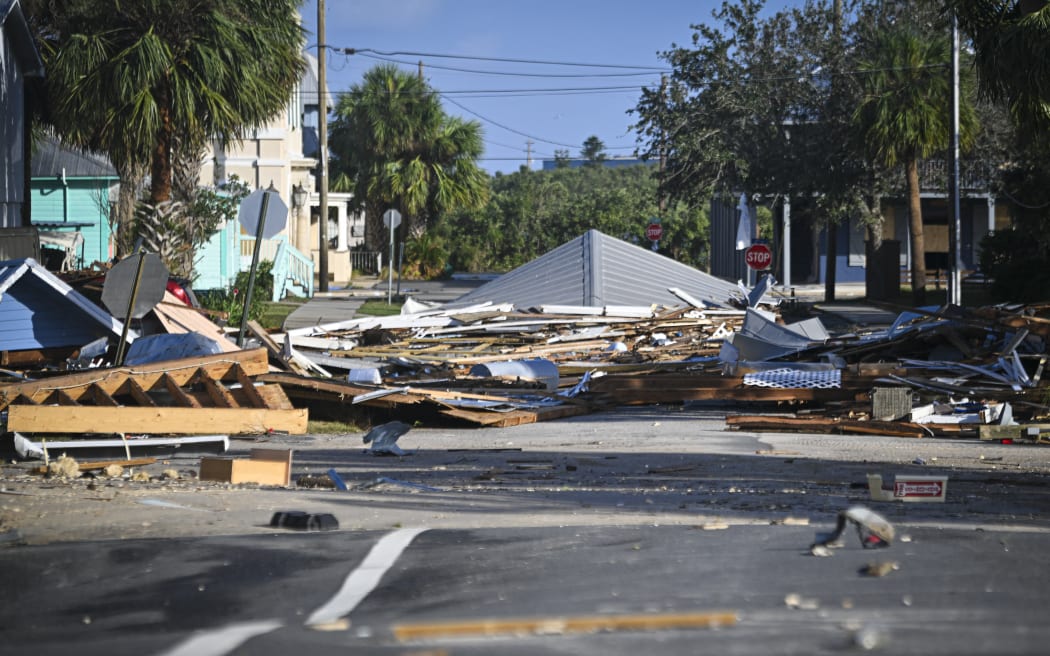
Debris left by Hurricane Helene after making landfall are seen in Cedar Key, Florida, on September 27, 2024. Hurricane Helene weakened on September 27 hours after it made landfall in the US state of Florida, with officials warning the storm remained "extremely dangerous" as it surged inland, leaving flooded roads and homes in its wake.

Debris left by Hurricane Helene after making landfall are seen in Cedar Key, Florida, on 27 September , 2024. Photo: AFP

Helene hit Florida’s Big Bend region as a powerful Category 4 hurricane on Thursday (local time) and left a chaotic landscape of overturned boats in harbours, felled trees, submerged cars and flooded streets.

A New Zealander based in Florida said she was seeing wind and power outages like never before as the southeastern United States grappled with Tropical Storm Helene.

Chloe Hill was in St Petersburg, Florida, and told RNZ tens of millions of people across the southeast had been told to evacuate.

“I have friends who are on the barrier islands, who cannot get off the islands any more, because they have closed all the bridges, and they won’t let anyone on or off.

“And they’ve said, pretty much, ‘If you decided to stay when you were told to evacuate, you’re on your own’.”

Some residents had used silicone filler to seal their doors as they attempted to block floodwaters, she said.

“Residents have taped up, or even used silicone … to try and prevent flooding coming in the houses.

“There had been sandbag sites, you’re able to sandbag, but I think the level of surge in flooding on the beaches … I think it’s pretty hard to keep that kind of water out.”

Some people had not taken the storm warnings as seriously as they should have, Hill said.

Police and firefighters carried out thousands of water rescues throughout the affected states, including in Atlanta, where an apartment complex had to be evacuated due to flooding.

Downgraded to tropical depression

Helene came ashore in Florida with 225km/h winds, weakening to a tropical storm as it moved into Georgia early on Friday. As of early afternoon, the storm had been downgraded to a tropical depression and was packing maximum sustained winds of 55km/h as it slowed over Tennessee and Kentucky, the National Hurricane Center said.

Helene’s heavy rains were still producing catastrophic flooding in the southern Appalachians, the NHC said.

More than 50 people were trapped on the roof of a hospital at midday on Friday in Unicoi County, Tennessee, nearly 200km northeast of Knoxville, local media reported, as floodwaters swamped the rural community.

Rising waters from the Nolichucky River were preventing ambulances and emergency vehicles from evacuating patients and others there, the Unicoi County Emergency Management Agency said on social media, but emergency crews in boats were conducting rescues.

In western North Carolina, Rutherford County emergency officials warned residents near the Lake Lure Dam just before noon to immediately evacuate to higher ground, saying “dam failure imminent”.

In nearby Buncombe County, landslides forced interstates 40 and 26 to close, the county said on X.

The extent of the damage in Florida began emerging after daybreak.

In coastal Steinhatchee, a storm surge – the wall of seawater pushed ashore by winds – of 2.4-3 metres (eight to 10 feet) moved mobile homes, the NWS said on X. In Treasure Island, a barrier island community in Pinellas County, boats were grounded in front yards.

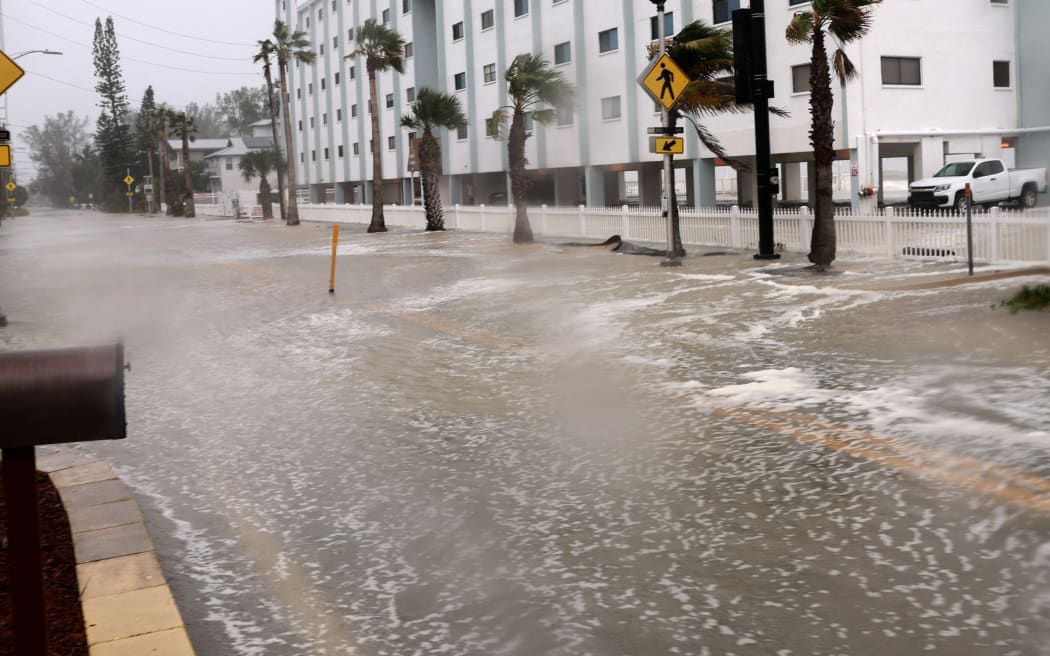
Water from the Gulf of Mexico floods a road as Hurricane Helene, already a Category 3 storm, churns offshore at St Pete Beach, Florida. on 26 September, 2024.

Water from the Gulf of Mexico floods a road as Hurricane Helene, already a Category 3 storm, churns offshore at St Pete Beach, Florida on 26 September. Photo: AFP/ Getty – Joe Raedle

The city of Tampa posted on X that emergency personnel had completed 78 water rescues of residents and that many roads were impassable because of flooding. The Pasco County sheriff’s office rescued more than 65 people overnight.

The US Coast Guard said it had saved nine people from storm waters. Video posted online showed a Coast Guard crew pulling a man and his dog wearing life vests from the ocean on Thursday after his sailboat became disabled off Sanibel Island.

Kevin Guthrie, Florida’s emergency management director, urged residents in the affected areas to stay off the roads.

“I beg you, do not go out,” Guthrie said at a morning press briefing. “We have 1500 search and rescue personnel in the impacted areas. Please get out of the way so we can do our jobs.”

Officials had pleaded with residents in Helene’s path to heed evacuation orders, describing the storm surge as “unsurvivable”, as NHC Director Michael Brennan warned.

In Taylor County, the Sheriff’s Department wrote on social media that residents who decided not to evacuate should write their names and dates of birth on their arms in permanent ink “so that you can be identified and family notified.”

Some residents had stubbornly stayed put.

Ken Wood, 58, a state ferry boat operator in Pinellas County, said he should have heeded evacuation orders rather than riding out the storm at home with his 16-year-old cat, Andy.

“I’ll never do that again, I swear,” Wood said. “It was a harrowing experience. It roared all night like a train. It was unnerving. The house shook.”

Down the hill from his house, the storm flooded some homes with chest-deep salt water. One house caught fire and burned down, shooting 30-foot flames in the stormy sky, he said.

“Old Andy seemed like he didn’t care,” Wood said. “He did fine. But next time we leave.”

Some of Wood’s neighbours were not as fortunate. Pinellas County Sheriff Bob Gualtieri said first responders were unable to answer several emergency calls from residents overnight due to the conditions. On Friday, county authorities found at least five people dead.

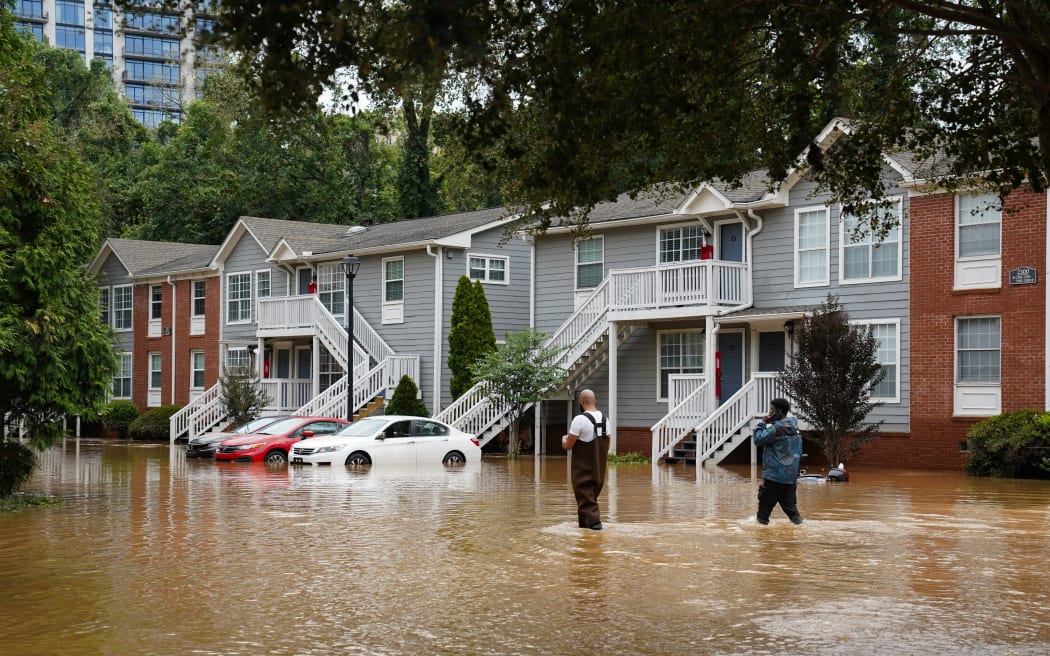
An apartment at Peachtree Park Apartments can be seen flooded after hurricane Helene brought in heavy rains overnight on September 27, 2024 in Atlanta, Georgia. Hurricane Helene made landfall late Thursday night as a category 4 hurricane in the panhandle of Florida and is working its way north, it is now considered a tropical storm.

Flooded apartments in Atlanta, Georgia after Hurricane Helene brought heavy rains. Photo: Getty via AFP

Two other people in Florida died, Governor Ron DeSantis confirmed. Georgia Governor Brian Kemp cited 11 storm-related fatalities in his state so far, while North Carolina Governor Roy Cooper said there had been two deaths in his state.

At least 13 people had died during the storm across South Carolina, the Charleston-based Post and Courier newspaper reported, citing local officials.

Helene was unusually large for a Gulf hurricane, forecasters said, though a storm’s size is not the same as its strength, which is based on maximum sustained wind speeds.

A few hours before landfall, Helene’s tropical-storm winds extended outward 500km, according to the National Hurricane Center. By comparison, Idalia, another major hurricane that struck Florida’s Big Bend region last year, had tropical-storm winds extending 260km about eight hours before it made landfall.

Airports in Tampa, Tallahassee and St Petersburg suspended operations on Thursday but reopened on Friday, though extensive delays were expected.

More than 4.6 million homes and businesses were without power midday on Friday in Florida, Georgia, the Carolinas and other states, according to the tracking website Poweroutage.us.

– Reuters / RNZ

All Blacks v Australia: All you need to know

By rnz.co.nz and is republished with permission

All Blacks v Wallabies

Kick-off: 7.05pm Saturday 28 September (NZT)

Sky Stadium, Wellington

Live updates on RNZ Sport

The All Blacks are coming off a win but are also after an improved performance against the Wallabies this weekend. They head to a venue they haven’t won at since 2018, with a narrative hanging over them around their inability to finish off test matches.

Scott Robertson has made a few changes to his side that beat the Wallabies 31-28 in Sydney, with this test being seen as a pretty important warm-up for the end of year tour next month. The Wallabies were admittedly very brave in their fightback last weekend so will be looking to hopefully avoid the slow start that saw them down 21-0 after only 15 minutes.

Here’s a look at the teams:

All Blacks: 1 Ethan de Groot 2 Codie Taylor 3 Tyrel Lomax 4 Scott Barrett (c) 5 Tupou Vaa’i 6 Wallace Sititi 7 Sam Cane 8 Ardie Savea 9 TJ Perenara 10 Beauden Barrett 11 Caleb Clarke 12 Anton Lienert-Brown 13 Rieko Ioane 14 Sevu Reece 15 Will Jordan

Bench: 16 Asafo Aumua 17 Tamaiti Williams 18 Pasilio Tosi 19 Patrick Tuipulotu 20 Luke Jacobson 21 Cortez Ratima 22 Damian McKenzie 23 David Havili

Wallabies: 1 Angus Bell, 2 Matt Faessler 3 Taniela Tupou 4 Nick Frost 5 Jeremy Williams 6 Rob Valetini 7 Fraser McReight 8 Harry Wilson (c) 9 Jake Gordon (26 Tests) 10 Noah Lolesio 11 Dylan Pietsch 12 Hunter Paisami 13 Len Ikitau 14 Andrew Kellaway 15 Tom Wright

Bench: 16 Brandon Paenga-Amosa 17 Isaac Kailea 18 Allan Alaalatoa 19 Lukhan Salakaia-Loto 20 Langi Gleeson 21 Tate McDermott 22 Ben Donaldson 23 Josh Flook

Beauden Barrett of New Zealand celebrates his try.

Beauden Barrett of New Zealand celebrates his try. Photo: Andrew Cornaga/www.photosport.nz

All Blacks selections

The old Canes connection of Beauden Barrett and TJ Perenara is reunited for this test, which will almost certainly be the last time we see them in a test match on New Zealand soil. Barrett’s inclusion at 10 is interesting but not entirely unpredictable, given that Damian McKenzie has started every test this season, but DMac’s demotion to the bench suggests this is more of a dropping than a rotation. Elsewhere, Anton Lienert-Brown comes in for the injured Jordie Barrett and David Havili gets the nod as the utility bench replacement. Sam Cane gets a start in his 100th test match.

Scott Robertson head coach of the All Blacks during the team announcement press conference.

Scott Robertson head coach of the All Blacks during the team announcement press conference. Photo: Lynne Cameron/ActionPress

Wallabies selections

Joe Schmidt has only made a couple of changes to last weekend, with Jake Gordon coming in as a straight swap for Nic White at halfback. They’re not losing much there, but it does raise a question as to why Tate McDermott isn’t getting a look in as starter. Dylan Pietsch – who was very good in his shift off the bench last weekend – comes in on the wing in place of the injured Marika Koroibete.

What they’re saying

“These blokes know each other pretty well from Super Rugby, from tests over the years – albeit some of ours are only dipping their toe in for the first time really at this level, which has been pretty daunting for them and was particularly daunting at 21-0 down last weekend.” – Wallabies coach Joe Schmidt.

“We have to front up tomorrow night, we want to finish strong. We’ve started games well but particularly that last quarter has let us down. It’s not a small fix, it’s a gradual one with habits coming in.” – All Blacks coach Scott Robertson.

Joe Schmidt, head coach of the Wallabies talks to James Slipper.

Joe Schmidt, head coach of the Wallabies talks to James Slipper. Photo: Scott Barbour/www.photosport.nz

What happened last time

All Blacks 31 – 28 Wallabies

Last weekend’s test was about the most obvious microcosm of the All Blacks’ season thus far, with things going great for the first period of the game and then going off the rails later on. They did win, and the defensive effort deserves credit for keeping the Wallabies at bay despite being two men down at the back end of the game. However, the All Blacks should never have been in that position as the match deserved to be wrapped up on the hour mark.

What’s going to happen

The Wellington Curse needs to be broken before NZ Rugby decides to stop playing test matches in the capital. The All Blacks haven’t won there since 2018, which makes Sky Stadium easily the worst venue they’ve played at over a 10-year period. Amazing, really, considering it’s a home venue.

Really, though, the All Blacks just need to keep the hammer down for the full 80 minutes and they should win this one running away. A big factor will be the officiating: the All Blacks have given up five yellow cards at the back end of games this year, so if they can keep their discipline that’ll go a long way to winning the test match.

Alleged leaks and defects spotted in multi-million pa’anga Vava‘u Emergency Coordination Centre

Alleged defects had been spotted and photographed in the new building designed to provide early emergency warnings and information to minimise potential natural hazards in Neiafu.

Tiles at Vava’u Emergency Coordination Centre are lifting into a tent shape. Photo/ Vāvā Lapota

Photos seen by Kaniva News appeared to show the floor tiles of the conference room inside the Vava‘u Emergency Coordination Centre to be warped and raised.

There is concern that hidden defects deep within the floor may not be easily visible.

There has also been a report of alleged leaks in the roof.

The Neiafu Town Officer, Vāvā Lapota, told Kaniva News that he had been advised during a visit to the centre to exercise caution when walking near the buckled tiles due to potential safety hazards.

Lapota claimed that he was also told that the Ministry of Lands and Natural Resources staff office inside the centre was considering moving from its current location to the Maama Mo’onia hall due to worries about the alleged damage possibly worsening.

The Minister of MEIDEC was contacted for comment.

We asked Minister Fekita ‘Utoikamanu whether she knew about the alleged defects.

We also asked whether she thought these alleged defects occurred too soon, considering the centre has only been open for three years.

We also asked if she knew of the Centre’s staff’s concerns about the alleged worsening damage.

The more than half a square kilometre Centre was intended for the government’s Meteorological Department and the National Emergency Management Office to provide early warnings and help the public prepare for emergencies.

The centre was furnished with office equipment worth TOP$ 152,411.14 and was opened by King Tupou VI in 2021.

It was designed to be further developed to assume responsibility in the event of failure or partial failure of the Fua’amotu Warning Centre or the NEMO.

The TOP$1,952,303.04 facility was co-funded by the World Bank, the Global Environment Facility, and the Global Facility for Disaster Reduction and Recovery (GFDRR) through the Japan-Bank Program for Mainstreaming Disaster Risk Management and the Government of Tonga. The construction was implemented under the Pacific Resilience Programme (PREP).

Tonga news in brief: September 26

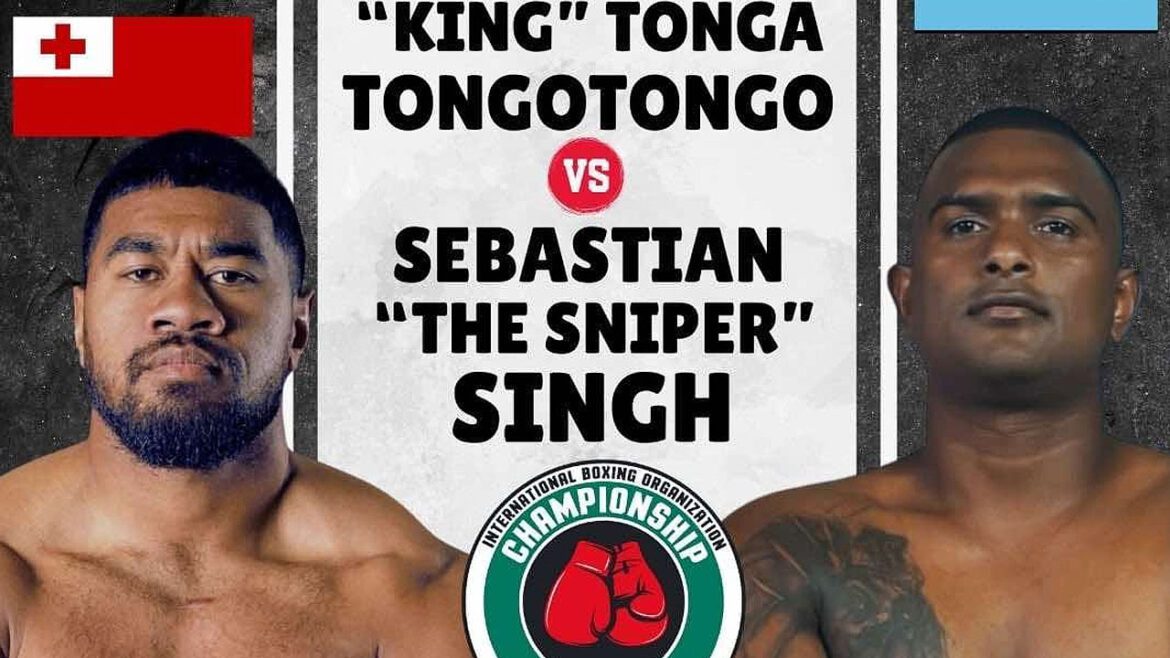
Tonga Tongotongo to face Sebastian “The Sniper” Singh Singh in Fiji next month. Photo/Facebook

Scam

A woman who falsely claimed to work at the Ministry of Communication (MEIDEC) and received money under false pretence has appeared in court.

Heilala Finau, 24, from Ngele’ia, falsely claimed to be the secretary to the director of MEIDECC.

She allegedly promised several families that the Ministry would build houses for them through aid initiatives for only $12,500, which was a scam.

Faka-Sepitema

This week, the Free Church of Tonga (Siasi ‘o Tonga Tauataina) convened its annual September roll call (Tali ui Sepitema) for female congregants from across the island at Falemasiva Hall in Haveluloto on September 25, 2024.

The Roll Call, a cherished Tongan church custom, takes place every September, during which women attire themselves in elegant white garments and gather in the church.

Tonga Power Ltd

Tonga Power Limited (TPL) will host the 31st Annual Pacific Power Association (PPA) Conference and Trade Exhibition, which will be held at the Falemasiva Hall from September 30 to October 3, 2024.

This event, with the theme “The Cost of the Transition to Renewables,” aims to convene approximately 250 participants from diverse Pacific regions, including electric utility and energy professionals.

The primary objective of this gathering is to collectively address significant challenges and exchange valuable insights on the transition to renewable energy.

Tongan rising star boxer

Tongan rising star in boxing Tonga Tongotongo will face Fijian boxer Sebastian “The Sniper” Singh Singh at Prince Charles Park in Nadi on October 26 as part of the South Pacific Boxing Promotion.

Tongotongo has an impressive record of eight knockout wins with zero losses.

Singh, on the other hand, will step into the ring with 15 wins, seven by knockout, seven losses, and three draws.

House fire

A large fire broke out in a house in Nuku’alofa’s Ngele’ia village yesterday, on Wednesday the 26.

No reports of injuries.

Receiving stolen goods

Tonga Police have charged an Asian man named Zao Zin, also known as Zuzu, with receiving stolen goods and allegedly inciting people to commit theft.

‘Not acceptable’ – The Warehouse reports large loss

By Anan Zaki of rnz.co.nz and is republished with permission

Major retailer The Warehouse Group has reported a large loss, which the company says reflects one of its toughest years on record.

Warehouse on Blenheim road in Christchurch

Photo: RNZ / Nate McKinnon

Key numbers for the 12 months ended July compared with a year ago:

  • Net loss $54.2m vs $29.8m profit
  • Sales revenue $3.0b vs $3.24b
  • Adjusted profit $18.9m vs $57.4m
  • No final dividend vs 8 cents per share

The group, which owns The Warehouse, Noel Leeming and Warehouse Stationery chains, said its bottom line was significantly affected by its disposal of outdoor goods brand Torpedo7 for just $1 in March.

The company reported a loss of $60 million from the sale of Torpedo7.

Leaving aside one-offs, its adjusted profit was also well down from the previous year.

Chair Dame Joan Withers said the year was one of the most challenging in its 42-year history.

“The poor financial performance we’ve reported this year is not acceptable,” Dame Joan said.

“The board and executive leadership team are acutely aware of the disappointment shareholders will be experiencing and the big job ahead of us to get the company back on track,” she said.

Group sales fell just over 6 percent due to falling consumer demand, however margins held steady at 33.6 percent.

“The economic climate in Aotearoa New Zealand has been difficult for most retailers, with inflation, high interest rates, and a weak economy significantly reducing consumer demand,” Dame Joan said.

“However, our trading performance and operational execution have fallen short and exacerbated these challenges,” she said.

Interim chief executive John Journee, who replaced Nick Grayston earlier in the year, said the company “scored too many own goals”.

“Our ecosystem strategy was too ambitious, and we took our eye off the ball on product. We held onto Torpedo7 and TheMarket.com too long, reacted too slowly to changing customer spending, and fell out of step with what Kiwi families want,” Journee said.

“We’ve made mistakes and we own that. But we know where we went wrong, and we’re already working hard to fix it,” he said.

The Warehouse sales fell 5.3 percent to $1.8 billion, Warehouse Stationery sales fell 6.7 percent to $231.9m and Noel Leeming sales decreased 5.3 percent to $1b.

Looking ahead, Journee said the retail environment remained tough, and the company was cautious about when retail spending could bounce back.

“While we’ve been able to regain market share in our core retail segment in the first six weeks of FY25, our sales have been soft, and our gross profit remains under pressure as we clear the last of our winter stock and continue to reset our product offer,” he said.

The company is scheduled to provide a first quarter trading update in early November.

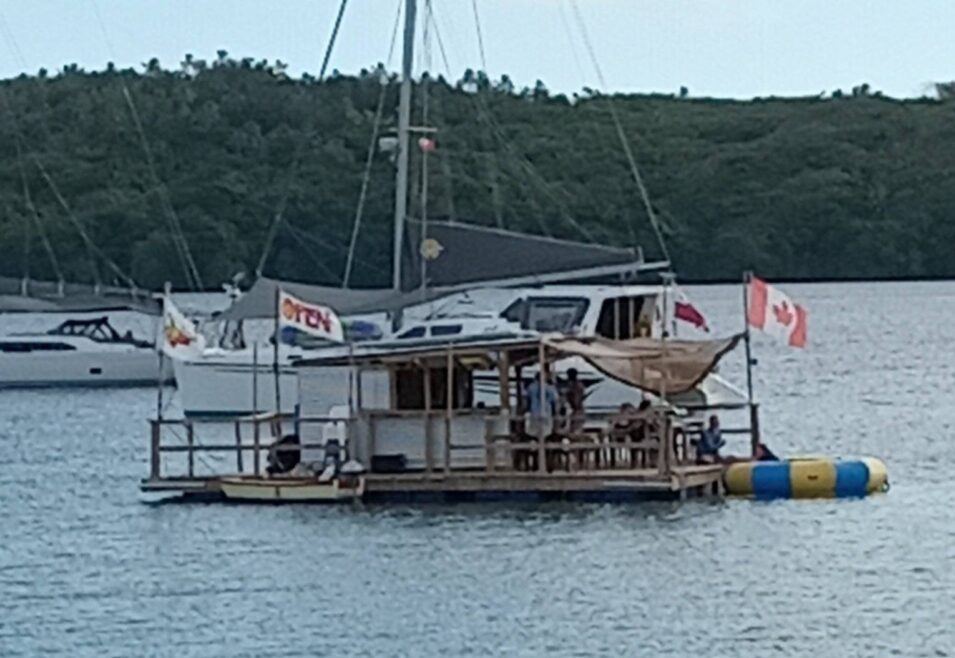
Floating bar in Neiafu sparks safety concerns; owner says ‘it is fully licensed’  

A floating bar and restaurant service on Vava’u island in Tonga has raised safety measure concerns and what appeared to be a lack of a proper certification process.

The Hideaway floating bar and restaurant was launched in September 2023. Photo/ Vava Lapota

Police recently visited the Hide Away floating business service in Neiafu waters after Neiafu Town Officer Vāvā Lapota inquired about the service’s legal status.  

Lapota told Kaniva News that he was concerned about reports of alcohol being sold within the floating service.

He said the process of offering a license for such a business must include him providing a letter of authorisation to the Ministry of Trade and Economic Development.

He said he had just spotted the bar floating in the water last week and was surprised because he had not been approached about whether they had applied for an operating license.

Lapota said he had also contacted the Ministry of Health about the Hide Away floating bar. He was allegedly told that the business operator had made inquiries, but the Ministry has not yet issued a certificate.

“The legal process must include authorisation from the Ministry of Infrastructure, Ministry of Trade and Economic Development, Ministry of Health, Ministry of Police and the town officer”, Lapota said.

The town officer said he talked to the Ministry of Trade and Economic Development and asked about the Hideaway Café’s legal status. He was allegedly told about the process, including the requirement to provide a letter.

“The letter from the town officer must indicate whether they agreed for the business to be operated in the village or not.”

Lapota voiced his concerns regarding the well-being of the bar patrons and the cleanliness of the Neiafu water.

The government Ministries could not be reached for comment.

Operator’s response

Charlett Millen, one of the Hide Away business and services owners, said they are the “only fully licensed floating restaurant” in Tonga.

“We adhere to the same stringent licensing and permit requirements as all other liquor-serving establishments in Tonga, in addition to extra regulations from Infrastructure and Ports & Marine authorities”, she told Kaniva News.

She said they take measures to ensure that their business is actively preserving the environment.  

“We diligently follow protocols, including a regularly updated rubbish removal and disposal log, and we welcome surprise inspections. To date, we are proud to say we have never received negative feedback”.

Safety measures

Charlett said that The Hideaway Café’s floating bar is equipped with a comprehensive set of safety measures to ensure the well-being of its patrons.

“When it comes to safety, The Hideaway Cafe is well-prepared”.

She said one of the business owners, Barry Millen, “known locally as Bear,” has been a certified lifeguard “since the age of 17 in Canada.”

“We also have life jackets on board, a requirement introduced by the Neiafu Police last year. Additionally, 95% of our guests live on yachts year-round, arriving at the restaurant by their own emergency boats. All our guests are experienced swimmers, often more skilled than we are!”

She said the floating bar also has “a floating trampoline attached, which provides extra flotation support”.

“Our restroom uses a closed composting system with coconut coir. Waste is securely transferred to our home, where it completes the composting process in a sealed unit. After at least a year, the compost is used in our garden. Similarly, liquid waste is collected and disposed of in our home septic system. Given the size of our establishment, these processes are swift, efficient, and discrete.

“We proudly maintain a strict no-plastic policy. We handcraft our own paper straws and food containers to prevent plastic from ever entering the water. Additionally, we use glassware, which poses no threat to the environment—though not a single glass has ever fallen in.

“The Hideaway Cafe is fully off-grid, powered entirely by a solar energy system that ensures our food is stored at the correct temperature in a solar-powered refrigerator. Even our icemaker is supplied by an onboard rainwater catchment system, which provides filtered water for drinking and washing.

Charlett has invited “anyone who may have questions about The Hideaway Cafe’s safety and compliance” to visit and personally inspect their facility.

“We are confident that your visit will provide reassurance and peace of mind. “

She said the Police had visited the bar on Monday.

The Hideaway floating bar and restaurant was launched in September 2023. It has been open since May 2024, and as with every year, the operators plan to remove it from the water in November 2024 at the end of the season.