The brother of All Black great Jonah Lomu is accused of being involved in importing methamphetamine worth thousands of dollars into New Zealand.
John Makatoa Lomu, the former All Black star’s younger brother, appeared at the Manukau District Court on Friday where his court ordered name suppression lapsed.
The 46-year-old, together with Silila Vaivai, face charges of importing and possessing methamphetamine.
They face further charges of importing and possessing an unknown class-A drug.
John Lomu, younger brother of Jonah Lomu, appears at the Manukau District Court, charged with importing drugs. RICKY WILSON / Stuff
They have pleaded not guilty to all charges and elected trial by jury.
Judge Nick Webby set a date for the pair to be back in court in October.
Lomu and Vaivai are both on bail.
The Manukau Rugby League under 9s team that Jonah and John Lomu played for, taken from Facebook. Unknown / Stuff
Lomu declined to talk to Stuff as he left Court and hid his face with his black hoodie.
The offending is said to have happened in August and September 2023.
John and Jonah played rugby league together as children in Manukau.
In 2019, John Lomu told Niu FM that Jonah got him his first car when he was still in school.
Jonah Lomu, aged 40, died from a heart attack in November 2015 following a long struggle with kidney failure.
The rugby superstar played 63 tests for the All Blacks between 1994 and 2002.
In his eight years, mostly in the number 11 jersey, he scored 37 tries.
Lomu’s prowess on the wing was helped by his size and speed and his ability to attack was unrivalled.
A highlight of his career came in the 1995 World Cup semifinal against England in South Africa when he ran straight over and through England’s full back Mike Catt.
The argument over the photo has drawn strong attention to the spike in crime rate, with some saying the situation has gotten out of hand.
However, there was also concern about the prevalence of domestic violence in Tonga.
Recent reports from the kingdom’s Women and Children Crisis Centre show that, in many domestic violence cases, the perpetrator is a drug user or trafficker, with the centre’s director, ‘Ofa Guttenbeil-Likikiliki, reportedly saying the severity of the violence in the cases was horrific.
The photo has drawn mixed reaction from the online users.
“There is a saying ko e ‘ātunga pe ‘ena ia e konaa’”, a commenter said in Tongan, referring to the saying that “If you drink alcohol, you should be prepared for any troubles that may arise.”.
Some advised the man to change his way of life and attend church activities.
Some sympathised and told commenters to put their shoes in his situation.
“This is a learning experience for the brother”.
Another commenter stated that it is unwise to beat someone and that it should not be condoned.
By Jamie Wall, Digital Sports Journalist, rnz.co.nz and is republished with permission
Analysis – Beauden Barrett cut a sombre figure when he summed up the All Blacks’ now historically unmatched record at Sky Stadium. The All Black fullback, who spent eight seasons as the Hurricanes’ golden boy and won a Super Rugby title on the field he’d just walked off, described the now six-year stretch between the last All Black victory in Wellington as “an inconvenient fact”.
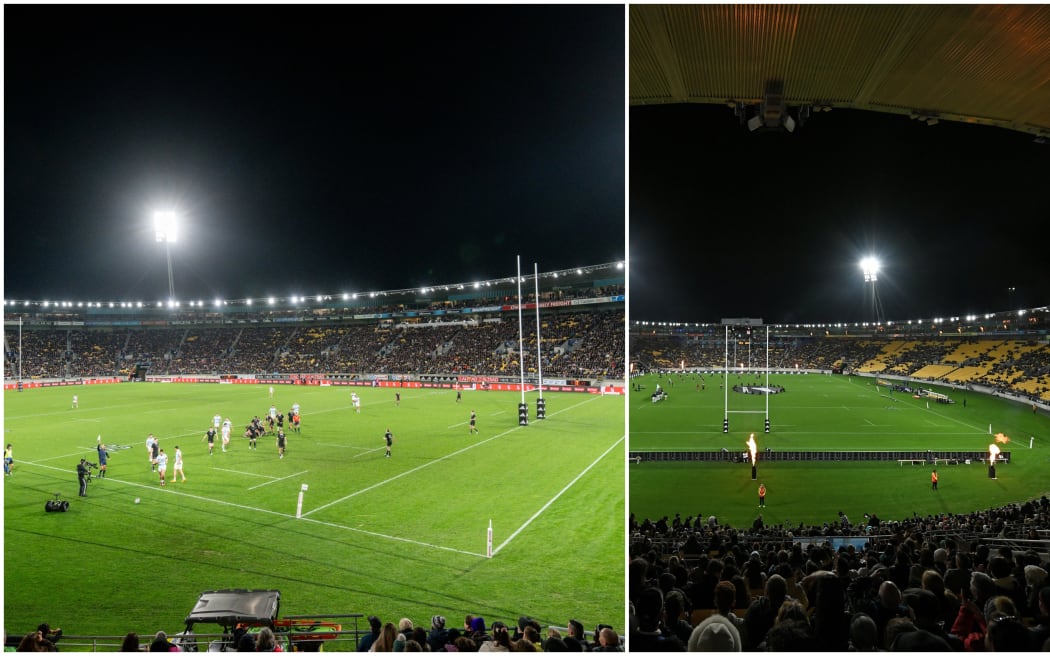
In a classic little brother move, Jordie Barrett followed Beauden’s interview and said exactly the same line about the pitiable results. But much of the talk leading up to and since the 38-30 defeat to the Pumas was about the 25,000 crowd at Sky Stadium, which therefore showed off a lot of its infamously visible yellow seats.
So naturally, the reaction was that rugby’s dying, the economy is to blame and that the stadium isn’t fit for purpose anymore. Which is great for some cheap pops online, but it ignores another inconvenient fact: a 25,000 crowd is the same as it’s always been because New Zealanders just aren’t as interested in watching the All Blacks play the Pumas.
Fans arrive at Sky Stadium for the All Blacks v Argentina. Sky Stadium, Wellington. Photo: Kerry Marshall / www.photosport.nz
Now, this is very much an indictment on rugby fans more than anything else, considering the Pumas have now beaten the All Blacks more times in New Zealand than the Wallabies have in 23 years and as many as the Springboks have in 14.
But since their first meeting at Carisbrook in 1979, 25,000 is exactly the average crowd figure for the 19 times* the All Blacks have hosted the Pumas, no matter where it’s been played, the state of the economy or what public’s relationship with rugby has been.
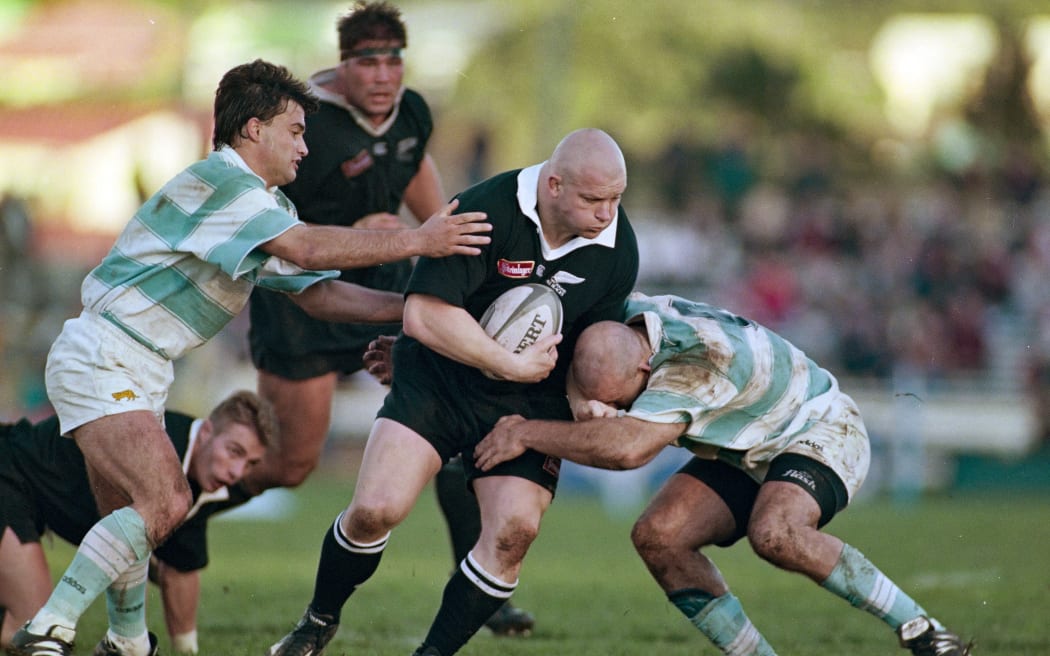
In fact, it’s the same crowd figure for when the teams played at Athletic Park in 1997, perceived by many to be a high water mark of public rugby engagement. The All Blacks were in one of their strongest periods ever, the Hurricanes had just come off a breakout season that saw their final home game draw a full house, local hero Tana Umaga was making his home debut, ticket prices were extremely reasonable and there was a 2:30pm kick-off in beautiful sunshine.
Mark ‘Bull’ Allen, All Blacks v Argentina, Athletic Park, Wellington Photo: Alan Lee/Photosport
Add in the fact that it was Wellington in the 1990s and there was very little else to do on a Saturday afternoon, but even all that couldn’t get the turnstiles clicking for more than what would be a pretty reasonable crowd for an NPC game at the time.
Since then, NZ Rugby has seen fit to use the Pumas fixture for smaller markets like Hamilton, New Plymouth, Nelson and Napier as well as Christchurch’s 13-year-old temporary stadium. While all those venues were full, that was very much at the limit of what those venues could draw.
What this really comes down to is New Zealanders’ navel-gazing attitude, and the fact that despite indisputable recent evidence to the contrary, the Pumas aren’t seen as a big market team. That is somewhat fairly based on the fact that up until the Argentines’ breakthrough win in Christchurch, none of the Rugby Championship tests held in New Zealand could be described as close and in the early years, even entertaining.
Historically, that ambivalence hasn’t even been limited to what was happening on the field.
In fact, during the politically turbulent season of 1976, when protesters attempted to storm the Auckland Airport runway to prevent the All Blacks’ plane from leaving for a tour of apartheid South Africa, no one seemed to have much of an issue that year with another All Black team visiting a military-junta controlled Argentina that was busy waging war on its own population.
It depends on how you look at it, anyway. Photo: Elias Rodriguez/Photosport
It is certainly fair to point out that Wellington’s economy is on the downturn, and that it is a mostly depressing place full of depressed people. But this isn’t really a case of correlation equalling causation.
Those crowd figures aren’t a secret. The test match would have been budgeted for a crowd roughly this size, besides, other than Eden Park that figure would’ve more than sold out every other venue** in the country.
So the question of why it was actually in Wellington at all is a valid one, however Sky Stadium was owed at least one extra test given there wasn’t one last year and the debacle in 2021 that saw Eden Park host two Bledisloe Cup tests in one week. Plus, there’s a big clue in regard to who holds the naming rights to the place, given its ease of use for broadcast.
Fans arrive at Sky Stadium for the All Blacks v Argentina. Sky Stadium, Wellington. Photo: Kerry Marshall / www.photosport.nz
But the real issue here is that New Zealanders need to actually realise the Pumas side are now a constant threat and should put some respect on their name. Most of all the All Blacks, otherwise they’ll be heading for another defeat this Saturday night. And if that keeps happening, that’s something that will certainly affect crowd numbers in the future.
*This figure doesn’t include the 2011 Rugby World Cup quarter-final, which is the only time the Pumas have played at Eden Park. It had a sold out crowd of 60,000, however these were balloted tickets sold months in advance without knowledge of who would actually be playing.
**Forsyth Barr Stadium’s capacity can be raised to 30,000 with the addition of temporary seating.
Lollies containing a “potentially lethal dose” of methamphetamine were distributed in food parcels from the Auckland City Mission after they were donated by a member of the public.
The contaminated lolly is on the right. Photo: Supplied / Auckland City mission
The mission was alerted when a parcel recipient reported “funny tasting” lollies, and missioner Helen Robinson says she is “absolutely devastated” by the turn of events.
The Drug Foundation said a lolly checked contained 3g of meth – a “potentially lethal dose”.
The white lolly was brought into one of its drug checking clinics in Auckland on Tuesday afternoon.
Foundation executive director Sarah Helm said “a common dose to swallow is between 10-25mg, so this contaminated lolly contained up to 300 doses”.
“Swallowing that much methamphetamine is extremely dangerous and could result in death.”
Helen Robinson Photo: RNZ / Amy Williams
In a statement, the mission said the Rinda brand pineapple lollies in a sealed retail-sized package were donated by an unknown member of the public.
“As a measure of safety, lollies still on site were tested by NZ Drug Foundation. Tests confirmed that the lollies tested contained potentially lethal levels of methamphetamine.
“We are in the process of contacting possible recipients to inform them of the issue and give them guidance on next steps. Public safety is our key concern.”
The mission said it only accepted commercially manufactured food for inclusion in food parcels and the lollies appeared as such when donated.
It was “deeply concerned” and was working with the NZ Drug Foundation and police, it said.
Helm said “We don’t know how widespread these contaminated lollies are, so we recommend not eating any Rinda brand pineapple lollies if you have them”.
“If you or someone you know has eaten one and feels unwell, call 111 immediately.”
Robinson said anyone concerned they might have received one of the lollies should called 111 and if they were feeling unwell, go to the nearest healthcare provider urgently, or also call the national poison line on 0800 764 766.
Symptoms might include:
Chest pain
A racing heart
Seizures
Hyperthermia
Delirium
Loss of consciousness
In a statement, police said they were investigating the incident and were treating the matter as a priority, given the risk to the public.
“Our initial enquiries have established that the food items concerned – Rinda brand pineapple lollies – may have been distributed to food parcel recipients over the last several weeks.
“Police are urging anyone who has received the Rinda brand pineapple lollies in a food parcel to not consume the lollies and to secure them out of reach of anyone in the household.
“If you do have these lollies in your household, please call police on 111 so we can retrieve them.”
The Drug Foundation said it has notified High Alert, who are part of the National Drug Intelligence Bureau, responsible for drug harm notifications.
Malcolm Bishop KC of Wales, UK, replaces former Chief Justice Michael Whitten who left Tonga in September last year.
A report by Legal News Wales says Bishop, a founder member of 30 Park Place has been appointed Lord Chief Justice and President of the Land Court of the Kingdom of Tonga.
The appointment was approved by His Majesty King Tupou V1 in the Privy Council and is effective September 1, 2024.
Bishop was a founding member of 30 Park Place chambers in 1972. The set is now the largest in Wales, supporting clients in both England and Wales. His career over the last half century has taken him a long way from the magistrates courts of South Wales—12,000 miles to the Kingdom of Tonga.
Bishop reflected on this journey:
“In 1972, 30 Park Place was a small set, just six of us in a few rooms above Lloyds Bank at 55 Park Place. The then head, Charles Pitchford took the daring decision to take on four pupils. It was a risk for such a small set, but it proved quite successful because they all made their mark. John Jenkins and Peter Griffiths later became Silks while Bill Gaskell and Mark Furness graced the circuit bench.”
“We moved to 30 park Place in the early ’80’s, bought 30 and then next door, and grew to be the largest and leading chambers in Wales, with a dozen or so circuit judges, umpteen Recorders and chairs of tribunals – the star of our set the late Christopher Pitchford who reached the Court of Appeal. We can count the former Counsel General, Lord Chancellor and Attorney General as previous members. We certainly made our mark.”
But it was not all was hard graft. There was time for fun too, as he said:
“We put on a pantomime at the Welsh college of drama. Helen Mifflin starred as the good fairy of the family division, Phil Richard was the wicked wizard – with the primary school sons of John Rees as his juniors – while Paul Lewis, in drag, was ‘Wishee Washee’. I was the Big Friendly Judge. Patrick Curran was the producer and Chris Pitchford did the voice over.
“Happy days, long to be cherished from the warmer climes of the South Pacific.”
30 Park Place wish Malcolm Bishop KC, The Hon. Lord Chief Justice and President of the land Court, Kingdom of Tonga the very best for his next adventure.
Peace Corps Director Carol Spahn is visiting Tonga today, Tuesday 13.
Director Spahn will meet with Peace Corps Volunteers and Blue Pacific Youth Champions in Fiji and Tonga to learn about their current projects and collaboration with community members
She was expected to meet with partner government officials, volunteers, and community partners.
The Director’s visit highlights the agency’s commitment to supporting the development priorities of Fiji and Tonga, with a strong emphasis on meeting their requests for partnership on climate resilience and inclusive economic development.
The Director’s engagements include administering the oath of service to 19 new Peace Corps Volunteers in Tonga.
Director Spahn will meet with Peace Corps Volunteers and Blue Pacific Youth Champions to learn about their current projects and collaboration with community members.
As a signature program within the Blue Pacific Youth Initiative, the Blue Pacific Youth Champions are young leaders from rural communities across the Pacific who participate in a year-long program to learn about climate adaptation and resilience strategies and facilitate projects in their communities.
The Peace Corps is an international service network of volunteers, community members, host country partners and staff who are driven by the agency’s mission of world peace and friendship.
Jail term for drug offender who assaulted undercover officer
A drug dealer from Ha’alalo has been sentenced for methamphetamine possession and assaulting an undercover police officer during his arrest.
Mr Haisini Fonohema, 37, was charged with two drug possession offences.
He was found with 1.08g of methamphetamine, classified as a Class A illicit drug, and 0.08g of cannabis, classified as a Class B illicit drug.
He was also charged with assaulting a police officer by punching him three times.
His co-offender, Sosaia Palei, 39, received a suspended sentence.
Mr Palei was also charged with possessing drug paraphernalia, specifically a smoking pipe used for methamphetamine.
The charges arose from a police operation following information linking Mr. Fonohema to illegal drug activities.
An undercover officer approached Mr. Fonohema, posing as a drug user, and was able to obtain evidence leading to his arrest.
During the arrest, Mr Fonohema resisted and assaulted the police officer.
A young Killer Beez gang member who broke into a man’s South Auckland home and fatally shot him as the victim’s 6-year-old son slept nearby has been handed a lengthy prison sentence after a judge noted the botched robbery was just one part of a larger violent crime spree.
The 26-year-old, who for legal reasons cannot yet be named, was found guilty of Siaosi Tulua’s murder last November following a jury trial in the High Court at Auckland in which he and co-defendant friend Tamati Simpson were accused of two separate killings over the course of the 2019 spree.
In an unusual split decision, the defendant with suppression was acquitted of the second murder charge but found guilty of causing Tulua’s death and a raft of lesser charges. Simpson, meanwhile, was acquitted of Tulua’s murder but found guilty of causing the other death.
Prosecutors said Tulua, 39, was targeted because he was selling cannabis out of his garage, next door to the home where the defendant’s girlfriend lived. The defendant, then 21, had been looking to rob tinny houses and dealers.
Tulua was shot at close range, with the single bullet hitting his hand before entering his abdomen. The shooting appears to have been triggered by a sudden movement rather than having been planned, Justice Christian Whata determined last week as he considered the sentence, noting that gunpowder residue was found on the victim’s hand.
But regardless of whether the shooting itself was pre-meditated, the defendant had gone into the home illegally and with malintent, the judge said.
“You went to Mr Tulua’s house to rob him,” Justice Whata told the defendant.
He noted that it was alternatively suggested he had gone there to shut down or tax the tinny house on behalf of his gang – a motivation that the judge characterised as “the same if not worse” than a robbery.
Tulua was remembered during a series of emotional victim impact statements as “a humble and caring person for his family”. His death was “such a waste of a good man”, his sister told the defendant.
In a written statement that was read out in court, the victim’s son, now 11, said he still struggles with the loss of his father.
“I don’t know why these people wouldn’t just talk to my dad like grown-up adults,” he wrote. “Now I’m stuck being lonely, fatherless, in fear and also hurt.”
Siaosi Tulua was killed in his own home in 2019. Photo / Police Ten 7
The boy’s mother recalled how she was tucking him in that night, “happy in life”, when the shot rang out and everything changed. Now, she said, her son gets trips to the cemetery to spend time with his father and has to make do with Tulua’s photo next to his cake on birthdays.
“How dare you!” she ended, her anger prompting her to go off script from the written statement that had been approved to read in court. “How dare you do that to my son, you f***ing murderer!”
Murder generally carries an automatic life sentence with a minimum term of imprisonment of no less than 10 years before the convict can apply for parole. However, murders committed in the course of another crime or during unlawful entry into a home require a minimum period of imprisonment of at least 17 years unless a judge finds such a term to be manifestly unjust.
Defence lawyer Ish Jayanandan suggested during the hearing that a 17-year minimum period would be unjust given the defendant’s young age at the time and other factors, including the outsized influence of his gang member uncle. Crown prosecutor David Stevens, meanwhile, suggested that the judge not only impose the 17-year minimum but add another two years on top of that.
The longer sentence would take into account other offences, including the incidents that were part of the spree, the Crown said.
The spree started in the early morning hours of April 17, 2019, when the first victim heard someone trying to bash his front door and he went to investigate. The defendant then fired a sawn-off rifle at him. The bullet missed the victim but was so close that shrapnel hit his face, Justice Whata noted. As a result, the defendant was found guilty at trial of discharging a firearm with intent to injure.
A man with continuing name suppression appears in the High Court at Auckland for sentencing, nine months after a jury found him guilty of murdering Siaosi Tulua in April 2019. Photo / Craig Kapitan
Three days later, the next two victims were targeted in quick succession, both cannabis dealers. The first was lured into a car under the guise of a sale, but when he got halfway in the car it sped off, trying to drag him. In the struggle that ensued, the defendant put a gun directly on the victim’s leg, but the victim fought back and was able to escape. Shortly thereafter, the car drove to Tulua’s house and the murder took place.
Tulua’s death went unsolved for some time, during which the defendant also committed a burglary. An associate of the defendant’s, also in on the burglary, pulled a gun on a neighbour when he tried to intervene. The defendant eventually emerged from the house with a jewellery box, the judge noted.
Had the 17-year minimum not been in play, Justice Whata said he would have settled on a minimum term of imprisonment of 14 years due to the defendant’s age and his difficult childhood.
His mother struggled with addiction and was attacked by his father in front of him, according to a report prepared for the hearing. Oranga Tamariki eventually removed the defendant from his parents’ custody and he was sent to live with his grandparents, where one of his role models became an uncle who had recently been released from prison. He was homeless at 13, joined the Killer Beez at 14, left school at 15, began what would become a daily meth use habit by the time he was 16 and was serving his first custodial sentence at 17, the judge said.
“I’m never out for long,” the defendant told a report writer. “This is all I know.”
Police at the scene at Darnell Crescent in Clover Park.
Despite all that, a 17-year minimum term of imprisonment wouldn’t be manifestly unjust, Justice Whata determined.
“There was a clear and grave risk of lethal harm,” he said of the home invasion. “Your girlfriend lived next door, so you must have known there was a family present there.”
Because the defendant spent so much time in custody awaiting trial, he will be eligible to begin applying for parole after 16 years.
Craig Kapitan is an Auckland-based journalist covering courts and justice. He joined the Herald in 2021 and has reported on courts since 2002 in three newsrooms in the US and New Zealand.
An Aucklander has won $44 million in Saturday’s Powerball draw, the biggest win in Lotto NZ’s history.
(File image) Photo: RNZ / Cole Eastham-Farrelly
Lotto said the winning ticket was bought online, with the winner snagging $44.06 million from Powerball First Division and another $66,667 from Lotto First Division.
The $44.06 million prize is tied for the biggest single prize in Powerball history, matching the winnings of another Aucklander in 2016.
While the jackpot has gone higher in the past, it was split between multiple winners on those occasions.
“We can’t wait to meet our new winner and support them as they process this life-changing news,” Lotto NZ’s head of corporate communications Lucy Fullarton said in a statement announcing the win.
Fourteen more players won the $66,667 Lotto First Division Prize, and two others won $250,000 from Strike Four.
A red severe thunderstorm warning has been issued for the lower North Island with strong wind warnings and watches also affecting parts of the country.
Storm clouds roll into Wellington on 12 August, 2024. Photo: Supplied / James Bass
MetService’s weather radar detected severe thunderstorms near Martinborough, the Aorangi Mountains and Ruakokoputuna at 3.30pm.
They were forecast to move northeast towards Masterton, Tayweru, Gladstone, the hill country east of Martinborough, Bideford, Carswell, Wainuioru, Westmere and Longbush at 4pm, before heading to Pongaroa, Tinui, Tiraumea, Waihoki, Castlehill and Blairlogie at 4.30pm.
Severe thunderstorms were also expected to hit offshore Castlepoint and Mataikona at 4.45pm.
“Due to the fast moving nature of this line and the embedded storms, there is a risk of severe thunderstorms with damaging wind gusts of around 130km/h. Wind gusts of this strength can cause some structural damage, including trees and power lines, and may make driving hazardous,” MetService said.
A severe thunderstorm watch remained in place for Tararya, Wairarapa, Wellington, Marlborough, Canterbury Plains, the Canterbury High Country and Hawke’s Bay.
MetService has also issued a strong wind warning for coastal Wairarapa north of Flat Point, with a strong wind watch for coastal parts of the Hawke’s Bay and the Tararua District.
Fire and Emergency said it has received about a dozen calls for damage caused by strong winds in Wellington and Wairarapa.
The calls were mainly coming in from Lower Hutt, with reports of trees and powerlines down, a spokesperson said.
According to Wellington Electricity, there were 90 customers without power in Horokiwi, expected to be restored by 7pm on Monday, with another 32 customers in Waitangirua, expected to have their power back on by 8pm.
Earlier warnings and watches for Wairarapa, Wellington, Marlborough, and the Hawke’s Bay have now been cancelled.
In a statement, MetService said the changing winds would bring fluctuating temperatures this week.
Meteorologist Clare O’Connor said: “A ‘southerly buster’ is a particularly strong cold front, characterised by blustery wind changes and a large drop in temperatures. A drop of 10C in a matter of minutes and winds suddenly gusting 90km/h is not unusual with the passage of these fronts.”
There was also a risk of thunderstorms and hail for eastern areas on Monday afternoon and into the evening.
The windy weather was expected to create heavy swell, up to six metres, off the east coast of the North Island and the Chatham Islands, MetService said.
“Elsewhere it will be the beginning of the calm after the storm as high pressure builds over the country. Wednesday wakes to a cold morning, especially about the central North Island where forecast minimum temperatures are sub-zero, below the average for this time of year.
“The cold snap is short lived with above average temperatures expected from Wednesday afternoon as milder westerly winds develop about the lower half of the South Island, then spread northwards over Thursday. Another swing to the lower end of the temperature scale, and a burst of heavy rain could be seen over the weekend.”