Home Blog Page 312

Nasal Vaccines Could Help Stop COVID-19 From Spreading—If Scientists Can Get Them Right

By Jamie Ducharme of Times.com

When SARS-CoV-2, the virus that causes COVID-19, infiltrates the body, it typically enters through the nose or mouth, then takes root and begins replicating.

A volunteer receives the second component of the nasal Sputnik V COVID-19 vaccine at Sechenov University Clinical Hospital No 2 in Moscow on Feb. 15, 2022.
 Artyom Geodakyan/TASS—Getty Images

But what if it could never get a foothold in the upper airways? That’s the promise of nasal COVID-19 vaccines, which are meant to prevent infection by blocking the virus at its point of entry.

In countries like the U.S., where about 76% of people have had at least one dose of the COVID-19 vaccine, nasal vaccines would by default be used primarily as booster shots, and some research teams are studying them specifically in this capacity. But if they’re found to be effective and eventually authorized, they could also give young children and people who fear needles more options.

There’s a long road ahead. While oral vaccines are fairly common, the only nasal vaccine cleared by the U.S. Food and Drug Administration to fight a respiratory pathogen is FluMist, which is used to prevent influenza among people ages 2 to 49. FluMist was in development for decades but was briefly taken off the market due to efficacy issues, which could foreshadow the challenges awaiting vaccine researchers working to create a nasal COVID-19 vaccine.

Still, researchers hope that nasal vaccines may one day do what even the highly effective mRNA vaccines made by Pfizer-BioNTech and Moderna have not: slow transmission enough to bring the pandemic to an end.

Shot-in-the-arm COVID-19 vaccines introduce the body to genetic material from the SARS-CoV-2 virus, teaching the immune system what to do if it’s faced with the real thing. These shots have proven very good at preventing severe disease and death, but less adept at blocking infections—particularly against highly contagious Omicron.

Nasal vaccines could theoretically prevent many infections by conferring “local” immunity where it’s needed most: the nose. If it worked, a spritz would blanket the upper airways with defenses similar to those generated by the body after a brush with the actual virus, says Dr. James Crowe, director of Vanderbilt University Medical Center’s Vaccine Center.

“You get the best immunity to virus pathogens by mimicking, to the greatest extent possible, the actual infection without causing disease,” Crowe says. “Stopping a virus in its tracks, right at the front door, is very attractive.”

If done right, Crowe says, nasal vaccines could be highly effective—but developing them is difficult. They typically use live but weakened forms of a virus, which introduces a “Goldilocks” challenge, Crowe says. Weaken the virus too much and the vaccine won’t work; not enough, and it could overstimulate the immune system, leading to side effects. The balance has to be perfect.https://7cd9edfa3ce1414bf170069917333f85.safeframe.googlesyndication.com/safeframe/1-0-38/html/container.html

The nose is also a very different environment than the deltoid muscle, where shots are typically given. It’s a near-direct line to the brain, which clearly necessitates a different set of precautions, Crowe says.

The upper airways are also built to encounter foreign substances and thus may not respond as readily to a vaccine, says Benjamin Goldman-Israelow, an instructor at the Yale School of Medicine. He co-authored a recent study, which has not yet been peer-reviewed, that examined how mice responded to nasal versus injected COVID-19 vaccines. The research found that mice mounted a stronger immune response when they were injected first and then boosted with a nasal vaccine, as opposed to getting a nasal vaccine alone.

That may be because the upper airways are equipped with natural defenses against invading particles—they’re the body’s entry point for the outside world, after all—and thus do not always respond strongly when first introduced. “By giving that initial priming through the [injected] mRNA vaccine, we educate the immune system, so that by the time we give the intranasal boost, the immune system already knows to recognize this as foreign,” Goldman-Israelow says.

Another rodent study by Yale researchers, published in December, found that mice vaccinated with a nasal flu shot were less likely to catch influenza than those that received an injected vaccine—a finding that may also apply to other respiratory diseases, such as COVID-19. Animal studies from other research teams have also shown promising signs that nasal vaccines may prevent infections, particularly when given as boosters.

Of course, large clinical trials—some of which are underway in other countries—are necessary to know how a product will work in humans. “We cannot draw conclusions about whether a nasal COVID-19 vaccine is going to work or not work until we see the data,” says Dr. Hana Mohammed El Sahly, a professor of virology and microbiology at Baylor College of Medicine.

Already, there have been setbacks. Last year, the biopharmaceutical company Altimmune stopped testing a nasal COVID-19 vaccine candidate due to disappointing trial results.

Nasal vaccines are difficult to get right. In the early 2000s, long before the COVID-19 pandemic, a nasal flu vaccine used in Switzerland was found to be associated with Bell’s palsy, a form of facial paralysis that is typically temporary. By the time that research was published, it was no longer in clinical use.

FluMist, the nasal flu vaccine used in the U.S. and first approved in 2003, hasn’t run into such safety issues, but it was briefly taken off the market due to efficacy problems. The U.S. Centers for Disease Control and Prevention’s vaccine advisory committee did not recommend its use in 2016, citing data that it had been only 3% effective during the prior flu season. A reformulated version of the vaccine returned to market for the 2018-2019 season. In its current form, “it does seem to work, and the data are supportive of its continued use,” El Sahly says.

Still, FluMist is not authorized for people who are 50 and older or younger than 2. It’s also not recommended for immunocompromised individuals and some people who have lung conditions such as asthma. That’s because it contains a live but weakened virus: an effective way to prompt an immune response, but one that can lead to potentially serious side effects in people with underlying conditions.

“It’s a balancing act,” Randall says. “You want the vaccine to be effective, but you don’t want it to really hurt or cause [too much] inflammation.”

Leaps in vaccine science have made it easier, if not easy, to find that balance. The Yale team working on nasal vaccines, for example, created a formula that does not contain an adjuvant (a material often added to vaccines to stoke a stronger response from the immune system) in hopes of reducing side effects. The pandemic also means there’s lots of interest in and money available for developing new vaccine candidates, which hasn’t always been the case.

But creating a vaccine to fight viruses that mutate frequently, like influenza and SARS-CoV-2, will always be challenging. That’s true whether researchers are developing a nasal vaccine or a shot in the arm, Randall says.

“We can ensure that the sequence that we selected is the one that actually ends up in the vaccine,” he says. But there’s no telling whether the sequence in the vaccine will be the one that “Mother Nature throws at us.” Such mismatches explain why the flu shot is far more effective in some years compared to others.

So far, mRNA-based COVID-19 vaccines have held up well against new variants, providing strong protection against severe disease and death. Omicron, however, has been the best variant yet at dodging vaccine-acquired immunity, causing record-shattering numbers of cases and straining the health care system. That underscores the need for a tool that can prevent infections as well as severe disease.

“Really, the goal is to reduce or even eliminate transmission,” says Tianyang Mao, a graduate student at the Yale School of Medicine and co-author of the study on booster nasal vaccines for COVID-19.

Two years into the COVID-19 pandemic, the need is clear. But Yale’s Goldman-Israelow says his team is motivated to create a nasal vaccine not only for this pandemic, but also the next one. Having the technology ready and waiting could significantly strengthen our country’s response the next time a new threat emerges—just as decades of work on mRNA vaccines came to fruition just in time to help with the COVID-19 pandemic.

If nasal vaccines had been available sooner to complement the COVID-19 vaccines we already have, he says, they could have “helped reduce transmission and help prevent the continuation of the pandemic that we’ve seen.”
Covid-19: Fed up Northland nurse defaces anti-vax billboard

By Sam Olley of RNZ.co.nz and is republished with permission.

The nurse, who RNZ has agreed not to name, is increasingly worried about the number of patients she’s seeing who are still unvaccinated for Covid-19.

Te Tai Tokerau only reached the 90 percent first dose milestone last week.

The nurse has noticed a growing number of anti-vaccination signs outside properties and when she saw one erected on public land earlier this month, targeting misinformation at children, she intervened.

“There’s this huge billboard, it’s pretty massive and it’s on public land as you’re coming in. It’s quite a threatening sign especially towards kids sort of saying ‘Covid jab kills our kids’. And that sort of set me off.”

She decided to come back to the site under the cover of darkness.

“I phoned up dad. I said, ‘Can you please get the spray paint out ready to go?'”

The way the message had been painted meant she couldn’t “fix” it, the nurse said.

“So I just went all out and spraypainted the whole thing. So I wore like, you know, a massive hoodie and I wore a Shrek … a Shrek mask.”

The nurse said the protests at Parliament highlight why anti-vax billboards should be ousted.

“They think they are a majority but they really aren’t. They need to know that. They’re not working. They’re just going around putting up signs threatening kids… this is not okay. I don’t have kids but …I deal with children all the time.”

She is particularly concerned that anti-vaccination and Covid-19 misinformation signs are, in her view, becoming more noticeable in Northland, than pro-vaccination ones.

“The anti-vax signs are so much more aggressive, in your face,” she said.

“As soon as you hit Kerikeri up north, especially Cooper’s Beach area, [it’s] just filled with anti-vax, the wrong sort of information, complete misinformation.”

She said “there’s not enough” Covid-19 vaccination signs to get accurate information out.

“We need more people out there,” she said.

In a statement, the police said they “would not recommend such behaviour as it could potentially inflame a situation”.

They said the person doing the spraypainting could be liable themselves for their actions, and billboard concerns should be reported to “authorities”.

Hospitals consistently understaffed, nurses overworked – report

By Rowan Quinn of RNZ.co.nz and is republished with permission.

A major independent report has found nurses are overworked and exhausted because of consistent understaffing and that patients are not always getting full care.No caption

(File image) Photo: 123RF

The Safe Staffing review was ordered by Health Minister Andrew Little after pressure from nursing unions.

It found hospitals were regularly short of nurses and that has been made worse because of border closures.

The extra pressures from Covid-19 had taken a significant and lasting toll on the wellbeing of nurses and their whānau, the report said.

“If the number of nurses in the workforce are not increased, it is impossible to achieve safe staffing and positive

work environments with the current demand for care,” the report said.

“Nurses will remain overworked and exhausted.”

The report reviewed the safe staffing programme, Care Capacity Demand Management Programme, put in place 16 years ago to try to measure the number of nurses working versus the number needed.

But the report found that not all district health boards had been following it properly.

Eighty-three percent of nurses said patients did not get full care when understaffed.

Half said they suffered poor mental health when their shifts were understaffed and 41 percent said they were asked to take on extra shifts every week.

The union, NZ Nurses Organisation, said the report was vindication for everything they had been saying for years.

But they said the reality on the ground was actually much worse.

Health Ministry Andrew Little blamed the district health boards for not implementing the safe staffing programme and the National government for failing to take it seriously when it came into office in 2009.

“Since we became the government in 2017, we’ve employed an extra 3621 nurses in DHBs, increased nurses’ wages, made it easier for foreign-trained nurses to settle in New Zealand, and we’ve got recruitment programmes under way,” he said.

However, just last week New Zealand trained migrant nurses who wanted to stay in New Zealand complained they were not able to get residency visas, despite a government plan to give residency visas to nurses from overseas this year.

Little said he agreed there had been a lack of workforce planning for nursing and that the health reforms which ditch DHBs would help to fix that.

“It is critically important that we fix the nursing shortage for the sake of our overworked nurses and to ensure the safety of patients, and our health reforms will make nationwide workforce planning much easier as well as ensuring greater accountability.”

Covid-19: Pacific leaders “prepared” for more cases in Pacific community in NZ

By Eleisha Foon of RNZ.co.nz and is republished with permission.

Despite Pasifika making up about half of the cases in the current Omicron outbreak, community leaders say they’re prepared for what’s to come.

Pasifika immunologist Dr Dianne Sika-Paotonu, of Otago University

But, Pasifika Immunologist Dr Dianne Sika-Paotonu said the actual figure could be much greater, placing further pressure on our health system.

Pasifika people are being told to ready for self-isolation and to help others do the same, after a record number of cases surpassed 1000 yesterday nation wide.

In Canterbury, Tangata Atumotu Trust, general manager, Carmen Collie said they were prepared and ready for what is to come.

Her organisation have been spear-heading mass vaccination events in Christchurch with hundreds of self-isolation packs already handed to families with medical supplies to prepare people for geting omicron.

“Certainly we are prepared in Christchurch, we have been working in preparation for some weeks, if not months. We are working really hard in the boosting space, we are providing them with isolation preparation packs in a number of pacific languages.”

$NZD1.5 million has been made available to Pacific groups across the country, complementing the $2 million announced last year for funding towards boosting vaccine numbers for Pasifika.No caption

Photo: RNZ / Samuel Rillstone

Minister for Pacific Peoples Aupito William Sio said so far more than 100 applications had been received for the first round of funding.

It is expected to help Pacific youth groups, churches and other health organisations get safety messages and life saving information out in at least nine different languages.

He wanted community led initiatives to take charge ahead of the borders opening.

“So far the priorities is to prepare our communities,” he said.

Dr Dianne Sika-Paotonu said boosters, and information must continue to be accessible for our most vulnerable – especially 5-11 year olds.

“So, moving forward we need to ensure that there is an equity focus that reduces barriers but also builds trust for people to ensure they get access to the help, care and services they need. Please get vaccinated, boosted, tested, wear a mask, follow the public health measures and have a plan.”

She said despite Omicron reporting milder symptoms, she asked people take it seriously to slow the spread and to reach out to others to help them do the same.

Covid-19: 1573 daily community cases reported in New Zealand

By RNZ.co.nz and is republished with permission.

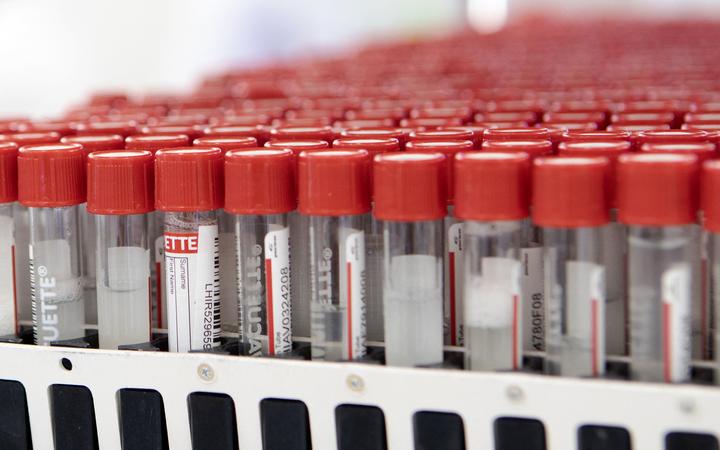
The Ministry of Health is reporting 1573 new community cases of Covid-19 in New Zealand today.Samples of the coronavirus (Covid-19) PCR gargle test are pictured before further examination in the LifeBrain laboratory in Vienna on February 1, 2022.

Samples of the coronavirus (Covid-19) PCR test (file image). Photo: AFP

In a statement, the Health Ministry said there were 62 people in hospital with the coronavirus. None are in ICU.

The Ministry said 1140 of the cases are in Auckland, with the others in the Northland (31), Waikato (143), Bay of Plenty (29), Lakes (35), Hawke’s Bay (2), MidCentral (3), Whanganui (11), Taranaki (8), Tairāwhiti (8), Wairarapa (30), Capital and Coast (20), Hutt Valley (22), Nelson Marlborough (49), Canterbury (7) and Southern (35) DHBs.

There were also 15 cases reported at the border today.

Yesterday’s community case numbers hit 1160.

The total number of Covid-19 cases in New Zealand since the pandemic began is now 24,660.

There were 40,452 vaccine booster doses given yesterday, including 2320 first doses, 1487 second doses and 1677 paediatric doses.

The Ministry said more than 90 percent of Māori aged 12 years and over in the Hutt Valley have now been fully vaccinated -the fourth DHB area in Aotearoa to reach this milestone.

“Since January 22, when the first Omicron case was detected in the community, double vaccinated cases are ten times less likely to require hospitalisation than unvaccinated cases – 4 percent of unvaccinated cases have required hospitalisation and 0.4 percent of fully vaccinated cases have required hospitalisation.”

Tonga Covid outbreak: 56 new cases; urgent building of isolation facility at Hu’atolitoli prison as more inmates test positive

Prime Minister Hu’akavameiliku

Tonga has 14 new cases in the community and 17 new cases at Hu’atolitoli prison.

There are 25 new cases at MIQs which were passengers on flights from overseas.

Prime Minister Hu’akavameiliku said the total number of active cases is 195.

He said on Monday 14 we had 139 active cases and today, Thursday 17, that number rises to 195 active cases. The difference between these two numbers of active cases amounted to 56 new active cases.

The Prime Minister said seven cases had been released from MIQs and six cases had been recovered taking the total number of cases since the outbreak to 208. He said deducting that 13 cases from 208 leaves us with the total number of 195 active cases.

Hon Hu’akavameiliku said all six positive cases previously recorded on Vava’u eventually tested negative.

The Minister of Health Saia Piukala said there are 14 new community cases.

He said the total number of positive cases at Hu’atolitoli prison was 30 and the prisoners contracted the virus through a warden.

He said 11 front line health officials tested positive.

Hon Piukala said the 25 cases from overseas at the MIQs appear to be people who had been at the “tail-end” of their infection.

Hon Piukala said the active cases showed no serious illness except two cases at Mu’a MIQ, with one who suffered a ruptured appendix while the other was having a boil.

Health Chief Officer Dr Siale ‘Akau’ola confirmed during the press conference this morning all passengers arriving from Fiji this week tested negative.

The transmission at Hu’atolitoli prison affected some prisoners and wardens.

The Minister of Prison Samiu Vaipulu said a new facility was currently being built at the prison today to cater for the positive cases.

Hon Vaipulu said two builders who were building the facility tested positive but they were asymptomatic.

The Prime Minister’s press conference this morning was emotional with the Minister of Health and the Minister of Prison trying to compose themselves while trying to respond to some questions from the media.

Fiji church ministers refuse to vaccinate against Covid-19

By RNZ.co.nz and is republished with permission.

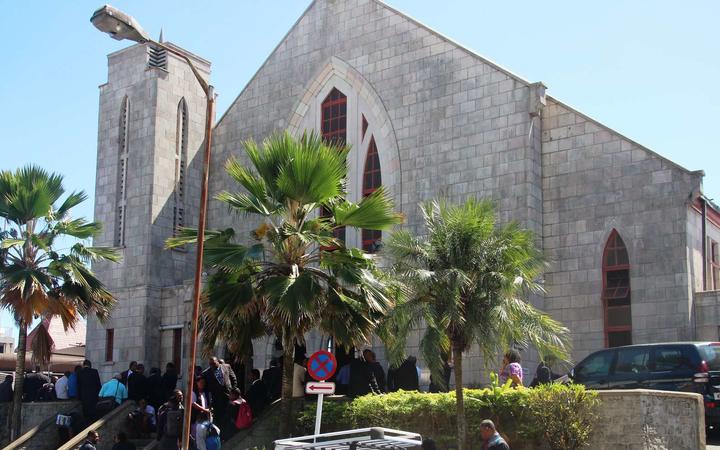
A group of church ministers in Fiji have resigned because they do not want to be vaccinated against Covid-19.A Methodist church in Fiji.

A Methodist church in Fiji. Photo: Facebook / Methodist Church in Fiji and Rotuma.

There has been growing pressure on the clergy to get the injections since the Fiji Government’s ‘No jab, no job’ policy for public servants was announced last June.

The Methodist Church said this week 11 of its pastors had tendered in their resignations.

The church’s secretary, Reverend Wilfred Regunamada, said the ministers were not forced to resign but had done so of their own free will.

“And in between that deadline, the church continued to call and ask them if they had changed their decision,” he said.

“Those who have not changed and made their decision, the church in the various circuits or the divisions that they were in, farewelled them very well. “

Regunamada said the church respected their decision and the vacant positions would be filled by other lay preachers and theology students within the church.

The Methodist Church is the largest Christian denomination in Fiji, with 36.2 percent of the total population (300,000) including 66.6 percent of indigenous Fijians.

In October last year, 10 ministers of the Christian Mission Fellowship Church quit over their refusal to vaccinate.

At the time, Reverend Regunamada the Methodist Church’s secretary for communications and overseas mission, said they had not laid off any of their ministers nor had anyone been forced to resign.

“Currently, we are carrying out awareness for our ministers and they are being given time, until November, to get their vaccines.

“The church’s stand is mainly to ensure the safety of its members which means that its ministers, who are servants of the people, need to be vaccinated first.

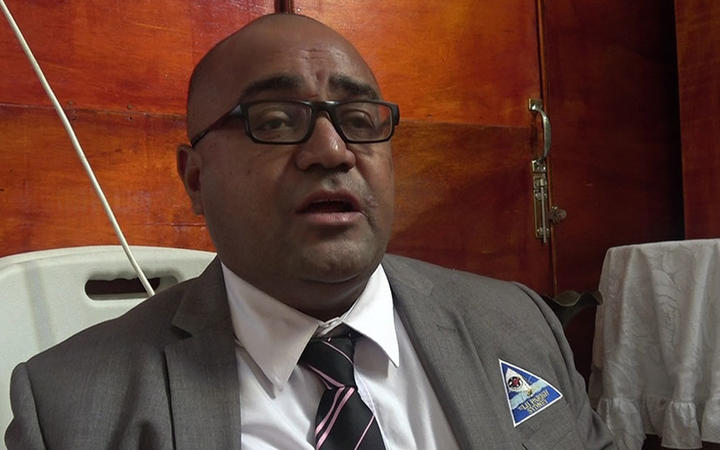
“At the moment, those that have not been vaccinated have been requested not to partake in any church services but have been advised to stay in their own homes and they are still being paid,” Regunamada said.Reverend Wilfred Regunamada.

Reverend Wilfred Regunamada. Photo: Supplied

Remaining 8 percent tough to vax – Govt

Meanwhile, Fiji’s Health Ministry is finding it hard to vaccinate the remaining eight percent of the adult population against Covid-19.

Health Secretary Dr James Fong said they continued to receive requests for vaccine exemption from people with medical comorbidities, particularly Non Communicable Diseases (NCDs).

He said the medical condition of these people require vaccination “and granting the exemption is not an option for any qualified medical person”.

“We have noted how difficult it is to increase our vaccination coverage for the last 8 percent of our adult population, despite the increased risk of severe outcomes in this group,” Dr Fong said.

He said community support was needed to sustain the impact of their efforts.

“While we will continue to do our part to promote and deploy vaccines, we need community support to sustain the impact of our efforts especially to the vulnerable within this 10 percent.”

“It is a grave concern that we continue to receive requests for vaccine exemption from persons with medical comorbidities, especially NCDs.”

As of 14 February 2022, 574,700 of Fiji’s adult population were fully vaccinated, the Health Ministry stated.

The booster dose program began at the end of November 2021. As of 14 February 2022, 91,414 individuals have received booster doses of the Moderna vaccine and 60 people got the Pfizer.

Dr Fong said for the month of February, 175,558 more people have become eligible for booster doses.

“We are targeting to cover all these eligible individuals in the days ahead. Please come forward to get your booster (third dose) vaccine if you are aged 18 or over and it has been at least 5 months since your second dose.”

Fiji has 141 active cases of Covid-19 in isolation while the death toll is at 820.

Experts split on raising age of superannuation

By Kim Moodie of RNZ.co.nz and is republished with permission.

Experts are split over the idea, with some saying it’s time to re-think the eligibility age, while others warn it will only worsen entrenched inequalities.

Deputy Prime Minister Grant Robertson says Labour is standing by its commitment to not raise the superannuation age. Photo: Pool / NZME / Mark Mitchell

Earlier this month, the OECD warned the government it needed to do more to cool down the overheating economy and bring down its debt levels.

Among its recommendations, which included removing obstacles to home affortability and building, the OECD suggested increasing the eligibility age for superannuation from 65, linking it to life expectancy.Brad Olsen

Brad Olsen Photo: Infometrics

Principal economist at Infometrics Brad Olsen said it was worth considering, as New Zealanders were now living longer and spending more time on their super.

“When the current New Zealand super ages were set, people were spending around about 13 percent to 18 percent of their life on New Zealand super.

“Now, they’re spending about 19 percent to 22 percent of their life.

“So, not only are people living longer, but there are more people now who are living on their super for an extended period of time.”

Olsen said the move could save billions of dollars that could be re-directed elsewhere.

But Age Concern’s chief executive Stephanie Clare said there was no reason to change it.

“We know today that some people who reach 65, they actually don’t stop working,” she said.

“They keep working, they love working, they want to work, for any reason. But there are some that can’t work any longer and have been holding out until they get a pension.

“We don’t want this to disadvantage anybody. We want people to have the choice.”

Clare said any changes should be announced a decade in advance, at least, to give people time to save.

Financial Advice New Zealand’s chief executive Katrina Shanks said any changes had to be flexible.

“The big things we need to think about are for those who are in physical jobs, and they can’t work past 65 or currently are struggling to work to 65, what does that look like for them?

“And, what do we have in place to make it more equal for those that have to leave the workplace earlier, because they’re in more physical roles?”

Focus should be on level playing field – academic

Dr Claire Dale, a research fellow in the Retirement Policy and Research Centre at the University of Auckland’s business school, said the government should level the playing field before it even thinks about raising the age.

“Area deprivation and ethnicity impact on life expectancy,” she said.

“Life expectancy at birth is lowest in the most deprived areas. So, your wealth and your ethnicity make a huge difference to your longevity.”

She said lifting the eligible superannuation age without boosting benefit payments would only make it worse for older people who were financially insecure.

“It’s very hard for an older person, if they lose their job, to get another job.

“You just can’t even get an interview, let alone have a hope of changing an employment. That’s going to exacerbate hardship also.”

But Olsen warned without re-considering the eligibility age, the government was sleepwalking into an incredibly difficult situation for younger New Zealanders.

“At the moment, we’ve got around about four workers supporting every elderly person, funding their superannuation,” he said.

“In the future, we’re going to have only two workers supporting every superannuation and paying for that New Zealand super.

“So, it does start to restrict New Zealand’s economic opportunities and where we might put our money. There is a huge opportunity cost involved with the current status of New Zealand superannuation.”

Finance Minister Grant Robertson rejected the OECD’s recommendation, saying the Labour Party will never increase the superannuation age.

“There’s a commitment that we’ve made, a social contract if you will, with New Zealanders to make sure they have dignity in their retirement and support in their retirement.

“I recognise there is a cost associated with that, but that is the priority decision that we make. As an economy I believe we can afford that.”

But the National Party’s finance spokesperson Simon Bridges said the government needed to rein in its spending.

“I hope he doesn’t say I know everything, my borrow and spend model is just fine,” Bridges said.

After the report was released, the National leader Christopher Luxon said the party’s policy to increase the age progressively to 67 from July 2037 remained.

Tongan suspects  identified in 2019 homicide of Kathryn Leavitt in US

Salt Lake Police are  searching for Tongan suspects who are accused of killing 27-year-old Kathryn Blaire Leavitt in 2019.

Leavitt was found shot dead in an apartment at 1211 N. Redwood Road on July 27, 2019 after officers responded to a call of a burglary in process. While en route, officers were told shots had been fired.

A press release on Tuesday (Salt Lake time) said: “SLCPD Homicide Detectives responded to the scene and began conducting a thorough investigation, which resulted in detectives learning the identities of six suspects in the murder of Ms. Leavitt and the obstruction of justice that has occurred since her death.”

The six suspects were identified as the following: 26-year-old Katoa Pahulu, 36-year-old Lachelle Fiefia, 26-year-old Mapilivai Laulea, 22-year-old Sunia Cavazos, 37-year-old Tevita Kofutua, and 41-year-old Timote Fonua.

SLCPD Captain Victor Siebeneck said, “It’s time you come forward. You’ve been running from justice for too long. This is your chance to set the record straight – to tell us what happened and to be the one who does the right thing and to tell us who killed Ms. Leavitt.”

Leavitt was a member of Utah’s Pacific Islander Community and the community has fought for justice in her case since 2019.

Anyone with information on this case should call 801-799-3000 and reference case number 19-137096.

Collections for Tonga continues around Aotearoa

By RNZ.co.nz and is republished with permission.

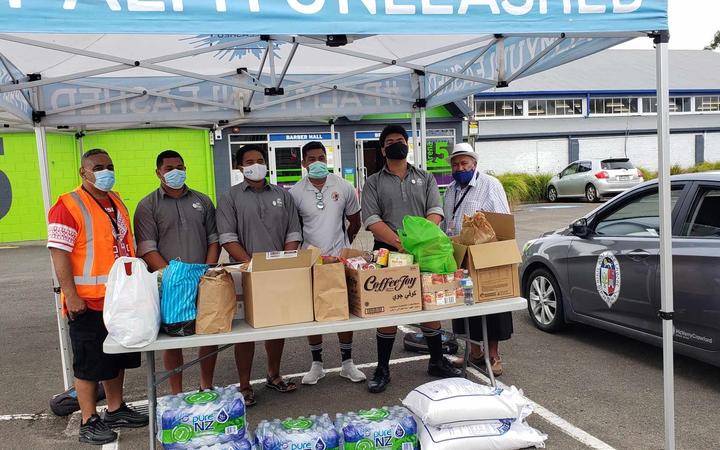
The Northland Pasifika community in New Zealand is planning on sending three shipping containers to Tonga packed full of essential supplies before Christmas.

Fale Pasifika Manager Johnny Kumitau said the local council is putting money towards the first container.

He is now calling on local businesses in Whangarei to help fund the others to lighten the load for families.

“When something happens everyone comes together, we have a pretty tight Pasifika community right from Dargaville to Kaitaia,” said Kumitau.

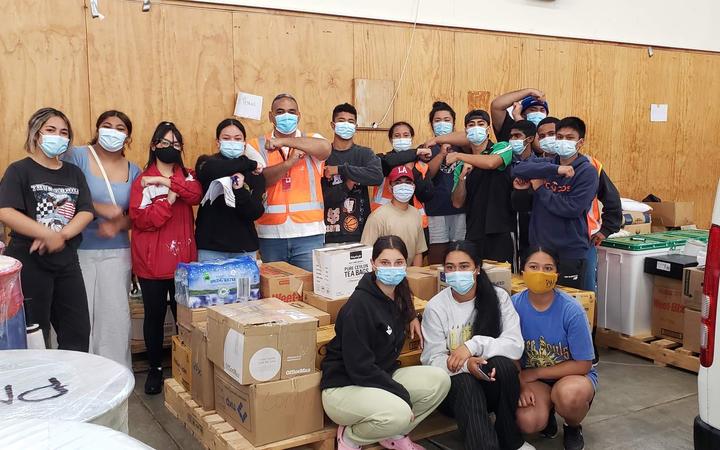
Food and water donations will be needed but also equipment to turn the soil and help reignite the agriculture sector decimated in the disaster, said Kumitau.Goods are packed for Tonga by volunteers in Palmerston North.

Goods are packed for Tonga by volunteers in Palmerston North. Photo: Nalasikau Halatuituia

“The other thing… probably looking at further down the track to support Tonga is having wheelbarrows and spades to turn the soil, to help with planting down the track, so there is a lot more to this than just food and water,” he said.

Anyone in the Northland region wanting to send essential food and water to Tonga can drop the goods off to F.W.C Tongan Church at 53 Murdoch Crescent Raumanga Whangarei.

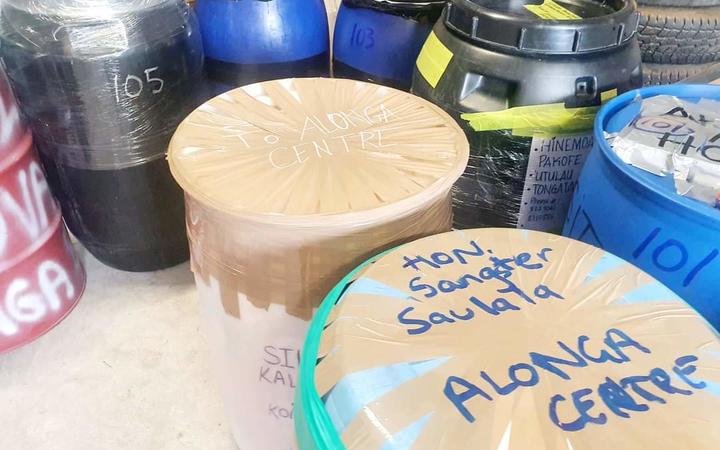
Donations from the Central North Island have been loaded into a 40ft container in Auckland. $71,000 worth of essential supplies are packed in drums from families in the central region of New Zealand’s North Island.

Palmerston North Tongan community leader Nailasikau Halatuituia has been co-ordinating the shipment.

He says one drum of essential food costs around $700 to fill, some have been topped up by community donations.

“The drums are packed by families in the central region and sent directly to their families in Tonga, it’s the start of the healing process from here, and also the families in Tonga when they receive those drums it’s part of that connection and solidarity as part of a family and community trying to recovery from this terrible disaster,” Halatuituia said.

One drum should last a family around one month, but many have been sharing food with their neighbours, he said.

“It’s been tough for the communities, but they managed to pull together. The amazing thing is our youth have been volunteering, we’ve had schools donate too.

“Their donations go straight to schools in Tonga for example we got St Peters go to Apifo’ou College, the LAC their donation goes straight to Beulah College in Tonga and we also have donation going to the women’s crisis centre and the disability centre,” he said.Volunteers packing goods for Tonga in Palmerston North.

Volunteers packing goods for Tonga in Palmerston North. Photo: Nalasikau Halatuituia

Youth in the central part of New Zealand’s North Island have been doing the hard yards for Tonga.

Work is also underway to prepare for the future with long term aid plans being worked through.

Most of the small fishing boats were damaged by the tsunami and there is a great need for new boats to be sent, Halatuituia said.

“Boats would enable them to start fishing, in the agriculture sector as well they will need some help to get it up and running again,” Halatuituia said.

The first container to leave the South Island is expected to leave Christchurch on Friday. It will travel to Auckland before heading to Tonga.

Christchurch Tongan Community Secretary Sami Paeahelotu said it will be closed off this Thursday.

Community leaders are looking at sending a second one,” he said.

Meanwhile ten forklifts are expected to be donated to the Aotearoa Tonga relief committee which will be sent in staggered shipments.

Aotearoa Tonga Relief Committee Spokesperson Pakilau Manase Lua said Turners and Growers and Foodstuffs suppliers are gifting three of the forklifts to speed up the unpacking process of essential food when it arrives.

Tongan residents impacted by the violent volcanic eruption and tsunami have reached out to New Zealanders asking if anyone can donate generators, he said.

His team was now looking for PVA 15-30 diesel generators, to send to Tonga.

“We’ve got requests from people on the ground in Tonga for diesel generators, ideally those which are 15-30, so we’re wanting to see if there are any donors out there that are happy to donate some diesel generators, particularly for freezers and fridges and things like that which are essentials,” he said.Goods are packed for Tonga in Palmerston North.

Goods are packed for Tonga in Palmerston North. Photo: Nalasikau Halatuituia

Havelulahi Ma’asi Taukei’aho is a Kanokupolu community leader in New Zealand has been a volunteer at Mt Smart driving forklifts.

“Generators, excavators, loaders, trucks for the rocks. We already sent them food, they said thanks for sending the food and water and things, it’s hard to get contact with them, we keep trying and trying,” Mr Taukei’aho said.

The next Matson shipment bound for Tonga carrying aid containers is scheduled to leave Auckland on Wednesday the 16th of February.

“There are actually areas on the main island Tongatapu, like Kanokupolu out on the western district which were absolutely flattened, people have lost everything, the infrastructure is down, all the power poles and all that, so it will take a lot of time to rebuild, but also on the outer islands which were again swamped by the waters and some people have actually relocated,” Manase Lua said.

Work is underway across New Zealand to gather much needed supplies to support the rebuild, Pakilau Manase Lua said he was overwhelmed by the response so far.

“We’re really fortunate, we were contacted by Turners and Growers who in turn contacted Jenny Salesa one of our co-chairs, they are offering to donate two forklifts, we are in conversations with foodstuffs who have a supplier who is keen to donate a forklift, so we are looking at three so far, it’s been a fantastic response,” Manase Lua said.

New Zealand Tube Mills has donated a further seven forklifts. Labour MP Anahila Kanongata’a-Suisuiki said they “heard our call, our cry for forklifts and he has answered them”.

She said the Tongan workers at New Zealand Tube Mills have been emotional following the news of their employer’s support.