Tuesday, February 3, 2026
Home Blog Page 46

Girl, 14, missing for four days from Auckland’s Ponsonby

By 1news.co.nz

(Source: NZ Police)
(Source: NZ Police) (Source: Supplied)

Police are concerned for the welfare of a teenage girl missing for four days from Auckland’s Ponsonby.

Marilyn, 14, was last seen in the Ponsonby area on May 18.

The girl is described as being 175cm tall with brown eyes and brown hair.

“Police and Marilyn’s family have concerns for her welfare and would like to find her as soon as possible,” police said.

Anyone with information has been asked to contact police on 111.

Supporting Sustainable Agriculture for a Resilient Pacific

Dear Editor,

I write with concern about the urgent need to support sustainable agriculture across the Pacificregion. Our island communities rely heavily on farming, yet climate change, soil degradation, and limited resources threaten our food security and livelihoods. 

Pacific farmers face increasing challenges such as unpredictable weather patterns, saltwater intrusion, and pests, which reduce crop yields and income. Without stronger support and investment, these vital food systems risk collapse, making our communities more dependent on 
costly imported goods. 

It is crucial for governments, regional organisations, and international partners to prioritize agricultural development that respects local knowledge and environmental limits. Introducing climate-resilient crops, improving irrigation systems, and providing training for farmers are key steps forward. 

Empowering youth and women in agriculture will also strengthen our communities and build long-term resilience. Sustainable agriculture not only protects our environment but also preserves our culture and identity. 

As a Pacific islander, I urge leaders to act swiftly and decisively to safeguard our agricultural heritage. The future of the Pacific depends on food sovereignty and resilient farming practices. 

Thank you for highlighting this important issue. 

Sincerely,
Uinise Finelaukau Hoponoa
Student ID: s11128120

Giant tsunami boulder in Tonga reveals Pacific’s violent history

A massive boulder weighing nearly 1,200 tonnes on Tonga’s Tongatapu island has been identified as one of the largest wave-transported rocks ever documented, offering crucial insights into the Pacific’s tsunami history.

Image: Martin Köhler standing in front of the Maka Lahi boulder. 

The Maka Lahi boulder, measuring 14 x 12 x 6.7 metres, was carried more than 200 metres inland by a catastrophic tsunami approximately 7,000 years ago, according to researchers from the University of Queensland.

They made the startling discovery after local farmers directed them to the enormous rock, which sits far from the coast amid dense vegetation.

“We had been surveying the southern side of the island of Tongatapu looking along the coastal cliffs at evidence of past tsunamis,” PhD candidate Martin Köhler said.

“It was late in the day, and we were talking to some farmers when they directed us to this boulder.

“I was so surprised; it is located far inland, outside of our field work area and must have been carried by a very big tsunami. 

“It was quite unbelievable to see this big piece of rock sitting there covered in and surrounded by vegetation.

“We made a 3D model and then went back to the coast and found the spot the boulder could have come from, on a cliff over 30 metres above the sea level.”

The Maka Lahi boulder is the world’s largest known cliff-top boulder, the researchers claimed.

Numerical modelling has established that wave heights of around 50 metres lasting around 90 seconds were needed to dislodge it from its cliff-edge origin and move it to its resting place.

Co-author Dr Annie Lau, a coastal geomorphologist, said Tonga had a long history of tsunamis triggered by volcanic eruptions and earthquakes along the underwater Tofua Ridge and the Tonga Trench.

“Tonga’s most recent tsunami in 2022 killed 6 people and caused a lot of damage,” Dr Lau said.

“Understanding past extreme events is critical for hazard preparation and risk assessment now and in the future.

“The findings we have reported on the Maka Lahi boulder are the evidence of a tsunami in the Pacific region in the Holocene epoch which began around 11,700 years ago.

“The analysis strengthens our understanding of wave transportation of rocks to improve coastal-hazard assessments in tsunami-prone regions around the world.”

Appeal Court extends receiver’s term in Lord Luani’s $3.38m claim against Lord Nuku 

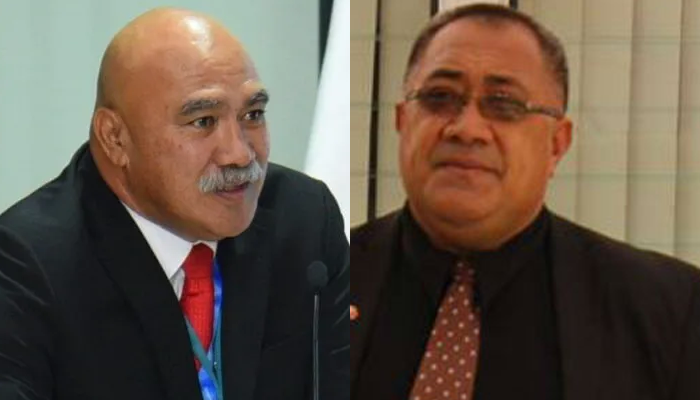
Tonga’s Court of Appeal has overturned a Supreme Court decision, reopening an eight-year legal dispute between Lord Nuku and Lord Luani, two members of the king’s nobility.  

Lord Nuku (L) and Lord Luani

The Appeal judges also extended the term of Lord Luani’s receiver, Dianne Warner, until 2026 to collect and enforce the decision made against Lord Nuku’s TOP$3,380,335.00 debt. 

In its May 16 ruling, the Court of Appeal found the lower court erred in dismissing enforcement proceedings, ordering the case remitted for rehearing with proper joinder of all parties while clarifying that receivers possess broad enforcement powers independent of the Land Act.  

The decision marks a significant development in Lord Luani’s protracted effort to recover the debt originally awarded in 2017, which had stalled despite a 2020 charging order securing Nuku’s tax allotment and two Veitongo leases, as lands officials cited procedural barriers to transfer. 

In a 2017 Appeal Court judgment, Lord Nuku had been ordered to pay Lord Luani the substantial sum. 

 Despite obtaining a 2020 charging order over Nuku’s assets, including a tax allotment and two leases (9436 and 9473) at Veitongo, enforcement stalled when the Minister of Lands claimed inability to transfer the leases without Nuku’s consent.  

By extending the receivership term and ordering costs against the Minister of Lands, the Court of Appeal has strengthened creditors’ ability to enforce judgments against land assets while setting the stage for potentially resolving one of Tonga’s most high-profile noble debt cases. 

The Court of Appeal criticized the Supreme Court’s handling of the case, particularly its dismissal of the Receiver’s application due to the absence of key parties, stating this procedural issue could have been resolved by joining Lord Nuku and the lessees rather than rejecting the claim outright.  

The Court of Appeal clarified several important legal principles.  

It affirmed that receivers appointed for equitable execution have broad powers to enforce judgments, including authority that may override provisions of the Land Act.  

The judges emphasised that charging orders operate independently of the Land Act and don’t require consent from the Minister or landholders.  

With the case now remitted to the Supreme Court, the next phase will require formal joinder of Lord Nuku and the leaseholders, potentially paving the way for Lord Luani to finally obtain the disputed properties.  

The Court of Appeal also ordered the respondent, the Minister of Lands, to pay the appellant’s costs, adding financial pressure to resolve the long-running dispute.  

The extended receivership term through February 2026 provides Warner with a two-year window to complete the complex recovery process.  

Illegal sea cucumber operation uncovered in Vavaʻu as Tonga considers extending harvesting ban

VAVAʻU, Tonga – Authorities have seized illegally processed sea cucumbers in Vavaʻu amid reports that the Tongan government is considering extending a ban on harvesting the protected species.

It is understood the accused are in court in relation to the illegal sea cucumber operations. Photo/Vāvā lapota

Photos taken in Vavaʻu and obtained by Kaniva News show what appears to be a business buying and processing sea cucumbers, despite a nationwide prohibition on their fishing.

Neiafu Town Officer Vava Lapota documented the confiscated sea slugs, which Fisheries Officers took from an illegal operation.

He told Kaniva News that about two accused face court proceedings for illegal sea cucumber harvesting and trading.

The discovery follows an investigation by the Hōleva town officer after a cooler filled with rotting sea cucumbers was found abandoned last month.

This comes as the Tongan government weighs extending a harvesting ban to allow depleted sea cucumber populations to recover.

The ban has existed since the 2010s, with the latest extension in 2022.

Fisheries Ministry CEO Dr Sione Matoto recently stated that lifting the ban remains uncertain, citing a recent survey. He confirmed that harvesting is still prohibited.

Sea cucumbers, a delicacy in Asian markets, have been overfished in Tongan waters, prompting strict regulations.

Concerns over unsafe diving practices, including fatalities linked to scuba and hookah equipment, led to a ban on artificial breathing devices for harvesting.

Under Tongan law, possessing sea cucumbers on a boat with such equipment is a criminal offence.

The government’s continued suspension aims to restore stocks, but enforcement remains challenging as illegal operations persist.

Authorities have yet to comment on potential penalties for those involved in the latest case.

Witness horrified by Zombie Drug victims in NYC, ‘prays crisis doesn’t reach Tonga’

A Tongan witness in New York City was left shocked after encountering what appeared to be victims of the so-called “zombie drug” lying motionless and uncontrollably drowsy outside Moynihan Train Hall.

Apparent victims of the “zombie drug” lie motionless outside New York City’s Moynihan Train Hall, a disturbing scene witnessed by a Tongan observer who fears the crisis could spread to Tonga. (Photo: Simaima Sekona/Kaniva News)

Simaima Sekona, who livestreamed the disturbing scene, told Kaniva News she prayed such a drug epidemic would never reach Tonga.

The term “zombie drug” refers to a dangerous class of synthetic drugs, including substances like xylazine, a powerful sedative often mixed with opioids, which leaves users in a trance-like, lifeless state.

The U.S. and other nations are increasingly alarmed by the rise of these drugs, which cause severe physical and mental deterioration.

Sekona described seeing multiple individuals slumped on the steps of the train hall, barely responsive, and seemingly under the influence of the drug.

“It was heartbreaking and frightening,” she said.

“I hope Tonga never has to face this kind of tragedy.”

While Tonga is currently battling its own illicit drug crisis, authorities have not yet reported cases of the “zombie drug” in the kingdom.

As Kaniva News recently reported, methamphetamine, cannabis, and other illicit drugs are now infiltrating families in Tonga and being sold near school zones, putting youth at risk.

The global spread of the zombie drug has raised concerns among nations in the Pacific about the potential for new and more dangerous drugs entering the region.

In 2020, the NZ Herald reported that a deadly drug known for inducing zombie-like behaviour, and linked to more than 70 deaths in New Zealand, had resurfaced in the community, putting authorities on high alert. The substance is “ultra-potent” and 85 times stronger than cannabis.

In 2015, it caused scores of users to exhibit “zombie-like” symptoms, including extreme lethargy and disorientation.

As international awareness grows, witnesses like Sekona are urging their home countries to remain vigilant against the threat.

Tonga’s new cargo monitoring policy, observation allowed, physical contact prohibited

The Ministry of Customs and Revenue has updated its new policy to allow customers to physically monitor their shipments and cargoes while being cleared by authorities at the wharf.

Former Minister of Revenue Māteni Tapueluelu. Photo/Tnews, Youtube

Under the new system, cargo owners or their authorised representatives may monitor physical inspections through CCTV or from designated viewing areas.

They are strictly prohibited from touching or handling goods during examination.

This follows Kaniva News‘ earlier report about the Ministry’s groundbreaking initiative to allow real-time cargo monitoring.

Minister Mateni Tapueluelu explained that the policy change addresses longstanding complaints about lost or mishandled shipments in the multi-agency clearance process involving Stevedores, Quarantine, and Wharf staff.

While enhancing transparency, the Ministry has implemented stringent security measures. Observers may only watch from approved areas, and all physical inspections remain the exclusive responsibility of relevant authorities.

The policy is currently in its trial period, during which authorities will evaluate its effects on operational efficiency and customer satisfaction.

This innovative approach aims to increase public trust in customs procedures while maintaining rigorous border control standards.

Trump unveils $175 billion ‘Golden Dome’ defense shield, appoints space force general to lead project  

 WASHINGTON – Former President Donald Trump has announced a sweeping $175 billion plan to develop the “Golden Dome,” an advanced missile defence shield designed to protect the U.S. from aerial, hypersonic, and space-based threats.

The initiative, a cornerstone of his second-term military strategy, will be led by U.S. Space Force General Michael Guetlein, Trump revealed during a White House press conference Tuesday.  

Just seven days into his new administration, Trump directed the Defence Department to expedite plans for the system, which the White House described as critical to countering “the most catastrophic threat” facing the nation.

The Golden Dome—partly inspired by Israel’s Iron Dome but vastly more expansive—would integrate next-generation sensors, interceptors, and space-based technologies across land, sea, and orbit.  

The announcement came as Canada signalled its intent to join the project.

Former Defence Minister Bill Blair, during a visit to Washington earlier this year, confirmed Ottawa’s interest, stating that participation aligns with Canada’s “national interest,” particularly in monitoring Arctic threats.  

Next-Gen Threats: Hypersonics and Orbital Strikes 

Trump emphasised the system’s ability to neutralise emerging dangers, including hypersonic missiles and Fractional Orbital Bombardment Systems (FOBS)—Cold War—era concepts revived by recent advancements in Chinese and Russian arsenals.

“It will intercept threats from anywhere, even the other side of the world or from space,” he declared in the Oval Office.  

Critics question the feasibility and cost, but proponents argue the Dome could redefine global deterrence.

As contracts are drafted, all eyes are on Space Force’s timeline—and whether allies like Canada will secure a stake in the high-stakes project.  

Tonga Police investigate separate deaths, man’s suicide claims; a Fijian woman’s battle with cancer

NUKU’ALOFA, Tonga – Tonga Police have responded to two unrelated deaths this month, releasing statements to clarify the circumstances surrounding each case.

Tonga Police. Photo/Kalino Lātū

On Wednesday, May 14, 2025, authorities discovered the body of a 31-year-old man in Ma’ufanga.

After an investigation, police confirmed the death as a suicide.

The man’s remains have been released to his family for funeral preparations.

“Tonga Police extends its condolences to the family during this difficult time,” the statement read.

Hotel Death of Fijian Woman

Separately, on Saturday, May 17, 2025, police were called to a Nuku’alofa hotel following reports of a deceased 79-year-old Fijian national residing in Australia.

A medical report and family confirmation identified advanced cancer as the cause of death. Her body has also been handed over to relatives.

Police reiterated their sympathies, acknowledging the grief of the bereaved family.

COMMENTARY Dress Code Debate, Deputy PM’s shorts spark cultural clash in Tonga

Commentary – The recent uproar over Deputy Prime Minister Taniela Fusimālohi’s decision to wear shorts during an official visit to Tonga’s outer islands has highlighted a growing clash between tradition and modern practicality in the kingdom.

All civil servants, except for uniformed staff like police, must wear tupenu and ta’ovala.

Former Prime Minister Hu’akavameiliku condemned Fusimālohi’s attire as “ta’efaka’apa’apa” (disrespectful), reigniting Tonga’s long-standing dress code debate.

Some conservatives often argue that men wearing trousers at formal government events is inappropriate, despite foreign dignitaries routinely wearing long trousers when meeting the king at the palace.

The controversy extends to lingering resistance against women wearing trousers in official settings, revealing deeper cultural tensions around gender and tradition. Yet many contend that trousers offer women better coverage and mobility in public gatherings.

The parliamentary debate reflects critical questions about cultural preservation versus modernisation in a rapidly changing world.

Tonga’s lufilufi’i dress code – requiring complete leg coverage – is deeply rooted in principles of modesty and respect. This cultural framework establishes specific protocols governing appropriate attire in different social contexts.

For men, the code mandates strict observance around sisters. They must never appear shirtless in the presence of sisters or nieces of the opposite sex. Similarly, women are recommended to carefully cover their legs when sitting near their brothers.

Formal occasions carry additional requirements

All men are recommended to wear tupenu (traditional long wraps) and ta’ovala (ceremonial waist mats) as markers of respect. The prohibition against shirtlessness in public spaces is particularly stringent, and violations are considered serious offences against social norms.

Those who disregard these protocols risk being labelled maneva, a term denoting shameless exposure or improper lack of clothing. These labels carry significant social weight, serving as powerful deterrents against dress code violations while upholding Tonga’s cherished values of modesty and cultural propriety.

Critics lambasted those with a lack of dress code with remarks like: “Ko ho’o maneva atu ‘oku ‘ikai ke ke sio ‘oku ‘eikisia e nofo!” (You went there naked (without ta’ovala) don’t you see the chiefs (or superiors) were in the gathering?).

Yet Fusimālohi’s practical defence – that harsh environments like bushland or sea work demand functional attire – resonates with many Tongans.

The Deputy Prime Minister argued that wearing tupenu and ta’ovala at sea risked winds blowing the tupenu aside, potentially exposing the wearer.

His critics insist that leaders uphold tradition unconditionally, while supporters argue that rigid adherence risks hypocrisy.

Shirtless Performers Accepted

This exposes a cultural paradox: Tongan society celebrates shirtless male mako dancers and Miss Heilala contestants in revealing sarongs, yet condemns a leader’s functional fieldwork attire. Also, both male and female bodybuilders regularly showcased their physiques to Tongan audiences without problems, even though their clothing was very revealing.

Such inconsistency demands reflection – are we applying cultural standards selectively? If entertainment bends tradition, why not governance in practical contexts?

The solution may lie in balance. Like all living traditions, Tonga’s dress codes must evolve while maintaining their essence.

A ta’ovala in Parliament signifies respect; girls wearing shorts while boys play shirtless in intercollegiate sports ensures safety and practicality. Rather than policing attire, we should consider the wearer’s intent: Are we preserving the spirit of our culture, or merely enforcing its surface-level rules?

This debate transcends clothing. It’s about Tonga navigating its 21st-century identity.

The wisest path respects tradition while allowing reasoned exceptions.

Culture thrives not in rigidity but in its capacity to remain meaningful across changing tides.