Nuku’alofa, Tonga – Miss Heilala Racheal Guttenbeil was spotted tending to her vegetable garden dressed in elegant Tongan formal attire to mark World Environment Day.
Miss Heilala Racheal Guttenbeil tends to an onion plant in her garden, dressed in elegant Tongan attire—blending culture with sustainability 🌱👑. This #WorldEnvironmentDay, she reminds us that every small action—whether planting, reducing plastic, or protecting water—helps build a healthier, greener future. Photo/Miss Heilala Pageant (Facebook)
This year’s global campaign, “Beat Plastic Pollution,” highlights the urgent need to combat the devastating effects of plastic waste on ecosystems, wildlife, and human health.
The Miss Heilala Pageant shared a photo of Miss Guttenbeil crouching beside a vegetable planter box, gently touching the leaves of an onion plant.
The caption calls on the public to support environmental conservation and urges everyone to join their plant-growing initiatives, reduce plastic use, and preserve water sources.
It also states: “Remember: Every small action counts toward a healthier, cleaner, and greener future.”
The beauty queen’s symbolic gesture not only honoured Tonga’s rich traditions but also reinforced the importance of sustainable living.
By merging cultural heritage with environmental activism, Miss Heilala sent a powerful message about preserving natural and cultural treasures for future generations.
Her initiative follows Tonga’s recent Emancipation Day celebrations, where the reigning Beauty Queen paid tribute to the national holiday by donning the country’s colours—red and white—while holding a kele’a, a cultural symbol of something of great importance.
As nations worldwide unite to reduce plastic waste, Tonga’s beauty ambassadors are leading by example, proving that tradition and environmental stewardship can go hand in hand.
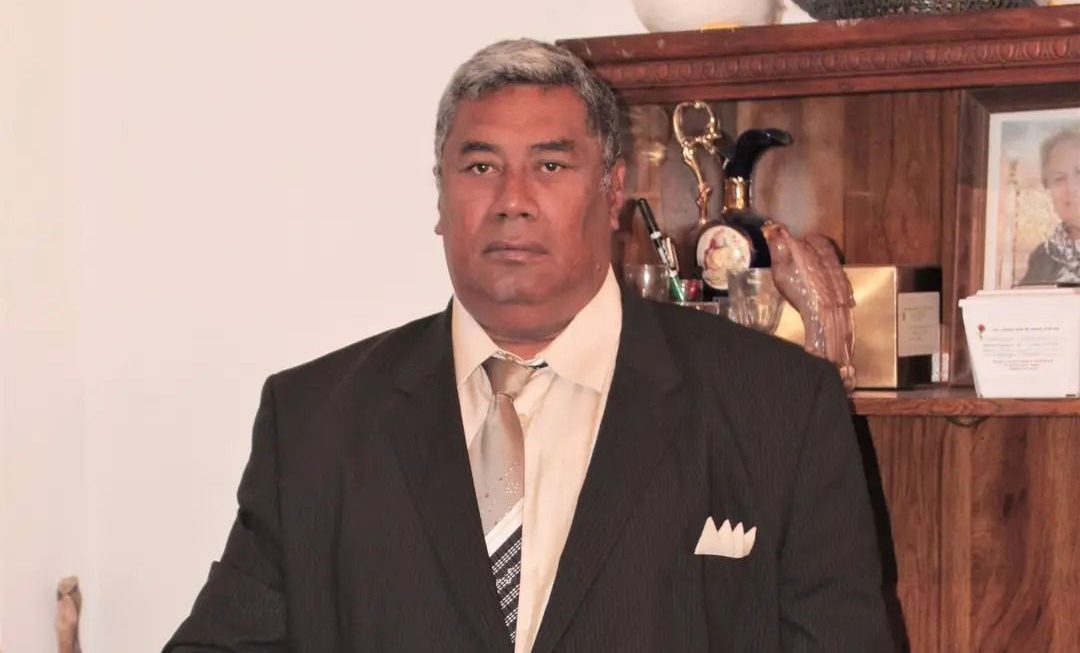
The death of Lord Lasike has revived interest in his ancestors’ ties to Christianity and royalty, their quest for status and the title’s controversial history.
Lord Lasike
Lasike, 67, died from an illness on May 28.
The government has declared that all national flags will be flown at half-mast to honour the former Speaker of the Legislative Assembly.
In a statement issued this afternoon, the Honourable Prime Minister, Dr ‘Aisake Valu Eke, declared that all flags across the kingdom would be lowered on Thursday, June 5, 2025, as a mark of respect during Lord Lasike’s funeral.
The death of the late noble, whose estates included Ha‘afeva Island and the village of Lakepa in Tongatapu, was honoured by his heralds (matāpule) and others through the art of lau kakala and lau mātanga—traditional Tongan persuasive oratory that celebrates the life and legacy of the deceased.
The government’s statement read: “The Public is hereby notified that the Honourable Prime Minister has decreed that all national flags in the Kingdom of Tonga are to be flown at half-mast on Thursday, 5th June 2025, in respect of the funeral of the Noble of the Realm, Lord Lasike.”
The Hereditary Title Lasike and Its Fijian Roots
Research suggests the name Lasike originated in Fiji as a Tongan adaptation of Radike Baleisāsā, later becoming Lasike Paleisāsā in Tongan.
It says both Fijian and Tongan traditions state that Radike was a brother of Fiji’s Tu’i Nayau, the chief of the island of Nayau and Lakeba in the Lau group, Fiji.
The Stathans’ research reveals that while many aspects of the title’s history remain unclear, it confirms Lasike had become an established title by 1861.
The earliest known bearer of the title was Lasike Kalolo Palei (Palei is a Tongan shortening of Baleisāsā), often abbreviated as Lasike Kalolo or Kalolo, who was present when King Tāufa‘āhau Tupou I granted emancipation from serfdom at Pouono, Vava‘u, in 1862.
The Lasike Family’s Catholic Connection
Lasike Kalolo lived during the arrival of the first Catholic Marist Brothers in Tonga and became a devoted Catholic.
According to the Stathans’ and other sources, the name Kalolo was first adapted by Catholics for the Marist fathers and brothers who bore the names Charles and Carlo.
The Stanthans quoted the Marist missionary Fr Pierre Castagnier, Pātele Petelō in Tongan, who documented Kalolo’s influence in his 1866 journal, noting that Kalolo was expected to be appointed chief judge. In a 1879 letter, Castagnier described him as “our very great Catholic chief in his parish of Ma‘ofanga, Tongatapu.”
It says Kalolo occasionally performed baptisms, particularly in emergencies when a priest was unavailable. Fr Castagnier frequently visited him between 1865 and 1881, administered his last rites on June 9, 1881, and officiated his burial in Pea village on June 16.
Succession and the Shift to Methodism
Lasike Kalolo was succeeded by his son, Tāniela (later known as Lasike Taniela), in 1881. However, Fr Castagnier noted that Tāniela was illegitimate and thus constitutionally ineligible for the title, as the Tongan constitution required succession to pass only to legitimate sons.
Lasike Kalolo did have a legitimate heir—his son Kamilo—but Kamilo declined the title. Even Kamilo’s younger brother refused the name, leaving the succession open despite legal restrictions.
According to the research, it appears that to secure his position in Tupou I’s court, Tāniela made the strategic decision to convert from Catholicism to Methodism.
Thirteen years after inheriting the title, Tāniela was ennobled by King George Tupou II.
He was succeeded by his son, Lasike Tēvita Tu‘amoheloa, whose mother, Mele Vaevau Tatu, was a granddaughter of Niupalavu, a brother of Tu‘i Kanokupolu Tuku‘aho.
The title later passed to Lasike Tēvita’s son, ‘Enelē Anga‘aetau, in 1934. With no legal heir, it eventually went to his nephew, Saletili Manu‘ofahiki Tu‘uhetoka, in 1970. Saletili died in 2001, and his son Havea Hikule‘o assumed the title in 2002, holding it until his own passing last month.
The loss and restoration of the title
As Kaniva News reported previously, on July 9, 2012, Lord Lasike was convicted in the Supreme Court of possessing ammunition without a license.
Lord Lasike lost his hereditary title and estates of Lasike, his seat in the Legislative Assembly and his position as Speaker.
All payments of remuneration, allowances and other entitlements to the plaintiff ceased from July 9, 2012.
Following his conviction, the Attorney General (AG), Mr. Adsett, insisted that he would advise the king to revoke Lord Lasike’s appointment as Speaker and the Legislative Assembly to call a by-election.
Lord Lasike then told Kaniva News that he questioned the Attorney General’s decision, as he was actively appealing his conviction.
Lord Lasike successfully appealed his conviction in the Supreme Court in October 2012 and regained his title and estates, but not his seat in Parliament or position as Speaker.
On February 7, 2013, His Majesty in Council restored the plaintiff to his hereditary title and estate of Lasike.
Winner of Miss Heilala Racheal Guttenbeil has reignited pride in Tonga’s emancipation legacy, posing in a striking red-and-white sarong, the nation’s colours, on Emancipation Day on Monday, June 2.
Miss Heilala 2024-2025 Rachael Guttenbeil wears Tonga’s national colours – red symbolising the blood of Christ and white for peace – in a powerful Emancipation Day tribute. The colours trace back to King George Tupou I’s 1862 abolition of serfdom. Photo/Rachael Guttenbeil
The colours, significant in Tonga’s history of liberation, symbolise the blood of Jesus, represented by red, and peace, represented by white, embodying faith and freedom.
“Emancipation Day in Tonga is celebrated on June 4th each year,” Guttenbeil wrote on Facebook alongside the photos, showcasing the colours first enshrined by King George Tupou I during his groundbreaking 19th-century reforms.
The monarch, known as the Founder of Modern Tonga, abolished the feudal system that bound commoners as virtual slaves to chiefs, cementing the colours as emblems of unity and independence.
King George Tupou I enshrined the abolition in his 1862 Code of Laws and formally declared it a public holiday.
Miss Guttenbeil said: “It is a significant event that commemorates the freedom and rights of the Tongan people.”
“Happy Holidays everyone. What a great day to be celebrating it at one of the beautiful islands in Tonga.”
In one of her photos, Guttenbeil poses with a keleʻa, a conch shell traditionally blown to herald significant events.
Miss Guttenbeil was crowned Miss Heilala 2024-2025 and secured second place in the prestigious Miss Pacific Islands 2024-2025 pageant.
Tonga Tourism describes the Miss Heilala title as far more than a beauty crown—it represents “a role model, an ambassador, and a symbol of the strength and grace of Tongan women.”
Tonga Police carried out a series of safety operations over the weekend, leading to the arrest of 51 individuals for various offences, including drunk driving, public intoxication, and drug-related crimes.
The operations, which involved roadblocks and targeted patrols across Tongatapu, were part of ongoing efforts to maintain public safety and curb alcohol-fueled disturbances.
Among those arrested, 16 drivers were charged with driving under the influence of alcohol, while three others faced charges for refusing to undergo mandatory alcohol testing.
Additionally, 29 individuals were detained for public drunkenness, and three were arrested for drug-related offences. The arrested individuals ranged in age from 16 to 61, with 45 males and six females taken into custody.
Concerns Regarding the Well-Being of Youth
Authorities expressed concern over young people’s involvement in these offences and urged parents and guardians to monitor their children’s activities, particularly on weekends.
Tonga Police reiterated their zero-tolerance policy toward drugs, emphasising their commitment to removing illegal substances from communities and protecting residents from their harmful effects.
The police also reminded the public that refusing to participate in alcohol testing is a criminal offence, and those who do so will be held accountable.
They thanked community volunteers for their support in promoting a safer environment.
Residents are encouraged to report any illegal or suspicious activities to their nearest police station or by calling the emergency line at 922. For further media inquiries, contact the Tonga Police Media & Public Relations Office at 740-1614.
Tonga’s pioneering legacy in marine conservation will take centre stage at this Sunday’s World Oceans Day Pelagos Sanctuary Voyage at Monaco’s Port Hercules.
His Majesty King Tupou VI’s daughter, Princess Lātūfuipeka Tuku’aho, will represent the kingdom, marking 47 years since its historic whale hunting ban.
The move preserved Tonga’s waters as a critical breeding ground for humpback whales and set a precedent for Pacific marine protection.
The Pelagos Sanctuary Voyage for World Oceans Day is an initiative that uses new technologies to raise awareness and educate the public, particularly younger generations, about the importance of conserving the Pelagos Sanctuary.
Whale Hunting Ban
In 1978, King Tāufaʻāhau Tupou IV made global headlines by issuing a Royal Decree prohibiting all whaling in Tongan waters.
This established one of the world’s first whale sanctuaries years before the International Whaling Commission’s 1986 commercial whaling moratorium.
A report said that “Since the Royal decree, which banned the hunting of whales in Tongan waters, the Tongan breeding populations have recovered from less than 50 to more than 2000 whales”.
The government of Tonga reaffirmed its commitment to the Royal Proclamation of His Majesty King Tupou IV from 1978 by declaring that all Tongan waters would be designated a Sanctuary for Whales in 2017.
As Kaniva News reported in 2021, following a whale stranding in Ha’apai where locals enthusiastically harvested the meat, social media has seen renewed calls to legalise whale hunting, considered a delicacy by some.
These recurring demands, which resurface periodically, are supported by critics who believe whale meat could help address Tonga’s obesity crisis, as the country currently ranks among the world’s most obese populations.
The Pelagos Sanctuary Voyage in Monaco provides a fitting platform to celebrate Tonga’s achievements while addressing current ocean threats. The Pelagos Sanctuary—a protected marine area spanning the waters of France, Italy, and Monaco—serves as a Mediterranean counterpart to Tonga’s conservation model.
During the event, experts will discuss critical issues including the expansion of global marine protections, with a focus on achieving the ambitious “30 by 30” goal to safeguard 30% of the world’s oceans by 2030.
Nuku’alofa, Tonga – Tonga’s Parliament is in session today, deliberating the country’s largest-ever budget—a historic $992.8 million proposal—with live broadcasts enabling citizens to witness the debate in real time.
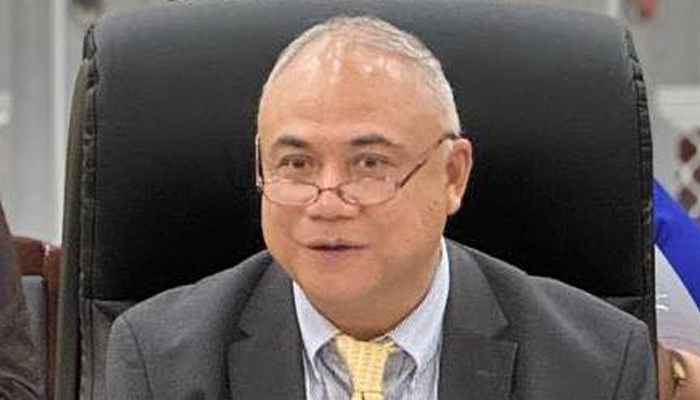
Prime MInister and Minister of Finance Dr ‘Aisake Eke
This follows Parliament’s approval of the Prime Minister’s submission of the 2025-2026 government budget, which passed with 21 votes in favour.
This decision allows the Prime Minister, Dr Aisake Valu Eke, who also serves as the Minister of Finance, to present the details of the budget to the House before it is finalised by July 1.
The budget breaks down into $560.4 million (59%) in recurrent cash expenditures, covering essential government operations, and $389.8 million (41%) for developments.
Detailing the $560.4 million (59%) in recurrent expenditures, Dr Eke highlighted a $29.1 million deficit, meaning the government will need to secure additional funding, raising total recurrent costs to $589.5 million.
Dr Eke defended the allocations, stating the budget aligns with the King’s directives, national priorities, public feedback from recent summits, and government partnerships.
The Minister of Finance announced that the government will secure a $43 million bond to fund the $29.1 million budget deficit. Of this amount, $13 million will be allocated to bond repayments in the new fiscal year, while the remaining $30 million will be directed to the private sector through the new domestic bond market.
Domestic Bond Market
Dr Eke revealed that by the next fiscal year, the government plans to establish a domestic bond market with an initial $30 million allocation. He noted that $300 million in government funds currently held in banks remains unspent.
The new bond policy will utilise $30 million (10%) of these funds to offer bonds to private businesses at an interest rate of 2-3%, significantly lower than the 6-10% rates charged by commercial banks.
He described this as a major shift, providing businesses with cheaper, more accessible financing while reducing reliance on traditional bank loans.
He emphasised his administration’s policy of funding and supporting the private sector, citing a historical lack of financial assistance.
He said that previously, private businesses relied heavily on banks for funding, which often imposed strict lending requirements.
However, opposition lawmakers have raised concerns over reduced infrastructure and long-term investment funding, questioning whether the budget sufficiently addresses Tonga’s development needs.
As deliberations continue live, the nation awaits Parliament’s final decision, which will determine Tonga’s economic direction for the coming year.
The new budget marks a shift from last year’s $899 million budget, which was 52% domestically funded ($452.3 million) and 48% reliant on overseas partners.
Deputy Prime Minister Taniela Fusimālohi has sternly warned reporters about the dangers of inaccurate reporting while providing an update on a complaint he lodged against former Cabinet Minister Sevenitiini Toumo‘ua.
Former Minister of Infrastructure and Civil Aviation Seventeen Toumo’ua
Toumo’ua alleged that staff from Fusimālohi’s Ministry of Infrastructure had dismantled a house previously provided to a family in Ha’asini.
His Facebook allegations included what appeared to be photos of himself and the family living in the house.
The allegations had been promptly raised in Parliament, leading to heated exchanges between Toumo’ua and Fusimālohi, who vehemently dismissed them as false. Fusimālohi said at the time the matter was reported to the Police.
He told reporters on Friday during a press conference that the Police are investigating (“fai e ngāue ki ai”) the complaint.
The disputed house was reportedly part of a government project involving hundreds of prefabricated homes built for the recent Pacific Leaders Forum in Tonga.
After the event, some of these temporary structures were allocated to needy families.
Fusimālohi previously emphasised in the House that the former minister’s claims were false.
On Friday, he urged reporters to verify facts before publishing analyses.
“Inaccurate reporting could land you in court,” the Deputy Prime Minister cautioned, referencing Tonga’s sedition laws, Section 48 and the Electronic Communication Abuse Offences Act (2020).
The latter criminalises using digital platforms to harass or spread harmful content, with penalties of up to $10,000 in fines or three years’ imprisonment, or both.
Deputy Prime Minister Fusimālohi issued this update following his warning to FM 87.5 regarding its analysis program, which inaccurately reported that the government had illegally terminated contracts of former directors of government boards.
Fusimālohi clarified that the contracts had expired naturally in March of this year as per their original terms, and the Eke government had simply declined to renew them.
He noted that the Caretaker government had pre-signed extension of these contracts in December 2024, a move the Eke government maintains was illegal, citing the Caretaker government’s limited authority under the law.
Police investigations into the former minister’s social media posts are ongoing.
In a shocking turn of events, a 21-year-old probationary constable from Tonga Police has been arrested for possession of illicit drugs following a successful operation by the Drug Enforcement Unit.
A Tongan Police officer. Photo/Kaniva Tonga
The arrest occurred on the evening of Saturday, May 31, 2025, during a targeted crackdown on drug-related activities in Nuku’alofa.
Acting on a tip-off about a vehicle allegedly involved in drug sales, officers swiftly mobilised and apprehended the suspects.
A 31-year-old male passenger was also arrested alongside the suspended without pay constable.
Authorities seized methamphetamine, cash, and drug paraphernalia during the operation.
Both individuals remain in custody as investigations continue.
The Tonga Police Commissioner condemned the incident, emphasising that such behaviour undermines public trust.
“This is not a reflection of who we are,” the Commissioner stated, praising the dedication of the majority of officers while reaffirming a zero-tolerance stance on crime within the force.
The public is urged to report suspicious activities as the Tonga Police intensify efforts to combat the spread of illicit drugs in communities.
For media inquiries, contact the Tonga Police Media & Public Relations Office at 740-1614.
NUKU’ALOFA—The king has approved the Eke government’s bill to eliminate the practice of Cabinet Ministers selecting members of the government’s board of directors based on cronyism.
King Tupou VI
The move delivers on a campaign promise to overhaul all government bodies, targeting reform and alleged corruption.
The reforms significantly reduced the cost of board salaries by 29%, slashing annual spending from $1.4 million to just $400,000 and shrinking the total number of directors from 35 to 16.
The seven government boards had been consolidated into five, with appointments now guided by strict “fit and proper” standards.
The government said the move would end the old practice of selecting directors based on personal ties, church affiliations, or political favouritism.
King’s approval
Prime Minister Eke announced the King’s approval of the law on Friday, marking two milestone decisions. First, any government-owned business registered as a company must also be processed and registered as a public enterprise entity.
He said the law also mandates publicly advertised recruitment processes for all director appointments.
The Prime Minister, his Deputy Prime Minister, and several Cabinet Ministers were holding a press conference on Friday.
Deputy Prime Minister Taniela Fusimālohi claimed significant financial losses across government boards resulted from unscrupulous decision-making.
He said the government’s new mandatory “fit and proper person” criteria for selecting qualified, experienced directors will make sure only decent members are selected.
Fusimālohi questioned the appointments of the former board members when he saw a list of names.
He warned that the public would ultimately bear the financial consequences of poor board decisions.
He said this was why the government sought suitable and decent people to operate the government’s businesses.
“Look at Lulutai Airlines. What is happening there raises the question of a fit and proper person.
“Tonga Development Bank, there is the same question there, a fit and proper person”.
“This is not just about saving money—it’s about ensuring qualified, independent leaders oversee public resources,” Fusimālohi said in Tongan.
“No more appointments just because someone is a friend or sits in the same pew on Sundays.”
Questions about the selection process follow a May 2022 Supreme Court case in which former Minister Poasi Tei admitted appointing Saia Penitani—a campaign helper in Houma village and ex-Ministry of Health staffer—to three boards (Tonga Power Ltd, Tonga Water Board, and Tonga Waste Authority) as Minister of Public Enterprises with Cabinet approval.
Tei denied in court that this was political payback, insisting he appointed Penitani based on trust in his ability to deliver results.
The new law
The new law mandates that government businesses be registered as companies and become public entities.
It follows allegations that the former Hu’akavameiliku government failed to register Lulutai Airlines as a Public Entity within the legally required one-year period – an omission that allowed Cabinet Ministers serving on the Lulutai board to retain their positions.
NUKU’ALOFA, Tonga—Deputy Prime Minister Taniela Fusimalohi has revealed that none of the board directors whose contract renewals were rejected by the Eke government pursued legal action, despite earlier claims of illegality.
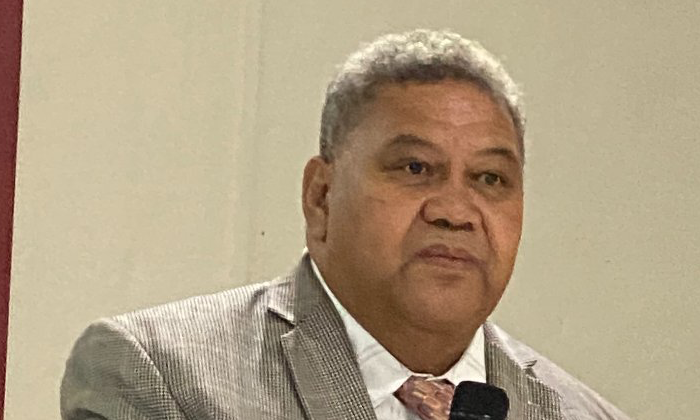
Katalina Tohi (L) and Deputy Prime Minister Taniela Fusimālohi
Fusimālohi also clarified that reports claiming the government had illegally terminated the contracts of former directors were misleading.
He explained that the directors, appointed by the previous government, had remained in their board roles until March this year—the official end of their contracts.
The Eke government rejected the pre-renewal of those contracts, which the Caretaker government approved around December 2024.
Fusimālohi defended the government’s decision, stating that the Caretaker government lacked the authority to renew contracts as it held limited powers pending the incoming government’s transition.
Agreement with former directors
Fusimālohi revealed that the Minister for Public Enterprises had a “productive discussion” with the former directors.
Fusimālohi said the Minister met with them and explained the government’s new policy and guidelines for all government boards.
According to Fusimālohi, the Minister informed the former directors of their contract end dates, explained the new restructuring process, noted that a new recruitment would occur, and stated they could reapply.
Fusimālohi said in Tongan: “Pea’ ne ‘osi fai e talanoa lelei ia ‘a e Minisitaá mo kinautolu. Ko e kaha‘u ē te tau fokotu‘utu‘u lelei. Ko ho‘omou me‘á ē ‘oku ha‘u ‘o ngata hē. ‘E toe fai e likulutimeni fo‘ou. Mou kei ‘enitaitolo pe ki ai.”
The revelation and clarifications come amid escalating tensions between the government and local media, particularly after Fusimalohi called for the removal (“to‘o”) of FM 87.5’s radio show in which host Siaosi Lavaka featured Tongan-based Auckland lawyer Nalesoni Tupou, who allegedly claimed that the contract terminations were unlawful.
Directors’ Exit Sparks Legal Debate
However, critics, including broadcaster Katalina Tohi, who owns FM 87.5, have accused the Eke administration of disregarding natural justice.
Tohi warned that the former directors had legal rights and referenced past cases where similar government actions led to costly court rulings.
Responding to Tohi, Fusimālohi emphasised that journalists (kau faiongoongo) must verify their facts before presenting commentary or analysis.
He explained that this is why the government holds one-hour press conferences every Friday—to ensure the media receives accurate information.
He said he had already advised journalists to read Parliamentary Hansard and government statements before reporting.