A Tongan missionary for The Church of Jesus Christ of Latter-day Saints has reportedly been injured in what appears to have been a machete attack in Papua New Guinea.
Footage circulated on social media, seen by Kaniva News, shows a man in a white shirt, smeared with what appears to be human blood, walking with one hand tightly wrapped in black cloth, apparently indicating the location of his injuries.
Facebook user, Maʻata Monu Halafihi, shared the video and photographs online showing the young man with visible injuries.
She identified him as a relative, Elder Lautaha, who was the victim of the alleged attack.
At this stage, no official details about the incident have been released.
According to Halafihi’s account, Lautaha and his missionary companion managed to escape their attacker and sought refuge at the LDS church, where they were reportedly able to find safety.
Halafihi also posted words of encouragement for the injured missionary, wishing Elder Lautaha and his companion a “speedy recovery.”
The circumstances surrounding the attack, the extent of the injuries, and the safety of other missionaries in the area remain unclear.
Kaniva News sought comment today from both the victim and LDS Church authorities, but was unable to reach them.
This is a developing story, and further updates will be published as more information becomes available.
Nukuʻalofa — A 39‑year‑old father of six has been jailed for 18 months after the Supreme Court of Tonga sentenced him for cultivating and possessing cannabis, along with the unlawful possession of drug utensils.
The sentence, delivered by Lord Chief Justice Bishop KC, drew attention not only to the seriousness of the offending but also to the severe consequences for the prisoner’s young family, who now face life without their sole provider.
Mekiloni Fotu Aso, a carpenter and part‑time plumber from Fuaʻamotu, pleaded guilty to three charges after police discovered 63 cannabis plants, 266 grams of packed cannabis, and drug‑smoking utensils during a search of his home on 14 July 2025.
He admitted ownership of the items and cooperated with police. The court found he played the role of a supplier, noting the need for deterrence and strong denunciation in drug‑related cases.
According to the pre‑sentence report, Aso is the sole breadwinner for his family, supporting six children aged between 15 years and six months. The court heard he had no previous criminal convictions and had maintained stable employment within his brother’s construction business.
His sudden imprisonment leaves his children without their primary source of financial support, a factor the judge acknowledged when ordering the return of TOP$390 seized during the police search, noting it belonged to the family and was needed for their welfare.
Despite Aso’s cooperation and early guilty plea, the court determined that the scale of cultivation and the presence of utensils used for consumption and distribution required a custodial response.
He was sentenced to 18 months, with the final six months suspended for two years on strict conditions, including probation supervision, reporting requirements, and mandatory participation in a drug and alcohol awareness programme. All other sentences for related counts were ordered to run concurrently.
Lord Chief Justice Bishop stressed that while this was Aso’s first offence, the seriousness of his actions could not be overlooked. However, he also acknowledged the impact on his children, stating that the return of the seized money was necessary given the family’s dependence on him for survival.
Aso will serve 12 months in custody, followed by six months suspended, during which he must remain offence‑free or risk serving the remaining term in full. His imprisonment, the court noted, stands as both a punishment for his offending and a stark reminder of the collateral damage experienced by families left behind.
Nukuʻalofa — The Supreme Court of Tonga has handed Bijay Singh an eight‑month prison sentence, fully suspended for three years, after he pleaded guilty to forgery, knowingly dealing with a forged document, and obtaining money and goods by false pretences totalling TOP$300.
Singh pleaded guilty on 5 November 2025 to four charges stemming from incidents on 17 April 2025, when he used a false cheque from a Sean & Huberto Auto Repair chequebook without authorisation.
The offences included forgery, after he issued a counterfeit cheque intending Palu Trade Vaini Service Station to treat it as genuine.
He then knowingly dealt with a forged document by submitting the same cheque for payment.
He also obtained money and goods by false pretences, receiving TOP$200 from a victim using a fraudulent TOP$300 cheque and securing TOP$100 worth of fuel with that same false cheque.
The Crown sought a custodial outcome, recommending eight months’ imprisonment with two months suspended, citing the seriousness of forgery and comparable cases.
A pre‑sentence report noted Singh’s background (a Fiji national living in Tonga since 2017, in a de‑facto relationship with three young children, employed at HM Imports Tonga) and assessed him as at high risk of re‑offending given prior financial offending and a 2016 deportation. Defence counsel sought a fully suspended sentence with strict conditions to support rehabilitation.
In delivering his decision, the Lord Chief Justice Bishop KC said he initially believed imprisonment was necessary “to remove you from society so that the public are protected.”
However, his position shifted after reading a letter from the defendant’s employer, which described the offender in unexpectedly positive terms.
The employer stated that the accused was “the best in Tonga” at his job, had stopped consuming alcohol, and had agreed to a structured repayment plan for his debts, with deductions taken directly from his wages. The judge said these factors weighed heavily in favour of giving the offender one final opportunity under strict conditions.
Mr Bishop also warned the accused: “This is your last chance… any breach will result in the eight months being activated in full.
Lord CJ Bishop set Count 2 as the head count, imposing a 10‑month starting point, reduced by two months for an early guilty plea (net eight months).
For Counts 1, 3 and 4, the Court imposed 5 months, 3 months, and 3 months, respectively, all concurrent with the head sentence.
While emphasising the need to “stamp out” forgery because it “makes commercial life in the Kingdom more difficult and causes loss to innocent people,” the Court credited Singh’s cooperation, early plea and a strong letter from his employer describing him as “the best in Tonga” at his job, noting alcohol cessation and wage deductions arranged to repay debts. On balance, the Court fully suspended the eight months for three years.
The suspension carries strict conditions:
No offending punishable by imprisonment during the suspension;
Repayment to victims within 12 months;
Placement on probation for the duration of the suspended term.
Any breach will activate the full eight months in custody.
“You have been given every chance… We must remove you from society so that the public are protected,” the judge said, adding he was “very reluctant” but persuaded to suspend the term given the employer’s guarantees and the structured repayments already in place.
Tongan‑born Scotland captain Sione Tuʻipulotu received remarkable royal attention this week when Princess Anne, The Princess Royal, presented him with the Calcutta Cup following Scotland’s 31–20 victory over England in the Guinness Six Nations match at Murrayfield Stadium on Saturday.
The emotional post‑match moment was widely shared across social media, showing Princess Anne warmly congratulating Tuʻipulotu as he stepped forward to receive one of rugby’s oldest and most prestigious trophies.
The Royal’s gesture — including a brief embrace — struck a chord with fans in both Scotland and Tonga, celebrating not only the victory but the milestone for a proud Tongan captain leading a Tier‑1 national side.
A Proud Day for Tonga and Scotland
Tuʻipulotu played a direct role in Scotland’s early dominance, throwing the long, pinpoint pass that sent flanker Jamie Ritchie over for Scotland’s second try at the 14‑minute mark, helping his side surge to a commanding 17–0 lead.
Match reports detail how he controlled Scotland’s midfield attack, combined cleanly with Finn Russell, and maintained clarity under pressure during key momentum swings, setting the tone for what became Scotland’s fifth win in six Calcutta Cup clashes.
Tuʻipulotu’s leadership was just as significant as his playmaking.
After a difficult opening‑round loss to Italy, he had spoken of the squad’s “desperation” to respond, and he backed that up with a performance rooted in discipline and intent.
Post‑match, he said he was “beyond proud” of the team’s effort, praising the collective resilience that helped Scotland blunt England’s attempts to fight back, particularly when the visitors were reduced to 14 players for two extended spells.
His command of the midfield defence and his direction at key moments reinforced Scotland’s control of the game, making the Calcutta Cup triumph both a tactical and emotional milestone in his captaincy.
Tuʻipulotu’s rising profile in European rugby mirrors the growing influence of Tongan athletes across global sport.
His Calcutta Cup moment, acknowledged personally by Princess Anne, further amplifies his standing as a cultural ambassador for both Tonga and Scotland.
A stunning debut try has put young Tongan flyer Sialetili Faeamani firmly on the NRL radar this week, with the Gold Coast Titans praising the 21‑year‑old for his explosive performance and growing impact within the club’s new generation of talent.
While coach Josh Hannay has spoken openly about the challenges ahead in the Titans’ rebuild, Faeamani’s try stood out as a bright spark — a sign that the club’s investment in emerging players is already beginning to pay off.
Josh Hannay, who took over as head coach in the off‑season, recently said “there’s going to be pain” for the Titans as they reshape their roster and transition heavily towards youth.
The inclusion of 21‑year‑old Faeamani — a Tongan‑heritage winger built for power and speed — is a clear illustration of that shift.
Faeamani, born in Auckland to Tongan parents, joined the Titans from the Penrith Panthers on a development contract for the 2026–27 seasons. The club viewed him as a long‑term project, but his explosive pre‑season performances accelerated that timeline dramatically.
NRL.com reported that Faeamani impressed Hannay with his strong carries and work ethic during trials, earning him selection for both pre‑season challenge matches and positioning him for an NRL Round 1 debut.
Zero Tackle later confirmed the Titans promoted him into their Top 30 squad, clearing the way for his first NRL appearance.
Faeamani rewarded the faith in him by scoring a try in his debut against the Cronulla‑Sutherland Sharks in Round 1. The Sporting News’ team list listed him as the Titans’ starting winger for the opening match of the 2026 season.
Hannay’s warning: ‘There’s going to be pain’
Hannay’s stark assessment — that the Titans will endure “pain” in 2026 — was tied directly to the club’s decision to rebuild its roster around promising young players like Faeamani.
The Gold Coast finished near the bottom of the ladder last season and narrowly avoided the wooden spoon, prompting Hannay to overhaul the squad and prioritise youth development. The Sporting News noted that the team has entered 2026 with a renewed system and several new faces in key positions.
Faeamani is the prototype of that new era: hungry, physical, and raw — a player whose development will take time, but whose ceiling is high.
Faeamani’s journey to the NRL has been anything but easy. After starring in 1st XV rugby for St Peter’s College in Auckland, he switched from union to league, joining the New Zealand Warriors’ SG Ball and Jersey Flegg squads. He then moved to Penrith, where he played U21s and earned his first NSW Cup appearances.
His performances caught Hannay’s attention, leading to his recruitment at the Titans. LeagueNews.co confirmed Faeamani signed a two‑year deal after impressing in Penrith’s 2025 campaign.
Faeamani himself said the transition to the NRL and the decision to leave New Zealand was a “risk,” but one that was “worth it.”
Symbol of a new Titans identity
For coach Hannay, blooding players like Faeamani is part of the long‑term plan. The coach highlighted the youngster’s “strong carry” and “great work ethic,” pointing to him as a player who fits the new identity he hopes to build on the Gold Coast.
But Hannay also knows that relying on rookies means inconsistency — hence the forecast of “pain” before the team finds stability.
The Titans’ Round 1 lineup featured several emerging players, including Faeamani, Jojo Fifita, and new halfback Lachlan Ilias, as part of a team reshaped significantly over the off‑season.
This youth movement reflects Hannay’s long‑range strategy:
Develop young talent now
Accept short‑term challenges
Build a stronger future core
As one of their most promising young backs, Faeamani sits squarely at the centre of that vision.
A Tongan star in the making?
The Auckland‑born winger proudly embraces his Tongan heritage and has already spoken about his ambition to represent Mate Ma’a Tonga at international level — a dream he hopes to fulfil if he can secure regular NRL minutes this season.
If his debut performance is any indication, Faeamani may soon become one of the standout Tongan players in the NRL’s next generation.
While the Titans brace for the tough season their coach has predicted, the emergence of players like Sialetili Faeamani offers hope for a brighter future.
In many ways, his journey captures the story of the Gold Coast in 2026: raw talent, signs of promise, early success — and a long road still ahead.
A young female police officer has broken into one of Tonga’s most male‑dominated cultural roles, emerging as a standout talent in the traditional art of drumming.
Constable Cecilia Le‘ao of Houma, Tongatapu, is attracting widespread admiration after stepping forward as a ma‘ulu‘ulu drummer—an honour traditionally reserved for men—and delivering a performance praised for its precision, power, and professionalism.
Her performance this week during Queen Sālote College’s centennial preparations drew significant public attention.
With many travellers arriving from overseas to attend the 100th anniversary, videos of Le‘ao’s exceptional drumming quickly spread across social media, becoming a frequent topic of praise and admiration.
The practice of tā nafa mā‘ulu‘ulu—the drumming that accompanies a mā‘ulu‘ulu performance—developed its own distinctive style separate from the dance itself.
Various drumming groups created signature rhythms by featuring a lead drummer who performed the main riffs and runs, while the rest of the drummers provided the supporting beat.
While drumming of this kind was never reserved exclusively for men, it was uncommon for women to perform it because of the physical demands involved. This is precisely what made Le‘ao’s performance so striking and captivating.
Interestingly, she is in her early 20s and of average build for a young woman, which further contributed to the high level of public attention she received.
The College’s celebration is a major event in Tonga, not only because it marks a significant anniversary, but also because the school belongs to the nation’s largest Christian denomination, the Free Wesleyan Church of Tonga.
International Women’s Day Tribute
According to a statement released by the Ministry of Police for International Women’s Day, Constable Le‘ao has served with Tonga Police for two years and eleven months and is currently stationed at the Nukunuku Police Station.
Balancing her responsibilities as a committed officer, she has also become known for her impressive musical ability, which recently took centre stage during the final rehearsal for Queen Salote College’s 100th anniversary commemoration.
Her involvement in the iconic school’s preparations underscores the vital role police officers play in supporting community events and national milestones. But it also represents something more: a quiet revolution in gender expectations within Tongan performing arts.
A Talent Born in Childhood
Le‘ao’s passion for drumming began long before she donned the police uniform. Growing up, she spent countless hours watching her father play the drums. His dedication to music left a strong imprint on her, shaping both her love for the instrument and her determination to learn.
Although she was told throughout her youth that drumming was a skill “only for men,” she refused to abandon her interest. Her defining moment came when her father was once unable to fulfil a drumming commitment. She stepped in—and never looked back.
Learning directly from her father, Tēvita Le‘ao developed not only her technique but the confidence to perform traditionally male roles with skill and dignity. His influence remains one of the strongest pillars of her musical journey.
Celebrating Diversity Within Tonga Police
Tonga Police has welcomed Constable Le‘ao’s achievement, noting that her story reflects the diverse talents within the organisation. Officers, they emphasise, are not only protectors of public safety but also active contributors to cultural, educational, and community life.
Constable Le‘ao’s rise as a female ma‘ulu‘ulu drummer is seen as an inspiring example of strength, resilience, and the evolving role of women in the Kingdom. Her dedication—both to policing and to preserving Tongan performing arts—continues to inspire colleagues, students, and community members alike.
By recognising officers such as Constable Le‘ao, Tonga Police celebrates the determination and achievements of women who break barriers and redefine what is possible for future generations.
Greymouth, NZ — A major search and rescue operation is under way in Greymouth after a report that a person was swept out to sea on Saturday evening.
Senior Sergeant Mark Kirkwood of West Coast Search and Rescue confirmed that emergency services were alerted around 6pm on Saturday after witnesses reported seeing someone carried out by the tide in the Greymouth/Blaketown area.
A large-scale response was launched, involving Police, Fire and Emergency New Zealand, Kotuku Surf Lifesaving, and Garden City Helicopters.
Search teams worked across the shoreline and offshore through Saturday evening and into today.
Among the assets deployed was the Emily B Drifter, a device used to simulate how a person in the water may drift, helping teams to predict likely search areas.
At approximately 7:30pm, a kayak was found washed up near Blaketown.
Police are now working to determine whether the kayak is linked to the person seen in the water.
“We are asking anybody who recognises this kayak, or who has not heard from someone who was kayaking in Greymouth yesterday, 7 March, to contact Police,” Senior Sergeant Kirkwood said.
Members of the public with information are urged to call 105 and quote reference number P065678948.
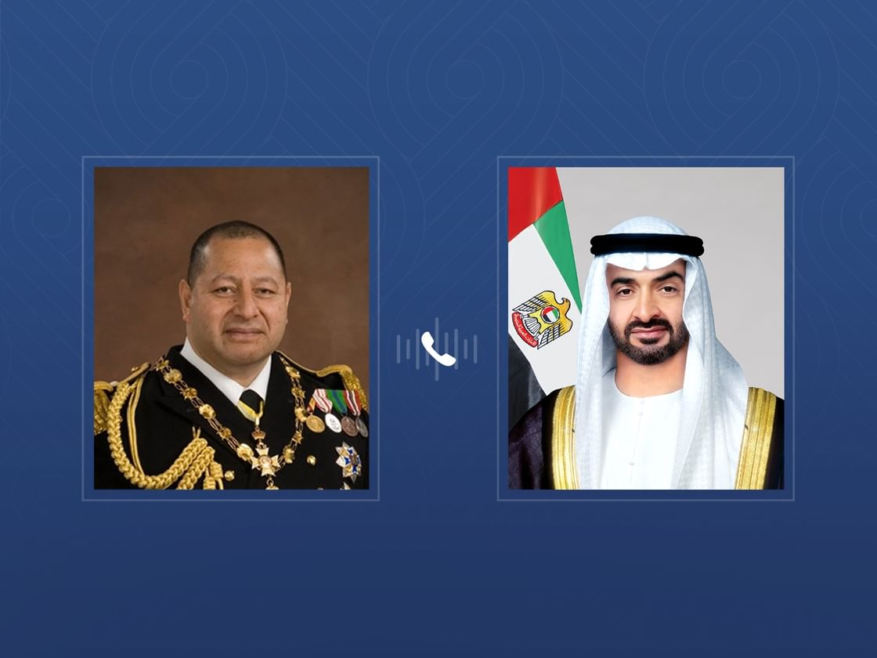
The King of Tonga has condemned the Iranian attacks targeting the United Arab Emirates (UAE) and other regional states, calling them a grave violation of national sovereignty, international law and the principles of the UN Charter.
His Highness thanked His Majesty Tupou VI for his supportive stance towards the UAE. Photo/WAM
The denunciation was conveyed to UAE President His Highness Sheikh Mohamed bin Zayed Al Nahyan during a phone call from His Majesty King Tupou VI of Tonga, according to the Emirates News Agency (WAM), the official state news agency of the United Arab Emirates.
His Highness expressed appreciation for Tonga’s supportive position as both leaders emphasised the need for dialogue and diplomacy to maintain regional and international security.
Iran Offensive Meets Surge
The call came amid intensifying conflict as the United States and Israel escalate joint military operations against Iran, with airstrikes reported across Tehran and Beirut while Iran launches retaliatory missile and drone attacks targeting Israel, U.S. bases and Gulf nations.
Israeli and U.S. military officials say most of Iran’s missile launchers and air defences have been destroyed, with B‑2 bombers striking deep underground facilities as part of an expanded offensive.
In the past 72 hours, President Donald Trump has signalled a major escalation in the conflict with Iran, with U.S. stealth bombers expected to arrive soon at UK military bases as part of an expanded air campaign.
The New York Post reports that Trump previously warned Tehran that “the big one” could be imminent, as the administration prepares for what officials describe as a significant surge in military strikes.
The Northrop B‑2 Spirit, the U.S. Air Force’s heavy strategic stealth bomber designed to evade advanced air-defence systems and deliver long‑range precision strikes, is among the aircraft positioned for potential deployment in the intensified operation.
Power Vacuum Widens in Tehran
Meanwhile, Iran’s leadership remains in flux following the killing of Supreme Leader Ayatollah Ali Khamenei in earlier strikes, with state media reporting preparations to select a new leader as the conflict enters its seventh day.
Iran declared the Strait of Hormuz closed, and drone-related incidents impacted U.S. diplomatic facilities in the Gulf.
In the last 48 hours, international media reports said Gulf countries remain on high alert as Iran has launched several waves of drone and missile strikes across the region in response to continued attacks by the United States and Israel.
Kuwait, Bahrain and the United Arab Emirates faced a barrage of Iranian attacks late on Thursday, with the Kuwaiti army’s general staff saying in a social media post that air defences were intercepting projectiles in the country’s airspace, Al Jazeera reported.
International responses to the war continue to evolve, with Canada not ruling out future military involvement and China preparing to send a special envoy to help mediate the conflict.
Meanwhile, Russia is reportedly providing Iran with intelligence on the locations and movements of American troops, ships and aircraft, marking the first indication that Moscow has sought to involve itself in the conflict, according to CNN.
Evacuation Urged for Tongans
The King’s message followed a series of travel notices issued by Tonga’s diplomatic services advising Tongans in the Middle East to register with Tonga’s Embassy in the United Arab Emirates and, most recently, urging them to leave the region as soon as possible.
Tonga and the United Arab Emirates maintain formal diplomatic relations, established in July 2007, forming the basis for growing cooperation between the two nations.
In recent years the relationship has strengthened further, including the signing of a Promotion and Protection of Investment Agreement at COP28 in Dubai in December 2023, aimed at expanding economic and development partnerships.
High‑level meetings between Tongan and Emirati leaders have also underscored both countries’ commitment to deepening collaboration in areas such as renewable energy, climate resilience and sustainable development.
Nuku‘alofa — The Tongan Government has once again postponed the enforcement of its planned ban on importing vehicles aged 10 years or older, extending the effective date to 30 June 2026.
The Ministry of Revenue and Customs announced the decision today following approval by Cabinet on 13 February 2026.
The prohibition was originally reinstated on 22 November 2024 by direction of the Legislative Assembly, before being deferred by Government directive on 21 February 2025.
According to the Ministry, the latest extension is intended to give Government agencies responsible for environmental protection, waste management, road transport, and customs operations more time to prepare for implementation.
Officials say the additional months will enable ministries to strengthen legal frameworks, align procedures, and conduct public awareness programs to ensure the prohibition can be effectively enforced.
The Ministry also called for cooperation from the public, including the Tongan diaspora, as well as shipping agents and freight forwarders.
Authorities urged importers to plan ahead and avoid the significant expenses and risks associated with bringing in vehicles that will become prohibited under the new rule.
The prohibition aims to reduce the importation of older vehicles, which are often linked to higher emissions, increased waste challenges, and greater road safety concerns.
Members of the public seeking more information are encouraged to contact the Ministry of Revenue and Customs on 7400653 or via email at cst@revenue.gov.to.
Prime Minister Christopher Luxon has emphatically rejected speculation about his leadership, insisting today that he is “absolutely not” considering stepping down despite a new poll showing support for the National Party plunging to its lowest level in more than four years.
Luxon made the comments in a live interview with Newstalk ZB after the latest Taxpayers’ Union–Curia poll put National at 28.4 percent, a nearly three‑point drop from last month and the party’s weakest result since 2021.
The Prime Minister told the broadcaster that all his ministers had assured him they continued to back him, dismissing rumours of internal pressure.
The RNZ report earlier today noted that Luxon was facing heightened scrutiny following a difficult week in which he struggled to articulate the government’s position on the Iran conflict, adding fuel to political speculation.
Despite this, Luxon said the “only thing” he was focused on was “the future of our children and grandchildren,” stressing that he still believed he had the skills to lead both the National Party and the country.
A separate report from Reuters described the poll results as the ruling party’s worst polling performance in over four years, noting that Luxon is no longer the public’s preferred prime minister—a symbolic blow less than eight months out from the November general election. The Reuters analysis found support for National’s coalition partners, New Zealand First and ACT, also slipping as the centre‑left Labour bloc gains ground.
Luxon, however, pushed back strongly against mounting speculation, insisting there is “no problem” with his leadership and that the public polling does not align with National’s internal numbers. He also said he had not set any threshold at which he would consider resigning, emphasising that he retains the full confidence of his caucus.
The Otago Daily Times reported that senior National ministers were today rallying behind the Prime Minister, saying there was “no need to panic” despite the political fallout. Finance Minister Nicola Willis acknowledged the result was “not acceptable” but reiterated her support for Luxon’s leadership.
Asked whether he was shaken by the poll, Luxon said the media had “gotten carried away” and that he appeared on radio specifically to dispel rumours that he was contemplating standing down. “No, I’m not doing that,” he told Newstalk ZB.
With the government facing a weakening economy, rising unemployment and growing public dissatisfaction, the coming months will determine whether Luxon’s insistence on staying the course can stabilise his leadership—or whether today’s poll marks the start of a deeper political crisis.