The Tonga National University (TNU), Public Service Commission and the country’s qualifications authority have jointly pledged to resolve problems surrounding the recognition of certificates from some TNU courses, following concerns raised in Parliament last month.
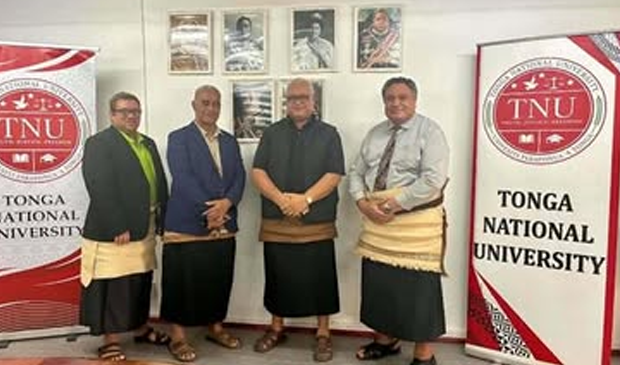
L-R: CEOs of PSC, Keni Tuʻuhetoka, MET, ʻIsikeli Oko, TNQAB Vilimaka Foliaki and Vice-chancellor of TNU, Dr. Giulio Masasso Paunga.
In a brief joint press release, TNU, the Tonga National Qualifications and Accreditation Board (TNQAB), Ministry of Education and Training (MET) and PSC said they wished to “jointly affirm their commitment to resolving matters relating to the issuance and recognition of certificates for students of TNU”.
However, the statement provided no details about which courses or qualifications were affected, how many students were involved, why the certificates had not been recognised or what action would now be taken to resolve the issue.
The statement comes after Kaniva News reported that Parliament was told some students had paid for, completed and passed TNU courses, only to find that their qualifications were not accepted by the PSC.
Tongatapu 7 MP Piveni Piukala told Parliament that graduates from TNU’s Business Faculty had complained that the PSC refused to recognise their qualifications, reportedly because some programmes had not been accredited by TNQAB.
Piukala said the students had paid for, completed and passed the courses.
Tongatapu 4 MP Māteni Tapueluelu said similar complaints had repeatedly been raised during a visit to his constituency.
He told Parliament that those involved had confirmed that some TNU courses had not yet been accredited, and questioned how students had been allowed to undertake those courses under such circumstances.
The new joint statement appears to confirm that the four institutions are now collectively addressing the matter.
TNU said TNQAB had fully registered it as a Post-Compulsory Education and Training provider and that it currently offers about 55 programmes through its faculties of Nursing and Health Sciences; Education, Arts and Humanities; Science and Technology; and Business and Public Administration.
“All parties acknowledge the importance of their collective effort on this matter,” the joint statement said.
Tonga is set to benefit from a new wave of United States and Australian investment in Pacific maritime security, including measures targeting illegal fishing, drug trafficking and other cross-border crime across the region.
Australia and the United States announced separate packages worth about US$580 million during the recent Pacific Islands Forum Leaders Meeting in Palau, as regional governments seek greater capacity to police their vast ocean territories.
For Tonga, the announcements are significant because the Kingdom controls an Exclusive Economic Zone vastly larger than its land area and is already among Pacific nations participating in a maritime shiprider arrangement with the United States.
Under such agreements, Tongan maritime law-enforcement personnel can embark on US vessels and exercise Tonga’s authority in its waters and Exclusive Economic Zone, extending the country’s ability to detect and respond to illegal activity far offshore.
US targets illegal fishing
The United States announced more than US$150 million in new Pacific initiatives, including US$17 million specifically aimed at combating illegal, unreported and unregulated fishing, commonly known as IUU fishing.
The programme is expected to help Pacific countries strengthen national laws and regulations, provide certified training for compliance officers and introduce new monitoring technologies.
For small island states such as Tonga, enforcement presents a particular challenge because limited patrol and surveillance resources must cover large areas of ocean.
Illegal fishing can deprive Pacific countries of fisheries resources and revenue while vessels operating beyond effective surveillance can be difficult for national authorities to detect and inspect.
Australia has also committed about US$430 million towards regional security measures, including enhanced aerial surveillance, policing cooperation and efforts to combat transnational drug trafficking.
Australian officials said aerial surveillance is already being used in the Pacific to combat illegal fishing, including privately operated aircraft funded by Australia’s Department of Defence.
Tonga part of shiprider network
Tonga is among a group of Pacific nations participating in US maritime shiprider arrangements alongside countries including Fiji, Samoa, Tuvalu, Vanuatu, Kiribati, Palau, Papua New Guinea and the Marshall Islands.
The arrangements allow Pacific law-enforcement officers to work aboard US vessels, providing additional reach for countries that otherwise have limited vessels, aircraft and personnel available to patrol their EEZs.
The growing cooperation was demonstrated earlier this year during the US Coast Guard’s Operation Blue Pacific, when the cutter Harriet Lane undertook a 75-day Pacific patrol.
US Coast Guard personnel assisted Fijian and Papua New Guinean authorities with 42 vessel boardings during the operation.
More US investment for Tonga
The maritime enforcement initiative comes alongside another US commitment directly involving Tonga.
Washington announced plans for a feasibility study aimed at strengthening Tonga’s fuel supply reliability and energy security, including possible upgrades to port facilities, fuel storage capacity and pipeline infrastructure.
The project forms part of a wider US$60 million regional energy-security initiative announced at the Forum.
Tonga has therefore emerged among the Pacific countries specifically identified for infrastructure and security-related assistance under Washington’s latest regional investment package.
The announcements come as Pacific governments face overlapping maritime challenges, ranging from illegal fishing and drug trafficking to the enormous practical task of monitoring some of the world’s largest ocean territories with relatively small national enforcement agencies.
Sydney, Australia – A second man has been charged with murder over the fatal shooting of Tongan-Australian man Alai Ahio during an alleged ambush at a Canley Heights home in May.
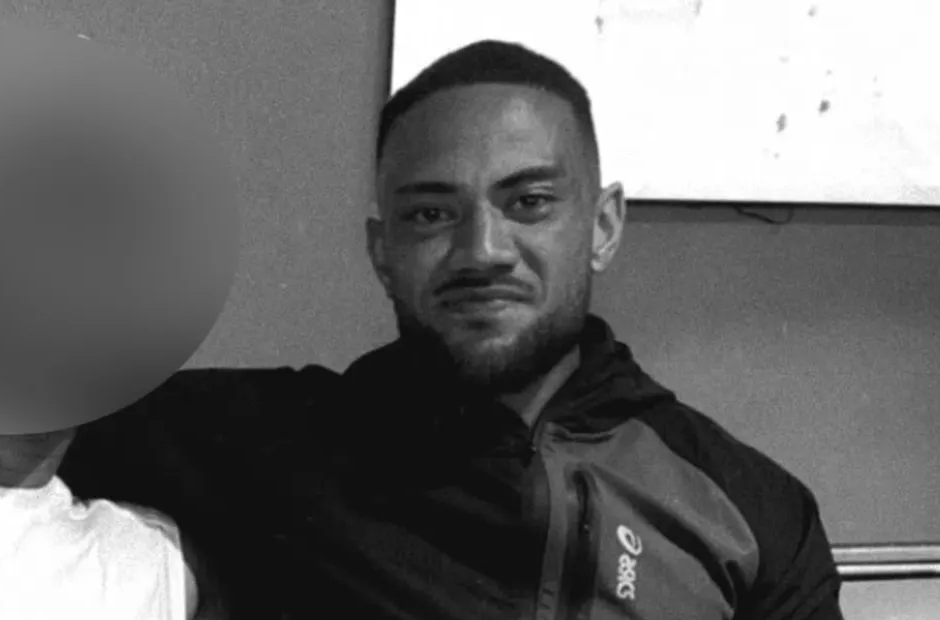
‘Alai ‘Ahio
Ahio, 28, was among five men allegedly attacked at a house on Arbutus Street on May 19. He arrived at Liverpool Hospital suffering from a gunshot wound but died shortly afterwards, while four other men sought treatment for injuries at Liverpool and Fairfield hospitals.
NSW Police said detectives arrested the latest accused, a 37-year-old man, at Silverwater at about 10.40am on Tuesday following further investigations by Strike Force Valko.
The man, identified in Australian media as Mahmoud Atwa, was charged with murder, possessing or using a prohibited weapon without a permit, and participating in a criminal group contributing to criminal activity.
He was remanded in custody and scheduled to appear before Bail Division Local Court on Wednesday.
Police said a 32-year-old man injured in the May attack was treated for a neck injury and remained in a serious but stable condition at the time.
Two other men, aged 23 and 22, presented at Fairfield Hospital in serious condition, while a 19-year-old man later arrived at Liverpool Hospital with an arm injury.
A 23-year-old man, identified in court reporting as Rishi Prakash, was arrested at Sydney International Airport in July and charged with murder and two counts of possessing an unauthorised pistol. He remains before the courts.
Australian media have described Ahio as a former associate of the Sydney drill-rap group OneFour. There is no suggestion that the group or the other victims were involved in the alleged attack.
Police said investigations into the shooting under Strike Force Valko were continuing. The National Tribune
These two short original songs were composed as practical works through which I will begin testing Punake Theory. They are presented in the Tongan numerical notation system known as tuʻungafasi—the practice of notating and staffing music through numbers organised into rows and columns. Two audio recordings of the songs are also embedded on this page. The two songs are titled Peau 1 and Peau 2, reflecting the use of peau (waves) as a figure of speech, or heliaki, in the application’s questions-and-answers document. All notation, lyrics, and audio presented here are preliminary and subject to substantial development and revision throughout the six-month Fellowship. They are intended solely as initial creative experiments through which the ideas proposed for the Fellowship can be tested.
Peau 1
Verse 1
Seuke si‘i fakamani mani ‘a e pe a u Si ene ta alo
33 : – I – : 78 II 33 : 33 I 39 : 8 II 87: 78 I 7 : – II – : -II 88 : 87 I 8 : 7 II 7:
Kau nofo au mo e fakaamu pehe ange mai ke u heka he alapalavu
75 I 5 : 79II 8 : 7 I – : – II 99 : 99 I 8 : 7 II 99 : 99 I 88 : 77 II 9 : 9 I – :
He taau e hiki fonua maa e kahau Aotearoa ko e kenani
– II 88 : 3 I 3 : 3 II 3 : 98 I 89 : 8 II 7 : – I – : – II – : 33 I 33 :33 II 33 : 3 I 33
fakatalutalu Kuo tohi tongi koe heeku manatu Heku o ke hoko
33 : 33 I 3 : 3 II – : – I 4 : 4 II 4 : 4 I 99 : 99 II 33 : 3 I – : – II 33 : 33 I 3 :7 –
Ko hoto salusalu Teu tau leva ki he pa anga ngalu
5 II 44 : 44 I 4 : 3 II – : – I 4 : 43 II 39 : – I 9 : -5 II 54 : 88 I 33 : – I – : – II
Peau 1 (lyrics)
Verse 1
Seuke si‘i fakamanimani ‘a e peau
Si’ene ta’alo kau nofo au moe fakaamu
Pehe ange mai ke u heka he alapalavu
He taau e hiki fonua ma’a e kaha’u
Refrain
Aotearoa ko e Kenani fakatalutalu
Kuo tohi tongi koe he’eku manatu
He kuo ke hoko ko hoto salusalu
Te u tauleva ki he pa’angangalu
Peau 2
Verse 1
Ko e peau tā e fanga Onehunga Kuo ne aake vilo pea ne taka ha ha! Ha ha!
3333 : 3333 I 3333 : 3 II 3333 : 3333 I 3333: 3–3 II 3 : 3–3 I 3 : 3II
Tala atu tama hake pea ke hola He ‘oku ta’au mo fakailifia ha ha! Ha ha!
9999 : 9999 I 8888 : 8 II 9999 : 9999 I 8888: 8–3 II 3 : 3–3 I 3 : 3II
Refrain
‘Oiaue! Fakapo! ‘Oiaue! Fakapo Tala ki ‘uta ‘oku tapu e hifo ‘Oiaue! Faka
5-55 : 54 I 3 : – II 5-55 : 54 I 3 : – II8888 : 8888 I 9999 : 9 II5-55 : 54 I
po ‘Oiaue! Fakapo! Tala ki ‘uta ‘oku tapu e hifo
3 : – II 5-55 : 54 I 3 : – II 9-99 : 9999 I 3333 : – II
Tonga’s long-awaited dialysis centre project, which the nation was told would be launched last year, has effectively collapsed after the United States-based organisation behind it failed to secure the funding needed to deliver the promised service, Health Minister Dr Siale ʻAkauʻola has revealed.
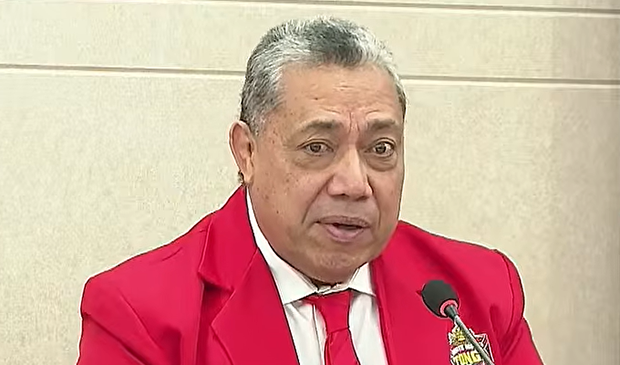
Dr Siale ‘Akau’ola, Minister of Health
The disclosure marks a dramatic setback for a project that was initially presented as a major philanthropic initiative backed by a Utah-based family with medical and business connections and an interest in addressing Tonga’s growing burden of diabetes and kidney disease.
In 2019, Utah news outlet KSL reported that Dr Mansoor Emam, a US-based doctor who had visited Tonga and treated patients suffering from diabetes and related illnesses, and his brother-in-law Khosrow B. Semnani, a prominent Salt Lake City industrialist and philanthropist, were behind plans to build the dialysis facility in Tonga.
The 2019 report did not indicate that the project was dependent on raising funds from donors or other outside sources. By 2024, however, fundraising and donor support had become an explicit part of efforts to establish the dialysis service, indicating that securing sufficient funding had become a significant issue for the project.
Dr Emam’s son, Rod Emam, had close ties to Tonga through his friendship with the late Tongan-American Siaosi Brown. Following Brown’s death while attempting to rescue a woman and child from dangerous waters in Utah, Emam proposed naming the dialysis facility the Siaosi Brown Dialysis Center in his friend’s memory. KSL reported that Dr Emam and Semnani agreed to the proposal.
Dialysis Project Background
The dialysis centre was to form part of a larger facility known as the Semnani Health Center and was promoted as bringing desperately needed dialysis treatment to Tonga, where no such service is currently available.
Tonga has a high burden of non-communicable diseases, particularly diabetes and hypertension, which can lead to chronic kidney disease and kidney failure. With no established dialysis service in Tonga, patients requiring dialysis have had to seek treatment overseas, including in Fiji, New Zealand and the United States, often at considerable financial and personal cost.
Semnani is the co-founder of the Semnani Family Foundation, a Utah-based philanthropic organisation that lists Tonga among the countries where it has undertaken humanitarian work. The foundation focuses primarily on health, education and disaster relief and reported net assets of about US$92.5 million in 2019, the year the Tonga dialysis project was publicly reported. By 2024, its net assets had grown to about US$132.1 million, according to publicly available US tax records.
Over the following years, however, fundraising and donor support became an increasingly visible part of the initiative, while the project appeared to make substantial progress: a groundbreaking ceremony was held in Tonga in 2023, construction began, international organisations became involved, and dialysis equipment was acquired.
The project moved even closer to becoming operational when 10 dialysis machines arrived in Tonga around April last year. This was followed by an announcement from then-Health Minister Dr ʻAna ʻAkauʻola at a press conference that the centre was expected to open in November 2025, prompting widespread celebration on social media as Tonga appeared finally set to have its own dialysis service.
However, Dr Siale revealed last week that the machines were second-hand.
Funding Capacity Falls Short
Dr Siale, the newly appointed Minister of Health, has now said that after reviewing the communications surrounding the project, it became clear that the sponsor had struggled to raise the necessary funds and lacked the financial capacity to deliver the service it had promised.
In Tongan he said: “Mahino ia ‘oku ‘ikai ke nau kei lava ke fakahoko ‘enau me’a ne palōmesi’.”
The sponsor has indicated that it needs more time to reconsider the project, but the Minister’s comments have raised serious doubts over whether the original arrangement can still proceed.
The failure of the original funding arrangement now leaves the Government facing a more fundamental question: how Tonga can establish and sustain its own dialysis service, and whether another funding arrangement or international partner will be required.
Operating Costs Pose Challenge
Dr Siale said the problem now was that the Ministry was not prepared to operate such an expensive and sophisticated service. While obtaining some of the necessary equipment was relatively straightforward, he said the greater challenge was the high cost of securing the specialised medical professionals required to provide dialysis treatment safely and sustainably.
He said there was a signed agreement between the Government and the US sponsors, under which the sponsors were responsible for providing the dialysis equipment and the specialist medical personnel required to operate the service for up to 10 yeas, while Tonga’s contribution was limited to providing the land, buildings and staffing.
A website dedicated to the project, siaisibrowndialysiscenter.com, still states that Tonga’s first dialysis clinic will begin providing services in 2026. It says five dialysis machines will be available at a site in Veitongo, near Vaiola Hospital, with treatment provided free of charge.
The website also outlines plans for a larger Health Education Center intended to serve hundreds of Tongans with chronic kidney disease, regardless of their ability to pay.
Auckland, NZ – Tonga international Leka Halasima produced one of the standout performances of the NRL semifinal, scoring both of the Warriors’ tries, but his heroics were not enough as Newcastle Knights escaped Eden Park with a dramatic 12-10 victory.
The defeat ended the Warriors’ 2026 premiership campaign in front of a record 48,511 spectators, but the 20-year-old Tongan-born forward emerged as one of the home side’s best performers — and was himself at the centre of a contentious refereeing decision in the dying moments.
Halasima was born in Tofoa, Tonga, on 21 September 2005, before growing up and completing his schooling in South Auckland. He came through the Māngere East Hawks and Ōtāhuhu Leopards junior systems before progressing through the Warriors development programme.
He made his NRL debut for the Warriors against Canterbury-Bankstown in July 2024 and has since established himself as one of the club’s brightest young talents.
Halasima also chose to represent Tonga internationally, despite being eligible for New Zealand, and was called into the Mate Maʻa Tonga squad for the 2025 Pacific Championships following his breakout Warriors season.
Two tries keep Warriors alive
Against Newcastle on Sunday, Halasima opened the scoring in the 13th minute, powering through three defenders after receiving the ball from Chanel Harris-Tavita.
Newcastle responded through Fletcher Sharpe before halftime and Dominic Young after the break to establish a 12-6 lead.
With the Warriors’ season slipping away, Halasima struck again in the 70th minute with an extraordinary finish in the corner, getting the ball down while his body was flying towards the sideline.
Taine Tuaupiki missed the difficult conversion, leaving Newcastle ahead 12-10 and setting up a frantic final 10 minutes.
Halasima finished with two tries, 19 runs for 167 metres and 10 tackle busts, despite returning from injury concerns. Fox Sports rated him the Warriors’ best performer of the match.
Halasima at centre of final controversy
But it was what happened to the Tongan star in the 79th minute that became one of the major talking points after the match.
As the Warriors chased a high kick in their final attempt to rescue the game, Newcastle forward Tyson Frizell crossed Halasima’s path, knocking him out of position before he could contest the ball.
Referee Ashley Klein allowed play to continue.
Had an escort infringement been ruled, the Warriors could have received a penalty within kicking range, potentially allowing them to level the scores and force extra time.
Warriors coach Andrew Webster strongly questioned the decision after the match, arguing that Frizell had gone across Halasima while appearing to contest the ball.
Webster was also frustrated by two earlier Bunker decisions but stopped short of blaming the officials for the defeat, acknowledging the Warriors had opportunities to win the match themselves. Newcastle coach Justin Holbrook, meanwhile, defended the late decisions and said he had not noticed controversy surrounding the Halasima incident during the game.
The tense finish spilled over after the final whistle, with some spectators throwing objects towards the match officials as they left the field. Eden Park chief executive Nick Sautner condemned the behaviour.
For Tonga, however, Halasima’s performance provided another indication of the young forward’s growing stature ahead of his future international appearances for Mate Maʻa Tonga.
His two tries could not save the Warriors’ season, but on one of the biggest stages of his young career, the Tofoa-born Tongan was responsible for every Warriors try and came within one contentious late decision of potentially helping send the semifinal into extra time.
Tonga Police have arrested and charged three people following an operation investigating the alleged importation of illicit drugs into the Kingdom.
Police said the accused are a 36-year-old woman from Halaleva and two men, aged 68 and 45, both from Vaini.
All three have been charged with conspiracy to import illicit drugs, according to a Police media release issued on Monday, 21 September.
The 36-year-old woman is also facing two additional charges, although Police did not specify in the statement what those charges were.
During the operation, officers allegedly seized approximately 200 grams of methamphetamine, together with a number of electronic devices.
Police did not disclose where or when the alleged methamphetamine was intercepted, its estimated street value, or the country from which authorities believe it originated.
The arrests are the latest development in Tonga’s continuing efforts to combat the trafficking and distribution of methamphetamine and other illicit drugs.
Police said the investigation remains ongoing, indicating that further inquiries are being carried out.
No further details about the three accused or when they are expected to appear in court were provided in the statement.
New South Wales, Australia – A Tongan man has died after getting into trouble in the water with two other men at a beach on the New South Wales Mid North Coast.
A photo of Kauvaka Tupou shared by family members and friends on social media.
The man has been identified by kāinga and friends on social media as Kauvaka Tupou, as messages of grief and condolences began circulating following news of the tragedy.
NSW Police have not yet publicly named the man, and Kaniva News has not independently confirmed the identification with Australian authorities.
Police said emergency services were called to Saltwater Beach, Saltwater, about 18km southeast of Taree, at about 1.45pm on Sunday, 20 September, following reports that three people were in trouble in the water.
Officers from the Manning/Great Lakes Police District attended alongside surf lifesavers.
The three men, all aged in their 20s, were pulled from the water.
NSW Ambulance paramedics treated all three at the scene, but one of the men could not be revived and died.
The two survivors were taken to Manning Base Hospital for treatment. Police have not publicly disclosed the nature of their injuries or their current conditions.
The circumstances surrounding how the three men got into difficulty remain unclear.
Police have launched an investigation into the incident and said a report will be prepared for the Coroner.
Tributes have begun flowing on social media for Kauvaka, with grieving relatives and friends expressing shock and disbelief at his sudden death.
Messages remembered him with affection and offered prayers and condolences to his kāinga, with several describing his death as a heartbreaking loss and saying he had been taken far too soon.
“Rest in peace, Kauvaka. Still cannot believe you are gone. Our hearts are broken. Sending all our love and prayers to your family during this difficult time. ʻOfa atu,” a commenter wrote.
“Gone far too soon, Kauvaka Tupou. Such heartbreaking news. May God comfort your family and everyone who knew and loved you. Rest peacefully, brother,” another wrote.
One commenter expressed particular sympathy for Kauvaka’s wife and their only child following his sudden death.
“A sad day for the family and everyone who knew Kauvaka. Our deepest condolences to his parents, siblings, relatives and friends. May the Lord give you strength through this unimaginable loss.”
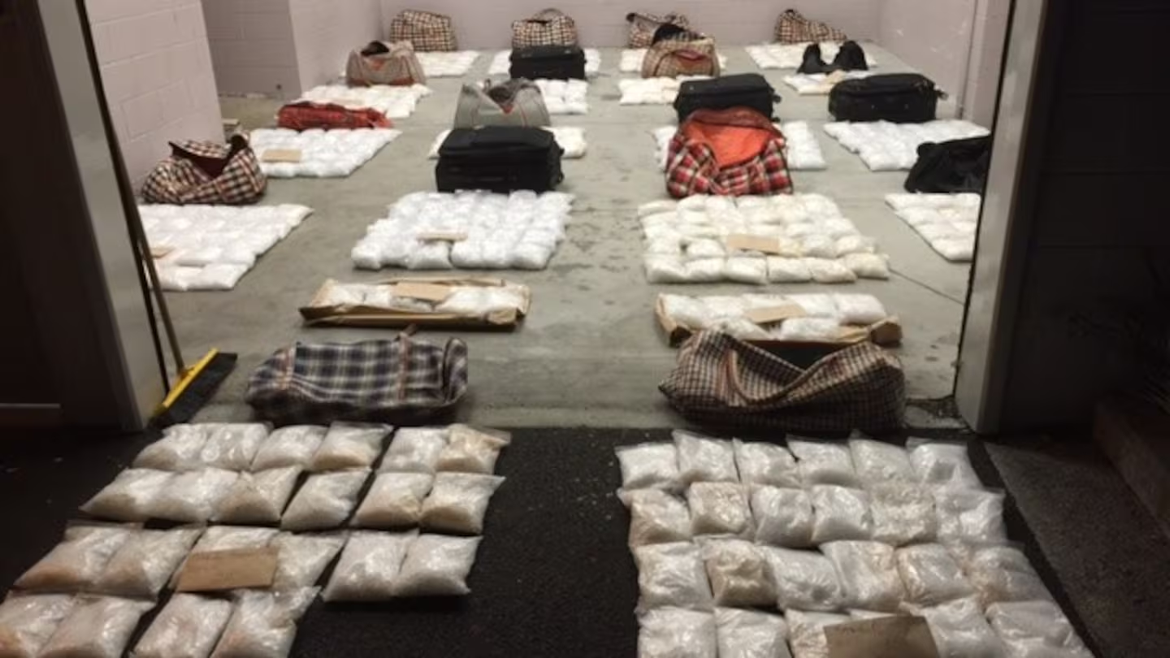
Auckland NZ – Tongan methamphetamine trafficker Ulakai Fakaosilea, who helped import more than half a tonne of the drug through Ninety Mile Beach before later orchestrating another massive shipment while behind bars, has failed to overturn his life sentence.
Part of the meth seized in the Far North with an approximate value of $448m. Photo/Supplied
The Court of Appeal dismissed Fakaosilea’s challenge to his life imprisonment in a judgment delivered on 15 September, ruling that the seriousness of his offending required the maximum available penalty.
Fakaosilea was already serving 22 years and nine months in prison for his role in the notorious importation of 501kg of methamphetamine into New Zealand when he became involved in further drug offending from inside prison.
Despite being incarcerated for one of New Zealand’s largest methamphetamine importations, he went on to play a leading role in another operation, orchestrating the importation of 198.2kg of methamphetamine.
He pleaded guilty to the later offending and in March last year was sentenced in the High Court to life imprisonment with a minimum non-parole period of 10 years.
Fakaosilea is the brother of Selaima Fakaosilea, who was also convicted over the record 501kg methamphetamine importation through Ninety Mile Beach in 2016 and received a lengthy prison sentence, although she was not sentenced to life imprisonment.
Guilty pleas fail to displace life sentence
Fakaosilea appealed, arguing that life imprisonment was manifestly excessive and that the Court should instead have imposed a fixed-term sentence, particularly because of his guilty pleas and personal circumstances.
However, the Court of Appeal found his leading role, the enormous quantity of methamphetamine involved and, critically, the fact that he committed the offences while already serving a lengthy sentence for similar offending placed his case among the most serious for which life imprisonment was available.
The Court considered whether Fakaosilea’s guilty pleas should have resulted in a finite sentence rather than life imprisonment.
It acknowledged that guilty pleas normally attract sentencing credit because they save court resources and remove the risk and expense of a trial.
But the judges found those considerations carried less weight in Fakaosilea’s circumstances when balanced against the need for deterrence, denunciation and protection of the community.
The Court stressed that a guilty plea can, in some cases, be sufficient to move a sentence away from life imprisonment, but said it was not enough in this case.
Offending from prison decisive
The Court said the most significant feature was that Fakaosilea organised serious methamphetamine offending from prison while serving a lengthy sentence for importing more than 501kg of the same drug.
It also rejected the argument that his other personal mitigating circumstances and prospects of rehabilitation made life imprisonment inappropriate.
The judges said aspects of Fakaosilea’s background helped explain his association with gangs and a criminal lifestyle, but did not sufficiently explain offending of such seriousness. The Court also found there was no demonstrated intention to leave gang life or rehabilitate.
In upholding the sentence, the Court said the circumstances required the continuing oversight that accompanies life imprisonment.
Unlike a finite prison term, a life sentence means Fakaosilea remains subject to the sentence for the rest of his life, even if he is eventually released on parole.
The Court concluded that, given the scale and circumstances of his repeated methamphetamine trafficking, that level of oversight was appropriate.