Tonga Prime Minister Lord Fakafanua has warned world leaders that the Pacific must not become a staging ground for military escalation or major-power rivalry, as he called for reform of the international system and stronger action on climate change and ocean protection.
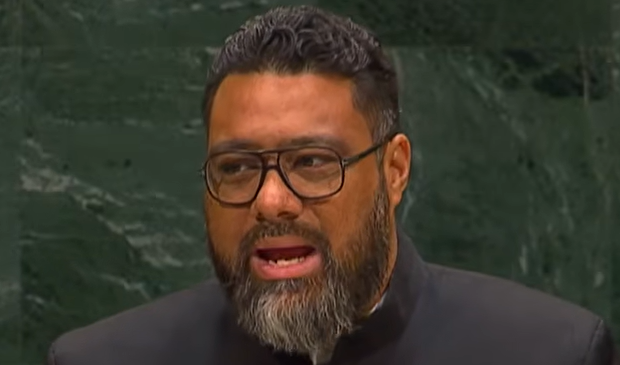
Delivering Tonga’s national statement at the 81st United Nations General Assembly in New York on September 25, Lord Fakafanua reaffirmed Tonga’s commitment to the Pacific Islands Forum’s 2050 Strategy for the Blue Pacific Continent and the region’s declaration as an Ocean of Peace.
“Our Ocean of Peace is more than the absence of conflict,” the Prime Minister said, pointing to transnational crime, illicit drugs, illegal, unreported and unregulated fishing, cyber threats and the unresolved consequences of nuclear testing and radioactive contamination among challenges confronting the region.
His remarks came as Pacific governments seek to maintain greater regional agency amid increasing geopolitical competition and security engagement by major powers.
Lord Fakafanua also used his UN address to argue that international institutions established after World War II were no longer adequately reflecting contemporary global realities.
“Too much of the international architecture still reflects the world of 1945 rather than today’s realities,” he said.
“If the United Nations is to remain the principal vehicle through which sovereign nations confront global challenges, it must transform.”
He called for a stronger UN General Assembly, a more inclusive and representative Security Council and reforms to the international financial system to provide faster and more accessible financing for countries most in need.
Climate change remained central to Tonga’s statement, with Lord Fakafanua warning that exceeding the 1.5C warming threshold should not be treated as a reason to abandon efforts to limit global temperature increases.
“Every fraction of a degree matters,” he said, calling for any overshoot to be limited in extent and duration and for temperatures to be brought below 1.5C as quickly as possible.
The Prime Minister urged major greenhouse-gas emitters to attend pre-COP31 meetings scheduled for Fiji and Tuvalu next month.
“Come to the Pacific and confront what 1.5 degrees means for our water, our food, our homes and our people,” he said.
He also called for greater international backing for Pacific-designed climate resilience initiatives, including the Pacific Resilience Facility and Weather Ready Pacific, as well as Tonga’s Climate Trust Fund.
Lord Fakafanua argued that climate change, biodiversity loss and ocean degradation could no longer be addressed as largely separate international issues.
“We cannot keep negotiating climate, biodiversity and the ocean in separate processes when they form an interconnected ecosystem requiring coherent solutions,” he said.
Tonga intends to protect at least 30 percent of its ocean by 2030, while the Government is targeting 70 percent renewable electricity by 2030 and 100 percent by 2035, according to the statement.
The Prime Minister also announced that Tonga intends to convene a Polynesian Ocean Summit in May 2027, bringing together governments, communities, scientists and international partners to strengthen ocean governance and turn regional commitments into practical action.
Pacific Islands Forum leaders had already welcomed the Polynesian Leaders Group’s intention to convene such a summit in 2027 as a Pacific-led platform for ocean governance, marine conservation and the blue economy.
Lord Fakafanua also turned to artificial intelligence and other emerging technologies, arguing that Small Island Developing States should have a role in determining the international rules governing technological change.
“Tonga does not need to be first in artificial intelligence, quantum computing or every technology that follows,” he said.
“But we will not simply endure global transformation. We will exercise sovereignty by helping shape the rules and norms that govern it.”
Before the General Assembly, Tonga had signalled that climate action, energy security, connectivity, sustainable development and the priorities of Small Island Developing States would be among the major issues its delegation would raise in New York.
Lord Fakafanua concluded Tonga’s message by reaffirming the Kingdom’s support for a more representative and responsive multilateral system that gives greater recognition to the vulnerabilities and priorities of small island states.