As Tonga advances to the Rugby League World Cup semifinals, Tongan-American pop and R&B singer Dinah Jane has defended her controversial rendition of the national anthem, expressing disappointment at Dame Valerie Adams for allegedly joining those mocking her performance.
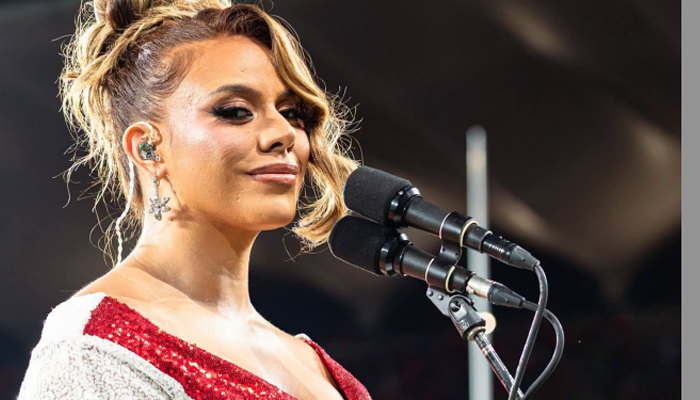
The former Fifth Harmony star sang the anthem ahead of Tonga’s Rugby League World Cup match against Samoa on Sunday, November 1, with her departure from the traditional melody drawing mixed reactions from listeners.
While supporters praised Jane’s performance, critics argued that she should have adhered to the anthem’s original melody and pitch progression.
She also briefly paused near the end, apparently allowing the crowd singing along with her to be heard more clearly.
The debate has drawn reactions from people across different sections of the community, including former Tongan New Zealand-born Olympic and world champion shot-putter Dame Valerie Adams.
Adams began her TikTok video by acknowledging that she might not be “qualified” to comment on Jane’s performance, before praising her rendition of the national anthem as “just beautiful” from the beginning.
However, she took issue with the final lines, particularly “maluʻi ʻa Tupou”, where Jane departed from the traditional melody and ascended to a high note.
Adams imitated the passage by singing in a high-pitched voice, comparing Jane’s vocal interpretation to Beyoncé’s style.
She said Jane should have maintained the national anthem’s original melody rather than introducing such variations.
The video attracted considerable attention on TikTok, recording 3,574 shares, 1,240 comments and 3,900 reactions.
Jane Responds to Criticism
Following Adams’ remarks, Jane issued a Facebook statement expressing disappointment at the former Olympic champion’s criticism of her performance.
“Ms. Valerie Adams, I would’ve appreciated hearing your thoughts directly if my rendition bothered you that much,” Jane wrote.
“Coming from someone I’ve held in such high regard, I expected a little more grace rather than adding fuel to an already burning fire.”
Jane said she was hurt to see another successful Tongan woman whom she had admired and supported participating in the criticism.
“The same artistic freedom that’s celebrated elsewhere suddenly becomes a problem when it comes from me,” she wrote.
She acknowledged the importance of the national anthem and the preference among some listeners for a traditional performance.
“But as an artist, I saw an opportunity to share a piece of myself through my interpretation, just as I did in 2017,” Jane said.
“My intention was never to disrespect our anthem, our culture, or our people. Everything I did came from a place of genuine love, honor, and pride.”
Jane recalls struggles over cultural identity
Jane said the criticism had been particularly painful because of her efforts to establish her identity as a Tongan-American artist.
She recalled that during her years with Fifth Harmony, there were occasions when she felt she had to suppress aspects of her identity to fit into the group.
“I’ve spent so much of my journey fighting to embrace and proudly represent my identity as a Polynesian woman,” she wrote.
She said she had not expected to face criticism from members of her own community after years of working to represent her heritage.
“I never imagined that once I finally stood proudly in that identity, I’d have to defend it to my own people,” she said.
Jane also acknowledged that criticism was part of being a public figure but said it could still be hurtful.
“I don’t normally give negativity my attention, but I refuse to pretend that words don’t hurt simply because I’m a public figure,” she wrote.
Encouragement for future Tongan singers
Jane said she did not want her performance or appearance to cause division among Tongans.
She expressed hope that future Tongan singers would feel encouraged to perform without fear of ridicule.
“My hope is that every Tongan singer who comes after me feels inspired and encouraged to sing from their absoluteeee heart without fear of being ridiculed for expressing themselves!!” she wrote.
Jane reaffirmed her identity as a Tongan-American woman and said the criticism would not change her cultural pride.
“You don’t have to love how I sang it to respect the love I sang it with….”
Jane’s rendition reflected her established musical identity as a contemporary pop and R&B singer, incorporating vocal embellishments and a climactic ascending run in the anthem’s final line rather than following its traditional descending melody.