Primary teachers have voted to accept the latest Ministry of Education collective agreement offer.
Photo: 123RF
In a statement this morning, NZEI Te Riu Roa said the offer was the fourth put to teachers.
It followed a long negotiation campaign which included the largest education strike in this country’s history.
A teachers’ protest march in Auckland on 20 March. Photo: RNZ / Jordan Dunn
The settlement includes a six percent pay increase in July, with two further increases in July and December 2024.
A lump sum payment of $3000 would be made in July, plus an additional $1500 for union members.
Classroom release times will increase from 10 to 25 hours per term and mileage allowances are to go up.
NZEI Te Riu Roa president Mark Potter said the more than doubling of classroom release time was the biggest win and the first increase since 2005.
“The work demands on teachers have skyrocketed in the last couple of decades and this means teachers will have more time to plan, assess and do individual work with students.”
The settlement also includes “significant” increases in Māori Immersion Teacher Allowance, the introduction of the Pasifika Bilingual Immersion Teaching Allowance, a rise in the reliever pay cap, and provisional to full certification costs paid for beginning teachers.
Potter said moving the cap on reliever teacher pay rates was a step toward paying experienced relief teachers fairly, and should make it easier for schools to find relievers.
Paeone Goonan, a resource teacher of learning and behaviour based at Ōpōtiki College and a member of the negotiating team, said the introduction of the cultural leadership allowances and the increase to the Māori Immersion Teaching Allowance were “historic improvements”.
“They acknowledge the skills and expertise of those kaiako and their culture and will compensate those teachers who are doing the mahi anyway, such as assisting with the new Aotearoa histories curriculum or teaching kapa haka.”
Last week, primary teachers called off strike action as they awaited the revised government offer.
Newtown Primary School deputy principal Leanne Whitfield said previous offers from the ministry were not good enough.
“The pay jolt we got a few years ago has mostly disappeared through inflation, but actually the impact on teachers through dealing with a very wide range of needs in our classrooms is a much greater problem at the moment.”
She said people would be shocked if they knew how under-resourced schools were.
Teacher Mary Bluck previously said a pay rise was not the most important issue for her.
“It’s about work conditions, smaller class sizes and greater support for our students,” she said.
“I’m striking for our children. Our children at this point in the junior school have not had a normal school or education life due to Covid and so they have greater needs and we don’t have the resources to support them in the way we’d like.”
School principals are backing the government’s crackdown on youth vaping, but say more needs to be done to combat what they are calling a crisis.
Photo: Unsplash
From August, all vapes sold will need removable or replaceable batteries – effectively banning disposable vapes.
New vape shops cannot be set up within 300 metres of schools or marae.
The government is also outlawing flavour names such as “strawberry jelly donut” to make them less attractive to children.
Announcing the changes on Tuesday, Minister of Health Ayesha Verrall said too many teenagers were vaping and the restrictions would have a big impact on the number taking up the habit.
Young people RNZ spoke to in central Christchurch were not so sure.
“I think young people will still be able to get them even with all of those measures … vapes are at every dairy on every corner and you can order them online, it’s all around us,” one teenager said.
“I think teenagers will still find a way to get it, because it’s teenagers and they always do, but hopefully they can stop little kids from getting hold of them,” another said.
The latest figures show youth vaping is increasing.
A recent survey by ASH New Zealand found daily vaping among 13- to 14-year-olds had shot up by 209 percent.
Meanwhile, Ministry of Health statistics showed the number of 15- to 17-year-olds who vaped every day had quadrupled in three years, from two percent in 2018-19 to eight percent in 2021-22.
Principals Federation president Leanne Otene said it was not just a problem for high schools – intermediates across the country, including hers, were dealing with it every day and teachers were feeling powerless.
“It’s definitely hard to police because it doesn’t leave an odour, it can be done in corners and it’s not something like smoking where it was easily detectable. There was some discussion about putting vaping detectors in schools but that’s just not possible, it’s just too expensive to do that.”
Otene said anything to make vaping less attractive to kids was a positive step.
“The mere fact that vaping comes in bubblegum and fruit flavours begs the question of who is this marketed to. The announcement today about flavour names is a real indication that the government realises vaping is directed at our young people in terms of its sale and purchase.
“Vaping was originally a way to help people give up smoking, no one considered that our young people would take it up with such voracity,” she said.
Otene said vaping was particularly a problem for Māori youth.
“Statistics show a high percentage of Māori boys, 28 percent are vaping, and our Māori girls are at 39 percent, so it is a problem for Māori. If we can get it away from our marae, all the better.”
Jacqui Brown, principal of New Plymouth Girls’ High School, said she was glad to see the phasing-out of cheap, disposable vapes.
“Removing access to disposable vapes is probably the strongest step because I think that helps prevent young people starting to vape. Financially they’re more priced in that bracket that teenagers can get hold of that level of money,” she said.
Brown said she wanted to see more help for students who were addicted to vaping.
“One of the things we’re finding are a small but significant number of students saying they’re addicted and can’t get through the day without vaping. Something I’d really like to see is more access to help them stop vaping.”
Cambridge Middle School principal Daryl Gibbs said the regulations were a “good start”, and that a total ban, along the lines of Australia, could be looked at in the future.
“I mean everyone’s pointing towards Australia … and their changes to making it a prescription only. You know there is arguments for that, that will stop those that that need access for smoking cessation, from accessing it,” he said.
He said vaping started as a measure to support those who had an addiction to smoking, but has now become a huge problem among teenagers.
Minister of Health Ayesha Verrall said the restrictions struck a balance between preventing young people from starting to vape, while still helping adults to quit smoking cigarettes.
Plea for ‘harsher controls’
Asthma and Respiratory Foundation chief executive Leticia Harding said the new rules hadn’t gone far enough.
She told Morning Report they would have liked to see a cap on the 1290 specialist vape retailers around the country.
Harding said the government needed to invest in support for those youth who were now already addicted to nicotine because of vaping.
“We talk to Quitline all the time, they don’t have that expertise, the resources to help our rangatahi actually quit vaping and that’s not good enough.
“And the sad thing is that this had been, this was foreseeable. This was talked about in 2017 and here we are. And so the ministry needs to do harsher controls around the space.”
Three thousands New Zealanders have now died from the Covid-19 virus, the Ministry of Health record shows.
In its latest report this week about the number of new cases it said there have been 12,028 Covid-19 cases reported in New Zealand over the past week.
The numbers cover Monday, May 29 to Sunday, June 4. Case numbers continue to fall, with 2343 fewer cases recorded than the week before.
As at midnight Monday there were 278 people in hospital with the virus.
Nine people were in an intensive care unit as at midnight Monday.
Fifty-nine more people with the virus have died, with the Ministry of Health explaining there was a higher than usual number of deaths reported “due to a backlog of deaths being coded”.
The ministry said two died in June, 13 in May, seven in April, three in March and three in January. The remainder of the deaths occurred in 2022.
The total number of deaths confirmed as attributable to Covid-19, either as the underlying cause of death or as a contributing factor, is 3001.The total number of deaths attributed to Covid-19 since the pandemic began now exceeds 3000 – reaching 3001.
The Institute of Environmental Science and Research said other tracked variants, such as FK.1.1 and XBB.1.5 remain in circulation.
FAKAMATALA FAKATONGA
A’u e mate’ ‘i Nu’u Sila’ ni ‘i he Koviti 19 ‘o fakalaka he 3000 talu ‘eni e tō ‘a e mahaki faka’auha fakamamani lahi’ ni ‘i he ta’u ‘e tolu kuo hili’.
I heene lipooti fakamuimui he uike ni ki he lahi ‘o e ngaahi keisi fo’ou ne pehē ai ko e toko 12,028 ‘i he uike kuo ‘osi.
Ko e fika ko ia kau ai ‘a e Monite Me ‘aho 29 ki he Sapate Sune ‘aho 4 ka ne mahino ‘oku ‘alu ke holo ‘a e fika’ ‘aki ‘a e toko 2343 mei he uike ki mu’a ai’.
I he tu’uapo Mōnite’ na’e toko 278 ‘i fale mahaki ma’u ‘e he vailasi’.
Toko hiva ne nau ‘i he ‘initenisivikea he tu’uapō Mōnite’.
Ne mate ha toe kakai ‘e toko 59 pea ‘i he fakamatala mei he Potungāue Mo’ui’ ne ki’i ngali kehe ‘a e ma’olunga ange fika ‘o e kau mate ‘i he angamaheni.
Pehe ‘e he potungaue ko e toko ua ne mate ‘i Sune, 13 ‘i Me, toko fitu ‘i ‘Epeleli, toko tolu ‘i Ma’asi pea toko tolu ‘i Sanuali. Ko e toenga ‘o e ate ne hoko ia ‘i he 2022.
Ko e lahi fakakatoa ‘o e mate kuo fakapapau’i ko e tupu mei he Koviti 19 pe ko ‘ene hoko ‘a e Koviti ko ha fakitoa tānaki a’u hake ‘eni ki he toko 3001.
Ko e genomic surveillance fakamuimui taha ‘oku ha ko e XBB.1.6 ‘a e fotunga kehe lahi taha kuo ne kama ‘a Nu’u Sila ‘o ne fakafofonga ‘a e peseta ‘e 24 ‘o e ngaahi keisi.
Ne pehē ‘e he Institute of Environmental Science and Research oku kei vilovilo holo pe mo e ngaahi fotunga kehe hange ko e FK.1.1 mo e XBB.1.5.
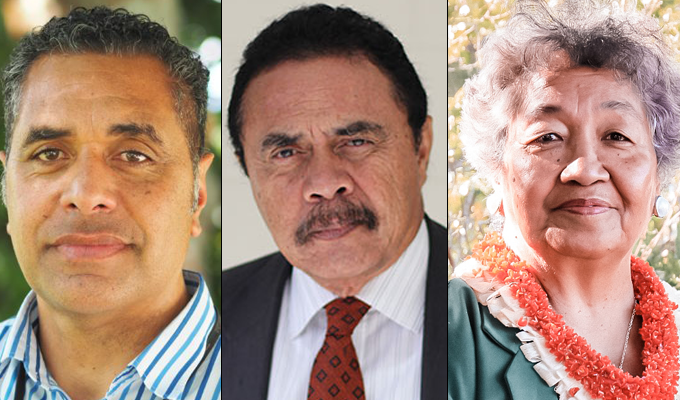
Paediatrician Dr Teuila Percival heads the list of Pacific recipients in the New Zealand King’s Birthday Honours List for 2023.
(L=R) Dr Siale ‘Alo Foliaki, Dr Semisi Taumoepeau and Meleane Pau’uvale
Dr Percival is one of at least 15 Pasifika people in New Zealand who are on the list. She is to be a Dame Companion of the New Zealand Order of Merit for services to health and the Pacific community.
For the past three decades she has been a strong advocate for Pacific children’s health in New Zealand and the Pacific.
Dr Teuila Percival . . . “It’s important for Pacific people to be recognised in the work they do.” Image: Pasifika Medical Association/RNZ
Dr Percival said she felt honoured to get the award after getting over the initial surprise.
“I think it’s important for Pacific people to be recognised in the work they do, so it’s really nice in that respect,” she said.
“It’s just a great job, I love working with kids. I think children are the most important thing.”
Dr Percival was a founding member of South Seas Healthcare, a community health service for Pacific people in Auckland since 1999.
She has also been deployed to Pacific nations after natural disasters like to Samoa in 2009 after the tsunami and to Vanuatu in 2015 following cyclone Pam.
Education Sacred Heart school counsellor Nua Silipa is to be an Officer of the New Zealand Order of Merit for her services to Pacific education.
Silipa said her experience struggling in the education system after immigrating from Samoa in 1962 had motivated her to help Pacific people in the classroom.
“When I look back now I think my journey was so hard as a minority in Christchurch,” Silipa said.
“It was a struggle because we weren’t in the classroom, the resources at that time were Janet and John . . . so as a learner I really struggled.”
She said the “whole experience of underachievement” motivated her to help “people who are different in the system”.
“It’s not a one size fits all in education.”
Nua Silipa said she felt humbled to be a recipient on the King’s Birthday Honours List.
She said the award also honoured the people who had been involved in improving education for Pasifika.
“I know there’s so, so many other people who are doing work quietly every day, helping our communities and I’m really in awe of them.
“There are many unsung heroes out in our community doing work for our people.”
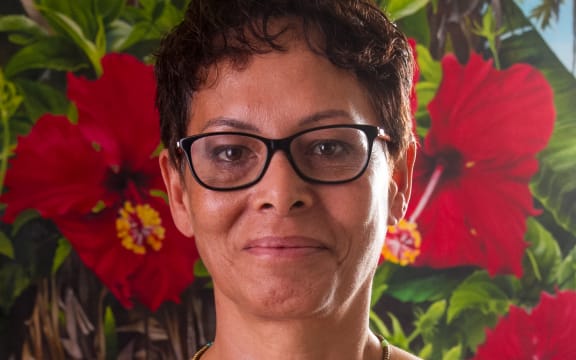
Technology Mary Aue is to be a Member of the New Zealand Order of Merit for her services to education, technology and Pacific and Māori communities.
Coconut Wireless creator Mary Aue . . . “There was no communication back then, so I created an e-newsletter.” Image: RNZ Pacific
Mary Aue is to be a Member of the New Zealand Order of Merit for her services to education, technology and Pacific and Māori communities Photo: Supplied
In 1999, she launched Coconut Wireless as an e-newsletter for Pasifika reaching 10,000 subscribers. It relaunched in 2014 as a social media platform and now has over 300,000 Facebook followers.
“There was a disconnect between community and government agencies and there was a disconnect between our communities,” she said.
“There was no communication back then, so I created an e-newsletter.”
The name Coconut Wireless was based on the island concept as a fast way of communicating through word of mouth.
Aue has also been an advocate for more Pacific and Māori learners in science, engineering, technology and mathematics (STEM).
Aue said she was originally going to decline the award as there were a lot of people in the community who do not get recognised behind the scenes.
“I have to thank my family, my friends and the amazing community that we’re all part of.”
Sport Teremoana Maua-Hodges said she “just about choked” on her cup of tea when she found out she had received the Queen’s Service Medal.
Maua-Hodges has been given the award for her contribution to sport and culture.
She said the award was the work of many people — including her parents — who travelled to New Zealand from the Cook Islands when she was a child.
“I’m very humbled by the award, but it’s not just me,” Maua-Hodges said.
“I stand on the shoulders of different heroes and heroines of our people in the community.
“It’s not my award, it’s our award.”
Maua-Hodges said the most important thing she had done was connect Cook Islanders.
“Uniting Cook Islanders who have come over from different islands in the Cook Islands and then to come here and be united here within their diversity makes me very proud.
“They’ve taken on the whole culture of Aotearoa but still as Cook Islanders . . . to show their voice, to show their flag, in the land of milk and honey.”
The Queen’s Service Medal will be renamed the King’s Service Medal once the necessary processes are done, and the updated Royal Warrant is approved by King Charles.
Pasifika recognised in the Queen’s Birthday Honours List for 2022:
Dame Companion of the New Zealand Order of Merit: Dr Teuila Mary Percival — for services to health and the Pacific community.
Officer of the New Zealand Order of Merit: Nua Semuā Silipa — for services to Pacific education.
Honorary Officer of the New Zealand Order of Merit: Meleane Pau’uvale — for services to the Tongan community and education.
Member of the New Zealand Order of Merit:
Mary Puatuki Aue — for services to education, technology and Pacific and Māori communities.
Dr Ofanaite Ana Dewes — for services to health and the Pacific community.
Fa’atili Iosua Esera — for services to Pacific education.
Dr Siale Alokihakau Foliaki — for services to mental health and the Pacific community.
Keni Upokotea Moeroa — for services to the Cook Islands community.
Talalelei Senetenari Taufale — for services to Pacific health.
Dr Semisi Pouvalu Taumoepeau — for services to education and tourism.
Honorary Member of the New Zealand Order of Merit: Fa’amoana Ioane Luafutu — for services to arts and the Pacific community.
Queen’s Service Medal:
Joseph Davis — for services to the Fijian community.
Reverend Alofa Ta’ase Lale — for services to the community.
Teremoana Maua-Hodges — for services to sport and culture.
Putiani Upoko — for services to the Pacific community.
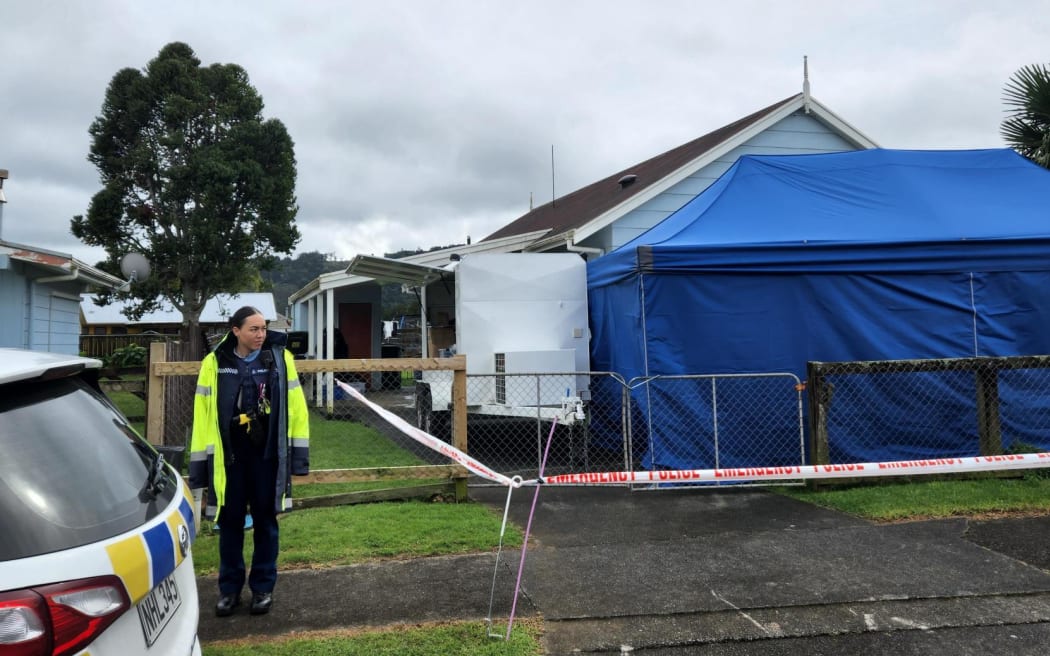
Police have arrested and charged a man with manslaughter, burglary and aggravated assault in connection with the death of Linda Woods in Kaikohe last week.
Photo: RNZ / Lucy Xia
Police have arrested and charged a man with manslaughter, burglary and aggravated assault in connection with the death of Linda Woods in Kaikohe last week.
Woods, 71, died Thursday night after being injured during a struggle when a person broke into her Taraire Street property.
The offender fled barefoot without his shorts following what police said earlier this week was probably a sexually motivated burglary.
Police executed a search warrant on the same Kaikohe street where the attack happened earlier on Tuesday, before announcing the arrest of a 52-year-old man.
He went into custody without incident, and will appear in Kaikohe District Court on Wednesday.
Police on Monday said they had found DNA believed to be linked to the offender.
Cellphone footage of part of the incident showed the back of the alleged offender’s head. Police said he was aged between 40 and 60, “with short, grey-speckled, possibly curly hair, Māori or Polynesian and with a solid build”.
Police on Tuesday thanked the community, particularly those who had supplied information during the investigation.
Please subscribe to unlock this content. Enter your email to get access.
An unexpected change to the protocol of the king’s kava ceremony which meant the two alofis’ fonos were not called out this morning has sparked intense debate.
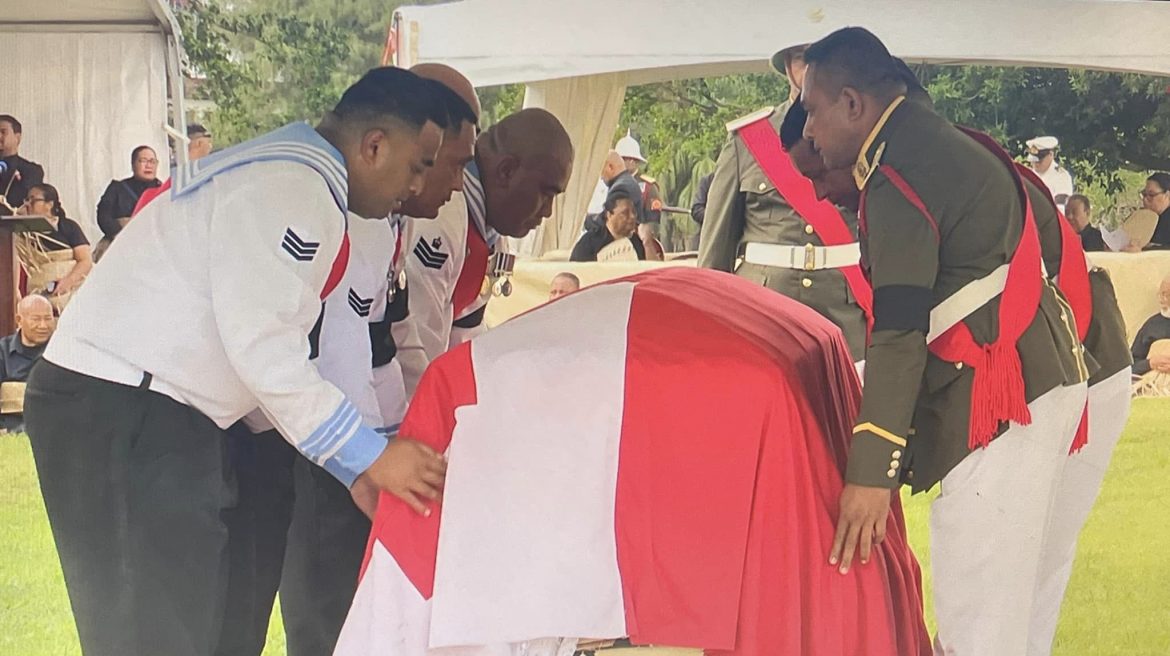
Princess Melesiu’ilikutapu’s flag draped coffin was carried towards Mala’ekula by high ranking officers of His Majesty’s Armed Forces. Photo/TBC
The pongipongi tapu (sacred morning) at the Nuku’alofa royal palace was presented to mark the first morning of the week after the late Princess Melesiu’ilikutapu Kalaniuvalu Fotofili’s burial at Tonga’s royal tomb Mala’ekula on June 3. Her Royal Highness passed away in Auckland at age 75.
The formal ceremony normally includes several customs, including the fakanofonofo (seating) of the two alofis or two sides of the kava ring divided by the king and the tou’a or kava makers’ seats, preparation of the kava by the tou’a to be distributed among the king and the nobles as well as the fakatū’uta. Fakatū’uta is the setting out of the ngāue, which are slaugthered hogs, yams and kava in rows inside the ‘alofis.
The ngāue has to be counted aloud by matāpules and be acknowledged aloud by the king’s ‘apa’apa ‘o e hau Māliepō, also known by his estate title Lauaki. He is the matāpule in charge of the ceremony, if it was to mark a royal funeral, and who always sat next on the king’s left
It is normal that following the fakatū’uta Māliepō orders one of the pigs to be cut into pieces. The fakala’ā part (back) of the hog, which is regarded as the most chiefly and the liver, must be taken and placed close to the king as his share. This must be done first before the rest of the cuts are distributed among the rest of the nobles sitting in the ‘alofis.
The next process is the kaifono. Kai means eat while fono refers to the food or the pieces of pork from the cuts. Kaifono also refers to the fahu who claim the fonos. The fahu is normally the highest ranking niece or grand-niece of the nobility in the alofis from their eldest female sibling’s or paternal aunt’s lines.
After the king’s fono is taken the protocol requires Māliepō to call out the names of the rest of those in the alofis one by one and indicated to their fahu to enter the alofi and take it. Since the king does not have a fahu, according to the custom his fono must be claimed by a non-Tongan person. This morning it was Hugh Moore, the son of the Australian High Commissioner to Tonga who became the king’s kaifono.
However, Māliepō changed the kaifono protocol this morning and announced that after he called out the king’s kaifono “ko ‘etau lava’ ia,” meaning the rest of the fonos must be removed from the alofis and taken outside quietly.
Online debate
The incident triggered an online debate, with people asking whether Māliepō was breaching the protocol.
Some wondered whether this was the new way of conducting the king’s kava ceremony.
A Tongan language tutor in Australia, Uanivā Havea, asked her followers on Facebook to help her understand why the nobility’s fonos were not called out.
Responding, a commenter said it was a tekelangi (boosting the dignity) designed by Māliepō to boost the dignity of the king to make the day special. The commenter said Māliepoo’s decision made the ceremony unique in the sense that only the king had his fono called out and no one else.
Some said the young Māliepō was new to the role and he has a lot to learn.
A cousin of Queen Nanasipau’u Tuku’aho commented on another post and said the king did not know about the change.
Hon. Tupou ‘Ahome’e Faupula said it was totally wrong to stop it (“hala aupito foi taofi”). She said Prince Ata talked to Princess Sinaitakala and it was clear there was no plan for a change.
She said all the fahus were ready to take their kaifono.
Hon. Faupula was responding to a post by Cass Vaea who said Māliepō stopped the nobility’s kaifono as a “tekelangi” of the king.
Not unusual
It is not new for the king’s leading matāpules to make unexpected changes in a royal ceremony as a tekelangi.
In a graduation ceremony at ‘Atenisi University in Tongatapu in 1990s, the late King Taufā’ahau was invited as guest of honour.
The university students performed a fakatū’uta or presentation as part of the royal reception but when the university’s matāpule, late Lehā’uli Vaivai was about to address the king he noticed that the king’s two matāpules were sitting very close to His Majesty.
Lehā’uli regarded that as disrespectful to the king and scolded the duo and told them to step down and sit away from the king. It triggered heated exchanges between Lehā’uli and the matāpules. Lehā’uli finally withdrew the fakatū’uta and said he would present it directly to the king at his palace later that day.
Professor Futa Helu of ‘Atenisi later explained that that was when such royal ceremony was tau-e-langi, an expression which literally means reaching the sky, referring to the moments and duration of excitement people experience because something unusual, but interesting, had happened. It made the day more memorable.
The Capital Nuku’alofa and its surrounding towns suffered a huge power cut early on Monday following a car crash damaging a high voltage power line.
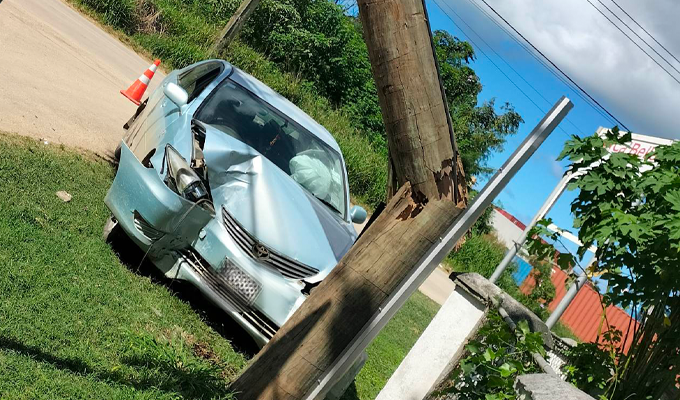
Car crashed into a power pole causing major power cut in Nuku’alofa. Photo/ Tonga Power
Tonga Power said a vehicle hit a power pole “near one of our high voltage poles at Ma’ufanga”.
“As a result, the power supply to your respective areas has been temporarily switched off for safety reasons starting from 2:30pm this afternoon”.it said.
Power was out in all major centres, including Ma’ufanga’s Small industries, Ha’amoko, Queen Salote Wharf, Patangata, Popua, Fasi, Downtown Nuku’alofa, Kolomotu’a, Sopu, Kapeta, Hala’ovave, Ísileli, Longolongo, Vaololoa, Havelu and Tofoa
“To rectify the situation and restore normal power services, emergency repair works are currently underway”, the power company said in a statement.
“We estimate that the repairs will take approximately 4 hours to complete, including the replacement of the affected pole and cables. Once the work is finalized, the power supply to your area will be promptly restored without any further notice.
“We sincerely apologize for any inconvenience caused by this unforeseen power disruption.
We understand the importance of uninterrupted power supply and are working diligently to minimize the impact on your daily routines.
“For the latest updates on the progress of the repairs, please feel free to contact our dedicated support team at the following numbers: 21344 or 944.
“Thank you for your understanding and cooperation during this temporary interruption.
“We greatly appreciate your patience as we work towards resolving the issue and ensuring the safety of our community”.
With King Charles’ real birthday coming late in the year, why does New Zealand still mark the monarch’s birthday in June?
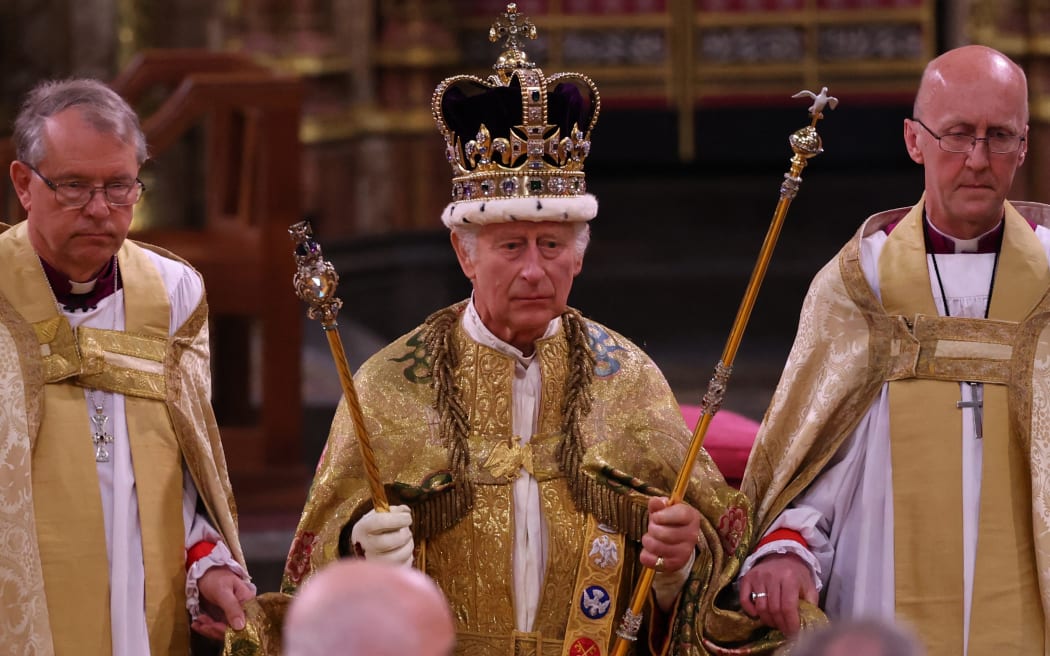
King Charles during his coronation. Photo: RICHARD POHLE / AFP
King Charles will officially celebrate his 75th birthday on 14 November, but now that he has taken the throne he receives the privilege of celebrating his birthday not once, but twice every year.
It was the same with Queen Elizabeth. Queen’s Birthday Weekend was celebrated on the first Monday in June each year, even though the Queen’s birthday was on April 21.
The Department of the Prime Minister and Cabinet were quick to confirm that the timing of the holiday weekend in June, formerly known as Queen’s Birthday, would remain the same under King Charles.
And the reason? Britain’s fickle winter weather.
It is traditional for British monarchs who are not born in summer to celebrate twice, with a second official birthday. Once on their actual date of birth, and then later in the British summer with a grand parade.
The belief is having a summer birthday means a higher chance of good weather during the Trooping the Colour parade, which marks the official celebration for the monarch’s birthday in the UK. Trooping the Colour is held outside Buckingham Palace on a Saturday in early June and has marked the celebration for over 270 years.
The tradition was started by George II in 1748. With a November birthday being too cold for a celebratory parade, he tied his celebrations in with the annual Trooping the Colour military parade.
Summer ‘official’ birthday celebrations were standardised during the reign of Edward VII, who also had a November birthday, according to Royal Museums Greenwich.
In 2022, the Trooping the Colour parade was held on a Thursday to mark the beginning of Queen Elizabeth’s platinum jubilee and UK citizens were given a bank holiday.
This year, the event will not be marked with a bank holiday as the parade returns to its usual scheduling of Saturday, 17 June.
COMMENTARY: The Tongan government should not have granted disgraced politician Etuate Lavulavu a radio license until the verdict in his retrial in the Supreme Court has been handed down.
A new FM Radio Broadcasting License was handed over to Tonga People’s Radio Limited (Ltd) FM 87.1 from the Department of Communications (MEIDECC), on May 29 at MEIDECC’s conference room. Photo/MEIDECC
Lavulavu has been granted a broadcasting license by the government even as he is awaiting a new trial.
The law presumes that everyone is innocent until proven guilty and the Supreme Court has made every effort to ensure that his new trial will be fair.
However, what will happen if he is found guilty and sent back to jail?
Will the government revoke his license? Or will it think it is appropriate to allow a convicted criminal to own a radio station?
The Tongan Government portal recently published a photograph of the Director of the Communications Department, ‘Alifeleti Tu’ihalamaka and others with Lavulavu at a ceremony to hand over a broadcasting license.
The license is for an FM radio station, Tonga People’s Radio Ltd, which Lavulavu jointly owns with Mahealani Kaufusi.
Lavulavu bought the government’s Kalonikali newspaper and was accused of publishing libelous material about former Deputy PM Semisi Sika.
Lavulavu and his wife ‘Akosita, were convicted of corruption and fraud in the Supreme Court and jailed in July 2021. However, that verdict was later overturned by the Court of Appeal and the couple will now face a re-trial on an amended indictment.
Lord Chief Justice Whitten said the charges were serious and there was a powerful public interest in ensuring that they were tried properly, fairly and according to law.
An application by ‘Etuate Lavulavu to strike out his prosecution, claiming it was an abuse of process, was struck out by the Lord Chief Justice on May 19.
Last December, the Supreme Court refused to return a passport to him when he wanted to travel overseas.
This is not the first time that the treatment the Lavulavus have received from government officials has upset the public. There was an outcry in 2021 when the Lavulavus were temporarily released to go home shortly after they were jailed.
Former Prime Minister Tu’ionetoa devoted an enormous amount of time defending former Infrastructure and Tourism Minister ‘Akosita Lavulavu.
The current outcry is something in the same vein and it has occurred because once again government officials have failed to understand that their actions must not only be completely above board at all times, but they must be seen to be that way.
Some members of the public might well think that it was reasonable to grant Lavulavu and his partner a license since he must be presumed innocent until proven guilty and that there is no proof that he will do anything to abuse his license.
However, for the Director of Communications to pose for a photograph on the official government portal was not appropriate. It is difficult to think of any other license owner who has been treated this way.
The problem is that by placing him on a government page with government officials, some people may think that the real purpose of publishing the photo was to rehabilitate Lavulavu and to indicate that he had some level of official support.
It was extremely unfortunate for the Department of Communication to create a situation – however inadvertently – where any members of the public might be tempted to think that the government was acting in a way that contradicted the aims of the judiciary.
If the Lavulavus are to be rehabilitated, that is properly a matter for the Supreme Court, which will either find them not guilty or send them back to jail.
Auckland Mayor Wayne Brown says he did not forward councillors a string of abusive emails that called them “dip shits”, saying they were sent by staff “in a fit of excitement”.
Auckland Mayor Wayne Brown presented his budget proposal at Auckland Transport headquarters on Thursday. Photo: RNZ / Marika Khabazi
“I neither wrote the emails, nor sent them, nor even know my staff had done so in a fit of excitement,” Brown said in a message to the New Zealand Herald today.
His head of communications, Kate Gourdie, backed this up saying “a member of the team that has control of his inbox” sent the email to councillors. She would not name the person responsible.
Attached to the email is a PDF of a collection of 18 critical and insulting comments aimed at councillors who do not support Brown’s budget and the media.
“Can l ask which of the dip s*** councillors are against the sale of the airport? Shame you can’t kick their ass as that’s where there [sic] brains are. Keep up your good work Mayor Brown. Regards Jim,” said one.
The attack on councillors who do not support offloading the airport shares to help plug a $325 million budget hole and keep household rate increases at 6.7 per cent (rate of inflation) has been called a “sign of desperation”, “highly inappropriate” and a “blitzkrieg attack” by stunned councillors.
Waitakere councillor Ken Turner today said that, like himself, Brown blurts out crazy stuff he hasn’t thought through at times, but the mayor is practical and brilliant at times and “has my full support”.
“He’s a disruptor and right now we need a disruptor,” said Turner.
But the first-term councillor said just because he supports the mayor, it doesn’t mean he will vote for everything he says.
Turner does not support the airport sale, saying the clear message coming out of West Auckland is not to sell the shares.
He cited a slip on his road in West Auckland on Monday that brought down the equivalent of 200 six-wheeler truckloads of material that is being moved to north of Waimuku at a cost he believes of $200,000, when it could cost $20,000.
“Selling the shares will release a whole bunch of money and it’s going to be sucked up like a sponge by this sort of unreasonable action. My job is to fix that, not sell the airport shares,” said Turner.
Wayne Walker, one of four councillors Brown called out on Thursday to keep a pledge they signed to hold rates to inflation, said the mayor is not building the collegiality and cooperation he needs to get the budget across the line.
Walker agreed with Turner that the culture of over-spending has to be addressed before considering a sale of the shares and said other alternatives should be looked at, including using a $1.25 billion budget to upgrade and replace assets, known as depreciation, and increasing revenue streams at venues like the zoo and Auckland Art Gallery.
Other councillors singled out were Mike Lee, Christine Fletcher and John Watson, who said the attempt to unleash vitriol on some councillors was distasteful.
“As far as the shares go I’m endeavouring to keep an open mind, but it doesn’t mean just capitulating to the kind of blitzkrieg attack that has been launched with the imperative to sell the shares and very quickly,” Watson said.
“There is a great degree of distrust with the way this has been administered and the contestability of the advice that has been presented.”
Manukau councillor Alf Filipaina from Manukau has said Brown’s action was “a sign of desperation”, adding: “It’s really unbecoming”.
Maungakiekie-Tāmaki councillor Josephine Bartley, who has also been the target of criticism by the mayor, posted an email on social media sent to the mayor with the message “since we’re sharing emails n all”.
The email, from an airport shareholder and airline captain, said “I’m sick to my back teeth of the petulant and childish manner in which you conduct yourself. It’s deeply unbecoming of a holder of such an office.”
Yesterday, Bartley criticised Brown’s way of getting his point across, saying he is just adding noise.
“We’re supposed to make decisions on behalf of our city and this isn’t helping,” she said.